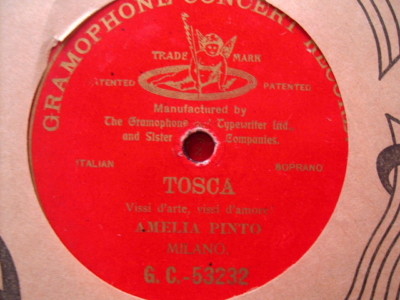
1902 AMELIA PINTO G&T MIlAN Raised LABEL TOSCA Vissi 78
$
170


Favourite Auctions
To save auctions to your favourites, please login
If you don't have an account, please register
Description
I will be running 3 weeks of great auctions, and would be happy to hold your items and bill you at the end of the cycle (April 10) for one combined shipment.
I AM HAPPY COMBINE MULTIPLE ITEMS in one shipment for a low postage rate.
IMPORTANT: IF YOU WIN MULTIPLE ITEMS DO NOT USE EBAY CHECK OUT.
Send me an invoice request instead to get the low combined postage rate.
I am currently selling a series of great Richard Wagner and classic European 78 rpm orchestral recordings on all the great European labels:
Famous Italian Soprano AMELIA PINTO on great early G&T recorded in Milan within days of the first Caruso Records
The 1902 Milan G & Ts reveal an important voice, an Isolde voice indeed: rich and voluminous in tone, with splendid high notes, a solid medium register, and a properly developed chest register. There is a slight, fluttery vibrato that would develop into a shrill wobble on her last recordings. Whereas she correctly covers the tone as she passes from the medium register to the head, she is not so skillful in joining the medium to the chest register. The F, first space, is often weak and she is never happy with E, first line.
AMELIA PINTO
Gramophone and Typewriter Limited
Milan, 11 April 1902
with piano accompaniment
Complete session
TOSCA: Vissi d’arte (Puccini) 2:56
(1782b) 53232
10" Raised Label G&T Stamper II G&T 78 rpm record:
Condition: VERY GOOD PLUS, clean and undamaged. light greying on a few grooves. Plays quiet with only light dist on top notes
from www.marstonrecords.com
AMELIA PINTO
The life and career of Amelia Pinto are well documented thanks to the researches of Dr. Nino Insinga, whose biography of the singer was published in The Record Collector, Vol. 45 No. 3, September 2000. She was born in Palermo on 21 January 1876, the daughter of a fencing master. In 1898 she went to the Accademia di Santa Cecilia, Rome, to study singing with Zaira Cortini Falchi and acting with Virginia Marini. She made a successful debut as La Gioconda in Brescia on 26 December 1899, followed by Il trillo del diavolo by Stanislao Falchi, her teacher’s husband. On 3 September 1900 she sang Tosca at the Teatro del Giglio, Lucca, which was illuminated by electricity for the first time on that occasion. Puccini signed a photograph for Amelia praising her “efficient and intelligent” Tosca. On 29 December 1900 she opened the Scala season as Isolde in the first performances in Milano of Tristano e Isotta, with Giuseppe Borgatti and Toscanini conducting. She was to repeat the role in Ravenna; the Teatro de la Opera, Buenos Aires; Rome; Trieste; Bologna (conducted by Luigi Mancinelli); Naples (conducted by Giuseppe Martucci); the Teatro Colón, Buenos Aires; La Scala again (March, 1914); Genoa; and Madrid. Her other Wagnerian roles were Brunilde in La Walkiria and Sigfrido, and Elisabetta in Tannhäuser. Toscanini engaged her for four other operas at La Scala between 1901 and 1902: La Regina di Saba (Goldmark), Mefistofele, La Walkiria, and the world premiere of Franchetti’s Germania (1 March 1902) with Caruso and Mario Sammarco. She also took part in Toscanini’s famous Verdi commemoration concert at La Scala on 1 February 1901, singing “La vergine degli angeli” with Oreste Luppi.
At the Teatro de la Opera, Buenos Aires, in 1901 she sang with Caruso again in La Regina di Saba and also appeared in Otello, Tannhäuser, and Medioevo Latino by Panizza, as well as repeating her Isolde with Borgatti and Toscanini. In 1902 Pinto made her only visit to the United States, as a member of the Mascagni Opera Company, a doomed venture. She was billed to sing Maria in Guglielmo Ratcliff at the Metropolitan and in Boston, but it was never performed. At the company’s Farewell Concert at the Metropolitan on 19 October, she eschewed Mascagni’s music and sang her favorite aria from Bottesini’s Ero e Leandro!
December 1902 saw her in Lisbon for La Gioconda, Tannhäuser, Germania, L’Africaine, and La Juive, and then on 3 May 1903 she sang Desdemona in Tamagno’s last performance of Otello at the Teatro Argentina, Rome. In October 1903 she went to Warsaw for Cavalleria rusticana and La Gioconda with Anselmi and La Juive with Mario Gilion. After singing Isolde and Gioconda (with Francesco Marconi) in Rome, she made her first appearances in her native city in La Gioconda, La dannazione di Faust, and Tannhäuser. She then went to Egypt, where she sang in La Cabrera, Mefistofele, and Siberia, which she also sang at the Théâtre Sarah-Bernhardt, Paris, with Titta Ruffo. After appearing in Madrid in L’Africaine and La Gioconda, she returned to the Teatro Costanzi in January 1906 for La dannazione di Faust with De Luca, La Juive, and Siberia. In May 1906 she sang in Santiago, Chile, in La Gioconda, Otello, Il trovatore, Tosca, Mefistofele, Chopin, and La dannazione di Faust. In December 1906 came her Isotta in Trieste, followed by the title role in Hérodiade, then Tosca in Catania, and Isotta in Bologna. She triumphed again as Isotta at the San Carlo, Naples, in December 1907, adding La Gioconda and Tosca. At the Colón, in May 1908, she sang Tristano e Isotta, Tosca, La Gioconda, Donna Anna in Don Giovanni with Ruffo and Chaliapin, and Brunilde in Sigfrido with Borgatti. She then retired from the stage to marry her patient and long-suffering fiancé.
She reappeared as Isotta at La Scala on 12 March 1914, repeating the role in Genoa in December. In January 1916 she accepted an engagement in Madrid, singing La Gioconda, Tristano e Isotta, and La Walkiria. Soon after these performances her father and her daughter Rosa Isotta died, and Amelia Pinto never sang in the theater again.
The 1902 Milan G & Ts reveal an important voice, an Isolde voice indeed: rich and voluminous in tone, with splendid high notes, a solid medium register, and a properly developed chest register. There is a slight, fluttery vibrato that would develop into a shrill wobble on her last recordings. Whereas she correctly covers the tone as she passes from the medium register to the head, she is not so skillful in joining the medium to the chest register. The F, first space, is often weak and she is never happy with E, first line.
The opening phrases of “Vissi d’arte” are oddly staccato, but this is an individual performance, sung slowly and intensely. She does not indulge in long phrases. In both takes she rushes the climax, but Puccini enjoyed her performance. In “Suicidio!” she also breaks phrases to take a breath, but there is no doubt about the power and glory of the tone, and there is a great deal of dramatic intensity. She sings Bottesini’s aria with grace and charm, making a nice effect with a soft but ringing G-flat above the stave. Her version of Santuzza’s aria is not particularly memorable, except for her audacious transposition of the final phrase an octave higher! Her most interesting record, and very well sung, is the excerpt from Act One of Germania, page 221 of the vocal score, beginning at the words “All’ardente desio”. She is singing a version, obviously specially arranged for her by Franchetti, that differs from the printed score. The original key is F Minor, but Pinto is singing in G-sharp Minor, with a beautiful high G-sharp pianissimo at “Era il passato oblio”, and on page 223 the music is radically changed from “Io gridavo: Ah, vivo alfine!” to the end of page 224, where there is a key change: the original score modulates into C Major here, Pinto’s version into B, a semitone lower. Her later records for Fonotipia include some interesting titles, especially the hitherto unpublished record of an aria from Giordano’s Marcella, which we are able to include through the kindness of Marco Contini. Alas, she is now vocally past her best. The lower voice sounds lugubrious, the lower middle weak, and the top rather hectic. In the closer recordings we hear that the quality and volume are still impressive, but in the “Morte di Isotta” the tremulous tones are forced, rather than floated on the breath, and the final F-sharp is too loud. We have chosen to include her very last recordings, two Sicilian songs from Alberto Favara’s “Canti della terra e del mare di Sicilia”, which she sings beautifully, with deeply passionate feeling, rising to a splendid high B-flat in “A la barcillunisa”.
Pls check my other auctions for more great records and phonograph items:
http://shop.ebay.com/carsten_sf/m.html
http://shop.ebay.com/carsten_sf/m.html
====
I am having three consecutive weeks of auctions.
I am happy to hold your items and bill you at the end of the auction cycle (April 10).
Pls send me a note if you would like me to hold records
Multiple item shipping: I am happy to combine items for shipment in one parcel.
If you win multiple items, pls send me an INVOICE REQUEST to calculate the correct postage. Ebay check out will not give you the multiple item discount!
Records will be packed safely between corrugated cardboard in a sturdy box with plenty of padding for safe shipment.
Shipment is usually Media Mail, unless another service is requested. Shipping is at your risk, I will be happy to insure items at your cost.
I charge actual postage plus a small fee for packing materials
As always, I guarantee your satisfaction. If you don't like the item, just return it, and I will refund the full purchase price.
If you are in the San Francisco area, I encourage pick-up in person.
US Domestic Shipping:
Here is a rough guideline for US Media Mail Shipping:
Prices below are for regular 78 rpm records. Up to about 5 records, I will ship Edison Discs for the same rates. Above that and for international shipments, it will be actual weight plus a small packing charge (1-2$)
1 record: 4$
2 records: 5$
5 records: 6$
10 records: 8$
International Buyers:
I am very happy to ship records worldwide.
Prices below are for regular 78 rpm records. For Edison Discs in international shipments, it will charge for the actual weight plus a small packing charge (1-2$) - for small quantities, it will not be much different from the charge for regular 78s.
Pls contact me for a shipping estimate, or send me an invoice request after close of auction.
Be aware that US Postal Rates can be high. Here are some examples.
Your best bet is the Large Priority box, everything that fits into a 12"x12"x5 1/2" box up to 20 pounds ships for 60$ (35$ Canada) worldwide.
However, I can get competitive rates from FedEx and the US Postal service for any kind of parcel weight
Germany (is pretty much the same for most countries, incl Japan and Western Europe)
1 record = 2 lbs 20$
4 lbs = 35$
20 lbs in 12x12" box 60$
Canada
1 record = 2 lbs 10$
4 lbs = 18$
20 lbs in 12x12" box ((12" albums won't fit)= 35$
I may be able to get some slightly better FedEx rates.
Pls email with your address for an estimate.
To estimate your shipment, pls go to
http://www.usps.com/tools/calculatepostage/welcome.htm?from=home_header&page=calculatepostage
My zip code is 94107.
Assume 1 pound per record plus 1 pound for packing.
Pls contact me with your country, home town and postal code before bidding for an estimate.
=====
As always, I would appreciate any suggestions and corrections from you, pls contact me with any question.
Thank you very much, and good luck bidding !!!