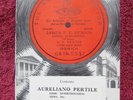
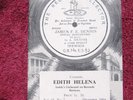
1905 EMMY DESTINN SIGNED BERLIN FONOTIPIA Mignon Connais Tu le Pays STYRIENNE x
$
25


Favourite Auctions
To save auctions to your favourites, please login
If you don't have an account, please register
Description
A series of great early Opera performances: From 1902 G&Ts to 40s wartime German records:
Great Czech Soprano Emmy Destinn from her rare 1905 first BERLIN Fonotipa recording session w piano
Signed in Dead Wax under the label
Singing both the role of morose Mignon and the mercurial Philine With a spectacular high note and Trill at the end
GEM: Berlin
1905.11.29 Wed
MIGNON (Ambroise Thomas / Jules Barbier, Michel Carré)
I/ 4: Connais-tu le pays — Romance
Kennst du das Land
Emmy Destinn (soprano). …?… (p).
master xPh 1016 D27 AN
GEM: Berlin
1905.11.29 Wed
MIGNON (Ambroise Thomas / Jules Barbier, Michel Carré)
II/10: Je connais un pauvre enfant — Styrienne
Kam ein armes Kind von fern
Emmy Destinn (soprano). …?… (p).
Fonotipia origina German Issue on Brown ODeon 10 3/8" 78 rpm record
Condition:
EXCELLENT MINUS/ VERY GOOD Plus PLUS, tiny 3 mm scratch at start Syrienne, plays E/ E- very quiet
A GREAT COPY
Emmy Destinn was one of the most sought-after singers before the Great War. She was a dramatic soprano with an exceptionally rich voice, power, great control and a singer with a passion for music. All these attributes led to remarkable achievements throughout her career. She sang at Bayreuth, London 's Covent Garden, Berlin 's Staatsoper, New York 's Metropolitan Opera and holds a prominent place in the history of opera.
Life and career
Emmy Destinn was born Emilie Pauline Venceslava Kittlova on 26 February 1878 in Katerinska Street, Prague, the oldest of five children. She probably inherited her voice from her mother, who studied singing in Milan, as a young and very good soprano. Since puberty, young Emmy showed a great interest for music and her parents, who were dedicated to the arts, encouraged her to pursue it.
Emmy first studied violin with Ferdinand Lachner and took on acting classes with Otylie Sklenarova-Mala. She privately studied singing with mezzo-soprano Marie Dreger-Loewe, a soloist of the Vienna Opera, whose artistic pseudonym was Destinn. Emmy later adopted this name as a tribute to her teacher. On 19 July 1898, Emmy was twenty years of age when she debuted at the Berlin 's Hofoper, partnered by another compatriot, tenor Karel Burian. The debut role was Santuzza in Cavalleria Rusticana followed by Valentina in Les Huguenots, Carmen and Salome. In 1901 and 1903, she was at the Prague National Theatre, singing Carmen, Mignon and Marenka (The Bartered Bride).
In November 1908, Destinn debuted at the Met as Aida with Caruso as Radames, Toscanini conducting. By 1910, she had become a popular and celebrated diva worldwide. Puccini chose her to create the role of Minnie in La Fanciulla del West for the Met world premiere. Destinn arrived in New York on opening day of the Met opera season (1910) and went to work immediately, rehearsing the role of Minnie.
During the following decade, Emmy enjoyed success after success in Berlin, especially at the Hofoper. She sang in 43 roles, including Santuzza, Carmen, Salome, Mignon among others and made 706 appearances on the stage! Wagner's widow Cosima invited her to Bayreuth, where she created the role of Senta (Der Fliegende Hollander). That success opened the door of Covent Garden, London.
She was Cio-Cio-San at the London premiere of Madama Butterfly on 18 July 1905, co-starring Enrico Caruso. In London, they sang together in many Romantic operas, including Cavalleria Rusticana, Aida, Don Giovanni, Les Huguenots, Andrea Chenier, Un ballo in Maschera and Tosca.
1919 was not a good year for Destinn. Despite that she travelled back to America as a star, the Metropolitan Opera had meantime opened the door to a new generation of singers, encouraged and took particular care of them. A very disappointed Destinn returned to Czechoslovakia .
She managed to secure a contract with the Prague National Theatre, where she sang Milada (Dalibor), Marenka and the princess of Bohemia in Smetana's opera, Libuse. Milada was her favourite role in Czech operas. She also performed in many other venues and audience greeted her as a national hero because of her patriotism, which was central to her character.
In 1923, twenty-five years after her debut, Destinn bade farewell to the regular artistic activity with many concert all over Europe. She then returned to Straz nad Nezarkou, where she lived a quiet life surrounded by her cats and antique treasures, collected throughout her career. She died unexpectedly at 52 years of age, while visiting her doctor in Ceske Budejovice, Czech Republic, on January 28 1930 .
price rating