1923 EUGENE GOOSSENS STRAVINSKY Petrouchka First Rec' Royal Albert Hall Orch 78
$
30


Favourite Auctions
To save auctions to your favourites, please login
If you don't have an account, please register
Description
Please wait for me to send you an invoice. DO NOT USE EBAY CHECKOUT if you want the lowest possible postage.
Welcome to my auctions of great records
This is my FIRST WEEK of 2 weeks of great auctions – I WILL PACK AND BILL YOUR RECORDS after the close on March 4.
PLEASE DO NOT PAY before I send you an invoice. It will take me up to 48 hours to pack your records, but this is the ONLY WAY to get you the LOWEST POSTAGE. If you pay before I sent you an invoice, the EBAY system will charge you a HIGHER POSTAGE for shipping.
A series of great classical orchestral and instrumental performances by major conductors, composers and instrumentalists.
First recording of Stravinsky's Ballet PETROUCHKA
Stravinsky – Petrouchka – Ballet Music
Royal Albert Hall Orchestra, Eugene Goossens
Victor 55245-8
Matrices Cc 4013-1, 4014-4, 4015-2, 4016-2, 4077-2, 4078-1, 4079-3, 4080-2
(single side numbers 3-0990 to 3-0997, UK issue on HMV D 853-6)
Recorded 21st December 1923 (sides 1, 6 and 7) and 15th January 1924 (sides 2, 3, 4, 5 and 8), Hayes
This recording is one of Goossens’s earliest, and was a significant gramophone premiere. Goossens was the conductor of the first recording of Stravinsky’s Petrouchka in late 1923 and early 1924. This was the only acoustic recording of the work, and this recording was superseded just four years later by Albert Coates’s electrical HMV recording and Stravinsky’s for Columbia (both with the London Symphony Orchestra). Goossens history with the work goes back to 1913, when he was a deputy violinist in the orchestra for the Ballet Russe performances at Covent Garden. In May 1925 he once more worked with Diaghilev when he conducted performances of Petrushka at the Teatro Liceo in Barcelona. In summer 1931 he again conducted the work for Beecham’s company at the Lyceum Theatre. Goossens brought Petrushka to the recording studios once more in 1959 – and didn’t take kindly to the criticism which the recording received, making it clear that he remembered all the details of the 1913 performances.
The performance is virtually complete. The First Tableau uses the concert ending, omitting the 10 bar passage between figures 47 and 48 in the score which link it to the Second Tableau. At about 2:40 in the Third Tableau, in the bar before figure 69, the introductory drum roll which links into the Dance of the Ballerina is omitted, as this is at a side join. The Third Tableau also includes one of the most notable instrumental fluffs in the recording, in an exposed bassoon part. The final side of the Third Tableau ends with the first two bars of the drum figure which begins the Fourth Tableau. The remaining two bars of this drum figure are not included at the start of the next side, so I’ve repeated them to make the passage complete.
It is remarkable how much detail of the scoring is contained within this late acoustic recording. Although some passages for cellos and basses alone are supplemented noticeably by bassoons, the recording seems overall to keep fairly close to the original scoring. A full range of percussion (including harp) is heard, along with cor anglais and bass clarinet. The playing (despite the bassoon fluff noted earlier) is remarkable – there are a few other misplaced notes, and one or two examples of inaccurate rhythm. Bear in mind that this new and difficult score was premiered just 12 and half years before this recording was made.
Among the horn players is Aubrey Brain – he also played on the Coates 1927/8 recording, and Stravinsky’s 1928 recording.
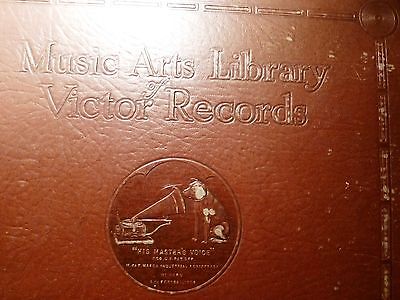
Complete 4x12" Blue label victor 78 rpm record in faux leather music library album with printed sleeves
Condition:
EXCELLENT - rare light scuff, BUT side 1/2 has a crack going 2cm into grooves. Plays very quiet with a quiete amazing sound that vividly pictures the different instrument groops. Album is great, spine has fallen off is included
Sir Eugene Aynsley Goossens (26 May 1893 – 13 June 1962) was an English conductor and composer.
Biography
He was born in Camden Town, London, the son of the Belgian conductor and violinist Eugène Goossens (fils, 1867-1958) and the grandson of the conductor Eugène Goossens (père; 1845-1906). (Note: His father and grandfather spelled Eugène with a grave accent; he himself did not.) He studied music at the age of ten in Bruges, three years later in Liverpool, and in 1907 in London on a scholarship at the Royal College of music under composer Charles Villiers stanford and the violinist Achille Rivarde among others. He won the silver medal of the Worshipful Company of musicians and was made associate of the Royal College of Music.
He was a violinist in Thomas Beecham's Queen's Hall Orchestra from 1912 to 1915 and performed in the philharmonic Quartet before coming to attention as Beecham's assistant conductor with a performance of Stanford's opera The Critic (1916). In 1921 he decided to make conducting his career and founded his own orchestra; with this ensemble he made a number of gramophone records for Edison-Bell's "Velvet Face" label. He gave the British concert premiere of Igor stravinsky's The Rite of spring on 7 June 1921 at the Queen's Hall with the composer present.
For nearly a quarter of a century, he accepted positions at U.S. orchestras. At the invitation of George Eastman he was conductor of the Rochester philharmonic orchestra from 1923 to 1931. This post also involved teaching at the Eastman school of music. During the late 1920s he often conducted for Vladimir Rosing's American opera Company, an organization which grew out of the Eastman School. From 1931 to 1946 he succeeded Fritz Reiner as the conductor of the Cincinnati symphony orchestra. In a tribute to Goossens on his departure for Australia, nine American composers collaborated on Variations on a Theme by Eugene Goossens, for orchestra. The composers were Ernest Bloch, Aaron Copland, paul Creston, Anis Fuleihan, Roy Harris, Walter piston, Bernard Rogers, Roger sessions and Deems Taylor, with Goossens himself writing the finale.[1]
Goossens spent nine years in Australia, from 1947 to 1956. He conducted the sydney symphony orchestra and other groups, and was the director of the NSW State Conservatorium of Music. He held these positions concurrently until March 1956, when he was forced to resign after a major public scandal, only a year after being knighted.
Scandal
In the early 1950s, Goossens met Rosaleen Norton, the so-called "Witch of Kings Cross". Norton was known as an artist of the grotesque and for her interest in the occult and erotica, which Goossens secretly shared. They conducted an intense affair, exchanging a number of passionate letters; although Goossens asked Norton to destroy all of them, she kept a bundle hidden behind a sofa.[2]
In early 1956, Goossens visited Europe, unaware that sydney police were already in possession of his letters to Norton and photographs of her occult activities, which had been stolen from her flat by Sydney Sun reporter Joe Morris, who had infiltrated her supposed "coven". When Goossens returned to Australia on 9 March 1956, he was detained at sydney Airport, following a tip-off by informants in London; his bags were searched by Customs officials, who found a large amount of what was then considered pornographic material, which included photographs, prints, books, a spool of film, some rubber masks, and sticks of incense.
Although he was not immediately arrested or charged, Goossens naively agreed to attend a police interview a few days later, where he was confronted with photographs of Norton's "ceremonies" and his letters. Faced with the evidence of his affair with Norton — which left him open to the serious charge of "scandalous conduct" — Goossens was forced to plead guilty to the pornography charges. He paid a fine of £100; more significantly, the scandal ruined his reputation and forced him to resign from his positions. He returned to England in disgrace.
The scandal was the basis of a novel, Pagan (1990), by Inez Baranay; it also inspired a play, The Devil is a Woman, by Louis Nowra and an opera, Eugene & Roie, by Drew Crawford. The scandal is documented in the film The Fall of the House, directed by Geoff Burton.[3] [4]
More Great Records on sale right now:
http://shop.ebay.com/carsten_sf/m.html
http://shop.ebay.com/carsten_sf/m.html
====
A Quick NOTE ON GRADING AND SHIPPING:
As you can see from my feedback, I try hard to earn your POSITIVE FEEDBACK and FIVE STAR RATINGS.
If for any reason your transaction was NOT SATISFACTORY, pls contact me and I will work something out with you. YOU WILL NEVER HAVE A REASON TO GIVE ME A NEGATIVE RATING or a LOW STAR RATING.
Quick note on grading:
The Grade (Excellent to Fair, I don't give Mint) refers to the WEAR of the record. Any other defects are stated separately
When I listen to a record, I may also give it an aural grade (again E to F), and make a SUBJECTIVE judgment of the pressing quality for hiss and surface noise.
"SUPERQUIET" is basically noiseless, like a vinyl pressing.
"VERY QUIET" is an quiet record for a given pressing.
"Quiet" is a record that is a great example without undue noise for a give pressing.
These judgments are SUBJECTIVE and will depend one the styli, phonograph etc. you use on your own equipment.
If you win multiple items, pls send me an INVOICE REQUEST to calculate the correct postage. Ebay check out will not give you the multiple item discount!
Records will be packed safely between corrugated cardboard in a sturdy box with plenty of padding for safe shipment.
Shipment is usually Media Mail, unless another service is requested. Shipping is at your risk, I will be happy to insure items at your cost.
I charge actual postage plus a small fee for packing materials
As always, I guarantee your satisfaction. If you don't like the item, just return it, and I will refund the full purchase price.
If you are in the San Francisco area, I encourage pick-up in person.
US Domestic Shipping:
Here is a guideline for US Media Mail Shipping:
Prices below are for regular 78 rpm records. Up to about 5 records, I will ship Edison Discs for the same rates. Albums from Album Sets count as 1 record. Above that and for international shipments, it will be actual weight plus a small packing charge (1-3$ depending on size of shipment)
1 record: 4.50 – 5.00$
2 records: 5.75$
5 records: 7.50$
10 records: 9.50$
MANY MORE RECORDS: Don't worry. I safely ship 40 - 50 pounds of records double boxed in moving boxes, and even then Media Mail will probably not exceed 30$.
Please send me a message if you would like to lower your shipping rates!
International Buyers:
I am very happy to ship records worldwide.
Please use the EBAY shipping cost only as a guideline. My actual charges are usually lower
International shipping: approx postage 1x10"=$25: 1x12"=$35: 10"Album 4 Rec=50$: 12" Album 2 Rec=50$
HOWEVER in most cases I can get you SIGNIFICANT savings by using other services. Pls contact me for a quote.
About 30% less to Canada.
Pls contact me for a shipping estimate, or send me an invoice request after close of auction.
AND AGAIN -THANK YOU FOR YOUR INTEREST
As you can see from my feedback, I take great care in presenting, grading and shipping your items. I really want you to be happy with the purchase. If you feel that anything is wrong with the item or the shipping, contact me and we will work it out !!!
As always, I would appreciate any suggestions and corrections from you, pls contact me with any question.
Thank you very much, and good luck bidding !!!
price rating