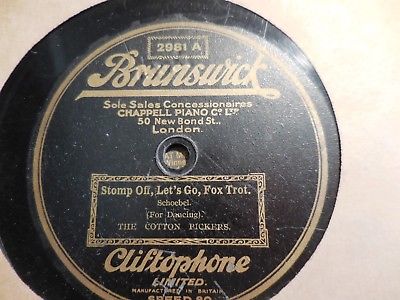
1923 The COTTON PICKERS STOMP OFF LET's GO/ CAROLINA Trumbauer, Miff Mole 78
$
36


Favourite Auctions
To save auctions to your favourites, please login
If you don't have an account, please register
Description
Please wait for me to send you an invoice. DO NOT USE EBAY CHECKOUT if you want the lowest possible postage.
Welcome to my auctions of great records
This is my FIRST WEEK of 2 weeks of great auctions – I WILL PACK AND BILL YOUR RECORDS after the close on after the end of the second week on Nov 11.
PLEASE DO NOT PAY before I send you an invoice. It will take me up to 48 hours to pack your records, but this is the ONLY WAY to get you the LOWEST POSTAGE. If you pay before I sent you an invoice, the EBAY system will charge you a HIGHER POSTAGE for shipping.
International shipping: approx postage 1x10"=$25: 1x12"=$35: 10"Album 4 Rec=50$: 12" Album 2 Rec=50$
HOWEVER in most cases I can get you SIGNIFICANT savings by using other services. Pls contact me for a quote.
About 30% less to Canada. Pls ignore international postage displayed in Ebay, rates are too high
Please wait for me to send you an invoice. DO NOT USE EBAY CHECKOUT if you want the lowest possible postage.
A series of great JAZZ Records from early Ragtime to Beb-Bop on 78 rpm Victrola Records
One of the great early Jazz Bands of a bluesy-cool jazz with great hot solos and impeccable rhythm are the Cotton Pickers on Brunswick. Here with two great numbers:
Carolina Stomp
(Rube Bloom) 11-13-1925 New York Brunswick
2981 Stomp Off, Let's Go
(Elmer Schoebel) 11-13-1925 New York Brunswick
2981
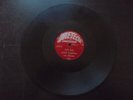
British CLIFTOPHONE 10" 78 rpm record
Condition: VERY GOOD very rubbed and many light scratches, Plays VG+ loud and clear w light hiss ticks and pops
Personnel:
Phil Napoleon - trumpet
Miff Mole - trombone
Jimmy Lytell - clarinet
Frank Signorelli - piano
John Cali - banjo
John Helleberg - tuba
Jack Roth - drums
The Cotton Pickers was Brunswick's chosen generic name for its purveyors of blues fox trots and throughout the 1920s the name was used on a considerable number of issues, even though the range of repertoire broadened and the personnel metamorphosed several times. The anchorman of the first generation to bear the Cotton Pickers name was trumpeter Phil Napoleon, a legitimately trained musician with a powerful, clean (if at times unadventurous) style, and who was well known to recording executives through his work for bandleader Sam Lanin and with the Original Memphis Five.
This song romanticized a ragtime dance craze popularized by Gilda Gray. The "shimmy" involved frantic, sensous gyrations of the hips and shoulders, personifying the madcap exuberance and permissive morals of the Jazz Age. It inspired several additional songs, including "Shimee Town" (featured in the Ziegfeld Follies of 1919), "Sim-Me-King Blues" (recorded by Mamie Smith in 1921), and the New Orleans Rhythm Kings' "Shim-Me-Sha-Wabble" (1923). The first recording of "I Wish I Could Shimmy Like My Sister Kate" was made by a very young Bessie Smith. The singer, then unknown, used the song as an audition record for Okeh Phonograph Company in 1921. The pianist was none other than Clarence Williams, who also organized the session. The record was never issued however.
It has been said that Louis Armstrong sold the song for $50 in 1918, but was never given recognition as the composer.
From Redhotjazz.com
When Mamie Smith recorded Crazy Blues for Okeh in 1920, little did she or her Svengali-like manager Perry Bradford have any idea what effect this would have on the recording industry or popular music in general. The astonishing success of this record caused shockwaves in the normally ultra-conservative recording industry û which was still recovering from the popularity of jazz and the apparently insatiable demand for dance records. These two factors combined in the demand for slow or "blues" fox trots, fuelled by the success of vocal blues records and booming sheet music sales for "blues" compositions.
From the spring of 1921 instrumental blues were increasingly featured by recording groups, composed and published mainly by black songwriters but performed by and large by white bands and orchestras. The impact of the blues craze on the recording companies can be gauged by examining the output of the era's best known jazz group, the Original Dixieland Jazz Band. From their first session in 1917 to the spring of 1921 most of their output comprised of original compositions by members of the band. From the spring of 1921 to their departure from Victor at the end of the year, all of their records were instrumental blues composed by black songwriters.
One by one the recording companies either hired or "created" bands for the sole purpose of recording "blues" numbers, and to add a ring of ethno-authenticity many were given "black" sounding names to convince the record-buying public of their being the genuine article. Gennett had Ladd's Black Aces, the Plaza group, the Six Black Diamonds, Okeh, the Tampa Blue Jazz Band and Brunswick had the Cotton Pickers. The reasons for the use of white bands to record music which was so rooted in the public's imagination as being black in origin are not difficult to grasp. Firstly, record company talent scouts and A&R men in 1922 were exclusively white (with the notable exception of Harry Pace's Black Swan company, the first major black-owned record company, whose A&R man was one Fletcher Henderson), and thus would have had little or no contact with or exposure to black musicians. Secondly, record companies ran their businesses in a tight and orderly manner; they liked reliable, known, competent musicians who could sight read in order to produce an acceptable master in the shortest possible time and in the minimum number of takes.
The Cotton Pickers was Brunswick's chosen generic name for its purveyors of blues fox trots and throughout the 1920s the name was used on a considerable number of issues, even though the range of repertoire broadened and the personnel metamorphosed several times. The anchorman of the first generation to bear the Cotton Pickers name was trumpeter Phil Napoleon, a legitimately trained musician with a powerful, clean (if at times unadventurous) style, and who was well known to recording executives through his work for bandleader Sam Lanin and with the Original Memphis Five.
Contrary to published discographies, this writer believes that the personnel of the first two sides under this name, rather than being an augmented Original Memphis Five, was in fact made under the direction of Bennie Kreuger. Kreuger was one of the best known saxophonists of the day and his orchestra was a big seller on Brunswick - he also freelanced with the Brunswick house band and it is reasonable to assume that he would be a prime candidate to approach to supply a scaled-down group to record instrumental blues numbers. For the first session Kreuger hired the Original Memphis Five's Phil Napoleon (who occasionally recorded with Kreuger's band) and trombonist Miff Mole, possibly with the group's pianist Frank Signorelli, to which he added his regular sidemen banjoist Bill Arenburg, tuba player John Helleberg and drummer Willie Farberman. Although Kreuger is best known as a saxophonist, he occasionally played clarinet, and the thin tone and low register slap tonguing on Hot Lips is entirely consistent with known examples of his clarinet style on other recordings.
For the following session the full Original Memphis Five was used, augmented by Cali and Helleberg. The sound is immediately more cohesive than on the previous session, aided in no small part by the two handed piano playing of Frank Signorelli and Jack Roth's drumming. Kreuger's replacement on clarinet, Jimmy Lytell, is in a different league. Like Napoleon and Signorelli, Lytell had worked with the Original Dixieland Jazz Band, replacing Larry Shields, and much of Shields' concepts and style had rubbed off on the youngster. Lytell however gradually developed his own style, marked by a purity of tone and a warmth in the chalumeau register, free of the yelps and cackling which bedevilled many early jazz clarinettists.
The trombonist on this and several other Cotton Pickers sessions was Irving Milfred "Miff" Mole and although only 23 years old, was already the acknowledged leading jazz performer on the instrument. His assuredness and astonishing technique which had taken the trombone from an almost comedic role in many early jazz bands to a fluent solo voice shines through on many Cotton Pickers sides. His replacement with the Original Memphis Five and thus with the Cotton Pickers was Charles Panelli, whose recording debut in 1918 with the Louisiana Five was hardly inspiring - long glissandos and a general stiffness and lack of harmonic invention. What happened to him between 1920 and 1923 is uncertain, but when he reappears on record in 1923 we find a confident, relaxed and technically brilliant player, capable of holding his own with any of his contemporaries, even the mighty Mole. In fact at times it is virtually impossible to differentiate between his and Mole's playing.
Over the ensuing two years this group recorded a considerable number of sides for Brunswick, and as the "blues" craze ran its course their repertoire broadened. The inclusion of more popular melodies such as Way Down Yonder In New Orleans and novelty numbers such as The Duck's Quack shows a shift in the record market, as does the addition of vocalists to several sides (not included on this CD). From this period comes Walk, Jenny, Walk, memorable for the remarkable drum solo by Jack Roth, first on woodblock followed by a tightly choked cymbal, played at great speed and with remarkable precision and dexterity. Also noteworthy from this period are the last two tracks by the augmented Original Memphis Five, Do Yo' Duty Daddy, a delightfully relaxed workout of a Ted Fiorito composition and Blue Rose.
With Blue Rose the Cotton Pickers name disappeared from the Brunswick catalogue for over a year. The reasons for this are uncertain, but it is no coincidence that the "blues" craze, particularly as a dance step had petered out, to be replaced by the much more frenetic Charleston. The demand for records by small jazz groups however did not decline, as testified by the scores of sides recorded by the Original Memphis Five, the Original Indiana Five, the New Orleans Jazz Band and others.
Brunswick also had a new star band (Ray Miller and his Orchestra), which had usurped those of Bennie Kreuger and Isham Jones as its leading orchestra û the star-studded aggregation led by drummer Ray Miller. Miller had been leading his own band in New York since 1918 and held a fairly consistent, if musically unadventurous personnel over the years. However in 1924 he was offered a long residency at New York's Arcadia Ballroom, and with a virtually blank chequebook busily set about hiring the cream of the younger, "modern" talent available. These included Miff Mole, virtuoso reedman Andy Sanella, pianist Rube Bloom and the sax star of the Benson Orchestra of Chicago, Frank Trumbauer. Miller was also requested by Brunswick to supply a scaled-down band to record "hot" numbers, and thus the Cotton Pickers name was resurrected for its third incarnation.
Stylistically, the 1924-1925 Cotton Pickers sides are poles apart from the earlier Original Memphis Five - based recordings; the latter were lineally descended from the Original Dixieland Jazz Band whereas the likes of Mole and Trumbauer had pushed forward the rhythmic and harmonic boundaries far beyond the New Orleans polyphony of the early groups. Bix Beiderbecke and the Wolverine Orchestra had hit New York a few months earlier, and his advanced musical thinking and "cool" style was already making its presence felt.
The repertoire of these "Miller" Cotton Pickers shows a clean break from the predominantly black composer/publisher base of the earlier sides; they are for the mostpart up-tempo renditions compositions by white, non-Tin Pan Alley composers. The writers were mainly Chicago-based bandleaders; Elmer Schoebel, Charley Straight, Albert Short and Fred Rose, or mid-westerners published by the Melrose Brothers in Chicago, such as Charlie Davis.
As for the records themselves Trumbauer steals the show on nearly all the tracks with his thrusting, confident C-melody sax. Mole's staccato, facile trombone is a perfect foil to Tram, and trumpeter Roy Johnson, free from the confines of the big band is inspired by the august company û his introductory fanfare on Down And Out Blues is both powerful and confident. This latter track was issued in Britain in 1926 with the label bearing the legend "Trombone Passage by Miff Mole" , which must have meant absolutely nothing to British record buyers!
The Cotton Pickers continued recording for Brunswick throughout 1925, using the newly-introduced electrical recording process. Whereas most companies licensed the Western Electric system, Brunswick commenced with its own "Light Ray" system, which produced a thin, distorted parody of sound. The acoustic system employed by Brunswick was of the highest order, producing a full, clear, well-balanced sound. Even the bass drum can be occasionally discerned.
Despite their being a product of a record company eager to cash in on a musical fad, the Cotton Pickers have endured over the years, being eagerly sought after by fans of 1920s white New York jazz. Their appeal is self - evident û outstanding musicianship, a feel for the repertoire and a sincerity in their approach which transcends their time. For the seasoned collector it is an opportunity to re-evaluate a neglected group, for the newcomer a golden opportunity to discover the early developments of New York jazz.
Artist Instrument Larry Abbott Clarinet Ward Archer Drums Bill Arenburg Banjo Vic Berton Drums Rube Bloom Piano Mickey Bloom Trumpet, Melotron Perry Botkin Banjo John Cali Banjo Hoagy Carmichael Vocals Louis Chassagne Bass Frank DiPrima Banjo Jimmy Dorsey Clarinet, Alto Saxophone Tommy Dorsey Trombone Willie Farberman Drums John Helleberg Bass Willie Farberman Drums Ray Kitchingman Banjo Ernest Hare Vocals Liby Holman Vocals Carl Kress Guitar Bennie Kreuger Clarinet, Leader Roy Johnson Trumpet Billy Jones Vocals Stan King Drums Scrappy Lambert Vocals Jimmy Lytell Clarinet Chuck Miller Clarinet Glenn Miller Trombone Miff Mole Trombone Phil Napoleon Trumpet Red Nichols Trumpet Charles Panelli Trombone Dick Robertson Vocals Jack Roth Piano, Drums Arthur Schutt Piano Frank Signorelli Piano Roy Smeck Banjo Joe Tarto Tuba, Bass Frank Trumbauer C Melody Saxophone Rudy Wiedoeft Alto SaxophoneMore Great Records on sale right now:
http://shop.ebay.com/carsten_sf/m.html
http://shop.ebay.com/carsten_sf/m.html
====
A Quick NOTE ON GRADING AND SHIPPING:
As you can see from my feedback, I try hard to earn your POSITIVE FEEDBACK and FIVE STAR RATINGS.
If for any reason your transaction was NOT SATISFACTORY, pls contact me and I will work something out with you. YOU WILL NEVER HAVE A REASON TO GIVE ME A NEGATIVE RATING or a LOW STAR RATING.
Quick note on grading:
The Grade (Excellent to Poor, I don't give Mint) refers to the WEAR of the record. Any other defects are stated separately
When I listen to a record, I may also give it an aural grade (again E to P), and make a SUBJECTIVE judgment of the pressing quality for hiss and surface noise.
"SUPERQUIET" is basically noiseless, like a vinyl pressing.
"VERY QUIET" is an exceptionally quiet record for a given pressing.
"Quiet" is a record that is a great example without undue noise for a give pressing.
These judgments are SUBJECTIVE and will depend one the styli, phonograph etc. you use on your own equipment.
Pls check my other auctions for more great records and phonograph items:
Multiple item shipping: I am happy to combine items for shipment in one parcel.
If you win multiple items, pls send me an INVOICE REQUEST to calculate the correct postage. Ebay check out will not give you the multiple item discount!
Records will be packed safely between corrugated cardboard in a sturdy box with plenty of padding for safe shipment.
Shipment is usually Media Mail, unless you request another service. Shipping is at your risk, I will be happy to insure items at your cost.
I charge actual postage plus a small fee for packing materials
As always, I guarantee your satisfaction. If you don't like the item, just return it, and I will refund the full purchase price.
If you are in the San Francisco area, I encourage pick-up in person.
US Domestic Shipping:
Here is a guideline for US Media Mail Shipping:
Prices below are for regular 78 rpm records. Up to about 5 records, I will ship Edison Discs for the same rates. Albums from Album Sets count as 1 record. Above that and for international shipments, it will be actual weight plus a small packing charge (1-3$ depending on size of shipment)
1 record: 4.75 – 5.00$
2 records: 6.00$
5 records: 7.50$
10 records: 10.00$
MANY MORE RECORDS: Don't worry. I safely ship 40 - 50 pounds of records double boxed in moving boxes, and even then Media Mail will probably not exceed 35$.
Please send me a message if you would like to lower your shipping rates!
I am very happy to ship records worldwide.
Please use the EBAY shipping cost only as a guideline. My actual charges are usually lower
One record usually ships for 25 – 28$ for 10" 35$ for most 12" records (Less for Canada).
I can get SIGNIFICANTLY LOWER rates from FedEx and the US Postal service for any kind of parcel weight, and will make use of all the cost-saving shipment methods
Pls contact me for a shipping estimate, or send me an invoice request after close of auction.
AND AGAIN -THANK YOU FOR YOUR INTEREST
As you can see from my feedback, I take great care in presenting, grading and shipping your items. I really want you to be happy with the purchase. If you feel that anything is wrong with the item or the shipping, contact me and we will work it out !!!
As always, I would appreciate any suggestions and corrections from you, pls contact me with any question.
Thank you very much, and good luck bidding !!!
price rating