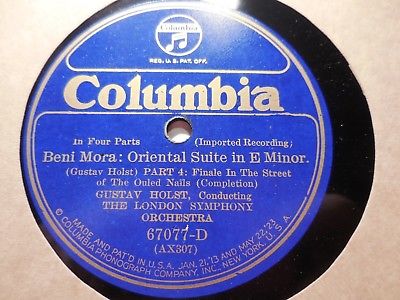
1924 GUSTAV HOLST cond acoustic BENI MORA Oriental Suite E Minor London Symp78
$
20


Favourite Auctions
To save auctions to your favourites, please login
If you don't have an account, please register
Description
Please wait for me to send you an invoice. DO NOT USE EBAY CHECKOUT if you want the lowest possible postage.
Welcome to my auctions of great records
This is my LAST WEEK of 2 weeks of great auctions – I WILL PACK AND BILL YOUR RECORDS after the close on MAY 13.
PLEASE DO NOT PAY before I send you an invoice. It will take me up to 48 hours to pack your records, but this is the ONLY WAY to get you the LOWEST POSTAGE. If you pay before I sent you an invoice, the EBAY system will charge you a HIGHER POSTAGE for shipping. Pls give me about 48 hours to send you an invoice.
International shipping: approx postage 1x10"=$25: 1x12"=$35: 10"Album 4 Rec=50$: 12" Album 2 Rec=50$
HOWEVER in most cases I can get you SIGNIFICANT savings by using other services. Pls contact me for a quote.
About 30% less to Canada. Pls ignore international postage displayed in Ebay, rates are too high
Please wait for me to send you an invoice. DO NOT USE EBAY CHECKOUT if you want the lowest possible postage.
A series of great classical orchestral and instrumental performances by major conductors, composers and instrumentalists.
Acoustic recording Gustav Holst conducts the London Symphony in
67076-D - 67077-D (Acoustic recording) [EF]
Beni Mora - Oriental Suite in E Minor (Holst)
Gustav Holst conducting London Symphony Orchestra
67076-D - 67077-D - Not assigned an album number
Matrix numbers: AX 304 to AX 307
Recorded: 14 February 1924; Petty France Studios
2x12" Columbia 78 rpm records, no album
Condition:EXCELLENT pristine, plays very very quiet
A CHOICE COPY
Beni Mora is a three-movement suite of music in E minor for large orchestra, by Gustav Holst. The first performance was at the Queen's Hall, London, on 1 May 1912, conducted by the composer.[1] The work was inspired by music Holst heard in Algeria during a holiday in 1908. The constant repetition of one theme from Arabic folk music in the last movement has been described as a precursor of modern minimalism. The piece also includes dance rhythms and wistful, slow sections, and makes strong use of woodwinds and percussion. Beni Mora has been recorded several times by British orchestras, most recently in 2011.
Background[edit]
In 1908 Holst, suffering from asthma, neuritis and depression, took a holiday in Algeria on medical advice.[2] This trip inspired the suite Beni Mora, which incorporated music he heard in the Algerian streets.[3] While in Algeria he listened to a local musician playing the same phrase on a bamboo flute for over two hours non-stop. He took the title from the setting of Robert Hichens's 1904 novel The Garden of Allah.[4] The first movement was originally a stand-alone piece, Oriental Dance (1909), dedicated to the music critic Edwin Evans. In 1910 Holst added the other two movements.[5]
Structure[edit]
The work is scored, in the words of Michael Kennedy "most piquantly and colourfully".[5] The three movements are titled, First Dance, Second Dance, and Finale: "In the Street of the Ouled Naïls."
First Dance[edit]
The dance opens with a broadly-phrased melody on the strings into which a strongly rhythmic figure interrupts, played by trumpets, trombones and tambourine. A lively dance rhythm follows, with solo parts for cor anglais, oboe and flute. The rhythm slows, and the opening string tune returns, before the full orchestra resumes the quick dance theme. The dance closes quietly.[5] The movement typically takes between 5½ and 6½ minutes in performance, though in a 1924 recording with the London Symphony Orchestra the composer took it at a much quicker tempo, ending the movement within 4½ minutes: see table below.
Second Dance[edit]
This is the shortest of the three movements, typically taking a little under four minutes in performance. It is an allegretto with lighter scoring than the outer movements. It begins with a 5
4 rhythm for solo timpani, over which a solo bassoon enters with a quiet theme. The gentle mood is maintained by a flute solo, interrupted by the timpani. The movement, quiet almost throughout, ends pianissimo.[5]
Finale: "In the Street of the Ouled Naïls"[edit]
The movement opens softly with phrases of indeterminate key until a solo flute enters with an eight-note theme repeated 163 times for the rest of the movement. Against the theme the full orchestra plays other dance rhythms. The volume rises to a climax and then sinks back to softness as the movement comes to an end.[5]
Reception[edit]
At the premiere the work received a mixed welcome. Some of the audience hissed and one critic wrote, "We do not ask for Biskra dancing girls in Langham Place".[5] On the other hand, the reviewer in The Times observed, "Mr Von Holst's[n 1] suite is compiled from genuine Arab tunes treated with extraordinary skill, especially in the vivid finale, in which a number of dance tunes are combined to illustrate a night scene in Biskra."[1]
Ralph Vaughan Williams wrote of Beni Mora, "if it had been played in Paris rather than London it would have given its composer a European reputation, and played in Italy would probably have caused a riot."[7] More recently, the critic Andrew Clements has written of the "proto-minimalist fashion" of the repeated tune in the finale.[8]
.
Gustav Theodore Holst (21 September 1874 û 25 May 1934)[1][2] was an English composer and was a music teacher for over 20 years. He is most famous for his orchestral suite The Planets.[1] Having studied at the Royal College of Music in London,[2] his early work was influenced by Ravel,[2] Grieg, Richard Strauss, and fellow student Ralph Vaughan Williams,[3] but most of his music is highly original, with influences from Hindu spiritualism and English folk tunes.[2] Holst's music is well known for unconventional use of metre and haunting melodies.
Holst wrote almost 200 catalogued compositions, including orchestral suites, operas, ballets, concertos, choral hymns, and songs (see Selected works below).
Holst became music master at St Paul's Girls' School[4] in 1905 and director of music at Morley College in 1907, continuing in both posts until retirement.[2]
He was the brother of Hollywood actor Ernest Cossart and father of the composer and conductor Imogen Holst, who wrote a biography of her father in 1938.[3]
Life
[edit] Name
He was originally named Gustavus Theodor von Holst, but he dropped the "von" from his name in response to anti-German sentiment in Britain during World War I, making it official by deed poll in 1918.[5][6]
[edit] Early life
Holst was born on 21 September 1874, at 4 Clarence Road, Cheltenham, Gloucestershire, England[1][5][7] to a family of Swedish extraction (by way of Latvia and Russia). The house was opened as a museum of Holst's life and times in 1974. He was educated at Cheltenham Grammar School for Boys.
Holst's grandfather, Gustavus von Holst of Riga, Latvia, a composer of elegant harp music, moved to England, becoming a notable harp teacher.[5] Holst's father Adolph von Holst, an organist, pianist, and choirmaster, taught piano lessons and gave recitals; and his mother, Clara von Holst, who died when Gustav was eight, was a singer.[5] As a frail child whose early recollections were musical, Holst had been taught to play piano and violin, and began composing when he was about twelve.[5]
Holst's father was the organist[1] at All Saints' Church in Pittville, and his childhood home is now a small museum, devoted partly to Holst, and partly to illustrating local domestic life of the mid-19th century.
Holst grew up in the world of Oscar Wilde, H. G. Wells, George Bernard Shaw, Arthur Conan Doyle, Gauguin, Monet, Wagner, Tchaikovsky, and Puccini. Both he and his sister learned piano from an early age, but Holst, stricken with a nerve condition that affected the movement of his right hand in adolescence, gave up the piano for the trombone,[2] which was less painful to play.
Royal College of Music (1894 site), where Holst & Ralph Vaughan Williams studied in 1895He attended the newly relocated Royal College of Music[1] in London on a scholarship, studying with Charles V. Stanford, and there in 1895[5] he met fellow student and lifelong friend Ralph Vaughan Williams,[1] whose own music was mainly quite different from HolstÆs,[5] but whose praise for his work was abundant and who later shared an interest in Holst teaching the English vocal and choral tradition (folk song, madrigals, and church music).[2]
Holst was influenced during these years by socialism, and attended lectures and speeches by George Bernard Shaw, with whom he shared a passion for vegetarianism, and by William Morris, both of whom were among the UK's most outspoken supporters of the socialist movement.
It was also during these years that Holst became interested in Hindu mysticism and spirituality,[2] and this interest was to influence his later works, including Sita (1899û1906, a three-act opera based on an episode in the Ramayana), Savitri,[2] a chamber opera based on a tale from the Mahabharata, and Hymns from the Rig Veda,[2] in preparation for which he taught himself basic Sanskrit to avoid reliance on the "substandard" translations of the day.
To earn a living in the period before he had a satisfactory income from his compositions, he played the trombone[1] in the Carl Rosa Opera Company[2] and in a popular orchestra called the "White Viennese Band" , conducted by Stanislas Wurm. The music was cheap and repetitive and not to Holst's liking, and he referred to this kind of work as "worming" and regarded it as "criminal". His need to "worm" came to an end as his compositions became more successful, and his income was given stability by his teaching posts.[1]
During these early years, he was influenced greatly by the poetry of Walt Whitman, as were many of his contemporaries, and set his words in The Mystic Trumpeter (1904). He also set to music poetry by Thomas Hardy[5] and Robert Bridges.
[edit] Musical career
In 1905, Holst was appointed Director of Music at St Paul's Girls' School[4][2] in Hammersmith, London, where he composed the successful and still popular St Paul's Suite[4] for the school orchestra in 1913.[1] In 1907, Holst also became director of music at Morley College.[2] These were the most important of his teaching posts, and he retained both until the end of his life.[2]
During the first two decades of the 20th century, musical society as a whole (and Holst's friend Vaughan Williams in particular) became interested in old English folksongs, madrigal singers,[2] and Tudor composers. Holst shared in his friendÆs admiration for the simplicity and economy of these melodies, and their use in his compositions is one of his musicÆs most recognizable features.
Holst was an avid rambler. He walked extensively in Italy, France, and England. He also travelled outside the bounds of Europe, heading to French-controlled Algeria in 1906 on doctor's orders as a treatment for asthma and the depression that crippled him after his submission failed to win the Ricordi Prize, a coveted award for composition. His travels in the Arab and Berber land, including an extensive bicycle tour of the Algerian Sahara, inspired the suite Beni Mora, written upon his return.
After the lukewarm reception of his choral work The Cloud Messenger in 1912, Holst was again off travelling, financing a trip to Spain with fellow composers Balfour Gardiner and brothers Clifford Bax and Arnold Bax with funds from an anonymous donation. Despite being shy, Holst was fascinated by people and society, and had always believed that the best way to learn about a city was to get lost in it. In Gerona, Catalonia, he often disappeared, only to be found hours later by his friends having abstract debates with local musicians. It was in Spain that Clifford Bax introduced Holst to astrology, a hobby that was to inspire the later Planets suite. He read astrological fortunes until his death, and called his interest in the stars his "pet vice".
Shortly after his return, St PaulÆs Girls School[4] opened a new music wing, and Holst composed St PaulÆs Suite[4] for the occasion.[1] In 1913, Stravinsky premiered The Rite of Spring, sparking riots in Paris and caustic criticism in London. A year later, Holst first heard SchoenbergÆs Five Pieces for Orchestra, an "ultra-modern" set of five movements employing "extreme chromaticism" (the consistent use of all 12 musical notes). Although he had earlier lampooned the stranger aspects of modern music, the new music of Stravinsky[2] and Schoenberg influenced his work on The Planets.
Holst's compositions for wind band, though relatively small in number, guaranteed him a position as the medium's cornerstone, as seen in innumerable present-day programmes featuring his two Suites for Military Band. His one work for brass band, A Moorside Suite, remains an important part of the brass band repertoire.
More Great Records on sale right now:
http://shop.ebay.com/carsten_sf/m.html
http://shop.ebay.com/carsten_sf/m.html
====
A Quick NOTE ON GRADING AND SHIPPING:
As you can see from my feedback, I try hard to earn your POSITIVE FEEDBACK and FIVE STAR RATINGS.
If for any reason your transaction was NOT SATISFACTORY, pls contact me and I will work something out with you. YOU WILL NEVER HAVE A REASON TO GIVE ME A NEGATIVE RATING or a LOW STAR RATING.
Quick note on grading:
The Grade (Excellent to Fair, I don't give Mint) refers to the WEAR of the record. Any other defects are stated separately
When I listen to a record, I may also give it an aural grade (again E to F), and make a SUBJECTIVE judgment of the pressing quality for hiss and surface noise.
"SUPERQUIET" is basically noiseless, like a vinyl pressing.
"VERY QUIET" is an exceptionally quiet record for a given pressing.
"Quiet" is a record that is a great example without undue noise for a give pressing.
These judgments are SUBJECTIVE and will depend one the styli, phonograph etc. you use on your own equipment.
Pls check my other auctions for more great records and phonograph items:
Multiple item shipping: I am happy to combine items for shipment in one parcel.
If you win multiple items, pls send me an INVOICE REQUEST to calculate the correct postage. Ebay check out will not give you the multiple item discount!
Records will be packed safely between corrugated cardboard in a sturdy box with plenty of padding for safe shipment.
Shipment is usually Media Mail, unless another service is requested. Shipping is at your risk, I will be happy to insure items at your cost.
I charge actual postage plus a small fee for packing materials
As always, I guarantee your satisfaction. If you don't like the item, just return it, and I will refund the full purchase price.
If you are in the San Francisco area, I encourage pick-up in person.
US Domestic Shipping:
Here is a guideline for US Media Mail Shipping:
Prices below are for regular 78 rpm records. Up to about 5 records, I will ship Edison Discs for the same rates. Albums from Album Sets count as 1 record. Above that and for international shipments, it will be actual weight plus a small packing charge (1-3$ depending on size of shipment)
1 record: 4.50 – 5.00$
2 records: 5.75$
5 records: 7.50$
10 records: 9.50$
MANY MORE RECORDS: Don't worry. I safely ship 40 - 50 pounds of records double boxed in moving boxes, and even then Media Mail will probably not exceed 30$.
Please send me a message if you would like to lower your shipping rates!
International Buyers:
All'attenzione degli acquirenti italiani:
ATTENTION TO ITALIAN BUYERS:
Due to rare problems with delivery in ITALY, I will NOT GUARANTEE delivery of parcels sent by US Postal Service First Class and Priority Mail. If you prefer secure delivery, I will be happy to quote you either Registered Mail or shipment by FEDEX
I am very happy to ship records worldwide.
Please use the EBAY shipping cost only as a guideline. My actual charges are usually lower
One record usually ships for 25 – 28$ for 10" 35$ for most 12" records (Less for Canada).
I can get SIGNIFICANTLY LOWER rates from FedEx and the US Postal service for any kind of parcel weight, and will make use of all the cost-saving shipment methods
Pls contact me for a shipping estimate, or send me an invoice request after close of auction.
AND AGAIN -THANK YOU FOR YOUR INTEREST
As you can see from my feedback, I take great care in presenting, grading and shipping your items. I really want you to be happy with the purchase. If you feel that anything is wrong with the item or the shipping, contact me and we will work it out !!!
As always, I would appreciate any suggestions and corrections from you, pls contact me with any question.
Thank you very much, and good luck bidding !!!
price rating