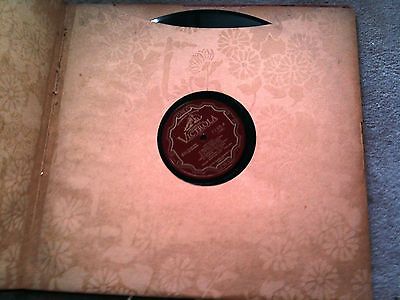
1929 Sergei RACHMANINOFF Piano SCHUMANN CARNAVAL Op 9 Orthophonic Album M 76 78
$
48


Favourite Auctions
To save auctions to your favourites, please login
If you don't have an account, please register
Description
Welcome to my auctions of great records
This is my FINAL WEEK of 3 weeks of great auctions – I WILL PACK AND BILL YOUR RECORDS after the close on September 27.
PLEASE DO NOT PAY before I send you an invoice. It will take me up to 48 hours to pack your records, but this is the ONLY WAY to get you the LOWEST POSTAGE. If you pay before I sent you an invoice, the EBAY system will charge you a HIGHER POSTAGE for shipping.
International shipping: approx postage 1x10"=$25: 1x12"=$28: 10"Album 4 Rec=45$: 12" Album 2 Rec=45$
About 30% less to Canada. Pls ignore international postage displayed in Ebay, rates are too high
Please wait for me to send you an invoice. DO NOT USE EBAY CHECKOUT if you want the lowest possible postage.
A series of great classical orchestral and instrumental performances by major conductors, composers and instrumentalists.
When Rachmaninov came to record Schumann’s Carnaval, Op. 9, on 9 April 1929 he recorded two takes of each side and three of side four in a three hour afternoon session. The next morning he spent two hours recording further takes of each side with the exception of side four, and in the afternoon recorded part of his Piano Concerto No. 2 with the Philadelphia Orchestra. Two days later the session took place with the aborted attempt at the beginning of the Chopin B flat minor Piano Sonata mentioned above, followed by retakes of the first two sides of Carnaval. Rachmaninov was obviously not satisfied with the first side of Carnaval as he made eight attempts, the seventh being passed for publication.
Sergei Rachmaninoff plays Schumann "Carnaval" Op. 9
Scènes mignonnes sur quatre notes
Robert SCHUMANN (1810–1856)
Carnaval, Op. 9
Préambule • Pierrot • Arlequin
Recorded on 12 April 1929
Matrix CVE-51089-7; Cat. 7184-A
Valse noble • Eusebius • Florestan • Coquette
Recorded on 9 April 1929
Matrix CVE-51090-2; Cat. 7184-B
Réplique • Sphinxes • Papillons • A.S.C.H.-S.C.H.A. (Lettres dansantes) • Chiarina • Chopin
Recorded on 10 April 1929
Matrix CVE-51091-3; Cat. 7185-A
Estrella • Reconnaissance • Pantalon et Colombine • Valse allemande • Intermezzo: Paganini
Recorded on 9 April 1929
Matrix CVE-51092-3; Cat. 7185-B
Aveu • Promenade • Pause • Marche des “Davidsbündler” contre les Philistins
Recorded on 10 April 1929
Matrices CVE-51093-3 and 51094-3; Cat. 7186
Complete 3x Orthophonic 12" 78 in original Orthophonic style album with patterned sleeves
Condition:
Excellent scuffs, rare faintest scratch, plays w light crackle. A GREAT COPY
Album is solid, but exterior is rough: spine split and very rough, right margin of front cover is rough with spots on cloth
Sergey Rachmaninov was born in Novgorod, Russia in 1873. After studies with a few local teachers, his cousin, Alexander Siloti (1863–1945), arranged for him to go to the Moscow Conservatory to study with Nikolay Zverev, a renowned disciplinarian. In fact, Rachmaninov and two other boys lived with Zverev under a strict régime of rigorous practice. In this environment, however, the young Rachmaninov met and heard the greatest musicians of the time including Anton Rubinstein, Anton Arensky, Sergey Taneyev and Pyotr Tchaikovsky. At the age of fifteen Rachmaninov began piano studies with Siloti, and also took harmony with Arensky and counterpoint with Taneyev. In 1891 Siloti resigned from the Moscow Conservatory, and rather than have a new teacher for his final year, Rachmaninov was allowed to take his final piano exams a year early.
The 1890s were spent in composition and conducting and it was in November 1901 that Rachmaninov gave the first performance of his famous Piano Concerto No. 2 in C minor, Op. 18. In 1909 he made his début in America, where he toured playing his newly written Piano Concerto No. 3 in D minor, Op. 30. The years up to World War I were taken up with touring, performing and composing, and in 1914 Rachmaninov toured southern Russia with Serge Koussevitzky giving concerts for the war effort. At the end of 1917, however, Rachmaninov received an invitation to perform in Stockholm and he took his wife and two daughters with him, never to return to his homeland. Having left all his possessions in Russia, he decided at the age of 45 that he would have to start a new life and support his family by performing on the piano. Although he had hated his previous experience of America, he decided that his best chances of success were in the New World. In four months at the end of 1918 he gave forty concerts there and within the next three years had bought a house in New York and signed a contract with Victor Records. For the next 25 years of his life he toured America each year for six months, performed in Europe for one month, and spent five months composing and resting, spending winters in New York and summers in Europe.
Rachmaninov was the first twentieth century composer of note to record all of his piano concertos and far from these recordings being left as a blue print for future performers, the trend and style when presenting these works gradually became more romantic and indulgent. This was due in part to the Hollywood connotations of his Second Piano Concerto which was used in the British film Brief Encounter. As the decades rolled on, performances and recordings of these concertos gathered more and more varnish until recently when they were recorded by Stephen Hough in a style far closer to Rachmaninov’s own.
In every recording by Rachmaninov, whether it be of his own compositions or not, one is immediately aware of his complete control. This is combined with acute clarity, sparse use of the sustaining pedal and an orchestral conception of sound. He scrupulously moulds phrases in a totally musical fashion with tempo and dynamic fluctuations that cannot possibly be indicated in the urtext score but which have everything to do with musical grammar and balance. The first track on this recording is a perfect example: Rachmaninov plays the opening phrase of Chopin’s Ballade in A flat, Op. 47, as if it is a conversation between a quartet of voices. An opening question in the soprano is followed by an answer in the tenor voice. The bass then speaks, answered by the soprano. The freedom of tempo, the subtle shading of tone and dynamics in these opening eight bars is a distillation of Rachmaninov’s total command and rigorous control of the music. While a poetic and artistically formed interpretation today can be seen as indulgent and wayward, with a disregard for the text and Chopin’s markings, yet Rachmaninov, as a composer himself, is able to bring to Chopin’s music what he, or any other composer, cannot possibly indicate in the score. It is these vital elements that bring the music to life and prevent it from sounding like a mere succession of notes.
Rachmaninov made a few recordings for Edison in 1919, but from that same year until his death in 1943, he recorded for Victor. He was as rigorous in the recording studio as he was in his practise studio. He would record a side over and over again until everything was exactly as he wanted it. The recording of the Ballade in A flat, an early electric recording, was not issued at the time and was one of the rare unpublished sides that survived as Rachmaninov would insist on any unsatisfactory sides being immediately destroyed. In the Nocturne in E flat, Op. 9, No. 2, every note is weighed and balanced. With his control of tone quality and his seamless legato, Rachmaninov plays the melody line as a singer would sing it with rallentandos and accelerandos fitted to the shapes of the phrases. Notice how he extends the value of the third note of the melody; he does the same on his recording of the famous eighteenth variation melody of his Rhapsody on a Theme of Paganini which again, is not written in the score. Rachmaninov recorded this Nocturne three times, one straight after the other, and it is the third attempt that was released and is heard here. With the Waltz in A flat, Op. 64, No. 3, he again recorded it three times in a row on 19 March 1927, then recorded it three more times on 5 April 1927, the last attempt being passed for issue. Notice the extraordinary use of rubato following the trills (at 0’58”) and the subsequent strong rhythmic characterisation.
The Waltz in E minor was a filler for the recording of Chopin’s Piano Sonata in B flat minor, Op. 35, making up the eighth side. Rachmaninov’s interpretation is more a violent diabolical ‘Mephisto’ waltz than one to dance to. At a recording session on 12 April 1929 in which he made retakes of parts of Schumann’s Carnaval, Op. 9, he began by recording the first side of Chopin’s Piano Sonata in B flat minor, Op. 35. He made two takes, but obviously knew he was not in the right mood to record the sonata so abandoned it and went on to the Schumann work. When he came to record the Chopin Sonata on 18 February 1930 new matrix numbers were used for the first side and no doubt the previously recorded version of side one was destroyed. The recording went well from 10am to 4pm with an hour’s break for lunch at 1pm. Rachmaninov recorded two takes of each side and three takes of the last side (the first take being issued of the last side while all the others were from take 2). The work was completed in the one session with three takes of the E minor Waltz being recorded at the end.
When Rachmaninov came to record Schumann’s Carnaval, Op. 9, on 9 April 1929 he recorded two takes of each side and three of side four in a three hour afternoon session. The next morning he spent two hours recording further takes of each side with the exception of side four, and in the afternoon recorded part of his Piano Concerto No. 2 with the Philadelphia Orchestra. Two days later the session took place with the aborted attempt at the beginning of the Chopin B flat minor Piano Sonata mentioned above, followed by retakes of the first two sides of Carnaval. Rachmaninov was obviously not satisfied with the first side of Carnaval as he made eight attempts, the seventh being passed for publication.
Although since arriving in the United States Rachmaninov had toured every year, by 1942 he was too old and frail to continue. On tour in January 1943 he was obviously unwell and the following month gave his last concert in Knoxville. Cancer was diagnosed, and he died at the end of March. His final recording sessions took place in Hollywood as he was living in Los Angeles at the time. On 25 February 1942 he recorded single takes of Variations in A major by Mozart, Schumann’s Novelette in F sharp minor and his own arrangement of movements from Bach’s E major Partita for solo violin. A note on the session sheets states in bold capital letters, ‘These matrices all scrapped at request of Mr. Rachmaninoff. He will remake these selections at a later date.’ Perhaps unsure of his health and how he would be feeling, Rachmaninov in fact returned the next day but did not repeat the Mozart and Schumann works, beginning the session with retakes of the Bach sides and continuing with his own arrangements of works by Kreisler and Tchaikovsky. The following day he stepped into the recording studio for the last time and the three final tracks on this recording come from this session. Even though his health was failing, the nearly seventy-year-old Rachmaninov gives sparkling performances of Tausig’s arrangement of Schumann’s song Der Kontrabandiste and two of Liszt’s arrangements of Chopin’s songs.
More Great Records on sale right now:
http://shop.ebay.com/carsten_sf/m.html
http://shop.ebay.com/carsten_sf/m.html
====
A Quick NOTE ON GRADING AND SHIPPING:
As you can see from my feedback, I try hard to earn your POSITIVE FEEDBACK and FIVE STAR RATINGS.
If for any reason your transaction was NOT SATISFACTORY, pls contact me and I will work something out with you. YOU WILL NEVER HAVE A REASON TO GIVE ME A NEGATIVE RATING or a LOW STAR RATING.
Quick note on grading:
The Grade (Excellent to Fair, I don't give Mint) refers to the WEAR of the record. Any other defects are stated separately
When I listen to a record, I may also give it an aural grade (again E to F), and make a SUBJECTIVE judgment of the pressing quality for hiss and surface noise.
"SUPERQUIET" is basically noiseless, like a vinyl pressing.
"VERY QUIET" is an exceptionally quiet record for a given pressing.
"Quiet" is a record that is a great example without undue noise for a give pressing.
These judgments are SUBJECTIVE and will depend one the styli, phonograph etc. you use on your own equipment.
Pls check my other auctions for more great records and phonograph items:
Multiple item shipping: I am happy to combine items for shipment in one parcel.
If you win multiple items, pls send me an INVOICE REQUEST to calculate the correct postage. Ebay check out will not give you the multiple item discount!
Records will be packed safely between corrugated cardboard in a sturdy box with plenty of padding for safe shipment.
Shipment is usually Media Mail, unless another service is requested. Shipping is at your risk, I will be happy to insure items at your cost.
I charge actual postage plus a small fee for packing materials
As always, I guarantee your satisfaction. If you don't like the item, just return it, and I will refund the full purchase price.
If you are in the San Francisco area, I encourage pick-up in person.
US Domestic Shipping:
Here is a guideline for US Media Mail Shipping:
Prices below are for regular 78 rpm records. Up to about 5 records, I will ship Edison Discs for the same rates. Albums from Album Sets count as 1 record. Above that and for international shipments, it will be actual weight plus a small packing charge (1-3$ depending on size of shipment)
1 record: 4.50 – 5.00$
2 records: 5.75$
5 records: 7.50$
10 records: 9.50$
MANY MORE RECORDS: Don't worry. I safely ship 40 - 50 pounds of records double boxed in moving boxes, and even then Media Mail will probably not exceed 30$.
Please send me a message if you would like to lower your shipping rates!
International Buyers:
All'attenzione degli acquirenti italiani:
ATTENTION TO ITALIAN BUYERS:
Due to rare problems with delivery in ITALY, I will NOT GUARANTEE delivery of parcels sent by US Postal Service First Class and Priority Mail. If you prefer secure delivery, I will be happy to quote you either Registered Mail or shipment by FEDEX
I am very happy to ship records worldwide.
Please use the EBAY shipping cost only as a guideline. My actual charges are usually lower
One record usually ships for 25 – 28$ (Less for Canada).
I can get competitive rates from FedEx and the US Postal service for any kind of parcel weight, and will make use of all the cost-saving shipment methods
Pls contact me for a shipping estimate, or send me an invoice request after close of auction.
AND AGAIN -THANK YOU FOR YOUR INTEREST
As you can see from my feedback, I take great care in presenting, grading and shipping your items. I really want you to be happy with the purchase. If you feel that anything is wrong with the item or the shipping, contact me and we will work it out !!!
As always, I would appreciate any suggestions and corrections from you, pls contact me with any question.
Thank you very much, and good luck bidding !!!
price rating


