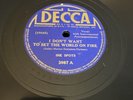
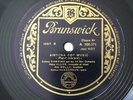
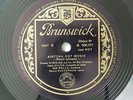
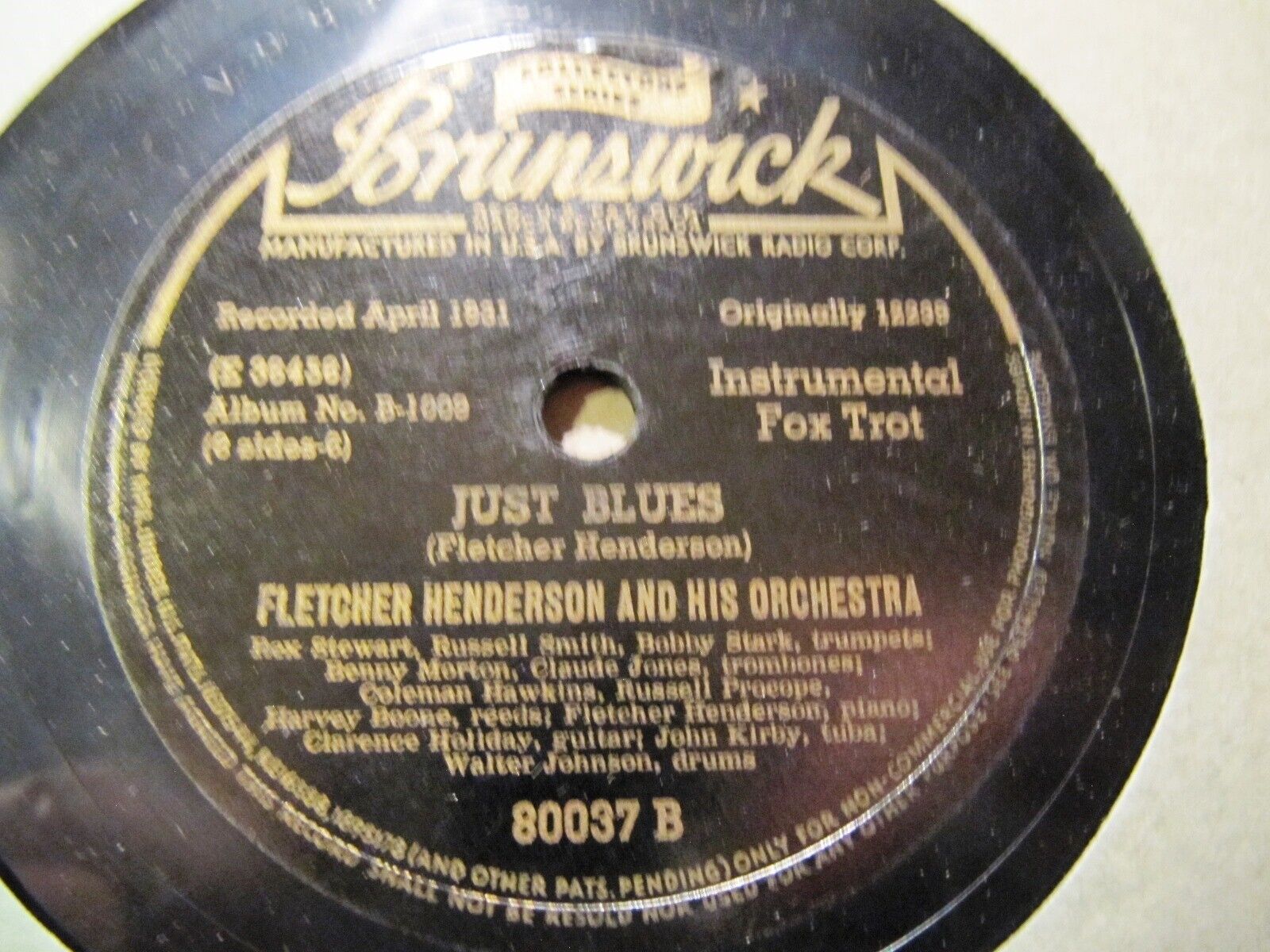
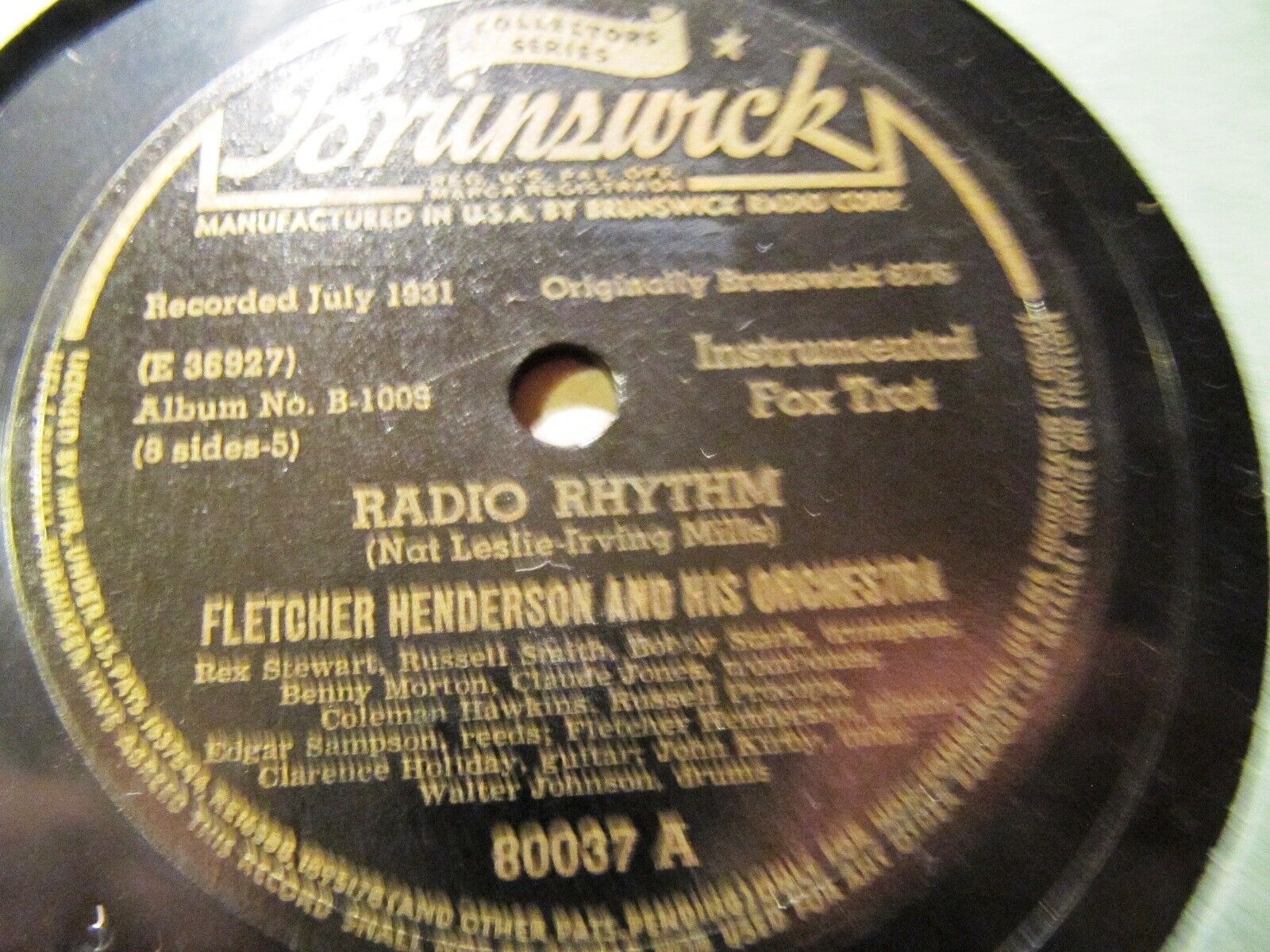
1931 FLETCHER HENDERSON Orch COLEMAN HAWKINS RADIO RHYTHM / Just Blues BRUNSWICK
$
25


Favourite Auctions
To save auctions to your favourites, please login
If you don't have an account, please register
Description
A series of great JAZZ Records from early Ragtime to Beb-Bop on 78 rpm Victrola Records
More great Jazz and Vocal Records in my other listings!
One of the greatest names in Jazz, and a true pioneer and promoter of Negro Jazz and Swing: Fletcher Henderson Orchestra Fletcher Henderson And His Orchestra
Label: Brunswick
Catalogue: 9-80037
A Fletcher Henderson And His Orchestra Radio Rhythm Nat Leslie, Irving Mills Rate
B Fletcher Henderson And His Orchestra Just Blues Fletcher Henderson Rate
Notes
A originally Brunswick 6176; recorded July, 1931.
B originally Brunswick 12239; recorded April, 1931.
Rex Stewart, Russell Smith, Bobby Stark, Trumpets; Benny Morton, Claude Jones, Trombones; Coleman Hawkins, Russell Procope, Edgar Sampson, Reeds; Fletcher Henderson, Piano; Clarence Holiday, Guitar; John Kirby, Tuba; Walter Johnson, Drums. B-side substitute Harvey Boone for Sampson.
Please see top of the page for condition
From Redhotjazz Site
Fletcher Henderson led the most commercially successful of the African-American Jazz bands of the 1920s. The smooth sound of his orchestra gave birth to the Swing style of the next decade. Henderson was from a middle class family and held a degree in chemistry from Atlanta University. He moved to New York in 1920 intending to do post-graduate work there while working as a chemist, but he found that jobs were closed to him because of his race. He instead found work demonstrating sheet music for W.C. Handy's music publishing company. He left that company to become a manager at the Black Swan Recording Company, and organized a band to support Blues singer Ethel Waters. In 1922, Fletcher led a band at the Club Alabam, which later moved to the Roseland Ballroom (Broadway at 50th St.) where they stayed for the next ten years. Coleman Hawkins played saxophone in the band and is generally considered to be the first great saxophonist in Jazz. In 1924 he hired the up-and-coming trumpet player Louis Armstrong importing him from Chicago, where he had been playing with King Oliver's Creole Jazz Band. The Orchestra continued to tour and record until 1939 when it disbanded, and he joined Benny Goodman Orchestra as the pianist and arranger. This was the first time that a "White" band hired a "Black" musician to appear on stage with an orchestra. Goodman even used the same arrangements as the Fletcher Henderson Orchestra had used. The band went on to become one of the most popular of the Swing bands. In 1943 Henderson left Goodman's band until 1947, when he rejoined Goodman them as an arranger. He toured as an accompanist for Ethel Waters in 1948 and 1949. In 1950 he suffered a stroke and was never able to play again.
The Fletcher Henderson Orchestra was the most popular African-American band of the 1920s. The smooth, carefully arranged sound of Henderson's orchestra was a huge influence on the Swing style of the next decade. The Orchestra played at the Club Alabam on West 44th Street in New York from 1922 to July of 1924 and then moved to the Roseland Ballroom when Armand J. Piron's Orchestra vacated the job and returned to New Orleans. In 1924 Henderson hired Louis Armstrong to replace Joe Smith on trumpet. Armstrong's thirteen months in the band caused quite a stir among New York Jazz musicians who had never heard anything like him. The orchestra also featured Coleman Hawkins on tenor saxophone, Buster Bailey on clarinet and Don Redman on alto saxophone and also contributing arrangements. When Armstrong left the band to return to Chicago to join Erskine Tate's Vendome Orchestra a succession of fine cornet and trumpet players played in the band. They included Rex Stewart, Tommy Ladnier and June Clark. The orchestra recorded with dozens of record companies under a number of different names and pseudonyms including Henderson's Dance Orchestra, Henderson's Club Alabam Orchestra, The Dixie Stompers, Henderson's Happy Six Orchestra, Fletcher Henderson and his Sawin' Six, Louisiana Stompers and the Connie's Inn Orchestra. In 1929 the band travelled to Philadelphia to play the music in a musical revue called Horseshoes. During rehearsals for the show a dispute over White musicians' role in the production fractured the band and half of the orchestra quit. Henderson put together another version of the band, but things were never the same and the band never resumed the level of popularity that it had enjoyed throughout the 1920s.
price rating