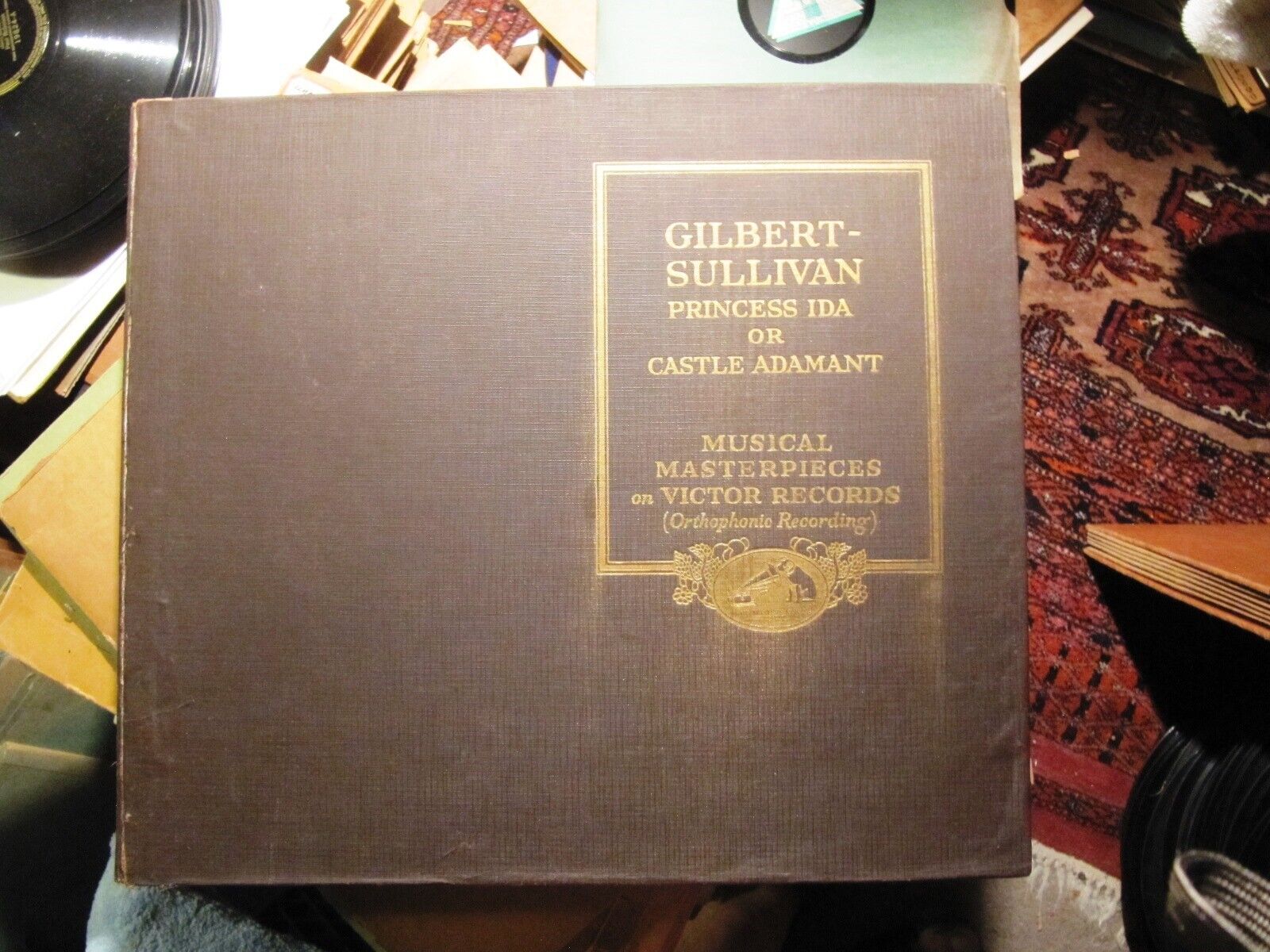
1932 GILBERT & SULLIVAN Complete Princess Ida D'Oyly Carte Malcolm SARGENT C-20.
$
50




$ 50
Sold For
Oct 18, 2023
Sold Date
Oct 14, 2023
Start Date
1
Number Of Bids
USA
Country Of Seller
eBay
Sold at
Favourite Auctions
To save auctions to your favourites, please login
If you don't have an account, please register
Description
A series of great OPERA Records from early G&Ts to World War II recordings on 78 rpm Victrola Records
Click this link for more great Opera and Vocal Records in my other listings!
Stunning first electric complete recording of Gilbert and Sullivan's Princess Ida
The 1932 recording is my personal favorite from among the four. Malcolm Sargent takes somewhat brisker tempi than he would later in life, and the singers bring great enthusiasm to their roles. Sound quality is excellent for the period
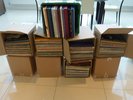
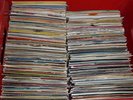
Victor 78rpm 11596/605 in Album C-20 Manual side couplings
Side
Nbr Matrix
Number Selection Rec.
Date
1 2B4218-1 Overture 26 Sep 32
2 2B4234-1 Search throughout the panorama 28 Sep 32
3 2B4220-1 Today we meet, my baby bride and I 26 Sep 32
4 2B4229-1 From the distant panorama 28 Sep 32
5 2B4228-2 If you give me your attention 27 Sep 32
6 2B4227-1 Come, Cyril, Florian 27 Sep 32
7 2B4235-3 Towards the empyrean heights 29 Sep 32
8 2B4236-3 Mighty maiden with a mission 29 Sep 32
9 2B4223-2 Gently, gently 27 Sep 32
10 2B4224-3 I am a maiden 27 Oct 32
11 2B4225-5 The world is but a broken toy 27 Oct 32
12 2B4219-1 A lady fair, of lineage high 26 Sep 32
13 2B4238-1 Now, wouldn't you like to rule the roast 29 Sep 32
14 2B4237-1 Would you know the kind of maid 29 Sep 32
15 2B4230-2 Madam, without the castle walls 28 Sep 32
16 2B4231-2 Be reassured, nor fear his anger blind 28 Sep 32
17 2B4239-1 Death to the invader! 29 Sep 32
18 2B4226-4 Whene'er I spoke sarcastic joke 27 Oct 32
19 2B4233-2 When anger spreads his wing 28 Sep 32
20 2B4232-1 This is our duty plain 28 Sep 32
The 1932 D'Oyly Carte Princess Ida
Cast
King Hildebrand Richard Watson
Hilarion Derek Oldham
Cyril Charles Goulding
Florian George Baker
King Gama Henry Lytton
Arac Darrell Fancourt
Guron Stuart Robertson
Scynthius Edward Halland
Princess Ida Muriel Dickson
Lady Blanche Dorothy Gill
Lady Psyche Alice Moxon
Melissa Nellie Briercliffe
Sacharissa Phyllis Evens
Conductor: Malcolm Sargent
Recorded in London,
26 September – 27 October 1932
Please see top of the page for condition
This recording, coming towards the end of the electrical era, was D'Oyly Carte's second Ida. The earlier set is more historically important, for its proximity to the opera's first London revival and its inclusion of "Come, mighty must," which D'Oyly Carte stopped performing after Bertha Lewis's death. This recording, however, benefits from the more-advanced electrical technology. The cast give an extremely "live" performance that easily surpasses either of D'Oyly Carte's subsequent recordings.
This was the last complete opera recorded during Henry Lytton's tenure as Principal Comedian, and one of the few he ever recorded. Most of the other operas recorded in this period featured George Baker in the patter roles. According to Micheal Walters, "the official reason given was that Lytton had started to suffer from lip paralysis, and his diction was not as clear as Baker's." Walters says you can hear the deterioration very slightly on this recording, but not on Lytton's earlier ones.
Review by Chris Webster
Well, how can I put this? There are many people who think this is the finest recording ever made of this opera, but I cannot list myself as being one of their number.
OK, as it's fairly obvious that as I don't like Dickson in G&S, I'm not going to care for her as Ida, but there are other performances here which I just don't think are worthy of any accolades. Oldham is just too Oldham-like for words, and he slides all over the place in a manner that some find dreamy and suitably sentimental, but which I find horrible, Baker has no personality as Florian, and Goulding as Cyril just doesn't come across on record at all. This is quite strange because I've read some wonderful reviews of his performances, but neither here nor on his only other G&S recording (the 1930 Pinafore) does he sound comfortable with what he is singing, and I don't think there is the slightest hint on record of what I believe he could achieve in the theatre.
There are however several redeeming features in the cast, sadly only in minor roles, but they ARE there and their contributions ARE a real pleasure and DO make a difference. I am speaking of Henry Lytton, who in spite of some diction problems still gives us a lovely characterisation as Gama; Darrell Fancourt, who gives a very fine rendering of "This helmet"; Nellie Briercliffe who gets the most out of every syllable as Melissa (except one — I do wish she had gone up on "exCLAIM"); and Richard Watson (sounding almost unrecognisable to my ears to the RW voice of the 1950 recordings), who is a very strong, no nonsense Hildebrand.
These contributors do help somewhat to balance things up, but I do think that it is Sargent and his chorus who really save the day with the energy that they inject into what would otherwise be an even patchier recording than I think it is. So swift is it in places that we are never allowed to mull over a problematic moment for too long.
I'm sure that, despite my comments, taken as a whole most people will enjoy this set. There are a number of major G&S folk who put this right at the top of their list of Ida recordings, and I dare say that I am in the minority with my feelings.
[THE GRAMOPHONE, January 1933, (Vol. X); pg. 326]
Advertisement
The Gilbert & Sullivan News — March, 1928
Although "Princess Ida" was first performed nearly fifty years ago (it was produced at the Savoy Theatre on January 5th, 1884), much of its music is unknown to the majority of people, for, in spite of the enormous appeal of the Gilbert and Sullivan operas, there are comparatively few who have seen (or should I have said "heard") this one. Yet, though "Princess Ida" has never enjoyed the popularity of, say, "The Gondoliers" or "The Mikado," much of its music and humour are, to my mind, quite as attractive as that in the more favoured works from the pens of this brilliant combination, and should be heard by all lovers of "Savoy Opera." This is now possible, as the Gramophone Company have just recorded the music (complete, with the exception of a few bars), on 10 double-sided records, Nos. DB4016-4025. (Album series No. 169.)
It is impossible to compare this recording with that of any other company, for the Gramophone Company enjoy the privilege of using the scores and parts of the D'Oyly Carte Opera Company, or, where necessary, making their own orchestral arrangements. Other recording companies are not permitted to do this, and are, therefore, restricted in their recording of Gilbert and Sullivan's works to the narrow limits of the published orchestral selections. Here, then, is something that you can get on no other record — nor should you waste time in search were it possible to do so — for the Gramophone Company are to be congratulated on the high standard that they reached in this, their latest achievement.
The only fault to be found with the recording is that it is a little too full, or, shall we say, it occasionally sacrifices quality for quantity. Apart from this, it is excellent — always sharp, clean, and well defined, with little or no surface noise.
Equally good is the orchestra, under the experienced baton of Dr. Malcolm Sargent. Their finished playing leaves nothing to be desired, unless we ask, perhaps (in one or two places), for what we so seldom get in this country — an orchestral accompaniment, instead of a fight to the death between soloists, chorus and orchestra.
I wish it were possible to speak as highly of the singing, for, while the chorus direction is really fine and their singing good (diction, as usual in chorus work — poor), the soloists are below the standard set by the recording and orchestral work. Of the gentlemen, Richard Watson (King Hildebrand) and George Baker (Florian) are by far the best. The honours among the ladies are shared by Muriel Dickson (Princess Ida) and AIice Moxon (Lady Psyche). I understand, by the way, that Miss Moxon was called in at the last minute to deputise, and, if this is so, her performance is all the more praiseworthy. The remainder of the cast (with one notable exception), despite the fact that some of them are now playing in Gilbert and Sullivan opera at the Savoy Theatre, are, frankly, disappointing. Might I add that this is another argument in favour of casting works for recording from experienced gramophone recording artistes?
The one exception is, of course, Sir Henry Lytton; I cannot imagine that George Grossmith, the original King Gama, could be more amusing, or have made better records of his part than those of this famous Savoyard. Incidentally, Sir Henry's diction is better than most of the singers in this series.
And now — having said all this — I shall still count this album one of the gems of my collection.
price rating