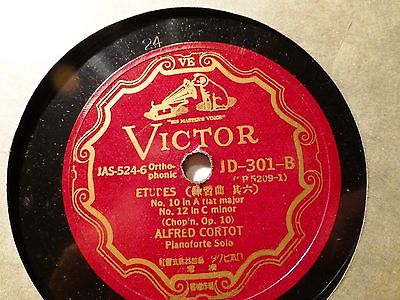
1933 ALFRED CORTOT CHOPIN 12 Etudes Op 10 Japanese Pressing 78
$
30


Favourite Auctions
To save auctions to your favourites, please login
If you don't have an account, please register
Description
Please wait for me to send you an invoice. DO NOT USE EBAY CHECKOUT if you want the lowest possible postage.
Welcome to my auctions of great records
This is my FINAL WEEK of 2 weeks of great auctions – I WILL PACK AND BILL YOUR RECORDS after the close of these auctions on MARCH 12. KINDLY ALLOW UP TO 48hrs for packing and billing to get you the exact postage.
PLEASE DO NOT PAY before I send you an invoice. It will take me up to 48 hours to pack your records, but this is the ONLY WAY to get you the LOWEST POSTAGE. If you pay before I sent you an invoice, the EBAY system will charge you a HIGHER POSTAGE for shipping.
I am currently selling a series of great instrumenta, opera and classic European 78 rpm orchestral recordings on all the great European and US labels:
Pianist Extraordinaire
ALFRED CORTOT in the famous first recording of Chopins 12 Etudes Op 10
Etudes, Op. 10Recorded at EMI Abbey Road Studio No. 3, London No. 1 in C major
Matrix: 2B 5203-3 [part], First released on HMV DB 2027, Recorded 5 July 1933
No. 2 in A minor
Matrix: 2B 5204-4 [part], First released on HMV DB 2027, Recorded 5 July 1933
No. 3 in E major
Matrix: 2B 5208-1, First released on HMV DB 2028, Recorded 5 July 1933
No. 4 in C sharp minor
Matrix: 2B 5203-3 [part], First released on HMV DB 2027, Recorded 5 July 1933
No. 5 in G flat major
Matrix: 2B 5204-4 [part], First released on HMV DB 2027, Recorded 5 July 1933
No. 6 in E flat minor
Matrix: 2B 6799-1 [part], First released on HMV DB 2028, Recorded 4 July 1933
No. 7 in C major
Matrix: 2B 5204-4 [part], First released on HMV DB 2027, Recorded 5 July 1933
No. 8 in F major
Matrix: 2B 5207-3 [part], First released on HMV DB 2029, Recorded 5 July 1933
No. 9 in F minor
Matrix: 2B 5207-3 [part], First released on HMV DB 2029, Recorded 5 July 1933
No. 10 in A flat major
Matrix: 2B 5209-1 [part], First released on HMV DB 2029, Recorded 5 July 1933
No. 11 in E flat major
Matrix: 2B 6799-1 [part], First released on HMV DB 2028, Recorded 4 July 1933
No. 12 in C minor
Matrix: 2B 5209-1 [part], First released on HMV DB 2029, Recorded 5 July 1933
on superb laminated Japanese Victor 3x12" 78 rpm record no album
Condition: EXCELLENT Rare scuffs, plays quiet w some swishy crackle
A series of great Violin, Piano and Orchestra records on rare labels, from 1902 Monarch to 1940 War Germany recordings.
Cortot's first complete recording of Chopin's Etudes, Opp. 10 and 25, was made in 1933 and 1934. On the 4 July 1933 he was at HMV's Studio No. 3 in Abbey Road where he recorded Etudes Nos. 6 and 11, then the Fantasie in F minor, then Etudes Nos. 1 and 4 followed by Etudes Nos. 5, 2 and 7. To make the most economical use of the 78rpm sides, HMV had Cortot record the Etudes in groups, so a technical slip in number 5, 2 or 7 meant that the whole side had to be recorded again as no editing was possible. The first side recorded (Nos. 6 and 11) was successful, and even though Cortot repeated the side the following day these two Etudes were issued from the first take. Also on the 5 July he recorded Nos. 9 and 8 three times, Nos. 1 and 4 twice more and No. 3 twice. Nos. 10 and 12 only needed one take, but Nos. 5, 2 and 7 (the last side he recorded the previous day) had to be repeated three more times. The Etudes are presented here on this compact disc in their conventional numerical order rather than in the order they were recorded. Although often castigated for his technical inaccuracy, Cortot's performance of the Op. 10 Etudes is full of poetry and musicality. The listener forgets that these are technical exercises and hears them for what they truly are, music from the wonderfully inventive mind of a composer brought to life by Cortot's artistry.
Alfred Denis Cortot (Nyon, Switzerland September 26, 1877 – Lausanne June 15, 1962) was a Swiss pianist and conductor. He is one of the most popular 20th century musicians, especially renowned for his poetic insight in Romantic period piano works, particularly those of Chopin and Schumann.
Early life and education
Born in Nyon in the French-speaking part of Switzerland, Cortot studied at the Paris Conservatoire with Emile Descombes (reputedly a pupil of Chopin) (as did Maurice Ravel), and with Louis Diémer, taking a premier prix in 1896. He made his debut at the Concerts Colonne in 1897, playing Beethoven's Piano Concerto No. 3. Between 1898 and 1901 he was a choral coach, and subsequently assistant conductor, at the Bayreuth Festspielhaus, and in 1902 he conducted the Paris premiere of Götterdämmerung by Wagner. He formed a concert society to perform Wagner's Parsifal, Beethoven's Missa solemnis, Brahms' German Requiem, and new works by French composers.
[edit] Career
In 1905, Cortot formed a trio with Jacques Thibaud and Pablo Casals, which established itself as the leading piano trio of its era, and probably of any era. From 1907 to 1923 Cortot taught at the Paris Conservatoire, where his pupils included Clara Haskil, Dinu Lipatti, Vlado Perlemuter, and even Marguerite Monnot, French composer of most of the best songs of Edith Piaf and of the 1956 stage musical Irma la Douce. In 1919 he founded the École Normale de Musique de Paris. His courses in musical interpretation were legendary. Extremely widely traveled as a pianist, he also appeared as guest conductor of many orchestras. He died in Lausanne.
[edit] World War II
Controversially, he supported the German occupation in France during the Second World War (he played in Nazi-sponsored concerts, for example), serving as Minister of Culture for the Vichy regime, and befriending Hitler's friend, architect, and (after 1942) Minister of Armaments and War Production Albert Speer[citation needed]. His Vichy connections, in particular, led to him being declared persona non grata after the Liberation. The motives for his wartime activities have been disputed; they may have arisen from nothing more than his lifelong championship of Teutonic musical culture. Moreover his wife, Clothilde Breal, daughter of the linguist, Michel Breal, was of Jewish origin and Clothilde Breal's cousin, Lise Bloch, was married to Leon Blum, the first Jew to become President du Conseil or Prime Minister in France. Cortot and the Blums maintained a close friendship. At any rate, he was banned from performing publicly for a year[citation needed], and his public image in France suffered greatly (though he continued to be well received as a recitalist in other countries, notably Italy and England).
[edit] Contribution
As the foremost piano interpreter of Chopin and Schumann, Cortot made editions of both those composers' music, which were notable for his own meticulous commentary on technical problems and matters of interpretation. He had famous memory lapses - particularly notable from the 1940s onwards, when non-musical matters were very much on his mind - and occasionally left wrong notes on his records. This was in stark contrast to his technically flawless student, Lipatti. However, when Cortot was in form, he showed a brilliant technique which could handle almost any kind of pianistic firework, as evidenced in his legendary recordings of Liszt's Sonata in B minor and Saint-Saens' Etude en Forme de Valse.
Cortot was also the author of the piano exercise book: "Rational Principles of Pianoforte Technique". This book contains many finger exercises to aid in the development of various aspects of piano playing technique. It was originally written in French but has since been translated into other languages.
Technical flaws notwithstanding, Cortot was among the very greatest musicians of the century, and represented the end of an era. He is considered the last exponent of a personal, subjective style that deprecated precise technique in favour of intuition, interpretation and authentic spirit. This approach was replaced by the modern "scientific" way of playing, which places logic and precision at the forefront and equates authenticity with metronomic and literal "interpretations".[citation needed] Cortot's recordings and musical annotations have seldom been out of print.
In his early years (approx. 1920-1930 period) Cortot recorded a number of piano rolls for the Aeolian/ Duo Art company, since 78rpm disks were not always satisfactory in quality or maximum duration of the recording. Once he performed a Liszt Rhapsody weaving his own playing live at the piano with its mechanical reproduction. With eyes closed some critics could not distinguish between the two. In later years Cortot of course switched to disk technology and he recorded right up to 1957, only 5 years before his death. By then he made errors even more often, but retained his special phrasing and the free, romantical performances he was famous for.
More Great Records on sale right now:
http://shop.ebay.com/carsten_sf/m.html
http://shop.ebay.com/carsten_sf/m.html
====
A Quick NOTE ON GRADING AND SHIPPING:
As you can see from my feedback, I try hard to earn your POSITIVE FEEDBACK and FIVE STAR RATINGS.
If for any reason your transaction was NOT SATISFACTORY, pls contact me and I will work something out with you. YOU WILL NEVER HAVE A REASON TO GIVE ME A NEGATIVE RATING or a LOW STAR RATING.
Quick note on grading:
The Grade (Excellent to Fair, I don't give Mint) refers to the WEAR of the record. Any other defects are stated separately
When I listen to a record, I may also give it an aural grade (again E to F), and make a SUBJECTIVE judgment of the pressing quality for hiss and surface noise.
"SUPERQUIET" is basically noiseless, like a vinyl pressing.
"VERY QUIET" is an quiet record for a given pressing.
"Quiet" is a record that is a great example without undue noise for a give pressing.
These judgments are SUBJECTIVE and will depend one the styli, phonograph etc. you use on your own equipment.
If you win multiple items, pls send me an INVOICE REQUEST to calculate the correct postage. Ebay check out will not give you the multiple item discount!
Records will be packed safely between corrugated cardboard in a sturdy box with plenty of padding for safe shipment.
Shipment is usually Media Mail, unless another service is requested. Shipping is at your risk, I will be happy to insure items at your cost.
I charge actual postage plus a small fee for packing materials
As always, I guarantee your satisfaction. If you don't like the item, just return it, and I will refund the full purchase price.
If you are in the San Francisco area, I encourage pick-up in person.
US Domestic Shipping:
Here is a guideline for US Media Mail Shipping:
Prices below are for regular 78 rpm records. Up to about 5 records, I will ship Edison Discs for the same rates. Albums from Album Sets count as 1 record. Above that and for international shipments, it will be actual weight plus a small packing charge (1-3$ depending on size of shipment)
1 record: 4.50 – 5.00$
2 records: 5.75$
5 records: 7.50$
10 records: 9.50$
MANY MORE RECORDS: Don't worry. I safely ship 40 - 50 pounds of records double boxed in moving boxes, and even then Media Mail will probably not exceed 30$.
Please send me a message if you would like to lower your shipping rates!
International Buyers:
I am very happy to ship records worldwide.
Please use the EBAY shipping cost only as a guideline. My actual charges are usually lower
International shipping: approx postage 1x10"=$25: 1x12"=$35: 10"Album 4 Rec=50$: 12" Album 2 Rec=50$
HOWEVER in most cases I can get you SIGNIFICANT savings by using other services. Pls contact me for a quote.
About 30% less to Canada.
Pls contact me for a shipping estimate, or send me an invoice request after close of auction.
AND AGAIN -THANK YOU FOR YOUR INTEREST
As you can see from my feedback, I take great care in presenting, grading and shipping your items. I really want you to be happy with the purchase. If you feel that anything is wrong with the item or the shipping, contact me and we will work it out !!!
As always, I would appreciate any suggestions and corrections from you, pls contact me with any question.
Thank you very much, and good luck bidding !!!
price rating