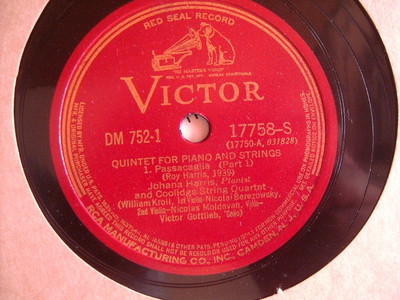
1939 ROY HARRIS Quintet Joana Harris Piano Coolidge 78
$
67


Favourite Auctions
To save auctions to your favourites, please login
If you don't have an account, please register
Description
WEEK 3 of 4 weeks of great auctions
IMPORTANT:
PLS READ BELOW for INCREASED SHIPPING CHARGES due to Ebay Policy
I AM HAPPY COMBINE MULTIPLE SHIPMENTS.
IF YOU WIN MULTIPLE ITEMS DO NOT USE EBAY CHECK OUT in order for me to get you low combined postage. Send me an invoice request instead.
A series of great Violin, Piano and Orchestra records on rare labels, from 1902 Monarch to 1940 War Germany recordings.
Important American modern composer ROY HARRIS in the first recording of his
Quintet for piano and string quartet
Performed by the CREATORS Joana Harris Piano and the Coolidge String Quartet
QUINTET for piano and string quartet.Completed December 31, 1936.
First performance,Johana Harris and Coolidge String Quartet,New York,
February 12,1937.Recorded by Victor Company (Johana Harris and Coolidge String Quartet).
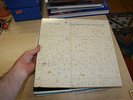
4x 12" pre war gold label 78 rpm record with original album DM 752and notes
Condition: Better than EXCELLENT, Album like new
Roy Ellsworth Harris (February 12, 1898 in Chandler, Oklahoma, United States - October 1, 1979), was an American classical composer. He wrote much music on American subjects, becoming best known for his Symphony No. 3.Life
He was born of mixed Scots, Irish and Welsh ancestry, in circumstances he sometimes liked to contrast with those of the more privileged East-coast composers: to poor parents, in a log cabin in Oklahoma, on Abraham Lincoln's birthday, one of five children (three of whom died early). A gambling win enabled his father to buy a small holding in California, where the boy grew up a farmer, in the rural isolation of the San Gabriel Valley. He studied piano with his mother, and later clarinet. Though he studied at the University of California, Berkeley, he was still virtually self-taught when he began writing music of his own, but in the early 1920s he had lessons from Arthur Bliss (then in Santa Barbara) and the senior American composer and researcher of American Indian (then called "Red Indian") music, Arthur Farwell. Harris sold his farmland and supported himself as a truck-driver and delivery man for a dairy firm. Gradually he made contacts in the East with other young composers, and partly through Aaron Copland's recommendation he was able to spend 1926-29 in Paris, as one of the many young Americans who received their final musical grooming in the masterclasses of Nadia Boulanger. Harris had no time for Boulanger's neoclassical, Stravinsky-derived aesthetic, but under her tutelage he began his lifelong study of Renaissance music, and wrote his first significant works: the concerto for piano, clarinet and string quartet drew praise from the seldom-impressible Frederick Delius.
Returning to the United States after suffering a back injury, Harris formed associations with Howard Hanson at the Eastman School of Music in Rochester and, more importantly, with Serge Koussevitsky at the Boston Symphony Orchestra. These associations secured performance outlets for the large-scale works he was writing. In 1934, a week after its premiere under Koussevitsky, his Symphony ‘1933’ became the first American symphony to be commercially recorded. It was his Symphony No.3, however, premiered by Koussevitsky in 1939, which proved to be the composer's biggest breakthrough and made him practically a household name.
During the 1930s Harris taught at Mills College -- later the home of Darius Milhaud -- Westminster Choir College (1934-1938) and the Juilliard School of Music; he spent most of the rest of his professional career restlessly moving through teaching posts and residences at colleges and universities in various parts of the USA, ending with a long stint in California, first at UCLA and finally at California State University, Los Angeles. Among his pupils were William Schuman and Peter Schickele (best known as the creator of P. D. Q. Bach). He received many of America's most prestigious cultural awards, and at the end of his life was proclaimed Honorary Composer Laureate of the State of California.
Character, reputation and style characteristics
Harris was a champion of many causes (he founded the International String Congress to combat what was perceived as a shortage of string players in the U.S., and co-founded the American Composers Alliance), a tireless organizer of conferences and contemporary music festivals, and a frequent radio broadcaster. He made several trips to the Soviet Union; his admiration for that country attracted adverse criticism during the McCarthy era. Harris was indeed in US terms a liberal on many social issues, and pugnaciously opposed to anti-semitism and racial discrimination. His last symphony, a commission for the American Bicentennial in 1976, was mauled by the critics at its first performance as a 'travesty of music' by a composer who had written himself out: but this may partly have been because it addressed the themes of slavery and the Civil War, and contradicted the required mood of national self-congratulation. In his last years Harris was increasingly depressed by the effects of the US's rampant materialism, discrimination against minorities and destruction of natural resources.
Although the rugged American patriotism of his works of the 1930s and 1940s is reflected in his research into and use of folk-music (and to a lesser extent of jazz rhythms), Harris was paradoxically obsessed with the great European pre-classical forms, especially the monolithic ones of fugue (which we hear in the Third Symphony) and passacaglia (as featured in the next most admired, the Seventh). His customary mode of discourse, with long singing lines and resonant modal harmonies, is ultimately based on his admiration for and development of Renaissance polyphony—and also antiphonal effects, which he exploits brilliantly with a large orchestra. Like many American composers of his time, he was deeply impressed by the symphonic achievement of Sibelius (who also drew on Renaissance polyphonic techniques). In Harris's best works the music grows organically from the opening bars, as if a tiny seed gives birth to an entire tree; and this is certainly the case with the Third Symphony, which joined the American repertoire during the same era as works by Aaron Copland and Virgil Thomson. The first edition of Kent Kennan's The Technique of Orchestration quotes three passages from this symphony to illustrate good orchestral writing for cello, timpani and vibraphone, respectively. The book quotes no other Harris symphonies. Few other American symphonies have acquired such a firmly-entrenched position in the standard performance repertory as has this one, due much to the championship of the piece by Leonard Bernstein, as well as to his several recordings of it.
His music, while often abstract, has a reputation for its optimistic, American tone. Musicologist John Canarina describes the "Harris style" as "exuberant horn passages and timpani ostinatos". Harris so frequently composed prismatically modulating chords that a valid one-word description of his orchestral music would be chromatic. He also liked to write bell-like passages for tuned percussion. This is readily apparent not only in the famous Third Symphony but also in the Sixth "Gettysburg".
In all, Harris composed over 170 works, including many works for amateurs, but the backbone of his output was his series of symphonies. Harris wrote no opera, but otherwise covered all the main genres of orchestral, vocal, choral, chamber and instrumental music as well as writing a significant number of works for band. His series of symphonies is still his most significant contribution to American music.
Quick NOTE ON GRADING AND SHIPPING:
As you can see from my feedback, I try hard to earn your POSITIVE FEEDBACK and FIVE STAR RATINGS.
If for any reason your transaction was NOT SATISFACTORY, pls contact me and I will work something out with you. YOU WILL NEVER HAVE A REASON TO GIVE ME A NEGATIVE RATING or a LOW STAR RATING.
Quick note on grading:
The Grade (Excellent to Fair, I don't give Mint) refers to the WEAR of the record. Any other defects are stated separately, when prefaced with "HOWEVER" or "BUT" they will be significant.
When I listen to a record, I may also give it an aural grade (again E to F), and make a SUBJECTIVE judgment of the pressing quality for hiss and surface noise.
"SUPERQUIET" is basically noiseless, like a vinyl pressing.
"VERY QUIET" is an exceptionally quiet record for a given pressing.
"Quiet" is a record that is a great example without undue noise for a give pressing.
These judgments are SUBJECTIVE and will depend one the styli, phonograph etc. you use on your own equipment.
Pls check my other auctions for more great records and phonograph items:
http://shop.ebay.com/carsten_sf/m.html
http://shop.ebay.com/carsten_sf/m.html
====
This is WEEK 1 of four consecutive weeks of auctions.
I am happy to hold your items and bill you at the end of the auction cycle. Pls send me a note if you would like me to hold records
Multiple item shipping: I am happy to combine items for shipment in one parcel.
If you win multiple items, pls send me an INVOICE REQUEST to calculate the correct postage. Ebay check out will not give you the multiple item discount!
Records will be packed safely between corrugated cardboard in a sturdy box with plenty of padding for safe shipment.
Shipment is usually Media Mail, unless another service is requested. Shipping is at your risk, I will be happy to insure items at your cost.
I charge actual postage plus a small fee for packing materials
As always, I guarantee your satisfaction. If you don't like the item, just return it, and I will refund the full purchase price.
If you are in the San Francisco area, I encourage pick-up in person.
EBAY NOW CHARGES 9% on all SHIPPING CHARGES
Also, USPS has increased postal rates. Since I am always shipping at cost, I am sorry to say that after keeping my shipping rates stable for 5 years, I unfortunately now have to increase the prices.
However, if you are interested in lowering you shipping cost, pls send me a message, and I may be able to arrange for better rates !!!
Here a quick breakdown of my costs, you see that due to the new Ebay policy you will pay anywhere from $.50 to $.80 in additional Ebay fees on the first record
10" record 12" record 12" Album of 4 records Total Weight 1.5 lbs 1.9 lbs 5.5 lbs Box 1.17 1.21 1.37 Cardboard Squares 3 0.97 3 1.00 4 1.33 Media Mail 2.82 2.82 4.46 Sum 4.96 5.03 7.16 Ebay Fee on Shipping 9% 0.45 0.45 0.64 Paypal Fee 2.9% 0.14 0.15 0.21 Total 5.55 5.62 8.01US Domestic Shipping:
Here is a guideline for US Media Mail Shipping:
Prices below are for regular 78 rpm records. Up to about 5 records, I will ship Edison Discs for the same rates. Albums from Album Sets count as 1 record. Above that and for international shipments, it will be actual weight plus a small packing charge (1-3$ depending on size of shipment)
1 record: 4.75$
2 records: 5.75$
5 records: 7.50$
10 records: 9.50$
MANY MORE RECORDS: Don't worry. I safely ship 40 - 50 pounds of records double boxed in moving boxes, and even then Media Mail will probably not exceed 30$.
The numbers above include the 9% Ebay fee on shipments.
Pls ignore the automatically calculated prices on the ebay site, as I will weigh every parcel and charge based on actual weight.
Please send me a message if you would like to lower your shipping rates!
International Buyers:
All'attenzione degli acquirenti italiani:
ATTENTION TO ITALIAN BUYERS:
Due to rare problems with delivery in ITALY, I will NOT GUARANTEE delivery of parcels sent by US Postal Service First Class and Priority Mail. If you prefer secure delivery, I will be happy to quote you either Registered Mail or shipment by FEDEX
I am very happy to ship records worldwide.
Prices below are for regular 78 rpm records. For Edison Discs in international shipments, it will charge for the actual weight plus a small packing charge (1-2$) - for small quantities, it will not be much different from the charge for regular 78s.
Pls contact me for a shipping estimate, or send me an invoice request after close of auction.
Be aware that US Postal Rates can be high. Here are some examples.
Your best bet is the Large Priority box, everything that fits into a 12"x12"x5 1/2" box up to 20 pounds ships for 60$ (35$ Canada) worldwide.
However, I can get competitive rates from FedEx and the US Postal service for any kind of parcel weight
Africa, Eastern Asia and Japan as well as Europe
1 record = 2 lbs $25 - $28
4 lbs = $37
20 lbs or all that fits into a 12"x12"x 5 1/2" box ((12" albums won't fit)= $60
I may be able to get some better FedEx rates.
Pls email with your address for an estimate.
Canada
1 record = 2 lbs $ 11 - $13
4 lbs = 22$
20 lbs or all that fits into a 12"x12"x 5 1/2" (12" albums won't fit)= $38
I may be able to get some better FedEx rates.
Pls email with your address for an estimate.
To estimate your shipment, pls go to
http://www.usps.com/tools/calculatepostage/welcome.htm?from=home_header&page=calculatepostage
My zip code is 94107.
Assume 1 pound per record plus 1 pound for packing.
AND AGAIN -THANK YOU FOR YOUR INTEREST
As you can see from my feedback, I take great care in presenting, grading and shipping your items. I really want you to be happy with the purchase. If you feel that anything is wrong with the item or the shipping, contact me and we will work it out !!!
Pls contact me with your country, home town and postal code before bidding for an estimate.
=====
As always, I would appreciate any suggestions and corrections from you, pls contact me with any question.
Thank you very much, and good luck bidding !!!
price rating




![The Dirty Truth [VINYL] Joanne Shaw Taylor Vinyl](https://www.popsike.net/php/thumbnail.php?url=https://www.popsike.pics/pix/20171130/162782399734.jpg)