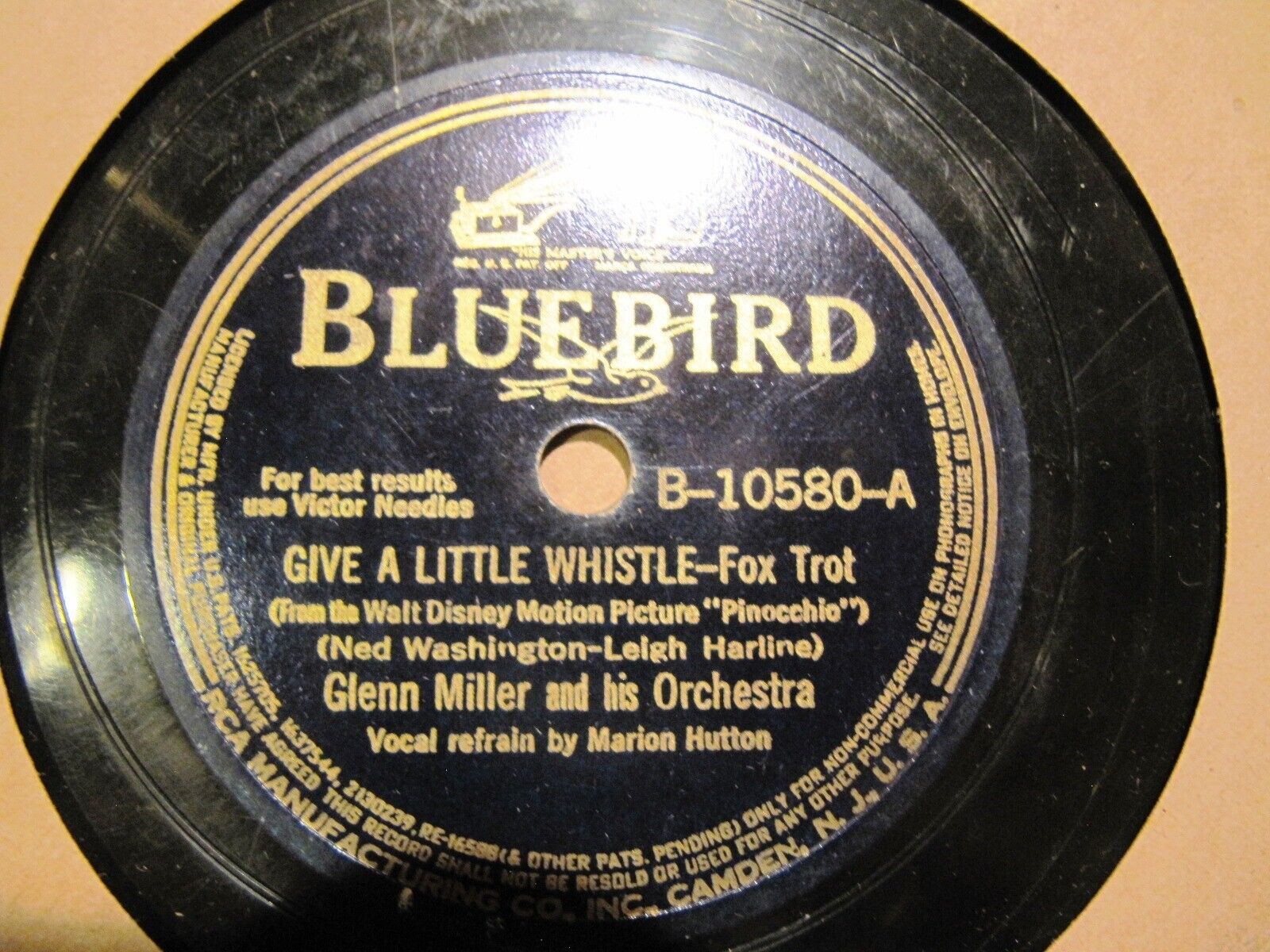
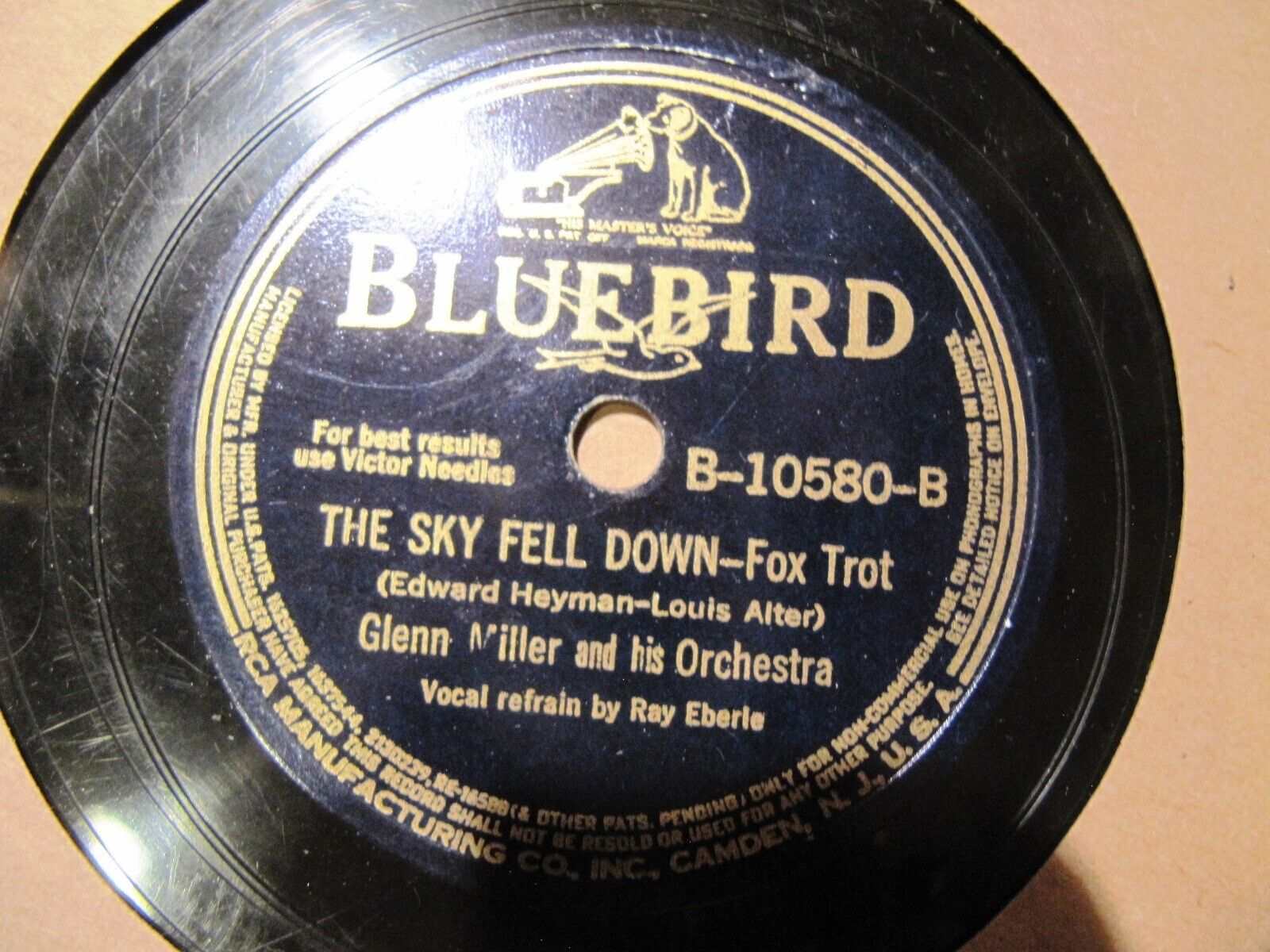
1940 GLENN MILLER Walt Disney PINOCCHIO Give A Little Whistle/ The Sky Fell Down
$
25


$ 25
Sold For
Oct 19, 2022
Sold Date
Oct 18, 2022
Start Date
1
Number Of Bids
USA
Country Of Seller
eBay
Sold at
Favourite Auctions
To save auctions to your favourites, please login
If you don't have an account, please register
Description
A series of great JAZZ Records from early Ragtime to Beb-Bop on 78 rpm Victrola Records
More great Jazz and Vocal Records in my other listings!
Theatrical release poster
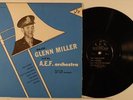
Two great tunes by GLENN MILLER and his ORchestra
Glenn Miller and his orchestra in a hot arrangement of a tune from Walt Disney Motion Picture "Pinocchio".
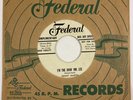
Glenn Miller And His Orchestra – Give A Little Whistle / The Sky Fell Down
Label:
Bluebird (3) B-10580
A Give A Little Whistle
Vocals [refrain] – Marion Hutton
Written-By – Leigh Harline, Ned Washington
B The Sky Fell Down
Vocals [Refrain] – Ray Eberle
Written-By – Edward Heyman, Louis Alter
Companies, etc.
Record Company – RCA Manufacturing Co., Inc.
Notes
Side A - From the Walt Disney Motion Picture "Pinocchio".
Please see top of the page for condition
Pinocchio is a 1940 American animated musical fantasy film produced by Walt Disney Productions and based on the 1883 Italian children's novel The Adventures of Pinocchio by Carlo Collodi. It was the 2nd animated feature film produced by Disney, made after the first animated success Snow White and the Seven Dwarfs (1937).
The plot involves an old Italian woodcarver named Geppetto who carves a wooden puppet named Pinocchio. The puppet is brought to life by a blue fairy, who informs him that he can become a real boy if he proves himself to be "brave, truthful, and unselfish". Pinocchio's efforts to become a real boy involve encounters with a host of unsavory characters. The key character of Jiminy Cricket is based on a 100-year "wise, old" talking cricket from the original book,[4] who warns Pinocchio of his impudence when they meet only to be killed in return shortly after, before returning as a ghost.[5] The film was adapted by several storyboard artists from Collodi's book. The production was supervised by Ben Sharpsteen and Hamilton Luske, and the film's sequences were directed by Norman Ferguson, T. Hee, Wilfred Jackson, Jack Kinney, and Bill Roberts. Pinocchio was a groundbreaking achievement in the area of effects animation, giving realistic movement to vehicles, machinery and natural elements such as rain, lightning, smoke, shadows and water. The film was released to theaters by RKO Radio Pictures on February 7, 1940.
Although it became the first animated feature to win a competitive Academy Award — winning two for Best Music, Original Score and for Best Music, Original Song for "When You Wish Upon a Star" — it was initially a box office bomb, mainly due to World War II cutting off the European and Asian markets overseas. It eventually made a profit in its 1945 reissue, and is considered one of the greatest animated films ever made, with a 100% rating on the website Rotten Tomatoes. The film and characters are still prevalent in popular culture, featuring at various Disney parks and in other forms of entertainment. In 1994, Pinocchio was added to the United States National Film Registry for being deemed "culturally, historically, or aesthetically significant".[6]
Glenn Miller And His Orchestra Profile: Glenn Miller and His Orchestra was formed by trombonist, arranger, composer, Glenn Miller. Glenn Miller was the best-selling recording artist 1939 - 1942. Miller was a sideman in many different groups beginning in 1926 with the Ben Pollack Orchestra. He was overshadowed in Pollack's band by Jack Teagarden who began taking all of the trombone solos. Miller focused on arranging and composing and by 1928 he had already published a songbook. Miller played frequently with other sideman who would become famous in their own rights with orchestras, Jimmy and Tommy Dorsey and Benny Goodman. Making some recordings with "Benny Goodman's Boys" in 1928 for Brunswick, Miller was a free-lance trombonist in several bands such as Red Nichols, Joe Venuti and Nat Shilkret. From the early to mid 30's Miller was arranger and composer for the Dorsey Brothers Orchestra and made many recordings with Bing Crosby and The Boswell Sisters for Brunswick and Decca. In 1935 he assembled the American orchestra for Ray Noble.
Anxious to break out on his own, Miller formed his first orchestra in 1937 and made his first recordings as the Glenn Miller Orchestra for Brunswick, Vocalion and Decca. By 1938 the band was unsuccessful and starving to death and disbanded. He revamped his style and arranging and credited the second and massively popular Glenn Miller Orchestra.
In September 1938 they made their first in a long list of recordings for Victor subsidiary Bluebird Records. In the spring of 1939, after a stint at the Meadowbrook Ballroom and Glen Island Casino, their popularity soared. By 1939 Miller's band was tops in the jukeboxes and was the most popular orchestra until 1942 when Miller went into the service during WWII. From Dec 1939 - September 1942 Miller had a radio program broadcast 3 times a week. His records sold millions and was awarded the first gold record for "Chattanooga Choo Choo" in 1941 as well as being seen in a few motion pictures.
By Joel Whitburn's tabulation, in less than four years the group saw 16 US number-one hits, as well as 6 Australian number-ones (three of which didn't hit top the US charts). The amount of hit singles Miller and His Orchestra had in such a short amount of time proved to be one of the greatest chart runs in history. "In the Mood" became an anthem of the swing craze and the most lasting of even his biggest records. The group sold over 60 million records, the most of any dance band. In the wake of Pearl Harbor, the very patriotic Miller joined the Army Air Forces where he would develop a modern military band for morale raising. The orchestra disbanded to a very emotional crowd at the Central Theater in Passaic, NJ on September 27, 1942. On December 15, 1944, Miller mysteriously disappeared over the English Channel. He was recognized as war hero. The band's music never left the American public; Despite never recording a studio album, Miller and His Orchestra had three posthumous Billboard number-one compilation albums as well as album certifications spanning several countries several decades years after his death at age 40.
price rating