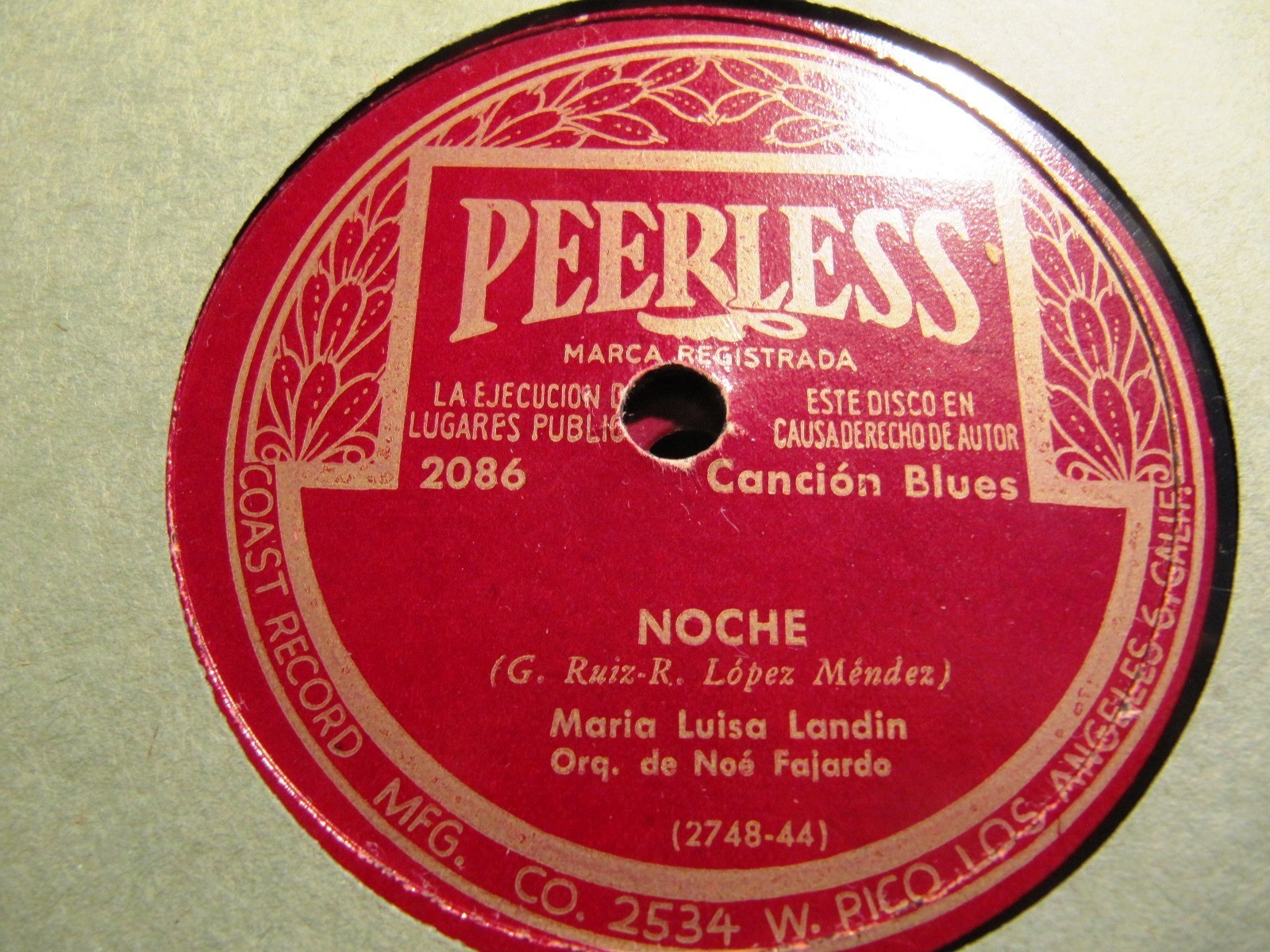
1944 MARIA LUISA LANDIN 1st REC PEERLESS Noe Farjardo Me Gustabas Noche
$
40


$ 40
Sold For
Sep 6, 2026
Sold Date
1
Number Of Bids
USA
Country Of Seller
eBay
Sold at
Favourite Auctions
To save auctions to your favourites, please login
If you don't have an account, please register
Description
A series of great Latin, Spanish, Portuguese and Brazilian dance and folk songs
Check out more Latin recordings for sale by clicking the link below
Over 100 Latin recordings available now!
María Luisa Landín en 1949.
Recorded in Mexico City
MARIA LUISA LANDIN The Queen of Bolero in her very first PEERLESS recordings
In 1946, María Luisa began her successful career as a soloist, perhaps one of the longest in the musical history of Mexico, accumulating a large number of recognitions and a wide repertoire that includes more than 150 recordings, most of them made for the RCA label, a Except for 4 boleros recorded in 1944 for PEERLESS: “Entre hamacas”, “Regresa”, Me gustabas ”and“ Noche ”.
Noche / Me gustabas
María Luisa Landín, Orquesta de Noé Fajardo
Released 1944
Peerless 2086
Orig Issue Peerless 10" 78 rpm
CONDITION: EXCELLENT minus unworn light rubs, 2 10 mm scratches on Noche cause mild ticks, plays very quiet
A GREAT COPY
María Luisa Landin was born on October 9, 1921, from a young age she demonstrated singing skills, it was in 1942 when she recorded her first musical theme: "Song of the soul", then hits such as "Lost love", "Blind love" came. , "You have to know how to lose", among others.
She made many tours in the interior of the Republic and in 1940 she made her first trip abroad and went to Havana. María Luisa Landín became an important bolero interpreter not only in Mexico but also in Latin America.
María Luisa Landín Rodríguez (Mexico City, October 9, 1921-Mexico City, June 20, 2014) 2 was a Mexican singer known as La Reina del Bolero.3
She recorded the bolero «Amor perdido», written by the Puerto Rican Pedro Flores, which - after «Las mañanitas» - is the most played song in the history of Mexican radio broadcasting. It is a true musical classic that has survived the years.
The disgusted and sore boleros of María Luisa Landín are the very essence of cabaret, that site of perdition and sin, recreated or invented by Mexican cinema, a motley microcosm with a sordid and sinful atmosphere, where the most unusual melodramas took place, places where The passions overflowed, where the adventurers, sinners and perverts overflowed their eroticism but miraculously kept their virtue and purity intact. There has been no more delightfully cabaret music than the songs performed by Landín, with wonderful instrumental arrangements.
Biography
In 1935 she began to sing, accompanied by her sister Avelina Landín (Mexico City, November 10, 1919 - Mexico City, February 21, 1991) .4
The two little sisters sang at home and at parties and, when they were young, in 1936,4 they made their first professional appearances on XEYZ and XEFO (radio stations in Mexico City). The duet, which called itself Pirita y Jade, was liked by the public and became known for the good voices of its youthful members. In 1938 they were exclusively hired by radio station XEQ, which promoted an artistic rivalry between them and the Águila Sisters, whom they presented as "The Best Duet in America." For some years Avelina and María Luisa sang together, then they no longer liked the names Pirita and Jade and decided to be Mari-Lina, to finally become Las Hermanas Landín. 4
In 1942 they separated because Avelina married the Mexican Ángel Zempoalteca Ortega (1925-1970), who did not allow her to continue her career.5 From then on, María Luisa formed a trio with sisters Emma and Aurora del Mar, and more. Later he would sing a duet with the tenor Néstor Mesta Chaires (Ciudad Lerdo, February 26, 1908 - Mexico City, June 29, 1971), with whom he made programs sponsored by the Coca Cola company, which had international diffusion. She also appeared on other radio shows, where she met and worked with the Puerto Rican musician and composer Rafael Hernández Marín, nicknamed El Jibarito, who would later achieve great fame and success as a composer of boleros. In 1941, María Luisa recorded a version of the well-known bolero «You have to know how to lose» (by the Chiapas composer Abel Domínguez), recorded at 78 rpm in the recording studio of the RCA record company. The album became a great success and broke sales records.6 In 1942 she recorded her first unreleased song, "Canción del alma", accompanied by the orchestra of the author of the bolero, Rafael Hernández Marín.6
Already as a successful singer, María Luisa Landín made frequent tours, not only throughout the country, but also internationally. In 1940 she had made her first professional tour to Havana (Cuba), 1 but years later she appeared in various South American countries. In 1949 she returned from her travels and joined the XEW, hired as a star figure for the program The miracle of songs. La Landín was presented as "The voice that reaches the heart", or as "The voice of the soul."
Lost love
The year 1949 is special for María Luisa, because she records "Amor perdidos", by the other great Puerto Rican composer Pedro Flores. The recording of it became not only a tremendous success, but over the years it would become a classic of Mexican popular music, which continues to be played decades after it was recorded.
There is an anecdote regarding this song. La Landín was reluctant to record it, but she was forced by her company, RCA Víctor. María Luisa refused because the bolero had already been premiered ten years ago by the popular singer from Sinaloa Manolita Arreola. Even María Luisa herself and her sister Avelina had already recorded it, when they sang as a duet. Much to her regret, María Luisa Landín agreed to re-record it, now as a soloist, accompanied by the orchestra led by maestro José Saber Marroquín, and with an excellent arrangement by the musician from Chiapas Rafael de Paz. Success was immediate.4
In 1950, taking advantage of the success of the song, the film Lost Love was filmed, directed by Miguel Morayta (1907), interpreted by the Cuban rumberas Amalia Aguilar and Yadira Jiménez, accompanied by Tito Junco, and with the intervention, of course, of María Luisa Landín who interprets the title song, and also with Dámaso Pérez Prado and María Victoria (by the way, there began a friendship between Landín and María Victoria, the same one that lasts to date,
price rating







![Various Artists - Tighten Up Vol. 1 [VINYL]](https://www.popsike.net/php/thumbnail.php?url=https://www.popsike.pics/pix/20220520/275318718477.jpg)
