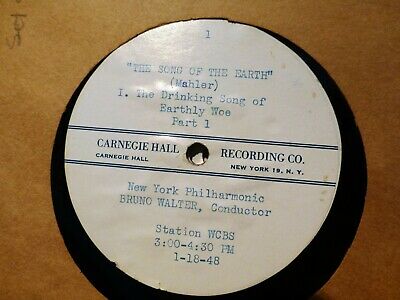
1948 Gustav MAHLER LIED VON DER ERDE LIVE ACETATE Bruno Walter Katheleen FERRIER
$
361


Favourite Auctions
To save auctions to your favourites, please login
If you don't have an account, please register
Description
Please wait for me to send you an invoice. DO NOT USE EBAY CHECKOUT if you want the lowest possible postage.
Welcome to my auctions of great records
This is my FIRST WEEK of 2 weeks of great auctions – I WILL PACK AND BILL YOUR RECORDS after the close on JUNE 9.
PLEASE DO NOT PAY before I send you an invoice.
International shipping: approx postage 1x10"=$25: 1x12"=$25 to $35: 10"Album 4 Rec=50$: 12" Album 2 Rec=50$
HOWEVER in most cases I can get you SIGNIFICANT savings by using other services. Pls contact me for a quote.
About 30% less to Canada. Pls ignore international postage displayed in Ebay, rates are too high
Please wait for me to send you an invoice. DO NOT USE EBAY CHECKOUT if you want the lowest possible postage.
Great German conductor and student of Gustav Mahler
One of the great live Mahler's Lied von der Erde recordings. The Naxos CD issue is from an inferior acetate with horrible inteference.
This is a recording made in Carnegie Hall of high fidelity quality. A unique recording, and the best availabe
BRUNO WALTER - who premiered DAS LIED VON DER ERDE posthumously on 20 November 1911 in the Tonhalle in Munich, with Bruno Walter conducting and sung by Sara Cahier and William Miller. (almost exactly 100 years ago)
Gustav MAHLER (1860-1911)
Das Lied von der Erde (1907-09)
Kathleen Ferrier (contralto); Set Svanholm (tenor)
Philharmonic Symphony Orchestra of New York /Bruno Walter
rec. live Carnegie Hall, New York, 18 January, 1948
Bruno Walter is of course of impeccable pedigree as the conductor of the 1911 premiere of this work. He made three commercial recordings and tended towards increasingly relaxed tempi as time went on; this is just as grand as the Decca recording but a tauter, brighter, more driven performance – and it must be said that the New York Philharmonic plays rather more confidently and securely than the VPO; the strings are fuller and the horns are especially good despite the odd blip.
Set Svanholm is more of an echter Heldentenor than Julius Patzak and has all the notes, although even this Tristan is taxed and audibly strained by his very demanding music. Given that Patzak was already 56 years old when he recorded for Walter and Svanholm is here only 43, one may all the more admire the astuteness with which Patzak husbands his resources, compared with Svanholm’s effortfulness, but both make much of the text and manage to prevail against big orchestras, which Walter made no effort to rein in.
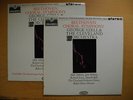
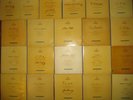
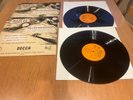
6 double sided 12" acetates aluminum core, typewritten label, drop sequence in generic album
Condition: BETTER THAN EXCELLENT, pristine, no damage to the acetate warp or wear. Light white powder on surface which is normal for acetates and can be removed with mineral spirits
exceptional sound quality, no off-the-air interference. Generous overlaps for splicing
Plays EXCEPTIONALLY QUIET
Album solid, spine has tape repair
Walter called Das Lied "Mahler's most personal work, perhaps the most personal work in music." I've never heard it in concert, and frankly I never want to – it's far too personal and intimate, and thus ideally suited to recordings and the privacy they afford. Indeed, Mahler had told Walter that he feared Das Lied was too intense for an audience, and after completing the orchestration he stashed the score and never sought a performance. Walter led the premiere on November 11, 1911, six months after Mahler's death. In the introduction to his biography of Mahler, he wrote: "It was a heavy responsibility to take my great friend's place and introduce his work to the world." For the next 50 years, Walter served as his mentor's most fervent advocate, and his performances radiated incomparable authority. Upon leaving the Vienna Opera, Mahler had written to Walter: "I know of no one who understands me as well as I feel you do and I believe I have entered deep into the mine of your soul." Alma, too, credited Walter with a full understanding of her husband and wrote in her autobiography: "After [Mahler's] death, Walter's great and exalted art was at his service. He mastered its every subtlety … and he took the spirit of Mahler's work as the keystone of his own work as an interpretive musician."
The vehicle through which Mahler found new meaning in life was a book he had been given at some point following his crash, and that resonated deeply within his troubled soul. Mahler had always been enamored of German folk poetry, and had based most of his songs and several symphonic movements on settings of their texts, especially Das Knaben Wunderhorn ("The Youth's Magic Horn"). The new book was Hans Bethge's Die chinesische Flöte ("The Chinese Flute"). Alma claimed that he obtained it during that dreadful summer of 1907 as a gift from a friend of her father, but scholars have since pointed out that the volume was first published only that October. In any event, the book rekindled his creativity and by the next summer he plunged into a new work based on seven of its poems. Cooke notes that through the poems Mahler began a search for life on the threshold of death. He wrote Walter that he felt transformed, having found consolation in his music: "When I hear music I hear definite answers to all my questions and am wholly clear and sure." Noted Walter: "As twilight dissolves in the glow of sunset, the gloom his illness had cast upon his spirit passed into the radiance of approaching departure." Alma recalled that he slaved over his new work that summer without distraction; indeed the dates on the score indicate that the entire work was written within two months, and then orchestrated the following winter.
Mahler was deeply superstitious. He already had written eight symphonies, but was afraid to write a ninth. He was keenly aware that, of his illustrious predecessors, Beethoven never passed that number and Bruckner died trying. (Mahler's fears undoubtedly would have been worsened had he known that two other great symphonists, Schubert and Dvorak, fell victim to the same limit, but haphazard publication at the time overlooked some of their work and thus obscured that fact.) To alleviate his fear of succumbing as well, especially in light of his diagnosis, Mahler did not number his new work but rather subtitled it "A Symphony for Tenor, Contralto (or Baritone) and Orchestra." (Yet fate was not so easily fooled – thinking the danger had passed, Mahler titled his next work his Symphony # 9 and then died while composing its successor.)
Although The Chinese Flute purported to comprise authentic direct translations of the original poems, in fact Bethge knew no Chinese at all but rather "borrowed" his material from other intermediate sources, notably a 1905 collection by Hans B. Heitman, which itself was based on French translations by noted sinologists Judith Gautner and Herven Saint-Denis. In his massive study of Mahler's final years, Dennis Mitchell affords fascinating comparisons among literal translations of the Chinese source poems and the French, Heitman and Bethge versions (as well as Mahler's augmentation of the Heitmans for his music texts). Thus, the poem behind the fourth song originally ran to only nine short lines, St. Denis and Heitman provided eight increasingly more expansive ones, Bethge's version ran to 22 and Mahler's 32, each filling in ever greater detail and personality, adding natural imagery and defining the psychology, all of which are merely implied in the original. Kurt Blaukopf notes that Bethge, himself a poet, infused his adaptations with cadences typical of his own work, and thus enhanced their suitability for musical settings. However, Mitchell notes that, unlike when Mahler set other poetry, here the music was dominant, as he often revised Bethge's wording to fit his musical inclinations, rather than molding the music to the existing text. Yet, Mitchell notes that despite all the revisions and romanticized touches that produced a Europeanized view, the essential oriental spirit remained largely intact.
Despite his derivative sourcing, Bethge's postface to his volume provides fine historical background that helps explain its appeal to a Europe being swept by taste for the orient. He notes that surviving Chinese poetry is up to three millennia old, and thus ranks with Hebrew and Indian literature as the most ancient we still know. It preserves the original feeling since the Chinese language barely evolved, remained well known since Chinese culture reveres its ancient literature as a living art, and also reflected the national character since China was untainted by foreign influences. (Westernization and then the Revolution would change all that, of course.) The classical period peaked in the 8th Century with Li-Tao-Po (702 – 763), a vagabond and drunkard whose themes of pervasive melancholy, the transience of life, drinking to escape from earthly woes and seeking the mysteries of existence through natural symbols typify the Chinese outlook of vaunting lyricism over the epic or dramatic approaches of the West. (Although Li-Tao-Po is believed to have drowned while drunk, legend has it that the gods summoned him across the waters to dwell in eternity.) Bethge recalled that upon first encountering these poems, he "perceived a fragile, quasi-evanescent tenderness of lyrical sound, … a fully realized imaginative art in words that illuminated … the riddle of existence, … tremblingly delicate, … pregnant with symbolism, … flower-like in its graceful rendering of emotion." Apparently Mahler, too, was taken by their subtle power and found in them a means by which he was able to confront and sublimate his fate.
At first intended as a song cycle to be entitled "The Jade Flute," and then "The Song of Earth's Sorrow," Mahler's work evolved into the hour-long Das Lied von der Erde ("The Song of the Earth") comprising six movements that alternate tenor and contralto as vocal soloist:
Das Trinklied vom Jammer der Erde ("The Drinking Song of the Earth's Sorrow") – after Li-Tao-Po, about 9 minutes in a typical performance – A celebration of wine to dispel doubts and fear, at least temporarily, as the thrusting energy of each verse subsides into "Dunkel ist das Leben, ist der Tod" ("Dark is life, is death"). After a comforting interlude, the central theme of the work emerges: the contrast between transitory lives and the permanence of nature, cemented by a striking image of a howling ape squatting on moonlit graves (which perhaps also suggests the futility of protesting the universal scheme).
Der Einsame in Herbst ("The Lonely One in Autumn") – Tchang-Tsi, 9 minutes – A gentle, weary reflection upon the withering of life.
Von der Jugend ("Of Youth") – Li-Tai-Po, 3 minutes – Happy youthful friends peacefully gather at a green porcelain pavilion and pool to drink and chat.
Von der Schönheit ("Of Beauty") – Li-Tai-Po, 7 minutes – Girls gather lotus flowers by a river bank. The music explodes as lads trot by on horses and then recedes, as a girl yearns after them.
Der Trukene im Frühling ("The Drunkard in Spring") – Li-Tai-Po, 5 minutes – Joy seems strained as the only way to bear the happiness of spring is to sleep drunkenly through it.
Der Abschied ("The Farewell") – Mong-Koo-Yen and Wang-Wei (who were personal friends), 30 minutes – In the first of two complementary poems, as evening falls and nature comes to rest, a poet awaits an overdue friend to bid a final farewell. After a leisurely interlude, the friend arrives to say that he is traveling home for the last time. The final lines are by Mahler himself, ending the work on a deeply personal and indescribably moving note – a perfect blend of hope and resignation, of yearning and peace, of completion and renewal, of faith in eternity tinged by the knowledge that he soon would take his leave:
Ich werde niemals in die Ferne schweifen,
Still ist mein Herz und harret seiner Stunde!
Die liebe Erde allüberall blüht auf in Lenz und grunt aufs neu!
Allüberall und ewig blauen Licht die Fernen!
Ewig … ewig …
I shall no longer seek the far horizon,
Still is my heart and awaits its hour!
The lovely earth everywhere blossoms and grows anew.
Everywhere and forever blue lights the horizon!
Forever … forever …
Such descriptions are woefully inadequate to suggest the exquisite beauty and efficiency of the words, their allusions to complex expressive truths beneath their shimmering realistic surface, the pervasive sadness of viewing life from afar. So, too, with Mahler's music, which Louis Biancolli aptly describes as always human and searching as both commentator and protagonist, speaking in an inspired stream of compelling self-revelation both personal and epochal, a clear extension of the scope of his prior symphonies, which he intended to embrace all aspects of life. Despite augmented forces, the orchestration is restrained, as if to reflect the sparse coloration of Chinese prints, while prominent use of gong, flute, mandolin, glockenspiel and ukulele hint at the Orient. It begins in swaggering confidence and at turns becomes wistful, frightening, delicate, snarling, sweet and even wryly humorous – a survey of the spirit and scope of life before the sober reflection and poignant searching of the finale. Michael Kennedy notes that while the music evolves with perpetual variation, it is unified by devices such as a falling second to signify yearning, and a rising minor third to evoke space and loneliness.
Blaukopf notes that, as a conductor, Mahler was intimately familiar with orchestral sound and concert-hall acoustics and, as an opera director, with the impact of flexible staging and unusual effects, all of which is evident throughout this most personal of his work. (Biancolli calls him a master anatomist, for whom the orchestra was a living organism.) Mitchell cites Mahler's fascination with the expressiveness of instruments playing at the extreme ends of their ranges to project a human quality of struggle. Thus, the first movement vocal part is written nearly an octave above a tenor's realm of comfort, including frequent fortissimo sustained a's and b-flats above the treble clef (for which the score helpfully provides alternative lower f-naturals), to ensure projection of the text's straining against life's troubles while the flutes' bizarre flutter-tonguing adds a touch of surreality. The runaway horse episode in the fourth movement ends with an unrelieved long string of forceful, rapid staccato notes, which the contralto either must break with an awkward breath or run short of wind, either way reflecting the physical exertion of the text.
Many commentators over the past century have grappled from a variety of perspectives with the novelty of Mahler's conception. Some seem fascinated by its melding of Chinese and Western outlooks. As summarized by Jonathan Kramer, Eastern philosophy views life as sparse and nature as a cycle of endless repetition, while a Western life is one of richness, dramatic confrontation and goal-oriented progress. Bethge added that the pervasive parallelism of Chinese thought is reflected even in the pictorial rhythm of its calligraphy.
Others hail Das Lied as an innovative hybrid between the two disparate musical elements of song and symphony. La Grange characterizes song as essentially intimate, lightly accompanied, dominated by voice, cast in strophic form, comprised of self-contained melodies barely transformed, and minimal growth, whereas the symphony is monumental, richly orchestrated, of more complex structure and of sophisticated development. To la Grange, the miracle of Das Lied is Mahler's combination of the two forms so that the essential integrity of each remains evident. Volker Scherleiss, though, notes that Mahler never treated song and symphony as distinct but rather as supplementary and complementary, with his songs conceived orchestrally and his symphonies suffused with vocal style, even without actual voices. Heard from that perspective, all his works combine intimacy and large expression, simple melody and complex thematic treatment.
Yet, several observers tend to liken Das Lied to a traditional symphony in which the first movement serves as the assertive opening, the second as the slow respite, the next three as a compound scherzo, and the finale as a weighty summation. Eric Blom goes further, spreading the middle three movements into a scherzo, a minuet and trio, and a rondo. Others, though, view it as having a psychological structure by which Mahler presents an exploration of life and where it all leads, perhaps as metaphoric autobiography. Thus, Biancolli sees a progression from open defiance of fate and life's vanities, through an exhausted wanderer's autumnal lament, backward glimpses at the vanished glory of youth, a desperate escape through drink from the futility of it all, and finally resignation and a calm farewell. Peter Branscombe finds the central question of existence posed at the outset, deferred in the central portion, and faced only at the end.
Indeed, many come to focus on the extraordinary finale which, by its sheer length and emotional weight, tends to balance, if not overshadow, all that precedes it. Especially alluring is its ineffably moving ending, in which Mahler bid farewell to the life he thought was over but to which he tenaciously clung, and in which he found solace in Nature as proof that he was destined to take his part in an eternal cycle of renewal. As the contralto repeatedly intones the word "ewig" ("forever") at the very bottom of her register, the first six iterations are in pairs, descending from e to d and d to c so as to nestle in the calm peace of C major. The last three words, though, are alone and drop only from e to d, where they remain unresolved and suspended, hovering a single degree above the tonic ground, waiting for a resolution that never comes. In Ernest Bloch's memorable phrase, it "melts with an unresolved suspension into an immeasurable forever." Or, as Walter noted: "While the world slowly melts away, he becomes the experience itself – a limitless range of feeling opens for he who soon will leave this earth." Mahler marks the end Gäzlich esterbend (completely dying away), yet his is a restless farewell – in the background, trombones, oboe, flute, celesta, harps, mandolin and strings flit by, varying the texture in repeated rhythmic fluctuations that suggest the oriental view of the continuity of life, perpetually changing yet somehow always the same. Clearly, Mahler was not about to go silently into the night. But rather than loudly protest his fate he internalized his emotion and affirmed his essential humanity as a guide for all who might follow.
Bruno Walter, Wien 1912
Bruno Walter (September 15, 1876 – February 17, 1962) was a German-born conductor. He is considered one of the best known conductors of the 20th century. Walter was born in Berlin, but is known to have lived in several countries between 1933 and 1939, before finally settling in the United States in 1939. Though he was born Bruno Schlesinger, he began using Walter as his surname in 1896, and officially changed his surname to Walter upon becoming a naturalised Austrian in 1911. Walter was for many years active as a composer, but his works have not entered the repertoire.
Born near Alexanderplatz in Berlin to a middle-class Jewish family as Bruno Schlesinger, he began his musical education at the Stern Conservatory at the age of eight, making his first public appearance as a pianist when he was nine. However, following visits to one of Hans von Bülow's concerts in 1889 and to Bayreuth in 1891, he changed his mind and decided upon a conducting career. He made his conducting début at the Cologne Opera with Albert Lortzing's Der Waffenschmied in 1894. Later that year he left for the Hamburg Opera to work as a chorus director. There he first met and worked with Gustav Mahler, whom he idolized and with whose music he later became strongly identified.[1]
[edit] Conducting
In 1896, Schlesinger took a conducting position at the opera house in Breslau – a job found for him by Mahler. The conductor recorded that the director of this theater, Theodor Löwe, required that before taking up this position he change his name of Schlesinger, which literally means Silesian, "because of its frequent occurrence in the capital of Silesia",[2] although other sources attribute the change to a desire to make his name sound less Jewish.[3] (Note: It is often stated that Walter was his middle name and he merely dropped the surname Schlesinger. This is not true; he had no middle name and "Walter" had never been one of his names.)[citation needed] In 1897, he took an opera-conducting position at Pressburg, and in 1898 he took one at the Riga Opera, Latvia. Then Walter returned in 1900 to Berlin, where he assumed the post of Royal Prussian Conductor at the Staatsoper Unter den Linden, succeeding Franz Schalk; his colleagues there included Richard Strauss and Karl Muck. While in Berlin he also conducted the premiere of Der arme Heinrich by Hans Pfitzner, who became a lifelong friend.
In 1901, Walter accepted Mahler's invitation to be his assistant at the Court Opera in Vienna. Walter led Verdi's Aida at his debut. In the following years Walter's conducting reputation soared as he was invited to conduct across Europe – in Prague, in London where in 1910 he conducted Tristan und Isolde and Ethel Smyth's The Wreckers at Covent Garden, and in Rome. A few months after Mahler's death in 1911, Walter led the first performance of Das Lied von der Erde in Munich, as well as Mahler's Symphony No. 9 in Vienna the next year.
[edit] Munich
Although Walter became an Austrian citizen in 1911, he left Vienna to become the Royal Bavarian Music Director in Munich in 1913. In January of the following year Walter conducted his first concert in Moscow. During the First World War he remained actively involved in conducting, giving premieres to Erich Wolfgang Korngold's Violanta and Der Ring des Polykrates as well as Hans Pfitzner's Palestrina. In 1920 he conducted the premiere of Walter Braunfels' Die Vögel.
In Munich, Walter was good friends with Cardinal Eugenio Pacelli (later Pope Pius XII).[4]
[edit] United States
Walter ended his Munich appointment in 1922 and left for New York in 1923, working with the New York Symphony Orchestra in Carnegie Hall; he later conducted in Detroit, Minnesota and Boston.
[edit] Berlin
Back in Europe Walter was re-engaged for several appointments, including Berlin in 1925 as musical director at the Städtische Opera, Charlottenburg, and in Leipzig in 1929. He made his debut at La Scala in 1926. In London, Walter was chief conductor of the German seasons at Covent Garden from 1924 to 1931.
In his speeches in the late 1920s, Nazi leader Adolf Hitler complained bitterly about the presence of Jewish conductors at the Berlin opera, and mentioned Walter a number of times, adding to Walter's name the phrase, "alias Schlesinger." [5] In 1933, when the Nazis took power, they undertook a systematic process of barring Jews from artistic life. Walter left for Austria, which became his main center of activity for the next several years, although he was also a frequent guest conductor of the Amsterdam Concertgebouw Orchestra from 1934 to 1939, and made guest appearances such as in annual concerts with the New York Philharmonic from 1932 to 1936. At the time of the Anschluss in 1938, Walter was at a recording session in Paris; France offered Walter citizenship, which he accepted. (His daughter was in Vienna at the time, and was arrested by the Nazis; Walter was able to use his influence to free her. He also used his influence to find safe quarters for his brother and sister in Scandinavia during the war.)
More Great Records on sale right now:
http://shop.ebay.com/carsten_sf/m.html
http://shop.ebay.com/carsten_sf/m.html
====
A Quick NOTE ON GRADING AND SHIPPING:
As you can see from my feedback, I try hard to earn your POSITIVE FEEDBACK and FIVE STAR RATINGS.
If for any reason your transaction was NOT SATISFACTORY, pls contact me and I will work something out with you. YOU WILL NEVER HAVE A REASON TO GIVE ME A NEGATIVE RATING or a LOW STAR RATING.
Quick note on grading:
The Grade (Excellent to Poor, I don't give Mint) refers to the WEAR of the record. Any other defects are stated separately
When I listen to a record, I may also give it an aural grade (again E to P), and make a SUBJECTIVE judgment of the pressing quality for hiss and surface noise.
"SUPERQUIET" is basically noiseless, like a vinyl pressing.
"VERY QUIET" is an exceptionally quiet record for a given pressing.
"Quiet" is a record that is a great example without undue noise for a give pressing.
These judgments are SUBJECTIVE and will depend one the styli, phonograph etc. you use on your own equipment.
Multiple item shipping: I am happy to combine items for shipment in one parcel.
If you win multiple items, pls send me an INVOICE REQUEST to calculate the correct postage. Ebay check out will not give you the correct multiple item discount!
Records will be packed safely between corrugated cardboard in a sturdy box with plenty of padding for safe shipment.
Shipment is usually Media Mail, unless you request another service. Shipping is at your risk, I will be happy to insure items at your cost.
I charge actual postage plus a small fee for packing materials
As always, I guarantee your satisfaction. If you don't like the item, just return it, and I will refund the full purchase price.
If you are in the San Francisco area, I encourage pick-up in person.
US Domestic Shipping:
Here is a guideline for US Media Mail Shipping:
Prices below are for regular 78 rpm records. Up to about 5 records, I will ship Edison Discs for the same rates. Albums from Album Sets count as 1 record. Above that and for international shipments, it will be actual weight plus a small packing charge (1-3$ depending on size of shipment)
1 record: 4.75 – 5.50$
2 records: 6.50$
5 records: 8.00$
10 records: 12.00$
MANY MORE RECORDS: Don't worry. I safely ship 40 - 50 pounds of records double boxed in moving boxes, and even then Media Mail will probably not exceed 35$.
Please send me a message if you would like to lower your shipping rates!
I am very happy to ship records worldwide.
Please use the EBAY shipping cost only as a guideline. My actual charges are usually lower
One record usually ships for 25$ for 10" 25-35$ for most 12" records (Less for Canada).
For certain destinations I can get SIGNIFICANTLY LOWER rates from FedEx and the US Postal service for any kind of parcel weight, and will make use of all the cost-saving shipment methods
Pls contact me for a shipping estimate, or send me an invoice request after close of auction.
AND AGAIN -THANK YOU FOR YOUR INTEREST
As you can see from my feedback, I take great care in presenting, grading and shipping your items. I really want you to be happy with the purchase. If you feel that anything is wrong with the item or the shipping, contact me and we will work it out !!!
As always, I would appreciate any suggestions and corrections from you, pls contact me with any question.
Thank you very much, and good luck bidding !!!
price rating