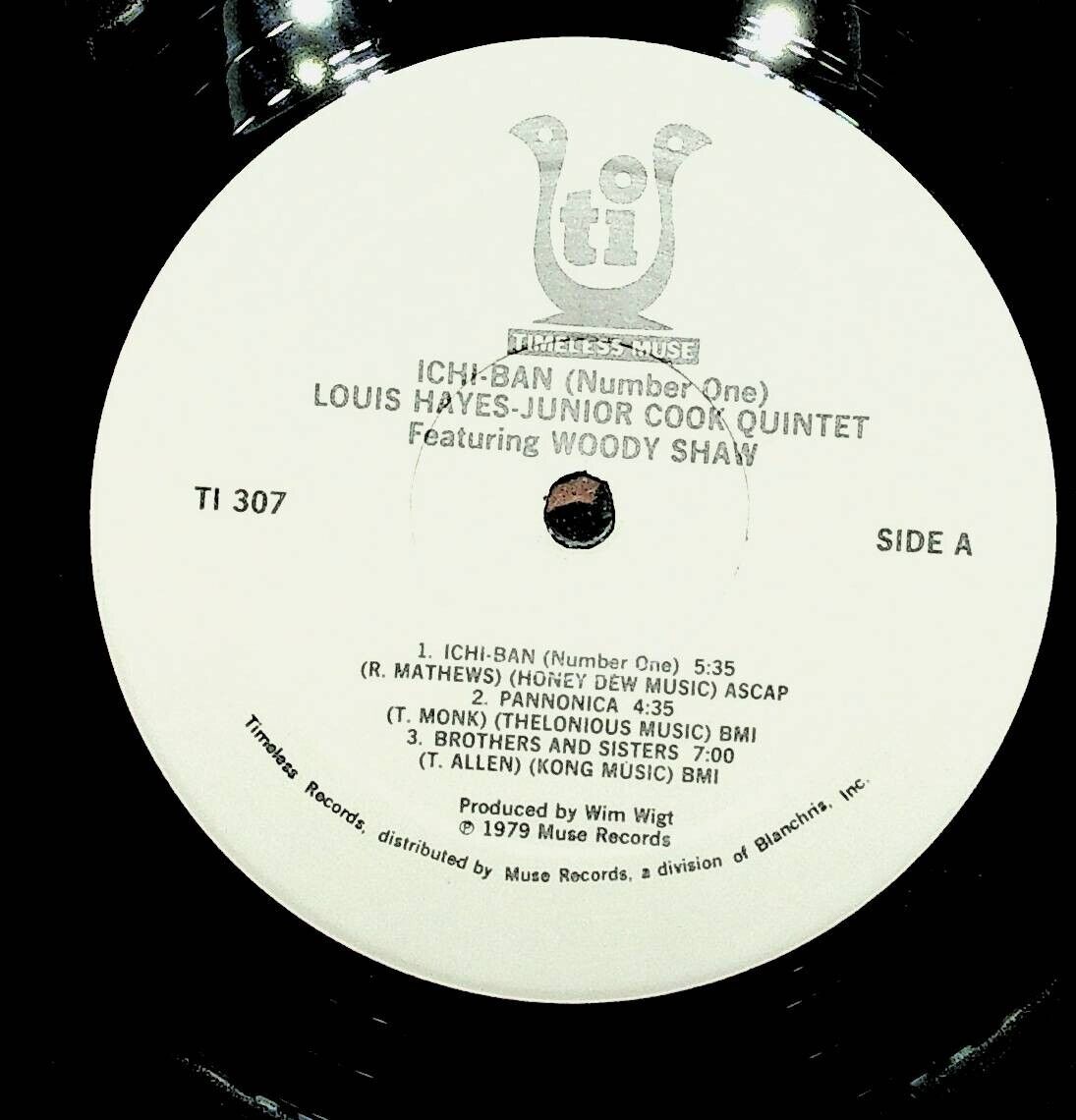
1979 Ichi-Ban Louis Hayes Junior Cook Woody Shaw Jazz Vinyl LP Record VG+
$
25




Favourite Auctions
To save auctions to your favourites, please login
If you don't have an account, please register
Description
Yes we combine shipping for multiple purchases. Add multiple items to your cart and the combined shipping total will automatically be calculated.
1979 Ichi-Ban Louis Hayes Junior Cook Woody Shaw Jazz Vinyl LP Record VG+
Vinyl / Jacket Grade Per Goldmine Standard: VG+ / VG+; Jacket still in shrink
SIDE A 1. ICHI-BAN (Number One) ......5:35 2. PANNONICA...................4:35 3. BROTHERS AND SISTERS .......7:00 SIDEB 1. THEMOONTRANE 6 50 2. BOOK’S BOSSA 1145 drums tenor saxophone trumpet Personnel: Louis Hayes Junior Cook Woody Shaw Ronnie Mathews piano Stafford James bass Guilherme Franco percussion It was a bitter cold winter night. Wind whipped through Manhattan’s canyons with vengeance. Ice and snow choked streets and sidewalks. Finally, a familiar sign—“Boomers" blinked ahead. As I stepped past the door, my glasses fogged quicker than San Francisco at dusk. “Why," I asked myself, “am I here?" Yes, I love jazz, but to relive the trials of Nanook in its pur- suit seemed just too much. The jukebox was serving generous portions of Trane's musings on favorite things. Animated conversations provided counterpoint. A cloud of bluish smoke hung from the ceiling. Still discernible, despite the reduced visibility, was Boomers’ regular clientele looking, as usual, like “a jazz crowd" assembled by Central Casting. Someone pulled the Seeburg’s plug. Musicians ambled toward the cramped stage. Mikes were adjusted, horns warmed and positions taken. Then, with a snap of the fingers, boom, they were off. The Moontrane had been launched and along with it, my introduction to the Louis Hayes- Junior Cook quintet featuring Woody Shaw with Ronnie Mathews and Stafford James. Much later, after we had tumbled out of the club following the last set, winds were still howling. But fortified by the music, no one really seemed to care. In spite of the group’s relatively short life during the first part of 1976, the Hayes-Cook unit was an important catalyst that helped rejuve- nate the wellsprings of bop. Along with the bands of Ted Curson and Billy Harper, the Hayes-Cook group derived much of its inspira- tion and substance from the tradition estab- lished by Parker, Gillespie, Silver and Blakey. Cook, for instance, after a two month stint with Diz in 1957, refined his funky, post-bop stylings during a six year tenure with Horace Silver, 1958-’64. Hayes, a Silver alum from the class of 1956-'59, propelled bop-based groups led by Cannonball Adderley, Oscar Peterson and Freddie Hubbard. Shaw, the young man with a horn who recently has captured critics and public alike, is firmly grounded in the canons of bop. Among his credits are Silver (1965) and Blakey (1973). Mathews, in addition to tours with Blakey in the late '60s and early '70s, was an important contributor to the bands of Max Roach, Roy Haynes, Kenny Dorham and Hubbard. As for James, his resume lists Blakey, 1973-4, Chico Hamilton, Barry Harris and Bobby Timmons Though bop was the center of gravity for the Cook-Hayes band, the structural outlines provided by well-defined melodic, harmonic and rhythmic markers were considerably loosened by the "free" vocabulary developed by Cole- man, Coltrane, Dolphy and Taylor during the 1960s. This was especially true for Shaw, Mathews and James. In an article for down beat, Shaw told me, “It was Eric Dolphy who really turned me around. The thing about Eric’s music is that you could either play the changes or be free on it. He taught me to play inside and outside at the same time. It had form and made a lot of sense. Eric is the one who helped me find my own indi- vidual approach to playing trumpet." Playing both “in" and "out," sometimes close to and then far from the tune’s structural grid, with a strong, driving forward motion that cooks and swings according to the etched-in- stone tenets of the mainstream—these are the touchstones of the neo-bop approach that invigorate the music of Ichi-Ban. The session opens with Mathew’s title track, a bright burner with oriental accents inspired by Ronnie’s tours of Japan with Art Blakey. Junior’s Trane-tinged flurries, Woody’s boppish bursts, Ronnie’s ever-intensifying forays and Louis’s thunder and lightning create an energy and esprit very much in the Blakey tradition. Pannonica, a not-heard-often-enough ballad by Thelonious Monk, is a showcase for Junior’s lyric persuasiveness. Against con- stantly shifting harmonic tides, Junior launches shimmering garlands of melodic invention that are tender without being sentimental. Brothers and Sisters is an exuberant frame constructed by another fine trumpeter-com- poser, Tex Allen. Its snappy Latin pulse springs exciting solos from Woody, Junior, Ronnie and Louis. Stafford's steady ostinatos and Guil- herme’s percussive colorings add the perfect finishing touch. The second side opens with a galvanizing romp through Shaw’s now classic The Moon- trane. Junior jumps in after the head and is followed by explosive charges detonated by Woody, Ronnie and Louis. Walter Booker, the Cook-Hayes unit’s origi- nal bassist, left shortly after the group’s debut to join Sarah Vaughan’s rhythm sectio i. Before departing, though, he penned the evocative Book’s Bossa whose graceful lyric arcs cradle melodic outings by all hands. The flow is enriched by Franco’s popping percussionistics and "talking" drums. Ichi-Ban, though recorded in 1976, has a sense of contemporaneity that derives from the players’ superb musicality and commitment to the highest standards. This is real music played by real musicians who take their muse seriously. Boomers and the Junior Cook-Louis Hayes quintet are now a part of history. The ripples they set in motion, however, continue to push outward. —CHUCK BERG Produced by Wim Wigt Recorded at Generation Sound Studio. NYC - May 5,1976 Engineer: Tony May Cover design: Tamar Zinn
Thank you for your business.
Gallimoresgoods
price rating