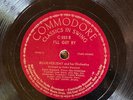
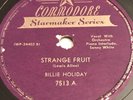
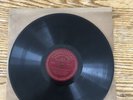
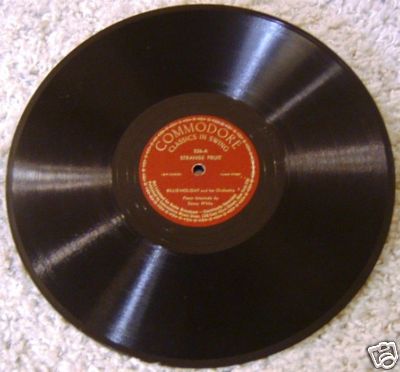
78 By Billie Holiday, "Strange Fruit" on Commodore
$
42


Favourite Auctions
To save auctions to your favourites, please login
If you don't have an account, please register
Description
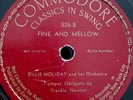
A 78 by Billie Holiday, "Strange Fruit" on Commodore
I'm digging deep into my personal collection for these blues 78's. Most of them are in E condition or better.
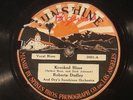
The record is in excellent condition. (See Photo)
Both od these sides were recorded April 20, 1939 in New York according to Brian Rust.
The shellac on it is in E- condition.
The labels are in excellent condition. (See Photo)
This record comes with a sleeve.
Artist Side A Side B Label Disc Number Condition
Commodore Label
Billie Holiday Strange Fruit Fine And Mellow Commodore 526 E, E-
Wikipedia Biography
Billie Holiday (born Eleanora Fagan; April 7, 1915 – July 17, 1959) was an American jazz singer and songwriter.
Nicknamed Lady Day[1] by her sometime collaborator Lester Young, Holiday was a seminal influence on jazz and pop singing. Her vocal style — strongly inspired by instrumentalists — pioneered a new way of manipulating wording and tempo, and also popularized a more personal and intimate approach to singing. Critic John Bush wrote that she "changed the art of American pop vocals forever."[2] She co-wrote only a few songs, but several of them have become jazz standards, notably "God Bless the Child", "Don't Explain", and "Lady Sings the Blues".
Billie Holiday had a difficult childhood, which greatly affected her life and career. Much of her childhood is clouded by conjecture and legend, some of it propagated by her autobiography, Lady Sings the Blues, first published in 1956 and later revealed to contain many inaccuracies.[3]
Her professional pseudonym was taken from Billie Dove, an actress she admired, and Clarence Holiday, her probable father. At the outset of her career, she spelled her last name "Halliday", presumably to distance herself from her neglectful father, but eventually changed it back to "Holiday".
There is some controversy regarding Holiday's paternity, stemming from a copy of her birth certificate in the Baltimore archives that lists the father as a "Frank DeViese". Some historians consider this an anomaly, probably inserted by a hospital or government worker.[4]
Thrown out of her parents' home in Baltimore after becoming pregnant at thirteen, Billie's mother, Sadie Fagan, moved to Philadelphia where Billie was born. Mother and child eventually settled in a poor section of Baltimore. Her parents married when she was three, but they soon divorced, leaving her to be raised largely by her mother and other relatives. At the age of 10, she reported that she had been raped.[5] That claim, combined with her frequent truancy, resulted in her being sent to The House of the Good Shepherd, a Catholic reform school, in 1925. It was only through the assistance of a family friend that she was released two years later.[6] Scared by these experiences, Holiday moved to New York City with her mother in 1928. In 1929 Holiday's mother discovered a neighbor, Wilbert Rich, in the act of raping her daughter; Rich was sentenced to three months in jail.
[edit] Early singing career
According to Billie Holiday's own account, she was recruited by a brothel, worked as a prostitute in 1930, and was eventually imprisoned for a short time for solicitation. It was in Harlem in the early 1930s that she started singing for tips in various night clubs. According to legend, penniless and facing eviction, she sang "Travelin All Alone" in a local club and reduced the audience to tears. She later worked at various clubs for tips, ultimately landing at Pod's and Jerry's, a well known Harlem jazz club. Her early work history is hard to verify, though accounts say she was working at a club named Monette's in 1933 when she was discovered by talent scout John Hammond.[7]
Hammond arranged for Holiday to make her recording debut on a 1933 Benny Goodman date, and Goodman was also on hand in 1935, when she continued her recording career with a group led by pianist Teddy Wilson. Their first collaboration included "What A Little Moonlight Can Do" and "Miss Brown To You", which helped to establish Billie Holiday as a major vocalist. She began recording under her own name a year later, producing a series of extraordinary performances with groups comprising the Swing Era's finest musicians.
Wilson was signed to Brunswick by John Hammond for the purpose of recording current pop tunes in the new Swing style for the growing jukebox trade. They were given free rein to improvise the material. Holiday's amazing method of improvising the melody line to fit the emotion was revolutionary (Wilson and Holiday took pedestrian pop tunes like "Twenty Four Hours A Day" or "Yankee Doodle Never Went To Town" and turned them into jazz classics with their arrangements). With few exceptions, the recordings she made with Wilson or under her own name during the 1930s and early 1940s are regarded as important parts of the jazz vocal library.
Among the musicians who accompanied her frequently was tenor saxophonist Lester Young, who had been a boarder at her mother's house in 1934 and with whom she had a special rapport. "Well, I think you can hear that on some of the old records, you know. Some time I'd sit down and listen to 'em myself, and it sound like two of the same voices, if you don't be careful, you know, or the same mind, or something like that."[8] Young nicknamed her "Lady Day" and she, in turn, dubbed him "Prez." She did a three-month residency at Clark Monroe's Uptown House in New York in 1937. In the late 1930s, she also had brief stints as a big band vocalist with Count Basie (1937) and Artie Shaw (1938). The latter association placed her among the first black women to work with a white orchestra, an arrangement that went against the tenor of the times.
[edit] The Commodore years and "Strange Fruit"
Holiday was recording for Columbia in the late 1930s when she was introduced to "Strange Fruit", a song based on a poem about lynching written by Abel Meeropol, a Jewish schoolteacher from the Bronx. Meeropol used the pseudonym "Lewis Allan" for the poem, which was set to music and performed at teachers' union meetings. It was eventually heard by Barney Josephson, proprietor of Café Society, an integrated nightclub in Greenwich Village, who introduced it to Holiday. She performed it at the club in 1939, with some trepidation, fearing possible retaliation. Holiday later said that the imagery in "Strange Fruit" reminded her of her father's death, and that this played a role in her persistence to perform it. In a 1958 interview, she also bemoaned the fact that many people did not grasp the song's message: "They'll ask me to 'sing that sexy song about the people swinging'", she said.[9]
When Holiday's producers at Columbia found the subject matter too sensitive, Milt Gabler agreed to record it for his Commodore Records. That was done in April, 1939 and "Strange Fruit" remained in her repertoire for twenty years. She later recorded it again for Verve. While the Commodore release did not get airplay, the controversial song sold well, though Gabler attributed that mostly to the record's other side, "Fine and Mellow", which was a jukebox hit.[10]
[edit] Decca Records and "Lover Man"
In addition to owning Commodore Records, Milt Gabler was an A&R man for Decca Records, and he signed Holiday to the label in 1944. Her first recording for Decca, "Lover Man", was a song written especially for her by Jimmy Davis, Roger "Ram" Ramirez, and Jimmy Sherman. Although its lyrics describe a woman who has never known love ("I long to try something I never had"), its theme—a woman longing for a missing lover—and its refrain, "Lover man, oh, where can you be?", struck a chord in wartime America and the record became one of her biggest hits.
Holiday continued to record for Decca until 1950, including sessions with the Duke Ellington and Count Basie orchestras, and two duets with Louis Armstrong. Holiday's Decca recordings featured big bands and, sometimes, strings, contrasting her intimate small group Columbia accompaniments. Some of the songs from her Decca repertoire became signatures, including "Don't Explain" and "Good Morning Heartache".
Grading
My grading system for 78 records is the N,E,V,G system.
The following definitions for this system are from Docks Record Guides.
New (N) : Apparently unplayed and showing no signs of wear.
Excellent (E): Showing only slight wear.
Playing surfaces still retain much of their original shine.
Surface noise is minimal.
Very Good (V): Somewhat more worn than an excellent record,
slight grayness appearing in the grooves, especially in louder passages.
Still a fairly clean and acceptable copy.
Surface and extraneous noise is noticeable, but does not overwhelm the music.
Good (G): A misnomer. A “good” record is really not so good.
It shows considerable wear and usage, grayness in the grooves,
random mars and light abrasions from a sleeveless existence.
Surface noise is prominent enough to impair enjoyment of the music.
Fair (F) and Poor (P) indicate the lowest grades of the condition code.
Since only the rarest records would be saleable in these grades, they appear infrequently.
Plus and minus signs are often suffixed to above grades to indicate a somewhat better or worse grade, when appropriate.
Packing & Shipping
All records are professionally packed. I use oversize new boxes. I tape two cardboard mailers, one on each side of the record. I put plenty of bubblewrap over that and then pack it in the oversize box using crumpled newspaper as cushion.
Be sure to check out my other auctions for Lots of 78‘s. If you win more than one of my auctions, then of course I will ship items together to save on postage.
Shipping and postage in the United States will be by media mail and will be $4.00 for the first record and an additional $.25 for each additional record.
Good Luck to all.
Payment & Shipping
I accept Paypal payments.
I also accept cash on pick-up.
Shipping and postage in the United States will be by media mail and will be $4.00.
International shipping will be higher. Email for a quote.
If you want insurance that will be extra.
$50 of insurance costs an extra $1.70.
price rating