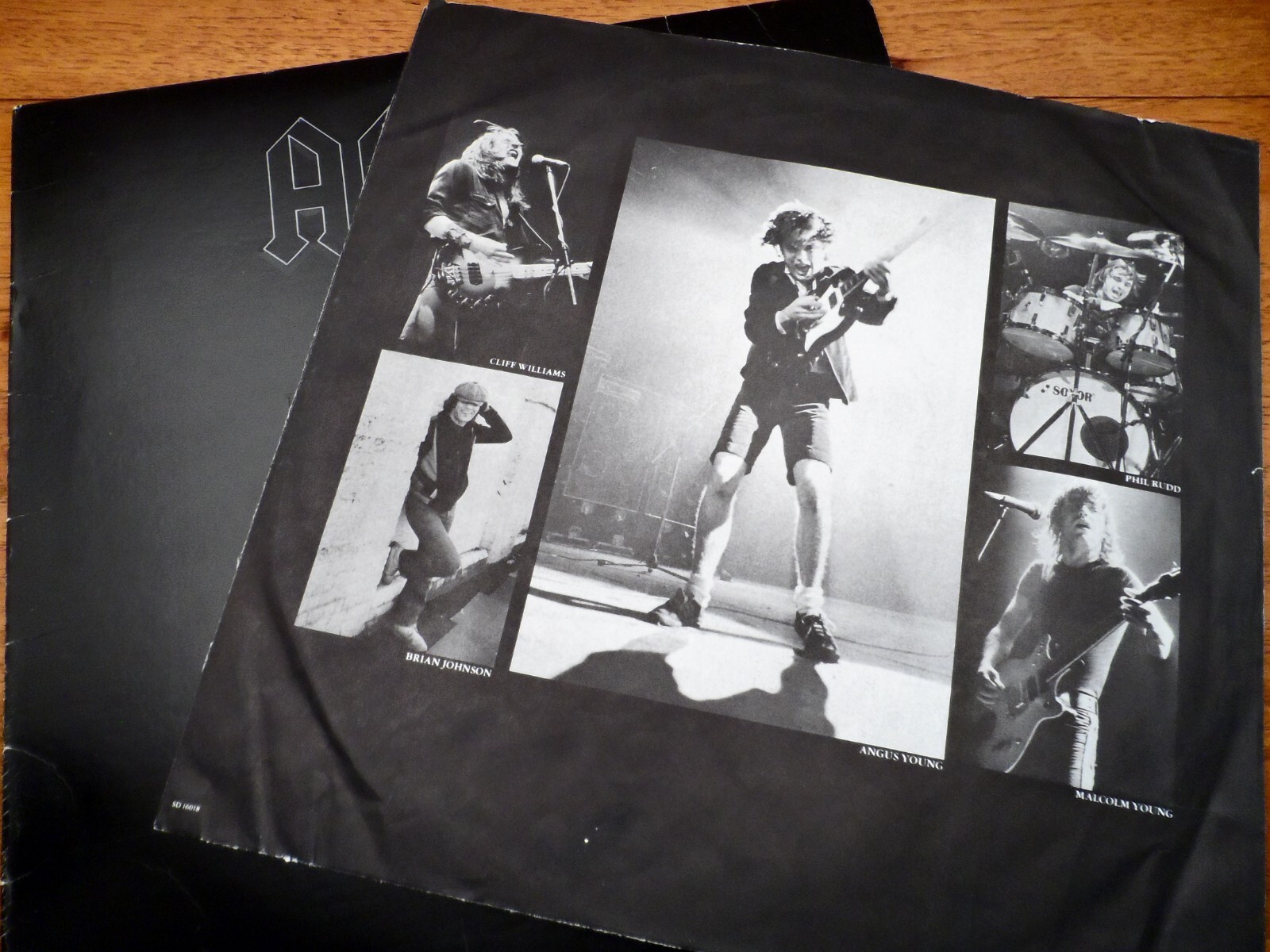
AC/DC Back in Black Rare 1980 Atlantic Original Monarch RL Master Vinyl LP
$
100




Favourite Auctions
To save auctions to your favourites, please login
If you don't have an account, please register
Description
Welcome to Classic Cadillac Records! I visually grade all my records as accurately as possible and will never grade anything above Near Mint unless it's still sealed. Please note that a visual grade can differ from a play grade, and am happy to spot check a record upon request. All orders are shipped within 1 business day (usually sooner) and packed with extra care to ensure fast, safe arrival. Please look closely at all pictures, read all relevant details and ask any questions you may have before buying. I offer a full 30-day return policy on everything I sell, so buy with confidence! 20% restocking fee charged on items returned for reasons other than it not working properly. Thanks for looking!
Back in Black Studio album by AC/DC Released 25 July 1980 Recorded April–May 1980 Studio Compass Point (Nassau) Genre
- Hard rock
- heavy metal
- Albert
- Atlantic
(1979) Back in Black
(1980) For Those About to Rock We Salute You
(1981) Singles from Back in Black
- "You Shook Me All Night Long"
Released: 15 August 1980 - "Hells Bells"
Released: 31 October 1980 (EU) - "Rock and Roll Ain't Noise Pollution"
Released: November 1980 (UK) - "Back in Black"
Released: December 1980 (US)
Back in Black is the seventh studio album by Australian rock band AC/DC, released on 25 July 1980, by Albert Productions and Atlantic Records. It was the band's first album to feature Brian Johnson as lead singer, following the death of their previous vocalist Bon Scott. After the commercial breakthrough of their 1979 album Highway to Hell, AC/DC was planning to record a follow-up, but in February 1980, Scott died from alcohol poisoning after a drinking binge. The remaining members of the group considered disbanding, but ultimately chose to continue on and recruited Johnson, who had previously been the vocalist for Geordie.
The album was composed by Johnson and brothers Angus and Malcolm Young, and recorded over seven weeks in the Bahamas from April to May 1980 with producer Robert John "Mutt" Lange, who had also produced Highway to Hell. Following its completion, the group mixed Back in Black at Electric Lady Studios in New York City. The album's all-black cover was designed as a "sign of mourning" for Scott.
Back in Black was an unprecedented commercial and critical success. It has sold an estimated 50 million copies worldwide, making it one of the best-selling albums in music history. AC/DC supported the album with a yearlong world tour that cemented them among the most popular music acts of the early 1980s. It has since been included on numerous "greatest albums" lists. On 21 August 2024, the album was certified 27× Platinum by the Recording Industry Association of America (RIAA), making it the third best-selling album in the United States and the best-selling album that never reached the top spot on the American charts.
Background
Bon Scott, the band's former vocalist, in December 1979.Formed in 1973, AC/DC first broke into international markets in 1977 with their fourth album, Let There Be Rock, and by 1979 they were poised for greater success with their sixth studio album, Highway to Hell. Producer Robert John "Mutt" Lange helped to make the band's sound more catchy and accessible, and Highway to Hell became their first gold album in the United States, selling over 500,000 copies, while also peaking at number 17 on that country's pop charts and number eight in the United Kingdom.
As the new decade approached, the group set off for the UK and France for the final leg of the Highway to Hell Tour, planning to begin recording their next album shortly after playing those dates. On 19 February 1980, vocalist Bon Scott went on a drinking binge in a London pub that caused him to lose consciousness, so a friend let him rest in the back of his Renault 5 overnight. The next morning, Scott was found unresponsive and rushed to King's College Hospital, where medical personnel pronounced him dead on arrival. The coroner ruled that pulmonary aspiration of vomit was the cause of Scott's death, but the official cause was listed on the death certificate as "acute alcoholic poisoning" and classified as "death by misadventure". Scott was cremated, and his ashes were interred by his family at Fremantle Cemetery in Fremantle, Western Australia. The loss devastated the band, who considered breaking up, but friends and family (particularly Scott’s) persuaded them to carry on.
After Scott's funeral on 1 March, the band immediately began auditions for a replacement frontman. At the advice of Lange, they brought in Geordie singer Brian Johnson, who impressed the group. The band begrudgingly worked through the rest of the list of applicants in the following days, and then brought Johnson back for a second rehearsal. On 29 March, to Johnson's surprise, Malcolm Young called the singer to offer him the job.
Critical reception
Retrospective professional reviews Review scores Source Rating AllMusic Blender Christgau's Record Guide B− The Encyclopedia of Popular Music The Great Rock Discography 8/10 MusicHound Rock Pitchfork 8.8/10 Rolling Stone The Rolling Stone Album Guide Spin Alternative Record Guide 8/10Reviewing the album for Rolling Stone in 1980, David Fricke regarded it as "not only the best of AC/DC's six American albums", but also "the apex of heavy-metal art: the first LP since Led Zeppelin II that captures all the blood, sweat and arrogance of the genre." Red Starr of Smash Hits was more critical, saying he found the songs indistinguishable from one another and marred by hypermasculine fantasies, rock music stock phrases, garish guitar, and dull rhythms, on "yet another triumph for lowest common denominator headbanging—the new thoroughly predictable, thoroughly dreadful AC/DC album", and gave Back in Black a score of 3 out of 10.
In a retrospective review, Rolling Stone critic Christian Hoard praised the album as the band's greatest work, possibly "the leanest and meanest record of all time—balls-out arena rock that punks could love." Barry Walters from Rolling Stone said Back in Black "still sounds thoroughly timeless, the essence of unrepentantly simple but savagely crafted hard rock" and called the album "a celebration of thrashing, animal sex", though he observed "mean-spirited sexism" on songs such as "What Do You Do for Money Honey" and "Given the Dog a Bone". Robert Christgau was less enthusiastic, writing in Christgau's Record Guide: The '80s (1990) that he found the band somewhat too "primitive" and their sexual imagery "unimaginative", and that, on the album, "Angus Young does come up with killer riffs, though not as consistently as a refined person like myself might hope, and lead singer Brian Johnson sings like there's a cattle prod at his scrotum, just the thing for fans who can't decide whether their newfound testosterone is agony or ecstasy."
Writing in 2011, Kitty Empire of The Observer admitted the album is "a preposterous, drongoid record [...] built on casual sexism, eye-rolling double entendres, a highly questionable attitude to sexual consent ('Don't you struggle/ Don't you fight/ Don't you worry/ Cos it's your turn tonight') a penchant for firearms, and a crass celebration of the unthinking macho hedonism that killed the band's original singer", but, nonetheless, concurred with Fricke's original view of the album as a heavy metal masterpiece and named it her favourite album ever, "the obsessive soundtrack of my adolescence, the racy middle-brow thriller that spoke to me both as a tomboy who wanted to be one of the guys, and the increasingly female ingenue who needed to work out the world of men. Plus teenagers love death."
The album is featured on many "best of" lists. Rolling Stone ranked it number 26 on their 1989 list of the "100 Best Albums of the Eighties", and number 73 on their 2003 list of "The 500 Greatest Albums of All Time" (it was number 77 on the 2012 revised list and number 84 on the 2020 list), while the title track was ranked number 190 on their list of the "500 Greatest Songs of All Time". VH1 ranked Back in Black number 82 on their 2001 list of the "Top 100 Albums", and the title track was ranked number 2 on their list of the "100 Greatest Hard Rock Songs". Q ranked the album number 9 on their 2006 list of the "40 Best Albums of the '80s", Time included it in their 2010 "All-TIME 100 Albums" list, and Rolling Stone Australia ranked it number one on their December 2021 list of the "200 Greatest Australian Albums of All Time". In 2005, the album was included in the book 1001 Albums You Must Hear Before You Die, and it was listed at number 2 in the 2010 book 100 Best Australian Albums. Apple Music listed Back in Black as 90th pick for their 100 Best Albums list in 2024.
Lyrics controversy
Five months after Bon Scott's death, AC/DC finished the work they had begun with him; they released Back in Black as a tribute to him, but his name did not appear in the writing credits. The issue of whether Scott's lyrics were used, uncredited, on the album remains an enduring topic of debate.
The Senior Vice President of Atlantic Records in London from 1968 to 1985, Phil Carson, stated, "[Johnson] wrote all the lyrics. It's fucking stupid to say anything else."
The official credits on the album were and remain "Young/Young/Johnson". In 2022, Johnson released his autobiography, The Lives of Brian, and denied Scott had written lyrics for Back in Black. He stated, "The conspiracy theories are legion – usually started by people who think they know but weren't there... it was me at the end of the pen, writing every night and every morning, with only the title to work with. That's what happened. That's the truth and I really hope that settles it." Johnson made particular reference to writing the lyrics to "You Shook Me All Night Long", "Have a Drink on Me", "Hells Bells" and "Back in Black", and stated that he was given nothing more than a riff and a title to work with. He also said that the title of the song "Rock 'n' Roll Ain't Noise Pollution" had come directly from a story Scott had told the rest of the band.
Legacy and influence
Back in Black is considered by many contemporary critics to be an influential hard rock and heavy metal album. According to Tim Jonze of The Guardian, it has been hailed by some as "a high watermark" for heavy metal music. NME regarded it as an important release in 1980s metal and heavy rock, naming it one of the 20 best metal albums of its decade, while The Daily Telegraph ranked it as one of the 20 greatest heavy metal albums of all time. Paul Brannigan of Metal Hammer cited it as one of the ten albums that helped reestablish the genre's global popularity in 1980, which he called "the greatest year for heavy metal". In 2005, it was ranked number one on Rock Hard's list of the "500 Greatest Rock & Metal Albums of All Time".
According to rock journalist Joe S. Harrington, Back in Black was released at a time when heavy metal stood at a turning point between a decline and a revival, as most bands in the genre were playing slower tempos and longer guitar solos, while AC/DC and Van Halen adopted punk rock's "high-energy implications" and "constricted their songs into more pop-oriented blasts". Harrington credited producer Lange for drawing AC/DC further away from the blues-oriented rock of their previous albums, and toward a more dynamic attack that concentrated and harmonized each element of the band: "the guitars were compacted into a singular statement of rhythmic efficiency, the rhythm section provided the thunderhorse overdrive, and vocalist Johnson belowed and brayed like the most unhinged practitioner of bluesy top-man dynamics since vintage Robert Plant." The resulting music, along with contemporaneous records by Motörhead and Ozzy Osbourne, helped revitalize and reintroduce metal to a younger generation of listeners, "eventually resulting in the punk-metal crossover personified by Metallica and others." In 1,000 Recordings to Hear Before You Die (2008), Tom Moon said Back in Black's "lean mean arena rock" and the production's "delicate balance of power and finesse [...] defined the commercial side of heavy music for years after its release."
Lange's production for the album has had an enduring impact in the music industry. Harrington wrote that "to this day, producers still use it as the de facto paint-by-numbers guidebook for how a hard-rock record should sound", and, in the years after its release, studios in Nashville would use it to check the acoustics of a room, while Motörhead would use it to tune their sound system. American death metal group Six Feet Under recorded a cover of the entire album under the title Graveyard Classics 2.
Track listing
All tracks are written by Angus Young, Malcolm Young and Brian Johnson.
Side A No. Title Length 1. "Hells Bells" 5:10 2. "Shoot to Thrill" 5:17 3. "What Do You Do for Money Honey" 3:33 4. "Givin the Dog a Bone" 3:30 5. "Let Me Put My Love into You" 4:16 Side B No. Title Length 6. "Back in Black" 4:15 7. "You Shook Me All Night Long" 3:30 8. "Have a Drink on Me" 3:57 9. "Shake a Leg" 4:06 10. "Rock and Roll Ain't Noise Pollution" 4:15 Total length: 42:11price rating


