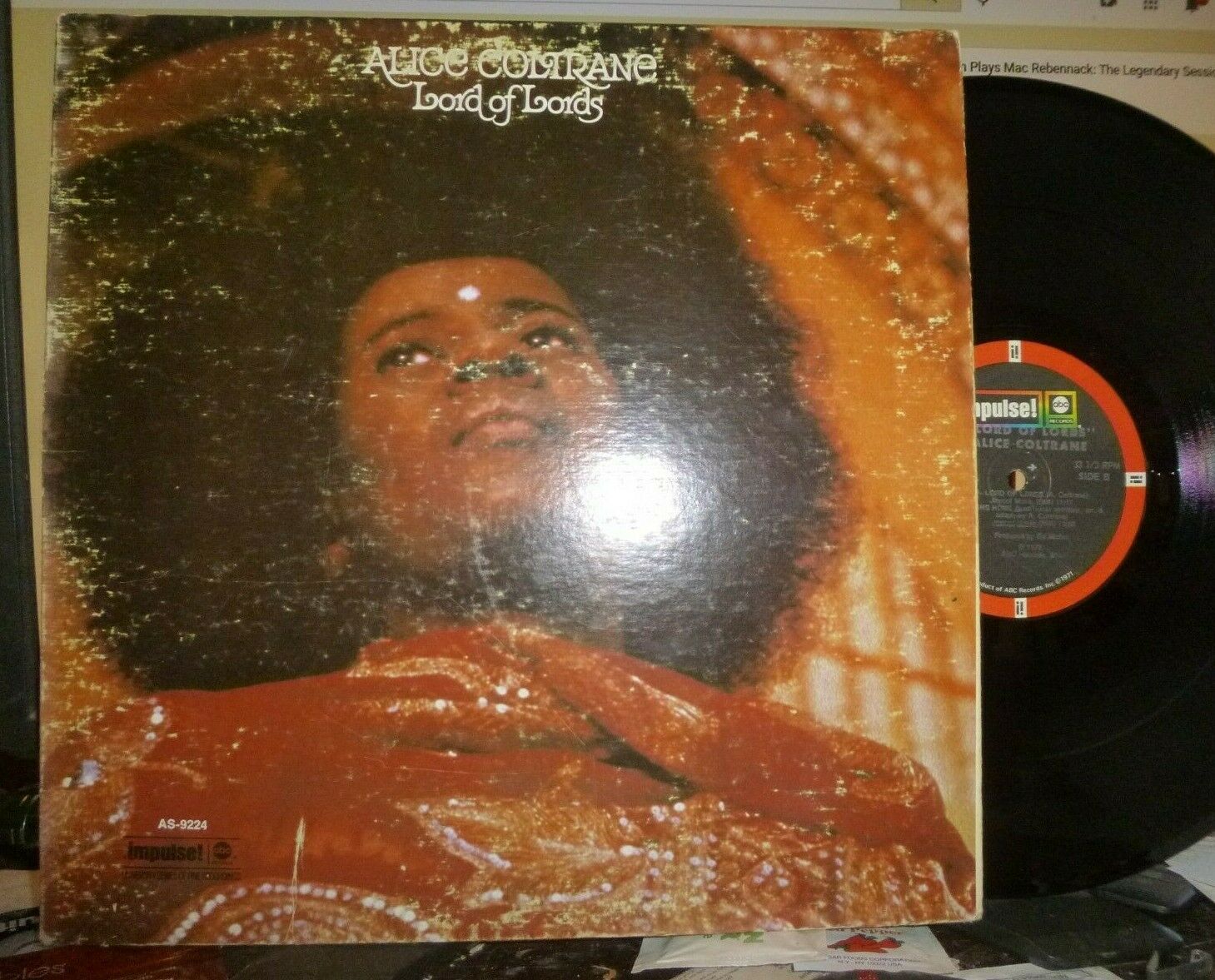
ALICE COLTRANE "Lord of Lords" LP Gatefold NM/VG 1972
$
38


Favourite Auctions
To save auctions to your favourites, please login
If you don't have an account, please register
Description
AllMusic Review by Thom Jurek [-]
Lord of Lords, released in 1973, was Alice Coltrane's final album for Impulse! It was the final part of a trilogy that began with Universal Consciousness and continued with the expansive World Galaxy. Like its immediate predecessors, the album features a 16-piece string orchestra that Coltrane arranged and conducted, fronted by a trio in which she plays piano, Wurlitzer organ, harp, and timpani with bassist Charlie Haden and drummer Ben Riley. Riley was familiar with the setting because he had been part of the sessions for World Galaxy. The first two pieces, "Andromeda's Suffering" and "Sri Rama Ohnedaruth" (titled after the spiritual name for her late husband, John Coltrane), are, in essence, classical works. There is little improvisation except on the piano underneath the wall of strings. They are scored for large tone clusters and minor-key drone effects, but also engage in creating timbral overtones. They are quite beautiful, yet have little or nothing to do with jazz except for the seemingly free passages toward the end of the latter track, but even these feel scored, because of the control of tension and dynamic. "Excerpts from The Firebird," which uses the organ to open the piece, features the strings playing almost (because with Alice Coltrane, she interpreted in her own way) directly from Igor Stravinsky's score. The droning organ is so gorgeous underneath those reaching strings that it's breathtaking. As to why she chose this piece as the centerpiece for her own album, she claimed that Stravinsky came to her in a vision and passed something on to her in a glass vial, a liquid that she drank!
Riley and Haden appear in earnest on the title track, a long modal piece where drones, rhythms, and time signatures are registered through the direction of Coltrane's piano and harp, creating a blissful kind of tension and dynamic. It cracks open at about six minutes, and Coltrane (on the organ), Haden, and Riley engage in some lively improvisation, with the strings offering trilling high-end swooping in the background. The set ends with Coltrane's transformation of a gospel hymn called "Going Home." Her harp introduces Riley's brushes and the strings, which in turn offer a root chord for her to play the melody and improvise upon it on the organ. Here the blues make their presence known. It offers a kind of understanding for the listener that Coltrane, no matter where this musical direction was headed (even as it went further toward the Cosmic Music she and her late husband envisioned together), continued to understand perfectly where her musical root was. The interplay between the three principals is lively and engaging, based on droning blues chords, and her soloing -- even amid flurries of notes -- comes right back to the root, and she quotes quite directly from Delta blues riffs and other gospel songs. Haden's bass is a beautiful anchor here (although mixed a bit low), and the strings offer a lovely response to her organ and harp. Riley's cymbals are shimmering shards of light throughout, ending Lord of Lords on a very high note. While it's true that Alice Coltrane's later Impulse! music may not be for everyone, even those who followed her earlier, more jazz-oriented recordings on Impulse!, it was obvious from the beginning that she was seeking to incorporate Indian classical music's drone center into her work, and was literally obsessed with the timbral, chromatic, and harmonic possibilities of strings. She succeeds here, in ending her Impulse! period with elegance, grace, and soul.
Alice Coltrane ?– Lord Of Lords
Label:
Impulse! ?– AS-9224, ABC Records ?– AS-9224
Format:
Vinyl, LP, Album, Stereo, Gatefold
Country:
US
Released:
1972
Genre:
Jazz
Style:
Free Jazz, Avant-garde Jazz
TracklistHide Credits
A1 Andromeda's Suffering
Written-By – A. Coltrane*
9:04
A2 Sri Rama Ohnedaruth
Written-By – A. Coltrane*
6:12
A3 Excerpts From The Firebird
Composed By – I. Stravinsky*
5:43
B1 Lord Of Lords
Written-By – A. Coltrane*
11:17
B2 Going Home
Adapted By – A. Coltrane*
Written-By – Traditional Spiritual*
10:02
Companies, etc.
Phonographic Copyright (p) – ABC Records, Inc.
Copyright (c) – ABC Records, Inc.
Published By – Jowcol Music
Published By – Belwin-Mills Publishing Corp.
Recorded At – The Village Recorder
Mixed At – The Village Recorder
Pressed By – RCA Records Pressing Plant, Indianapolis
Credits
Bass – Charlie Haden
Cello – Anne Goodman, Edgar Lustgarten (2), Jan Kelly*, Jerry Kessler*, Jesse Ehrlich, Raphael Kramer, Ray Kelley
Drums, Percussion – Ben Riley
Engineer – Baker Bigsby
Harp, Piano, Organ, Timpani [Tympani], Percussion, Arranged By, Conductor – Alice Coltrane
Lacquer Cut By – T.S.*
Producer – Ed Michel
Viola – David Schwartz, Leonard Selic, Marilyn Baker, Myra Kestenbaum, Rollice Dale, Samuel Boghosian*
Violin – Bernard Kundell, Gerald Vinci, Gordon Marron, James Getzoff, Janice Gower, Leonard Malarsky, Lou Klass, Murray Adler, Nathan Kaproff, Ronald Folsom, Sidney Sharp, William Henderson (2)
Notes
Produced by Ed Michel under the direction and inspiration of Alice Coltrane
Recorded and mixed at The Village Recorder, Los Angeles, from July 5 to July 13, 1972
Gatefold jacket includes track times different from those printed on the center labels.
Track duration for this submission taken from center labels.
Center labels mark sides as Side A and Side B.
Label variant: says "A Product of ABC Records Inc. © 1971"
GOLDMINE GRADING
MINT ---- It should appear to be perfect. No scuffs or scratches, blotches or stains, labels or writing, tears or splits. Mint means perfect.
NEAR MINT ---- Otherwise mint but has one or two tiny inconsequential flaws that do not affect play. Covers should be close to perfect with minor signs of wear or age just becoming evident: slight ring-wear, minor denting to a corner, or writing on the cover should all be noted properly.
VERY GOOD PLUS ---- The record has been handled and played infrequently or very carefully. Not too far from perfect. On a disc, there may be light paper scuffs from sliding in and out of a sleeve or the vinyl or some of the original luster may be lost. A slight scratch that did not affect play would be acceptably VG+ for most collectors.
VERY GOOD ---- Record displays visible signs of handling and playing, such as loss of vinyl luster, light surface scratches, groove wear and spindle trails. Some audible surface noise, but should not overwhelm the musical experience. Usually a cover is VG when one or two of these problems are evident: ring wear, seam splits, bent corners, loss of gloss, stains, etc.
GOOD ---- Well played with little luster and significant surface noise. Despite defects, record should still play all the way through without skipping. Several cover flaws will be apparent, but should not obliterate the artwork.
POOR ---- Any record or cover that does not qualify for the above "Good" grading should be seen as Poor. Several cover flaws.
price rating


![Love - Four Sail [180 gm vinyl] NEW SEALED.](https://www.popsike.net/php/thumbnail.php?url=https://www.popsike.pics/pix/20230423/155519427045.jpg)