ARCHIV LP 198-187: J.S. BACH - Suites for Solo Cello Nos. 3 & 4 - FOURNIER 1970s
C$
70
$
49
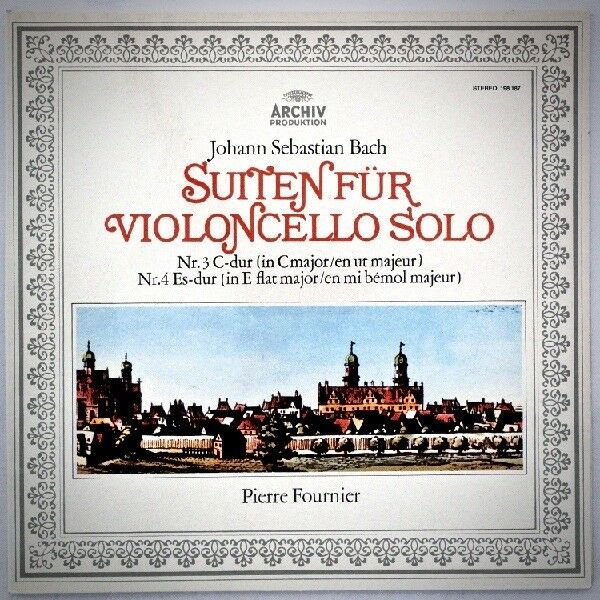
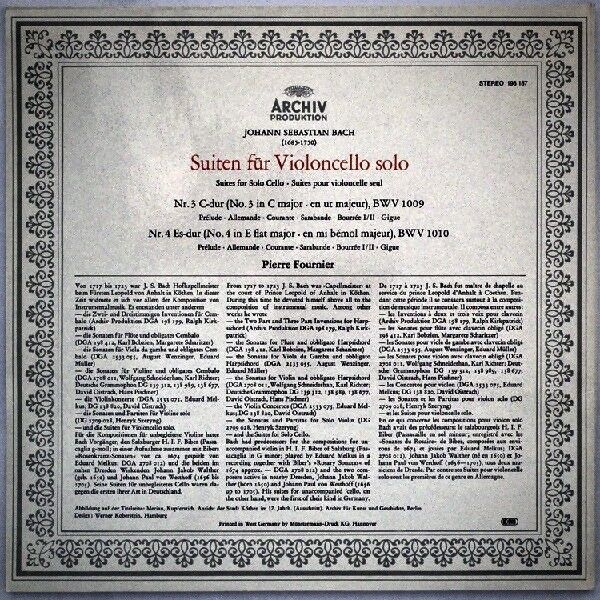


C$ 70
Sold For
Jan 7, 2021
Sold Date
Jan 16, 2019
Start Date
1
Number Of Bids
Canada
Country Of Seller
eBay
Sold at
Favourite Auctions
To save auctions to your favourites, please login
If you don't have an account, please register
Description
****Welcome to our listing, thanks very much for looking!
****See our own website! We have lots of out of print LPs and CDs! Find us on the web at -
hearthedifference.net
****Shipping cost is only an estimate - it depends on the actual weight and size of the package as well as the service required. We do not profit from shipping costs, so if we overcharge, we will refund the difference back to you. It's always best to wait for our invoice before paying for your item. We will combine shipping for multiple items purchased.
****Please see our other listings - new items added daily!
****To access our eBay store click on the little red door at the top right section of any of our eBay listings or, click on -
http://stores.ebay.com/Hear-The-Difference
Background -
Pierre Léon Marie Fournier was born into a military family. His father was a general; his mother was musical and taught him piano lessons. At the age of 9, he suffered a mild attack of polio. Weakness of his legs made pedaling the piano difficult. So he turned to the cello, and after making rapid progress, he was admitted to the Paris Conservatoire. His teachers there were Paul Bazelaire and Anton Hekking; he graduated in 1924 at the age of 17. Fournier made his debut the year after his graduation. This was a solo appearance with the Concerts Colonne Orchestra, which received favorable notices. The almost invariable comment in reviews was the perfection of his bowing technique. He began a successful career as a touring concert artist and as a performer in chamber music concerts, gaining a great reputation in Europe.In 1937 to 1939, he was the director of cello studies at the Ecole Normal. It was often said that he became a friendly rival with his contemporary, cellist Paul Tortelier, and after attending a Tortelier concert remarked to him, "Paul, I wish I had your left hand." Tortelier responded, "Pierre, I wish I had your right." To Fournier, the secret of his great right hand (i.e., bowing technique) was keeping the elbow high, holding the bow firmly, but allowing the hand and arm to move fluidly. He prescribed the Sevcik violin bowing studies for his cello students.
In 1941, he became a member of the faculty at the Paris Conservatoire, but during the war years, his concert touring career was impossible. Once the war was over, though, was able to resume and he rapidly increased in fame and international stature. His old audience found that he had grown in artistic depth. Hungarian violinist Joseph Szigeti, meeting Fournier in rehearsals for a 1947 Edinburgh Festival appearance, had not heard him for over ten years and wrote that he was "tremendously impressed by the Apollonian beauty and poise that his playing had acquired in the intervening years. Szigeti, Fournier, violist William Primrose, and pianist Artur Schnabel formed a piano quartet in those years and gave some fabled concerts at which they played virtually all of Schubert's and Brahms' piano chamber music. Sadly, the BBC acetate air checks of this cycle were allowed to deteriorate and have been lost.
Fournier made his first U.S. tour in 1948. His chamber music partner Artur Schnabel spread the word among cellists, other musicians, and critics that they were to be visited by a great new cellist. The New York and Boston critics were ecstatic. He had to give up his Conservatoire post because of his expanding concert career; he appeared in Moscow for the first time in 1959. Commentator Lev Grinberg wrote that he was notable for a romantic interpretation; clarity of form; vivid phrasing; and clean, broad bowing all "aimed at revealing the content."
He had a broad repertoire, including Bach, Boccherini, the Romantics, Debussy, Hindemith, and Prokofiev. Composers Martinu, Martinon, Martin, Roussel, and Poulenc all wrote works for him. He had a standing Friday night date to privately play chamber music with Alfred Cortot, the eminent French pianist, at which they might be visited by musicians like Jacques Thibaud. In 1953, he became a Chevalier of the Legion of Honor and was promoted to officer in 1963.
In 1972, he retired to Switzerland and gave master classes. He still gave concerts, even as late as 1984 when he was 78, and a London critic praised the fluency of his playing and his strong and solid left-hand technique. - Joseph Stevenson
-
LP made by ARCHIV PRODUCTION Records, in GERMANY
-
LP released circa 1970s
-
LP recorded in STEREO
-
Record Catalog Number: 198 187
-
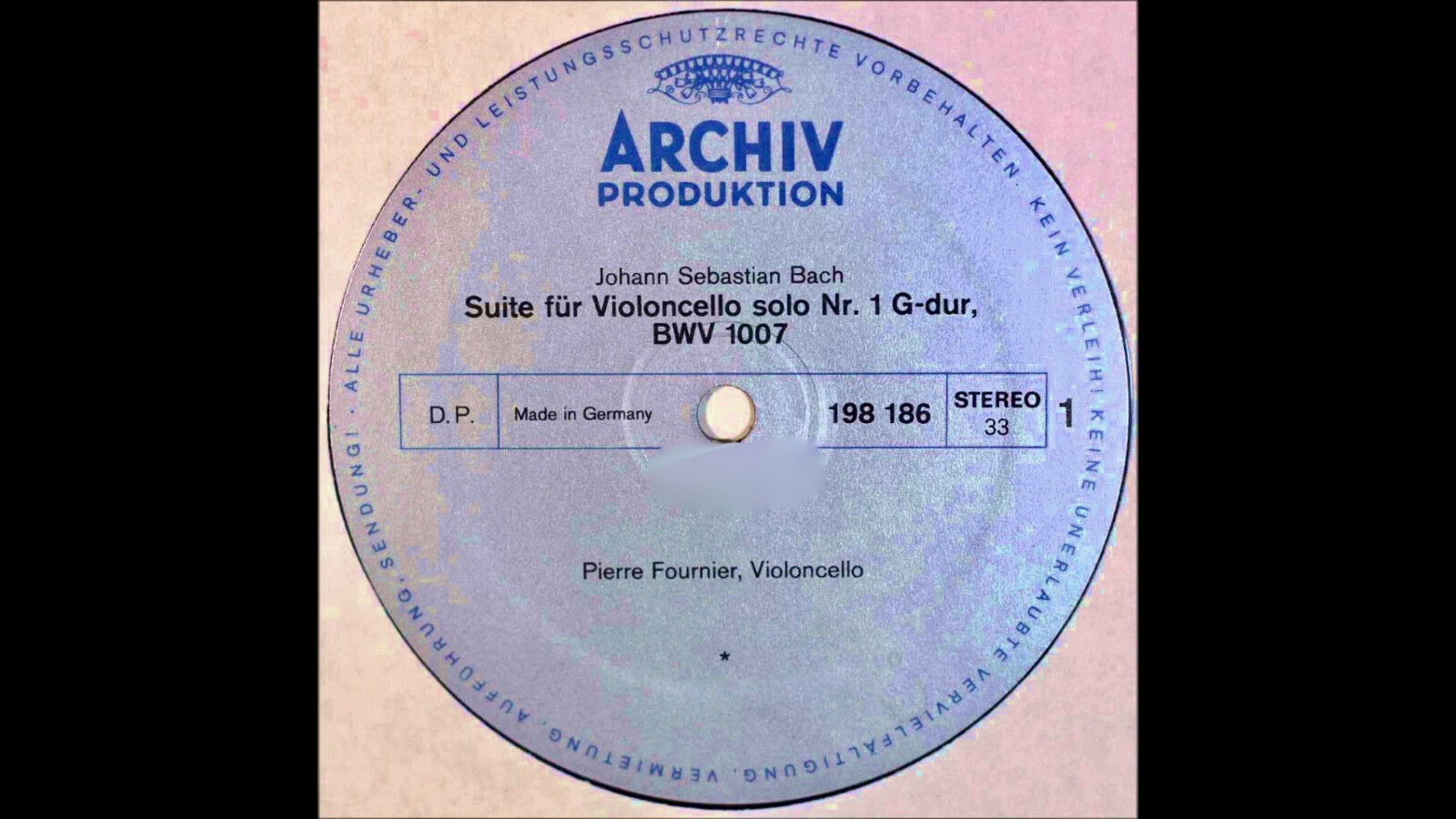
Record Labels are primarily SILVER with BLACK & BLUE lettering, and has the "ARCHIV PRODUKTION" logo on the record labels.
J.S. Bach // Pierre Fournier
Solo Cello Suites: No. 3 in C Major / No. 4 in E Flat Major
Track Listing -
A. Suiten Für Violoncello Solo Nr. 3 C-dur, BMV 1009B. Suiten Für Violoncello Solo Nr. 4 Es-dur, BMV 1010
Performers / Credits -
• Cello – Pierre Fournier
• Composed By – Johann Sebastian Bach
• Engineer, Recording Supervisor – Heinz Wildhagen
• Liner Notes – Erich Dolfein
• Painting – Jakob Ihle
• Producer – Karl-heinz Schneider
• Score Editor [Herausgeber (Editor / Editeur)] – E. H. Müller von Asow, Paul Grümmer
Other Information -
• Recorded At – Beethovensaal, Hannover
CONDITION Details:
The GATE-FOLD LP Jacket is in near mint minus condition! The jacket has NO seam splits or crushed corners. It shows some minor/light shelf wear primarily at the seams and corners.
The LP is in excellent plus condition! We found that the vinyl looked excellent on this vintage LP. There are no significant marks and the LP retains much of the original gloss and sheen! There are a couple of light spider marks, caused by sliding the LP in and out of the inner sleeve. There may be a bit of dust and perhaps a finger print or two on the vinyl so it should be cleaned before playing. There are NO serious spindle marks on the record labels either. Acquiring a vintage LP like this is for the performance and rarity of the LP, not necessarily for the sound quality.
A Short Note About LP GRADING -- Mint = Only used for sealed items.
- Near Mint = Virtually flawless in every way.
- Near Mint Minus = Item has some minor imperfections, some audible.
- Excellent = Item obviously played and enjoyed with some noise.
- Very Good Plus = Many more imperfections which are noticeable and obtrusive.
For best results, always properly clean your LPs before playing them.
The LP is an audiophile quality pressing (any collector of fine MFSL, half speeds, direct to discs, Japanese/UK pressings etc., can attest to the difference a quality pressing can make to an audio system).
Don't let this rarity slip by!!!
price rating