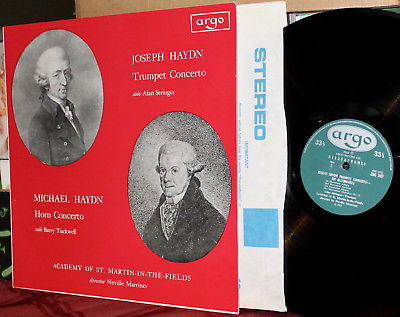
ARGO LP ZRG-543: J. HAYDN Trumpet / M. HAYDN Horn Concs. - TUCKWELL 1967 OVAL UK
$
35


$ 35
Sold For
Sep 2, 2018
Sold Date
Jan 16, 2018
Start Date
$ 50
Start price
1
Number Of Bids
USA
Country Of Seller
eBay
Sold at
Favourite Auctions
To save auctions to your favourites, please login
If you don't have an account, please register
Description
****Welcome to our listing, thanks very much for looking!
****See our own website! We have lots of out of print and rare LPs and CDs! Find us on the web at -
hearthedifference.net
****Shipping cost is only an estimate - it depends on the actual weight and size of the package as well as the service required. We do not profit from shipping costs, so if we overcharge, we will refund the difference back to you. It's always best to wait for our invoice before paying for your item. We do combine multiple items.
****Please see our other listings for more great LPs and CDs - new items added daily!****To access our eBay store click on the little red door at the top right section of any of our eBay listings or, click on -
http://stores.ebay.com/Hear-The-Difference
Background -
Barry Emmanuel Tuckwell AC, OBE (born 5 March 1931) is an Australian horn player who has spent most of his professional life in the United Kingdom and the United States. He was born on 5 March 1931 in Melbourne, son of Charles Tuckwell, an organist, and his wife Elizabeth (5 March is known by many as the Horn Duumvirate Date, as it was the birth date of both Tuckwell and Philip Farkas, perhaps the two most notable horn players ever). He has an older sister, Patricia, a violinist and fashion model widely known as Bambi. She married the photographer Athol Shmith and later George Lascelles, 7th Earl of Harewood, a first cousin of Queen Elizabeth II.After studying the piano, organ and violin as a chorister at St Andrew's Cathedral, Sydney, Tuckwell was introduced to the horn at age 13 and was playing professionally within six months. He studied at the Sydney Conservatorium of Music under Alan Mann, one of Australia's most influential brass players. Tuckwell has said, "The horn chose me. Right from the beginning, it was something I knew I could do."
Tuckwell relates an anecdote regarding his choice of instrument: sitting in a cafe one day with his sister Patricia, Charles Mackerras and a horn player from the local symphony, Patricia speculated on what Tuckwell's future in music might be. The horn player suggested, "Why not try the horn?" Tuckwell did so and within two years was playing in the Sydney Symphony Orchestra. With characteristic humor, when recounting this at the British Horn Society's festival in 2005, he turned to the audience and said, "One note a time, piece of cake!" The horn is often reckoned to be one of the most difficult orchestral instruments to master.
At 15, he was appointed by Joseph Post as third horn with the Melbourne Symphony Orchestra. A year later, he joined the Sydney Symphony Orchestra under Eugene Goossens, where he remained for three and a half years before leaving for England. His first appointment in 1951 was with the Hallé Orchestra under Sir John Barbirolli. After two years, he went to the Scottish National Orchestra under Karl Rankl and a year later to the Bournemouth Symphony Orchestra under Charles Groves. In 1955, he was appointed first horn with the London Symphony Orchestra.
During his 13 years with the LSO, which is a co-operative orchestra run entirely by the players, he was elected to the Board of Directors and was Chairman of the Board for six years. The chief conductors during this time were Josef Krips, Pierre Monteux, István Kertész and André Previn.
He resigned from the orchestra in 1968 to pursue a career as a soloist and conductor. For the next thirty years, he carved out a career exclusively as soloist — one of the few horn virtuosos to have done so, rather than combining occasional concert performances with an orchestral position or a teaching post. His last concert was with the Baltimore Symphony Orchestra in 1997.
He is one of the most recorded horn soloists, having made over 50 recordings. He has received three Grammy Award nominations.
Barry Tuckwell is perhaps the world's most renowned French horn player and is believed to have made more recordings than any other hornist in history. As a child, he studied violin and piano, as taught by his father and older brother. He was a chorister at St. Andrew's Cathedral in Sydney and also served as organist there. He began to study horn at 13 with Alan Mann of the Sydney Conservatory. He made such rapid progress that he became a member of the Sydney Symphony Orchestra at the age of 15, remaining in the orchestra from 1947 to 1950. By that time he had publicly performed nearly every major concerto in the standard repertory.
He went to England at 19, in part because of Britain's wider career opportunities, but also to study informally with the great horn virtuoso Dennis Brain. Tuckwell also credits listening to the recordings of jazz trombonist Tommy Dorsey with shaping his idea of brass sound.
Tuckwell's professional career blossomed first as the assistant first horn in the Hallé Orchestra in Manchester, then with the Scottish National Orchestra, and eventually the first horn of the Bournemouth Symphony Orchestra. In 1955, at the age of 24, he became principal horn of the London Symphony Orchestra. He became regarded as one of the most able and respected members of the orchestra, which elected him to its Board of Directors, and ultimately to its chairmanship.
During his LSO years he appeared regularly as a soloist, and in 1968 he left the orchestra to pursue a career exclusively as a horn soloist. He toured and taught widely all over the world, and is responsible for the commissioning of works that have become important addition to the horn repertory, including compositions by Gunther Schuller, Oliver Knussen, Richard Rodney Bennett, Thea Musgrave, and Ian Hamilton.
He was the first President of the International Horn Society (1970-1976) and served another term from 1992-1994, and is now a member of its Advisory Committee. He has worked diligently to advance horn playing and has worked on instrument design with makers such as Holton and Lawson. He was professor of horn at the Royal Academy of Music in London (1962-1972), Artist-in-residence at New Hampshire's Dartmouth College, Pomona College in California, and the Stratford Festival in Ontario. Tuckwell is also a noted editor of horn music and has authored two books on the techniques of horn playing.
In 1982 he helped found the Maryland Symphony Orchestra, serving as its music director into 1998. He was also music director of the Tasmanian Symphony Orchestra in Hobart, Australia. He also frequently appears as a guest conductor and has recorded an album of Wagner overtures. In 1992 Tuckwell was granted permanent U.S. residency under the new "Extraordinary Ability" immigration category, and became a U.S. citizen in 1997. He retired from professional horn playing in 1996, at the age of 65. He continues to conduct and teach, and works with promising youngsters at the Kendall Betts Horn Camp, Lyman, NH. - Joseph Stevenson
Alan Stringer (1928 - 2012) was principal trumpet of the Royal Liverpool Philharmonic Orchestra from 1953 to 1993, except for 1960–1961 when he played principal with the London Symphony Orchestra.
He was born on December 8th, 1928 in Manchester. At age eleven, he became solo cornet of the chapel band at Oldham Road Brotherhood Chapel where his mother sang solos and father played piano and managed the chapel band’s finances. A young Alan Stringer also joined the Victoria Hall Chapel Band and the Windsor Institute Band in Salford. Stringer’s first teacher, Mr. Dooley, conducted all three ensembles.
At the age of sixteen, Stringer played Principal Cornet of the Besses o’th Barn Brass Band, and even won the best cornet soloist prize and best soprano soloist prize in the same performance. From 1946 to 1952, Stringer played in the Royal Air Force Band. He met his wife Alice, a trombone player with the band, at this time. Then in 1953 he auditioned for the conductor of the Royal Liverpool Philharmonic Orchestra, Hugh Rignold, and at age twenty-four won the job as first trumpet with the RLPO, with no repertoire or sight reading in the audition. While in his tenure with the RLPO, he also taught at the Royal Northern College of Music and Chetham’s School of Music.
Stringer can be heard on many recordings, including his recording of the Haydn Concerto with the Academy of St. Martin in the Fields with Neville Marriner conducting, and his trumpet and organ record with organist Noel Rawsthorne.
After retirement he moved to France and lived in Nerac, between Bordeaux and Toulouse. He died September 8, 2012, nearly 84 years old.
On May 26, the Royal Liverpool Philharmonic Orchestra hosted a commemoration of the life of Alan Stringer at The Fly In The Loaf. Many famous trumpeters, brass players, musicians, friends, and family from several generations attended to celebrate Stringer’s life. People shared stories and recalled anecdotes as they warmly remembered and celebrated Stringer. - Brendan Ball
Rivaled only by Nikolaus Harnoncourt, Neville Marriner was one of the most important of the early figures who spearheaded the reawakening of modern interest in Baroque and early Classical music. In the 1950s, he founded Academy of St. Martin-in-the-Fields, the first British early music ensemble to find a large international audience. Marriner has since become one of the most popular conductors in the world, acclaimed for his interpretations of composers from Bach to Britten.
Marriner was first taught the violin as a child, by his father, and attended the Royal College of Music, beginning at age thirteen. Wounded during World War II, he met future collaborator Thurston Dart during his hospitalization. In 1948 he became professor at the Royal Academy of Music. As well as joining the Martin String Quartet as second violin, he formed a violin-and-harpsichord duet with Dart, and their performances led to the formation of the Jacobean Ensemble, an early music group that recorded the Purcell trio sonatas in 1950. Around this time, he began studying conducting with Pierre Monteux at Monteux's school in Maine. Marriner's reputation in general music circles also grew; in 1956 he was appointed principal second violin with the London Symphony Orchestra.
A turning point came in 1959, when Marriner was asked to supply music for the church of St. Martin-in-the-Fields, in London's Trafalgar Square. Marriner formed a chamber orchestra which he named the Academy of St. Martin-in-the-Fields. The group's work attracted the attention of the Decca imprint L'Oiseau Lyre, which recorded its performance of Couperin's Les Nations. Favorable reviews and unexpectedly robust sales of this recording led to more recordings for L'Oiseau Lyre and its sister label Argo, and by the end of the 1970s the Academy of St. Martin-in-the-Fields had become the best-selling chamber orchestra in recorded music's history. The group expanded from 13 players to twenty or more, and performed Classical symphonic works and 20th century British music as well as Baroque material. The sound of Marriner's Academy recordings is crisp, with an extremely bright sound, using period performance standards with modern instruments. Marriner's name remains closely associated with the Academy of St. Martin-in-the-Fields, and the group now has more than 300 recordings to its credit. These include the soundtrack for the 1984 film Amadeus, for which Marriner selected, arranged, and directed works of Salieri and Pergolesi, in addition to Mozart.
In 1969 Marriner he organized the Los Angeles Chamber Orchestra, and he later took this orchestra on a tour of Europe. Additionally, he served as a guest conductor with leading U.S. orchestras, and in England held an appointment as conductor of the Northern Sinfonia, based in Newcastle. In the late 1970s and early 1980s, he spent most of his time in the U.S., primarily as music director and conductor of the Minnesota Orchestra. After being knighted in 1985, Marriner went back to Europe, conducting of the Stuttgart Radio Symphony Orchestra from 1986-1989. He continued to conduct around the world, including at the Opéra de Lyon, and to record. In 2014, at the age of 90, he became the oldest conductor to lead a Proms concert to date.
His conducting was known for its vitality and brightness, as well as precise ensemble technique, a reflection of his violinist days. In a 1991 interview he said of his style: "I was never a potentate swinging a scepter, but was always in a dialogue with my musicians.” - Rovi Staff
-
LP made by ARGO, a division of DECCA Records, in the UK / England / Great Britain
-
LP released in 1967
-
LP is recorded in STEREO
-
Record Catalog Number: ZRG 543
-
Record Labels are primarily GREEN (Teal) with SILVER lettering, featuring the earliest ARGO Records "OVAL" logo on the record labels, with "Made in England" at the 2 o'clock position.
- LABELS:
- GREEN (Teal) label / silver text / large oval 'argo' logo
- "? 1967"
- "REGD. ? ARGO RECORD CO. LTD."
- "MADE IN ENGLAND"
SLEEVE:
- Front laminated
- No flip-backs
- "THE DECCA RECORD COMPANY LIMITED Argo division 115 Fulham Road London SW3"
- "Printed by Graphis Press Limited"
- "MADE IN ENGLAND"
• Matrix / Runout (Side 1 Label): ZRG 2965-2G I JT 1 (starting at 6 o’clock position in dead wax and moving counter clockwise)
• Matrix / Runout (Side 2 Label): ZRG 2966-2G N JT 3B
Joseph Haydn // Michael Haydn // Tuckwell // Stringer // Marriner
LP Title and Music on this rare LP -Joseph Haydn Trumpet Concerto / Michael Haydn Horn Concerto
Trumpet Concerto
Composed By – Joseph HaydnTrumpet – Alan Stringer
A1 1st Movement Allegro
A2 2nd Movement Andante
A3 3rd Movement Allegro
A4 Six Allemandes (Hoboken IX:9)
Composed By – Joseph Haydn
Horn Concerto
Composed By – Michael HaydnHorn – Barry Tuckwell
B1 1st Movement Larghetto
B2 2nd Movement Allegro Non Troppo
B3 3rd Movement Mennuet
B4 Six Minuets
Composed By – Michael Haydn
Performers / Credits on this disc include -
• Composed By – Joseph Haydn (tracks: A1 to A4), Michael Haydn (tracks: B1 to B4)
• Conductor – Neville Marriner
• Harpsichord [Cembalo continuo] – Colin Tilney
• Horn – Barry Tuckwell (tracks: B1 to B4)
• Liner Notes – H.C. Robbins Landon
• Orchestra – Academy Of St. Martin-In-The-Fields
• Trumpet – Alan Stringer (tracks: A1 to A4)
CONDITION Details:
The LP jacket is in near mint minus condition. The jacket is tight and clean, with NO seam splits. It is laminated on the front of the jacket, not back. The corners are solid. The colors on the jacket are sharp with NO discoloration on the front or back. The corners and seams show very little shelf wear due to the age (see pictures with this listing for more detail as they are of the actual item).
The LP is in near mint minus condition! There are no serious marks on the vinyl. There may be some very light spider marks on the LP which are caused by sliding the LP in and out of the inner sleeve. Most of the time, these types of marks are not audible, but it really depends on the sensitivity of your audio gear. This is not a new audiophile LP....some extraneous sound is inevitable and should be expected for a vintage LP. A vintage record is rarely perfect. The LP retains much of the original gloss and sheen! There are NO serious spindle marks on the record labels either. That said, acquiring a vintage LP like this is for the performance and rarity of the LP, not necessarily just for the sound quality.A Short Note About LP GRADING -
- Mint = Only used for sealed items.
- Near Mint = Virtually flawless in every way.
- Near Mint Minus = Item has some minor imperfections, some audible.
- Excellent = Item obviously played and enjoyed with some noise.
- Very Good Plus = Many more imperfections which are noticeable and obtrusive.
For best results, always thoroughly clean your LPs before playing them.
LPs can be audiophile quality pressings (any collector of fine MFSL, half speeds, direct to discs, Japanese/UK pressings etc., can attest to the difference a quality pressing can make to an audio system).
Don't let this rarity slip by!!!price rating