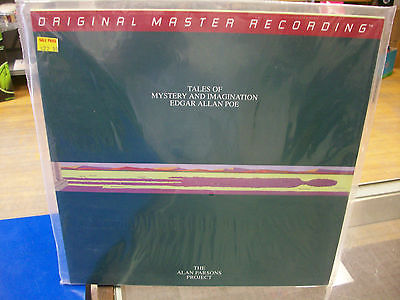
Alan Parsons Project Tales of Mystery and Imagination Original Master Recording
$
109


Favourite Auctions
To save auctions to your favourites, please login
If you don't have an account, please register
Description
Alan Parsons Project Tales of Mystery and Imagination Original Master Recording Special Limited Edition Numbered Copy - No. 0371 Half-Speed Master Mobile Fidelity Sound Lab
New Old Stock - unopened still sealed! MFSL 1-204
Tales of Mystery and Imagination Edgar Allan Poe is the debut album by the progressive rock group The Alan Parsons Project, released in 1976. The lyrical and musical themes – retellings of horror stories and poetry by Edgar Allan Poe — attracted a cult audience. The title of the album is taken from a popular title for a collection of Poe's macabre tales of the same name, Tales of Mystery & Imagination, first published in 1908 and reprinted many times since.
Musicians featured on the album include vocalists Arthur Brown of The Crazy World of Arthur Brown on The Tell Tale Heart and Terry Sylvester of The Hollies on To One In Paradise. The complete line-up of bands Ambrosia and Pilot play on the record, along with keyboardist Francis Monkman of Curved Air and Sky.
Tales of Mystery and Imagination peaked at No. 38 on Billboard's Pop Albums chart. "(The System Of) Doctor Tarr And Professor Fether" peaked at No. 37 on the Pop Singles chart.
Song information[edit]
"The Raven" features actor Leonard Whiting on lead vocals, with Alan Parsons performing vocals through an EMI vocoder. According to the album's liner notes, "The Raven" was the first rock song ever to feature a digital vocoder.
The Prelude section of "The Fall of the House of Usher", although uncredited, is inspired by the opera fragment "La chute de la maison Usher" byClaude Debussy which was composed between 1908 and 1917.[1] "The Fall of the House of Usher" is an instrumental suite which runs 16 minutes plus and takes up most of Side 2 of the recording.
On "The Raven", notes from both "I Robot" and "Breakdown" from the I Robot album can be heard. "To One in Paradise" has musical similarities to "Siren Song" on Alan Parsons' 1993 solo debut Try Anything Once.
Reception[edit]
Professional ratings Review scores Source Rating Allmusic [2] Rolling Stone (mixed)[3]Critical reaction to the album was often mixed; for example, Rolling Stone's Billy Altman concluded that it did not completely accurately reproduce Poe's tension and macabre fear, ending by claiming that "devotees of Gothic literature will have to wait for someone with more of the macabre in their blood for a truer musical reading of Poe's often terrifying works". Still, it was a mildly positive review.[4]
Release history[edit]
Originally simply called The Alan Parsons Project, the album was successful enough to achieve gold status. The identity of The Alan Parsons Project as a group was cemented on the second album, I Robot, in 1977.
The original version of the album was available for several years on vinyl and cassette, but was not immediately available on CD.
In 1987, Parsons completely remixed the album, including additional guitar passages and narration (by Orson Welles) as well as updating the production style to include heavy reverb and the gated reverb snare drum sound, which was popular in the 1980s. The CD notes that Welles never met Parsons or Eric Woolfson, but sent a tape to them of the performance shortly after the album was manufactured in 1976.
The first passage narrated by Welles on the 1987 remix (which comes before the first track, "A Dream Within a Dream") is sourced from an obscure nonfiction piece by Poe – No XVI of his Marginalia (from 1845 to 1849 Edgar Allan Poe titled some of his reflections and fragmentary material "Marginalia.") The second passage Welles reads (which comes before "The Fall of the House of Usher" (Prelude), seems to be a partial paraphrase or composite from nonfiction by Poe, chiefly from a collection of poems titled "Poems of Youth" by Poe (contained in "Introduction to Poems – 1831" in a section titled "Letter to Mr. B-----------"; the "Shadows of shadows passing" part of the quote comes from the Marginalia.
In 1994 Mobile Fidelity Sound Lab (MFSL) released the original 1976 version on CD (UDCD-606), making the original available digitally for the first time.
In 2007, a Deluxe Edition released by Universal Music included both the 1976 and the 1987 versions remastered by Alan Parsons during 2006 with eight additional bonus tracks.
Remakes[edit]
A variant of this song[which?] appears on the Eric Woolfson album Edgar Allan Poe (2009), which contains the complete music from Woolfson's 2003 stage musical of the same name. The variant track does not appear on Woolfson's 2003 CD Poe: More Tales of Mystery and Imagination, which was a highly abridged version of the stage musical. On the variant, the bass line and keyboard chords of the original Tales of Mystery and Imagination track are heard, but they are quieter, do not feature a vocoder, and instead of an abridged version of the Poe poem being sung, the Woolfson version features a fuller spoken dramatic reading of the poem.
Alan Parsons album A Valid Path includes "A Recurring Dream Within A Dream", a composite of "A Dream Within A Dream" and "The Raven" incorporating electronic music influences.
Legacy[edit]
In July 2010, the album was named as one of Classic Rock magazine's "50 Albums That Built Prog Rock".[5]
Slough Feg covered "The Tell-Tale Heart" for their 2010 album The Animal Spirits.
Track listing[edit]
All songs written by Alan Parsons and Eric Woolfson, except where noted.
Side one[edit]
- "A Dream Within a Dream" – 4:14
- instrumental
- "The Raven" – 3:57
- ft. Leonard Whiting on lead vocals, Alan Parsons lead vocal through an EMI vocoder
- "The Tell-Tale Heart" – 4:38
- ft. Arthur Brown
- "The Cask of Amontillado" – 4:33
- ft. John Miles
- "(The System of) Dr. Tarr and Professor Fether" – 4:20
- ft. John Miles and Jack Harris
Side two[edit]
- "The Fall of the House of Usher" (Parsons/Woolfson/Powell) – 16:10
- instrumental
- "Prelude" – 7:02
- "Arrival" – 2:39
- "Intermezzo" – 1:00
- "Pavane" – 4:36
- "Fall" – 0:51
- "To One in Paradise" – 4:46
- ft. Terry Sylvester on lead vocals, backing vocals by Eric Woolfson
Orson Welles' narration appears on the 1976 Mix and the 1987 Remix at the beginning of "A Dream Within a Dream".
price rating