BENNY GOODMAN Joseph Szigeti BELA BARTOCK Contrasts for Violin Clarinet & Piano
$
80

Favourite Auctions
To save auctions to your favourites, please login
If you don't have an account, please register
Description
Please note: This is only offered to the USA because I intend on over packing this and the International shipping cost, would be outrageous. In the USA I will pay any extra shipping costs.
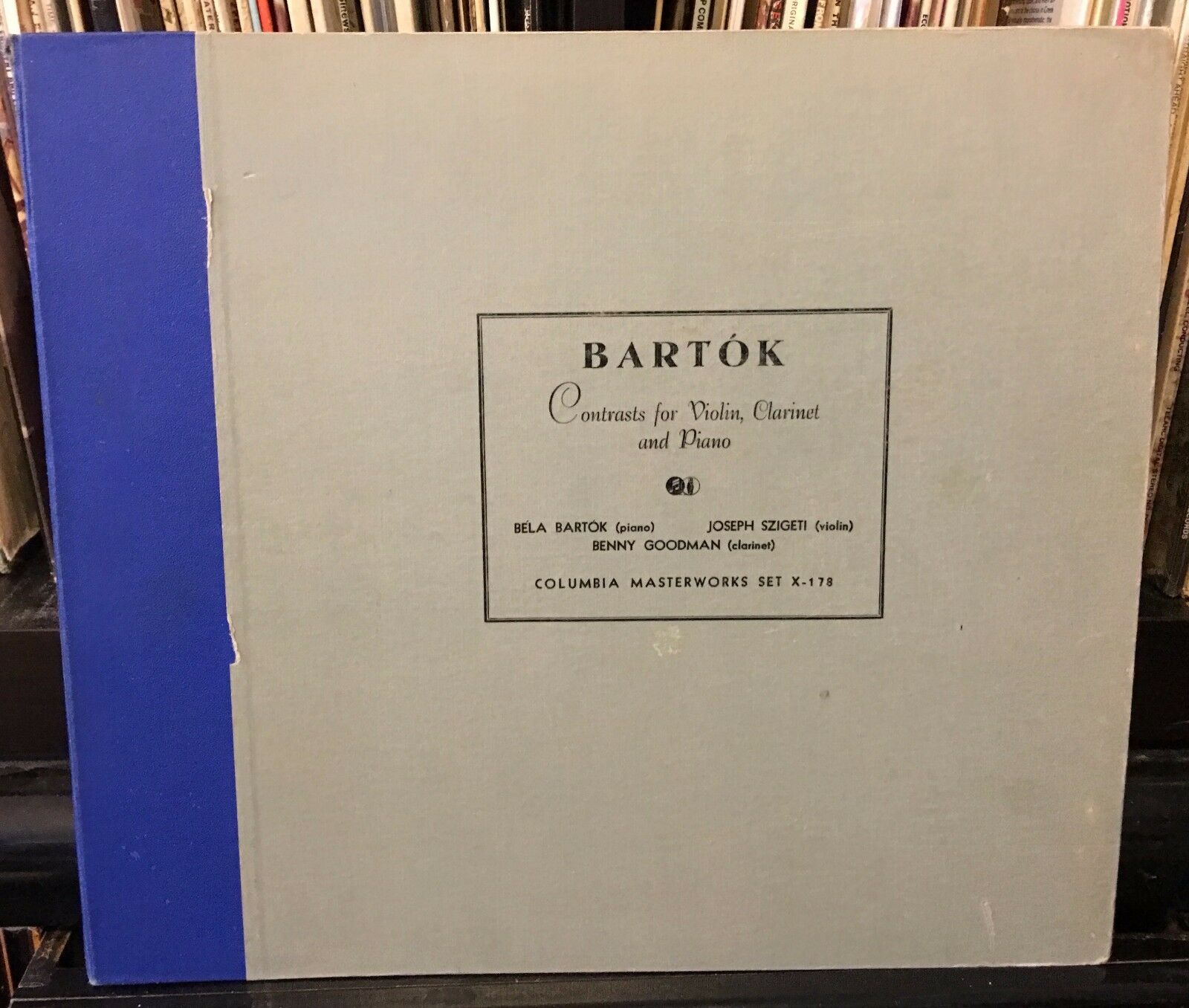
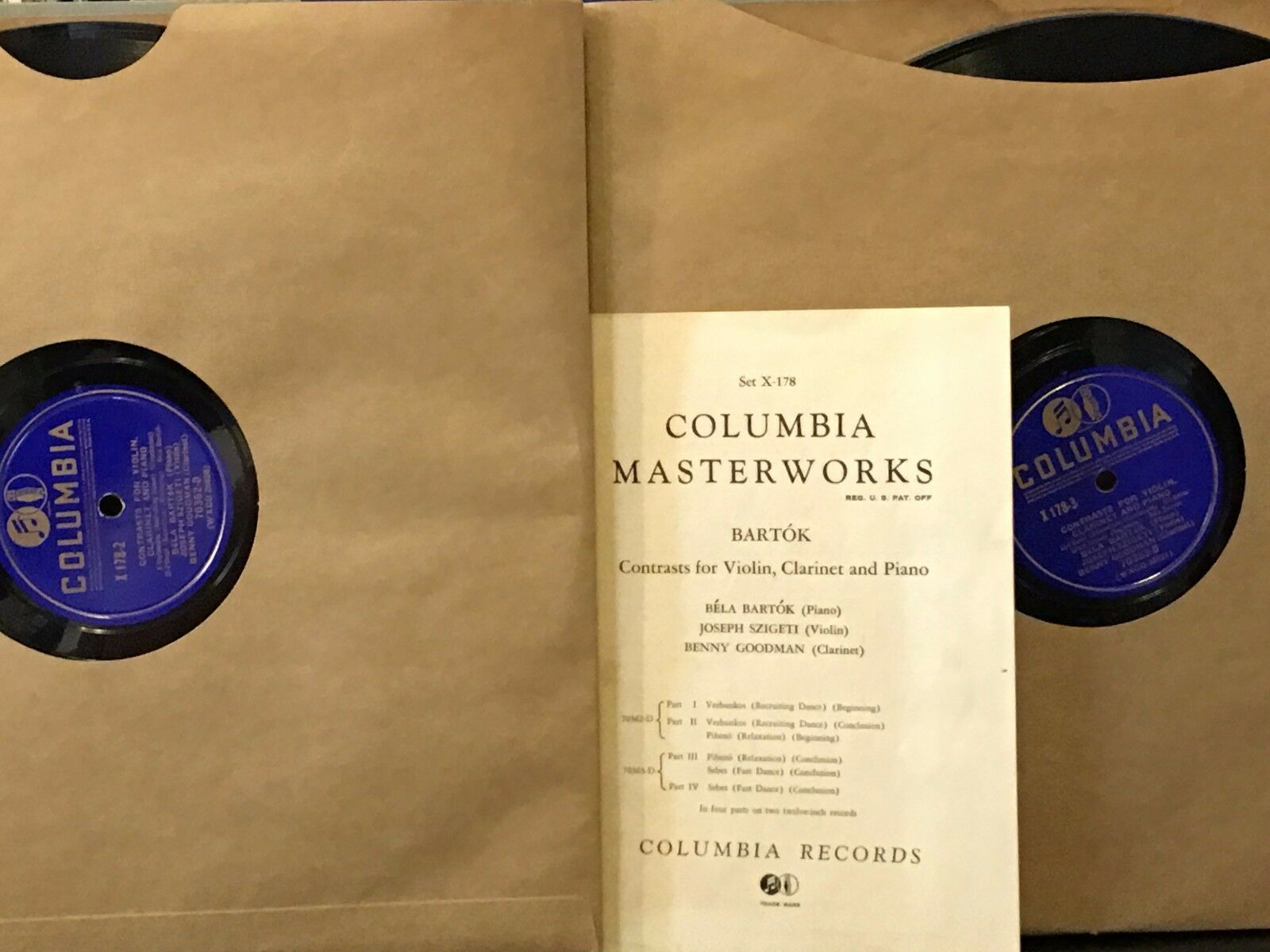
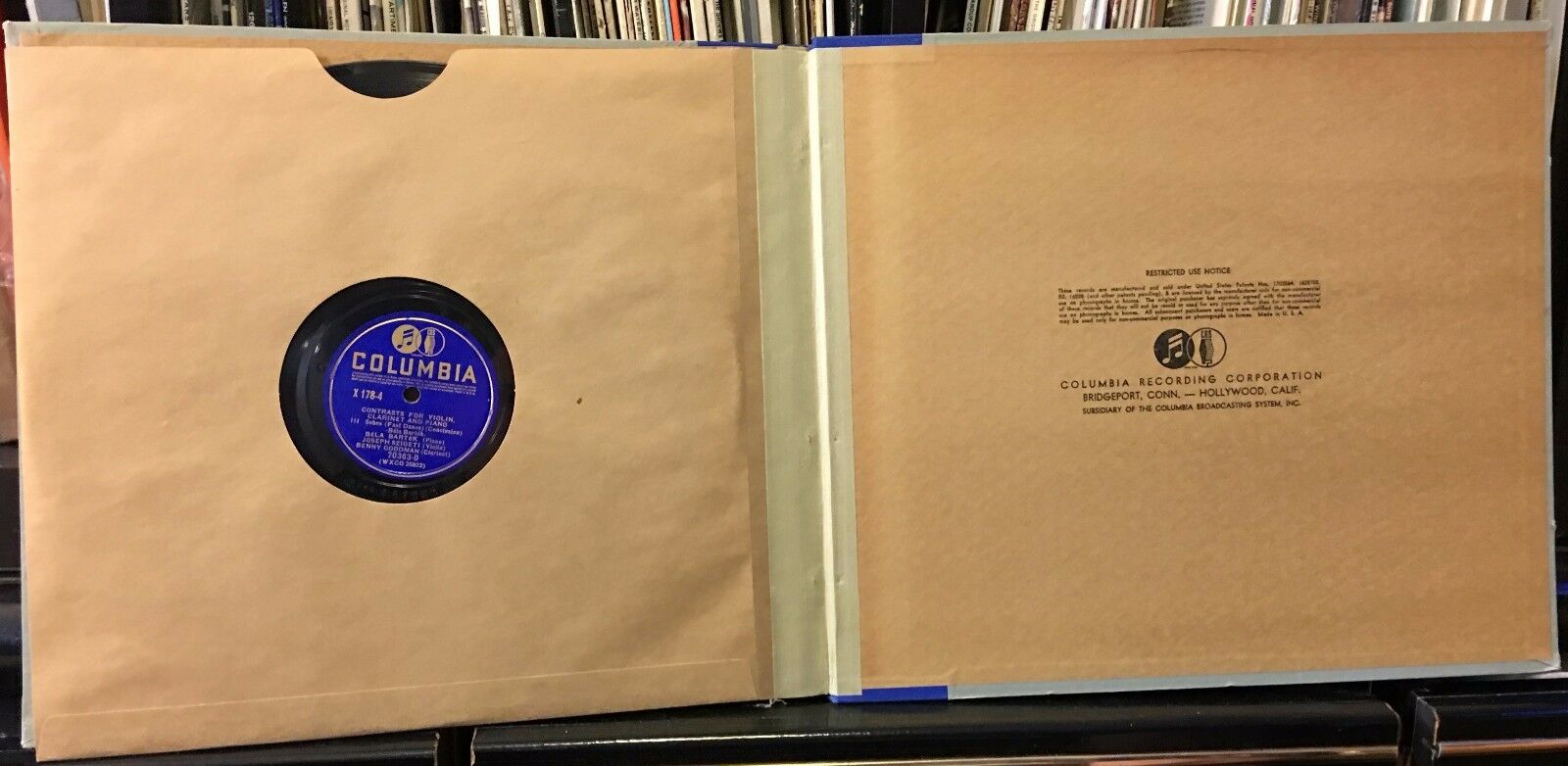
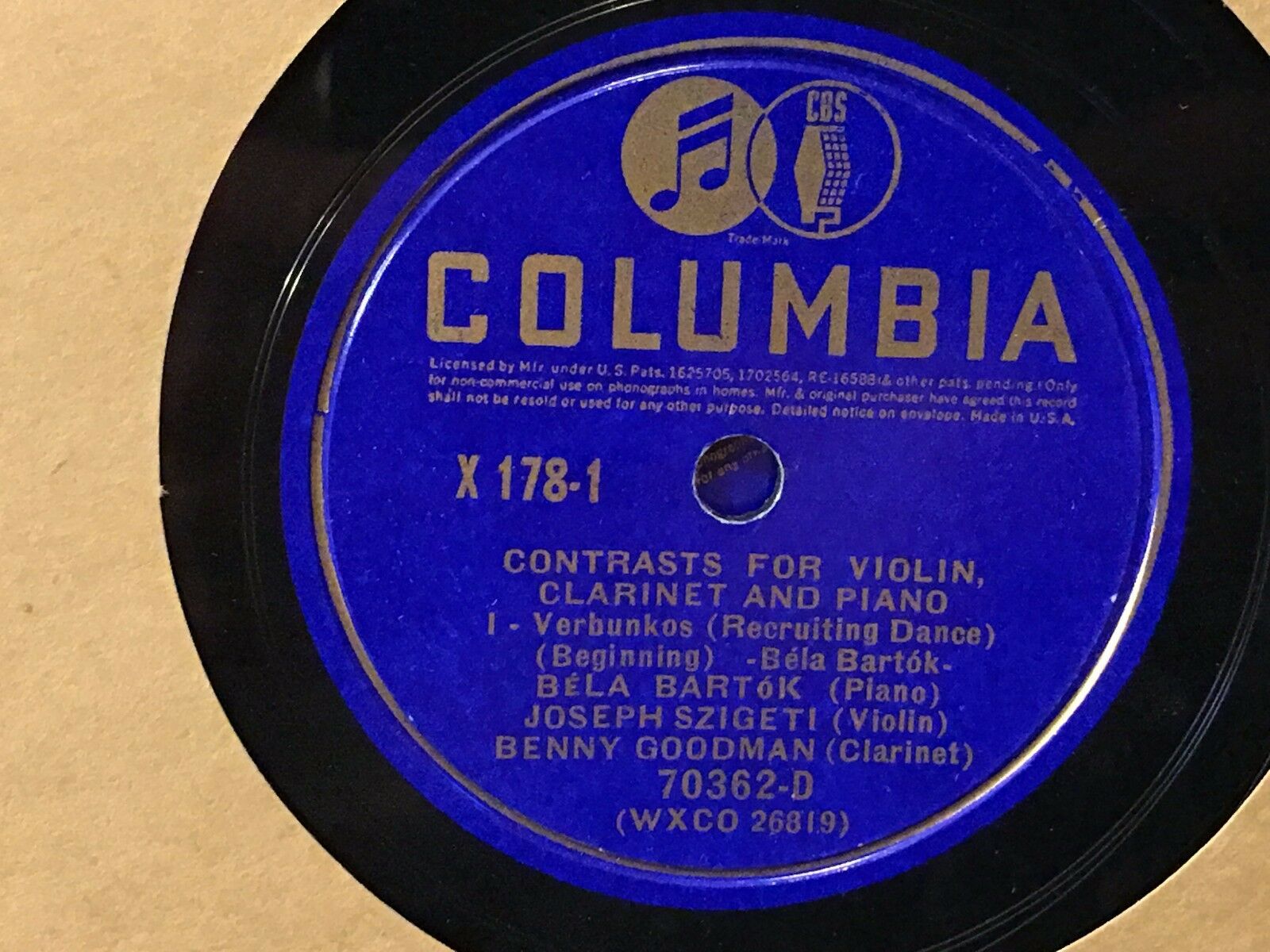
2 12" 2 sided 78'S in album (& insert) BELA BARTOK's Contrasts for Violin Clarinet & Piano Bela Bartok piano, Joseph Szigeti violin, Benny Goodman clarinet 1940 Columbia Masterworks set X-178 (MX 178-1; MX 178-4; MX-178-2; MX 178-3)
CONDITION (VJM 78 GRADING SCALE see below) DISCS: E very clean, i only see 5 or 6 superficial lines in total & 2 pin head indentations (together probably where a needle was dropped to heavily) none of which seemed to cause any sound. Only very minor surface sound. COVER / SLEEVE: VG+ (standard grading) some staining on the back sleeve, the very top of the spine has about a 1/8th inch split on one side and a 1/4 inch split on the other.
The work is in three movements:
- Verbunkos - Recruiting Dance
- Pihen? - "Relaxation"
- Sebes - Fast Dance
This is the first-ever recording of this Bartok composition
"Contrasts (Sz. 111, BB 116) is a 1938 composition scored for clarinet-violin-piano trio by Béla Bartók (1881-1945).
It is based on Hungarian and Romanian dance melodies and has three movements with a combined duration of 17–20 minutes.
Bartók wrote the work in response to a letter from violinist Joseph Szigeti, although it was officially commissioned by
clarinetist Benny Goodman. Bartók's only chamber piece to include a wind instrument, the piece is frequently performed
by the Verdehr Trio and was recorded for their Making of a Medium Series.
Szigeti originally wanted Bartók to write a short piece with two movements and a total duration of 6–7 minutes. This was most likely
so that a recording of it would be able to fit cleanly on a single gramophone record, with one movement on each side with capacity
for approximately four minutes running time.The first version of the work, titled Rhapsody, received its premiere on 9 January 1939
at Carnegie Hall, with Szigeti, Goodman, and pianist Endre Petri performing. Bartók subsequently added a middle movement and
changed the work's title to Contrasts. Szigeti, Goodman and Bartók first performed the final, three-movement work at Carnegie Hall
on 21 April 1940, and subsequently recorded it for Columbia. Bartók published the work in 1942 and dedicated it to Szigeti and Goodman."
VJM 78 GRADING SCALE
N:As new and unplayed (there are virtually no 78s that can
categorically be claimed to be unplayed).
N-:Nearly New, but has been played. No visible signs of wear or damage.
E+:Plays like new, with very, very few signs of handling, such as tiny
scuffs from being slipped in and out of sleeves.
E : Excellent. Still very shiny, near new looking, with no visible signs
of wear, but a few inaudible scuffs and scratches.
E-:Still shiny but without the luster of a new record, few light scratches.
V+ :is an average condition 78 in which scuffs and general use has dulled
the finish somewhat. Wear is moderate but playing is generally free from
distortion. Surface noise not overly pronounced.
V : Very Good Moderate, even wear throughout, but still very playable
. Surface noise and scratches audible but not intrusive.
V- :Quite playable still, but distortion and heavy greying in loud passages.
Music remains loud in most passages. Surface noise and scratches well
below music level.
G+: Grey throughout but still serviceable. Music begins to sound muffled.
Heavy scratches.
G : Good Quite seriously worn and scratched, but music level is still
higher than surface noise.
G- ; F ; and P
The VJM system has these designations for records in extremely poor condition.
Track Page Views With
Auctiva's FREE Counter
price rating