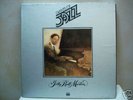
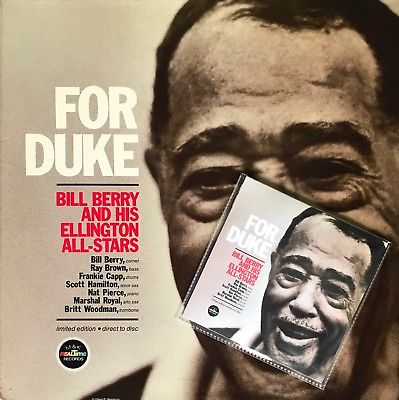
BILL BERRY - ELLINGTON ALL-STARS - FOR DUKE - Ltd Ed Direct Cut LP + CD project
£
124
$
164


Favourite Auctions
To save auctions to your favourites, please login
If you don't have an account, please register
Description
THE CHARM AND FINESSE OF VINYL CAPTURED ON CD
The Brief To produce a clean transfer from a vinyl LP onto CD.
The Process After sourcing the disc it is cleansed on the Pro-Ject VC-S record cleaner.
Transfer of programme content at 24-bit 96kHz resolution using a state of the art analogue to digital converter for maximum quality to a Mac using a Rega Planar 1 turntable.
Assessment and analysis of music file utilising studio quality iZotope RX 6 Standard software.
Sensitive reduction of surface noise and removal of undesirable elements such as clicks, crackle, rumble and other various artefacts related to the pressing process. Retention of existing detail being of paramount importance. Each track then painstakingly headphone checked in real time to further reduce or eliminate remaining undesirable elements where possible.
Tracks burned to music CD.
Statement How can a cd transfer from a vinyl record sound as good if not better?
Although the transfer is an analog to digital conversion process, pressing imperfections have been reduced or removed. The original warmth, equalisation and mastering quality found on the vinyl is retained. Well mastered cd's sound great - it's not a case of vinyl being better than digital, it’s just different.
You are buying PRIMARILY a restored transfer to cd as a backup copy to the vinyl disc. As the source quality of vinyl will vary considerably it must be regarded as inferior to the finished cd. Due to the nature of the vinyl pressing process and the unknown handling of the disc prior to sourcing, rarely will it play as cleanly or noiselessly as the cd - even a brand new factory fresh vinyl pressing will have minor imperfections. Vinyl gradings must therefore be considered as estimates of condition and are subjective - what can be acceptable to some may not be good enough to others. My service therefore is to capture the brilliance and warmth of a vinyl recording and, using professional software, eliminate or reduce the influence of undesirable elements previously described. Care is taken to avoid overuse of such software to avoid perceivable side effects. I'm a perfectionist, so if I'm not happy with the final result it will not be offered for sale.
The Project and outcome
Recorded in January of 1978 this direct-to-disc album has become accepted as one of the best, if not the best direct-to-disc recordings of all time by audiophiles. Although I tend to favour Les Brown’s direct cut offering, there is no doubting the incredible dynamic presence of the instrumentation recorded here.
The cutting lathe operator must have been biting his fingernails on this one as the last notes on the closing track of side one literally fade into the run-out groove… not really an ideal situation but another couple of seconds would have meant recording the whole side again!
Individual instrument miking, particularly of both open and muted trumpet is extremely close and presents a challenge for recording, engineering and cartridge tracking, and with plenty of rasping bite and energy is a formidable stylus hurdle to temper distortion.
The overall sound is a little on the dry side with minimal reverb, but there is great separation with almost a sense of the musicians being huddled around the mikes. The pressing is good by Teldec in Germany but maybe could have been a touch cleaner although surface noise is low. This highly regarded direct cut was sourced from Italy for its media grading and I confirm that it is certainly no less than NM - sleeve EX (slight stain), which is incredible for an album that is 40 years old!
An impressive 24-bit 96kHz high resolution transfer with an overall sense of ‘nearness’ that will sound its best through quality headphones. A worthy and rightly revered limited edition direct cut recording that will not disappoint and a rarity at this quality. Crank up the volume and enjoy!
Track listing:- Take The “A” Train / Mood Indigo / Things Ain’t What They Used To Be / Perdido / Satin Doll / I Got It Bad (And That Ain’t Good) / I Let A Song Go Out Of My Heart / Cotton Tail.
Cover Notes
FOR DUKE is a fond remembrance of the genius who reshaped American music for half a century. It mirrors his profound influence on all of the seven artists who made this album happen.
BILL BERRY, cornet, leads the way in the Ellington spirit. Like Duke, "Bill lets the fellows be themselves,'' says Britt Woodman.Bill remembers the 1961 night he joined Duke, for a run that lasted until 1963: "There were seven trumpet players on the stand. I don't even know who some of them were, or how long they'd been there. Or anything. You didn't really replace anybody on Duke's band. You took your place and the other guy wasn't there. There was nobody to replace. You were just you. It's a very simple concept. But one almost nobody thinks of. "We did 'For Duke' without trying to recreate anything. Because you can't. Not even what happened last night, let alone 20 years ago. "Yet I think we very much captured what Ellington meant. It's swinging, happy and feels good. And it's pretty in parts - covers a lot of emotions - the way he would have liked it."
RAY BROWN, bass, grew up on Ellington's music. "Why, at 14, I practiced playing to Duke's latest 78 on our windup phonograph - first picking out all the bass notes, then memorizing everything else, and finally wearing both sides of that record white before his next single came out a couple of months later.
"I knew Duke all my life and really idolized him. Once we got to visit together for a whole month, working at the Paramount in New York, when I was with Ella Fitzgerald. "And he was one of the first to make sure you could hear the bass player on his records, as far back as 1939." Ellington's choice for one of his last albums, a piano-bass duo: Ray Brown.
FRANKIE CAPP, drums. Ellington was playing the Oriental Theater in Chicago on August 20, 1931, while Frankie Capp was being born in Worcester, Mass. 12 years later, Frank watched with awe as the Ellington band moved direct from their bus to the stand to play a dance and concert in Worcester's Mechanics' Hall. "I couldn't believe nobody in the trumpet section had any music - and that none of the saxes ever looked at their parts. Johnny Hodges never took his hat off, either." A lifetime fan, later privileged to back Duke on TV's Steve Allen and Joey Bishop shows, he adds, "It seems like Duke influenced all the good music I've ever played."
SCOTT HAMILTON, tenor sax, was 19 when Duke died on May 24, 1974, and never had a chance to play in the Ellington band. Yet he, too, grew up with an appreciative awareness of the man and his music. Sometimes compared with Ben Webster, tenor star of Duke's "best" band of the early 40's, Scott remains very much his own man, musically and sartorially. He is thoroughly at home in "For Duke."
NAT PIERCE, piano, was a rare recipient of Duke's invitations to sit in with the Ellington Orchestra. "For Duke" tells you why. Nat has a percussive drive that moves this band just as it did Duke's, along with an innate sense of the appropriate. Highly versatile, he is first-call sub for Count Basie.
MARSHAL ROYAL, alto sax, was doubling as a high school student and night club musician when he joined Duke's band, on violin, for its first Hollywood flick, Amos and Andy's 1930 "Check And Double Check." Ever-after a friend of both Duke and Ellington altoist Johnny Hodges, Marshal brings 'For Duke' his own highly personal treatments of two Hodges favorites, "I Let A Song Go Out Of My Heart" and "Things Ain't What They Used To Be." In 1951, Count Basie hired Marshall Royal as lead alto and "strawboss,'' never guessing that he'd stick around for 20 years. While with Count, Marshal sometimes subbed on lead alto with Duke.
BRITT WOODMAN, trombone, was featured with the Ellington Orchestra from 1951 to 1960 and shares Duke's view that "jazz musicians should remain free," adding that "He was very tolerant. Sometimes too tolerant." Check out Britt’s solo on "Perdido" for a demonstration of Duke's brand of freedom.
RALPH JUNGHEIM
This 24-bit 96kHz high resolution transfer encompasses all the dynamism, power, depth and subtleties of the original vinyl. So keep your vinyl safe and enjoy the experience from the cd. Best experienced through quality headphones.
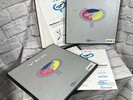
The Offer The original gatefold vinyl LP (stated condition M - not my grading - see screenshot of original advert). Restored transfer to cd and high quality 4 page scanned cover art with full original cover notes.
Note that the cd cannot be purchased separately from the LP. Only one copy available.
Buy with confidence from a trusted UK seller. Discounted Royal Mail Special Delivery (next working day before 1pm).
price rating