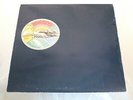
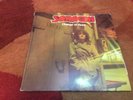
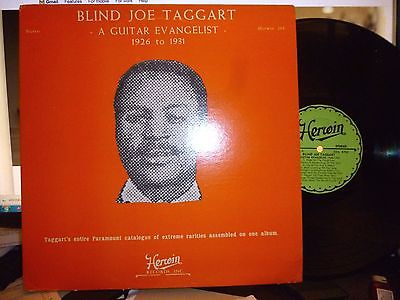
BLIND JOE TAGGART A Guitar Evangelist 1926 to 1931, LP NM/EX HERWIN,
$
18


Favourite Auctions
To save auctions to your favourites, please login
If you don't have an account, please register
Description
Condition: To my NON US customers, do NOT ask me to alter / change the declared value of your purchase for purposes of avoiding taxes in your country. I will NOT do so.
Artist Biography by Eugene Chadbourne
If one ever ran into Blind Joe Taggart in a dark alley, the only possible protection would be to have Blind John Henry Arnold with you. According to the famous folk singer and blues artist Josh White, there was only one man on earth who was meaner than Taggart, and that was Arnold. White obviously knew what he was talking about, having been abused and kicked around by both men, as well as the even more famous Blind Lemon Jefferson. Back in the old days when blind blues virtuoso roamed the streets displaying their genius for coins, someone had to lead them around. White was perhaps the most famous of a class of ex-lead boys for blind blues singers, a form of apprenticeship that has disappeared from the modern blues scene along with performers of the class of Taggart and his ilk. Performers trying to survive in such a lifestyle can hardly be blamed for developing what can be best described as street-hardened personalities.
Taggart was a fairly typical itinerant performer of the '20s, and most of the available information on him was handed down in interviews from White, who first met him when he was known as Joel Taggart in Greenville, SC. White's description of the difference between the two tyrants has become famous. Arnold was "mean, honest mean." Taggart, on the other hand, was "tricky, nasty mean. " Furthermore, he was not really blind, something that puts him in a subclass of blind blues musicians who actually had some vision available to them. Taggart had cataracts and could "see a little," according to White.
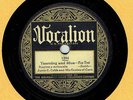
Of more importance than what Taggart could or couldn't see was the fact he was noticed in 1926. The Brunswick-Balke-Collender company from Chicago, which was beginning a series of record releases under the Vocalion label, was keenly aware that similar series of so-called "race" records were selling like hotcakes. Many types of performers were recorded during the '20s, and among these stacks of historic sides were this label's first ventures into recording singing evangelists, basically the gospel equivalent of country blues players. Near the end of that year, Taggart became the first full-time guitar evangelist to cut a side. The material he recorded was a happy meeting between his obvious versatility as a performer and the label's desire to try as many approaches as possible to the hitmaking destination. Taggart recorded several vocal duets with Emma Taggart, who was most likely his wife. Alternative takes that were released much later from these sessions helped create a further revision in the opinion of this artist held by blues scholars.
Not discovered by the mass blues audience during the folk revival of the '60s as was fellow meanie Blind Lemon Jefferson, Taggart basically had to wait for the CD-driven thoroughness of the Document label to fully illustrate the amount of ingenuity and inventiveness he brought to each of his performances. He also recorded duets with James Taggart, assumed to be his son. Like many busy blues artists, Taggart cut corners around recording contracts by recording under other names, including the pseudonyms Blind Joe Amos, Blind Jeremiah Taylor, Blind Tim Russell, and Blind Joe Donnel. Some of this activity was an attempt not to fool record labels but the Lord above, who it was assumed might not approve of Taggart playing the "devil's music" and could be tricked by a pseudonym. Taggart's music is sometimes considered to feature some of the oldest roots of any country blues artist. This includes melodic and stylistic influences from the Civil War era, considered a time when black and white musicians were perhaps not as restricted in access to each other's musical traditions as they would become later.
Blind Joe Taggart ?– A Guitar Evangelist 1926 To 1931
Label: Herwin Records, Inc. ?– Herwin 204 Format: Vinyl, LP, CompilationCountry: US Released: Genre: Blues Style: Gospel
Tracklist
1 Keep On The Firing Line 2 There's A Handwriting On The Wall 3 Scandalous And A Shame 4 Been Listening All Day Long 5 Religion Is Something Within YOu 6 Wonder When My Trouble Will Be Over 7 Pressin' Up That Shiny Way 8 Strange Things Happening In The Land 9 He Done What The World Couldn't Do 10 The Half Ain't Never Been Told 11 I've Crossed The Separation Line 12 Lord Don't Drive Me Away 13 Goin' To Rest Where Jesus Is 14 Mother's Love 15 Waded In The Water Trying To Get Home 16 In That Pearly White City Above 17 I Ain't No Sinner Now 18 Satan Your Kingdom Must Come DownSee our other EBAY auctions by using search by seller and using “record collector michigan”
Ferndale, Michigan 48220
Phone: 248-548-9888
Hours: Monday thru Saturday NOON to 6:00 PM (Eastern)
GOLDMINE GRADING
MINT ---- It should appear to be perfect. No scuffs or scratches, blotches or stains, labels or writing, tears or splits. Mint means perfect.
NEAR MINT ---- Otherwise mint but has one or two tiny inconsequential flaws that do not affect play. Covers should be close to perfect with minor signs of wear or age just becoming evident: slight ring-wear, minor denting to a corner, or writing on the cover should all be noted properly.
VERY GOOD PLUS ---- The record has been handled and played infrequently or very carefully. Not too far from perfect. On a disc, there may be light paper scuffs from sliding in and out of a sleeve or the vinyl or some of the original luster may be lost. A slight scratch that did not affect play would be acceptably VG+ for most collectors.
VERY GOOD ---- Record displays visible signs of handling and playing, such as loss of vinyl luster, light surface scratches, groove wear and spindle trails. Some audible surface noise, but should not overwhelm the musical experience. Usually a cover is VG when one or two of these problems are evident: ring wear, seam splits, bent corners, loss of gloss, stains, etc.
GOOD ---- Well played with little luster and significant surface noise. Despite defects, record should still play all the way through without skipping. Several cover flaws will be apparent, but should not obliterate the artwork.
POOR ---- Any record or cover that does not qualify for the above "Good" grading should be seen as Poor. Several cover flaws.
price rating