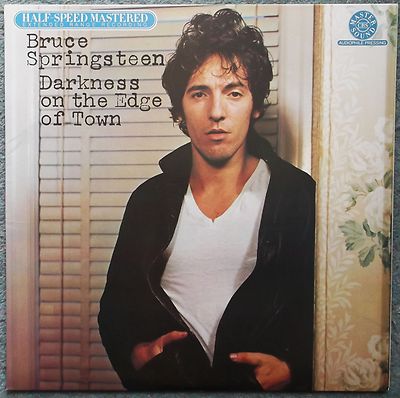
BRUCE SPRINGSTEEN - DARKNESS ON..... CBS MASTER SOUND AUDIOPHILE - Vinyl LP
£
68
$
90


Favourite Auctions
To save auctions to your favourites, please login
If you don't have an account, please register
Description
BRUCE SPRINGSTEEN
"DARKNESS ON THE EDGE OF TOWN"
CBS MASTER SOUND AUDIOPHILE PRESSING
with insert
Vinyl LP
1978 original release vinyl LP on the CBS/MASTERSOUND record label Cat n# HC 45318 Made in GERMANY
The album cover is in NM/MINT condition, , the inner picture leaflet is in NM/MINT condition, the LP is kept in a poly lined sleeve.
The vinyl itself is in NM/MINT condition.
If you are not fully satisfied you may return this album with a full refund inc postage.
If you need anymore information and pictures please get in touch, thanks.
Sorry if the shipping charges seem a bit high, the reason being i use heavy/strong packaging and the high cost of the Royal Mail price structure
THIS IS AS GOOD EXAMPLE OF WELL LOOKED AFTER OLD LP RECORD
Full track list
Side One
1."Badlands" – 4:01
2."Adam Raised a Cain" – 4:32
3."Something in the Night" – 5:11
4."Candy's Room" – 2:51
5."Racing in the Street" – 6:53 .
Side Two
1."The Promised Land" – 4:33
2."Factory" – 2:17
3."Streets of Fire" – 4:09
4."Prove It All Night" – 3:56
5."Darkness on the Edge of Town" – 4:30 .
All songs written by Bruce Springsteen.
THE BAND
Bruce Springsteen – lead vocals, lead guitar, harmonica
Roy Bittan – piano, vocals
Clarence Clemons – saxophone, vocals
Danny Federici – organ, glockenspiel
Garry Tallent – bass guitar
Steve Van Zandt – rhythm guitar, vocals
Max Weinberg – drums .
Darkness on the Edge of Town is the fourth album by Bruce Springsteen, released in the late spring of 1978. The album marked the end of a three year period of forced hiatus from recording brought on by contractual obligations and legal battling with former manager Mike Appel.[1] Although the album did not produce high charting singles it nevertheless remained on the charts for 97 weeks.[1] In September 2010 a documentary film chronicling the making of Darkness was first shown at the Toronto International Film Festival. Quoting Springsteen as saying “More than rich, more than famous, more than happy – I wanted to be great”, reviewer Stephen Whitty of the Newark Star-Ledger commented: "For many fans, that long journey pulled onto the Turnpike here
HISTORY
Recovering from legal troubles and the stress of the breakthrough success of Born to Run, Springsteen released a somewhat less commercial album in Darkness on the Edge of Town.
In terms of the original LP's sequencing, Springsteen continued his "four corners" approach from Born to Run, as the songs beginning each side ("Badlands" and "The Promised Land") were martial rallying cries to overcome circumstances, while the songs ending each side ("Racing in the Street", "Darkness on the Edge of Town") were sad dirges of circumstances overcoming all hope. Unlike Born to Run, the songs were recorded by the full band at once, frequently soon after Springsteen had written them.[3] Steven Van Zandt received a credit for production assistance for helping Springsteen tighten the arrangements from Born to Run's epic sound.[3]
This collection of songs, each sung in the first person, was given unity by several recurring themes. The words “darkness” / “dark” appear in six of the tracks, while nine of them feature the words “night” / “tonight”. “They” are mentioned in eight songs as a general suggestion of nameless people who exert a negative influence. “Work” / “worked” / “working” form part of six songs, as do “dream” / “dreams”. Six songs feature Bruce or his characters “driving” / “racing” / “riding” or mentioning the names of cars. There are references to “blood”, "born", "love" / "loved" in four of the tracks. In the song "Racing in the Street," Springsteen alludes to Martha & the Vandellas' Dancing in the Street with the lyric "Summer's here and the time is right for racing in the street," similar to the Rolling Stones' appropriation of the lyric in "Street Fightin' Man".
Though the album failed to generate any substantial hit singles ("Prove It All Night" made it into the Top 40 in the U.S. at #33, and follow-up "Badlands" just missed, peaking at #42), Darkness was critically well-received and claimed the number one slot on NME album of the year ranking. In 2003, the album was ranked number 151 on Rolling Stone magazine's list of the 500 greatest albums of all time.[4] The same year, the TV network VH1 named Darkness on the Edge of Town the 68th greatest album of all time.
The cover shot and inner sleeve photo were taken by photographer Frank Stefanko inside Stefanko's Haddonfield, New Jersey, home.[5] Springsteen says, "When I saw the picture I said, 'That's the guy in the songs.' I wanted the part of me that's still that guy to be on the cover. Frank stripped away all your celebrity and left you with your essence. That's what that record was about." [6]
A reissue box set was released in November 2010.[7][8][9] This had initially been planned for 2008, to mark the 30th anniversary of the original album's release, but was delayed, presumably due to Springsteen's numerous other 2008 projects.[10] By January 2009, Springsteen's manager, Jon Landau, was saying the project was still in the works: "When we can find six weeks to sit down and finish it I'm sure we will."[11]
A documentary entitled "The Promise: The Making of Darkness on the Edge of Town" was produced for the box set. The documentary premiered at the Toronto Film Festival in the fall of 2010 and aired on HBO on October 7, 2010
Unused material
During the Darkness sessions, Springsteen wrote or recorded many songs that he ended up not using on the album. This was to keep the album's thematic feel intact, even at the expense of not having hits on it.[21] According to Jimmy Iovine, Springsteen wrote at least 70 songs during the sessions and 52 of those songs were recorded with some not fully completed. As of 2011, 33 of those songs have been officially released.[22]
Some of the unused material became hits for other artists, such as "Because the Night" for Patti Smith, "Fire" for Robert Gordon and The Pointer Sisters, "Rendezvous" for Greg Kihn, "This Little Girl" for Gary U.S. Bonds, and several tracks for Southside Johnny (including much of the Asbury Jukes' Hearts of Stone album). Other songs such as "Independence Day", "Point Blank", "The Ties That Bind", and "Sherry Darling" would turn up on Springsteen's next album, The River, while still others became bootleg classics until surfacing on Springsteen's compilations Tracks, 18 Tracks and The Promise. The Promise features 21 tracks from the Darkness sessions, many with modern vocal takes and added instruments and was released in November 2010 compilation (and also included in a box set). Some of these Darkness outtakes were performed by Springsteen in concert during his 1978 tour and later.
review
by William Ruhlmann
Coming three years and one extended court battle after Born to Run, Darkness on the Edge of Town was highly anticipated. Some attributed the album's embattled tone to Bruce Springsteen's legal troubles, but it carried on from Born to Run, in which Springsteen had first begun to view his colorful cast of characters as "losers." On Darkness, he began to see them as the working class: his characters, some of whom he inhabited and sang for in the first person, had little and were in danger of losing even that. Their only hope for redemption lay in working harder, and their only escape lay in driving. Springsteen presented these hard truths in hard rock settings, the tracks paced by powerful drumming and searing guitar solos. Though not as heavily produced as Born to Run, Darkness was given a full-bodied sound; Springsteen's stories were becoming less heroic, but his musical style remained grand; the sound, and the conviction in his singing, added weight to songs like "Racing in the Street" and the title track, transforming the pathetic into the tragic. But despite the rock & roll fervor, Darkness was no easy listen, and it served notice that Springsteen was already willing to risk his popularity for his principles.
REVIEW Darkness on the Edge of Town
by Anthony Kuzminski
.
Bruce Springsteen – 'Darkness on the Edge of Town' (1978) Album Reflection & Review
Mister I ain't a boy, no I'm a man
-"The Promised Land"
The Bruce Springsteen who wrote and recorded Born To Run was a ghost by the time his fourth album, Darkness on the Edge of Town, was recorded and released in 1978. The wide-eyed virtue previously found on tracks such as "Night", "Born To Run" and "Thunder Road" was long gone. In its place was no longer a boy but a man who had seen the true darkness life and adulthood had to offer. While despair played a part on Born To Run, its dreamy imagery and roaring accompanying music were streamlined on Darkness. After Born To Run, Springsteen was thrown into the limelight in a way that he wasn't comfortable with and ultimately, he no longer saw eye to eye with his manager Mike Appel. What followed was an ugly lawsuit where Springsteen learned the callous realities of the music business and Appel managed to keep Springsteen out of the studio during this time. It wasn't until the summer of 1977 when Springsteen and the E Street Band were able to record again. During this time, the band executed thirty-plus compositions in the studio, but to everyone's amazement, Springsteen discarded a number of tracks everyone thought would be immense hits including "Fire" and "Because The Night". Springsteen had control of his life and career once again after the lawsuit. He had a clear vision of what he wanted and this involved a complex studio album consisting of songs that discuss the grim reality of life.
Opening with "Badlands", the E Street Band kicks open the door with a screaming anguish desperate to be heard. The album's most dynamic song (and its second single) has stood the test of time and is one of a handful of anthems performed every night with the E Street Band. It was a proclamation of frustration where the narrator spews forth lyrical torment. He's tired of being walked on and taken for granted and this is a self-righteous anthem aimed to vent. The lashing "Adam Raised A Cain" features a sadistic guitar that wields its father-son aggravation with biblical force. "Candy's Room" has a splintering manic drive that echoes the carnal yearning of the narrator. This is a marvelous example of where the lyrics on paper are numinous, but the weighty nature of the E Street Band proves to be merciless and lift the song to classic status. The band's dynamic puts you inside not just the mind but the actual body of the narrator where he probably felt as if his heart would rupture from his chest. The same could be said of the only Top-40 track, "Prove It All Night", another rebellious number with a resilient guitar work as the narrator lives on the edge of sin and redemption somewhere between life and death, because without a drive to want something more out of life, are you even really alive?
The pining "Racing In The Street" is a somber reflection similar to the anthems of despair on Born To Run but here the music is far more retrained and sobering. However, the accompanying piano and organ by Roy Bittan and Danny Federici is the stuff of legend. It's so incandescent and inviting that you could get lost in it…which is what many do. The car is a metaphor for renewal and hope and serves as a diversion is from much harsher realities of the world ("Some guys they just give up living and start dying little by little, piece by piece"). One of the reasons the album continues to resonate is because of the brutal and truthful depictions of these struggles. Few people had ever written about the woes of daily work the way Springsteen did in "Factory" without sounding ludicrous. Springsteen manages to do so because he experienced the same hardships. He witnessed his father's dreams be shattered by the challenges and impediments of life and he sings with a truly uncorrupted and indisputable voice. Other artists have tried to harness this authenticity, but it can't be stolen or bought; it only comes from life experiences.
"The Promised Land" (the album's second classic) is a clear indicator of where Springsteen was headed. He wanted to face life head on. He saw many around him suffering and trying to merely survive. He took this struggle and infused it with his more restrained production. While it may not be as triumphant as Born Ton Run, this was done so purposely. He wanted to dial down the music so that the lyrics wouldn't just be deciphered, but felt and absorbed. Lastly, the album's title track is finds a narrator who has experienced immense loss but that doesn't stop the fiery determination. A far cry from the lightweight material that was the rage in the 1970's, Springsteen takes the listener on a voyage through disappointment and lost illusions. Not as romantic as "Backstreets", but more primordial but ultimately redeeming. At the song's and album's conclusion, these characters may be broken, but they're not defeated. The philosophical nature of these songs elevates the record and Springsteen's mystique. The album as a whole is more potent as a collection than when listened to individually. Songs like "Streets of Fire", "Factory" and "Something In The Night" may not be in the upper echelon of Springsteen's collective work, but their themes are the glue that holds this record together. Without them, the album wouldn't have maintained its credibility or weightiness.
Is Darkness on the Edge of Town an unqualified five-star classic? It's close but just misses. One thing Springsteen fans tend to do is romanticize the prominence of Darkness. By no means is it bad, but people tend to confuse the scorching live versions of these songs with their studio counterparts. The tour in support of this record was one for the ages. Never before had anyone seen a performer so willing to not just give so much physically every night (with almost every show passing the three-hour mark), but the emotional drain on his psyche had to have taken a hit as Springsteen didn't just perform these songs…he lived them. The performances elicited far more than your standard blood, sweat and tears. The E Street Band, while always a great band, reached new heights on the 1978 tour. They became the band all others were judged by with their marathon shows and illustrious performances. If there is one thing missing from Springsteen's catalog, it is an official release from this tour. Rolling Stone magazine and numerous other publications raved about the tour and when you listen to the FM broadcasts from the Roxy, the Agora, Passaic and Winterland, you find a band that would shake the foundations of the theater to its core. The Darkness material soared to new heights on this tour and would continue to do so on The River tour a few years later. Springsteen has often commented how he feels the live versions of these songs are the way they were meant to sound. He's also commented on not being happy with the final mix of the album, leaving numerous people wondering why he's never attempted to remix it. The album could have even proven to be even more significant, as he left off "The Promise", arguably Springsteen's most cherished outtake. A re-recorded version appeared on 18 Tracks in 1999, but it lacks the time stamp of this period and the floating outtakes (while a tad pompous) probably should have found its way onto this album. Despite whatever reservations I have about the sound, production, songs left on the sidelines and mixing of this record, it doesn't make these songs any less reverberating. These ten songs encompass the sound of dashed dreams and bewildered souls who are incensed at those who have held them down. There's no thunder road to take flight to this time, these characters want a better life and instead of running from it, they hope to conquer it.
Tonight I'll be on that hill 'cause I can't stop
I'll be on that hill with everything I got
-"Darkness on the Edge of Town"
While the sweeping romanticism and sunnier melodies of Born To Run were long gone, the world was left with an artist with a keen eye on the daily fight to live. Instead of a street poet, a socially conscious artist emerged who would redefine the singer-songwriter definition over the next six-years. He put these unpretentious humans on a pedestal as people to look up to and a spotlight on their common trials and tribulations, making the fight to overcome them all that more miraculous. Darkness on the Edge of Town is a spiritual guide for living life and learning how to come to terms with its hardships and ultimately to take action and make it better. Amidst these ten songs are harsh truths many of us don't want to contemplate, but with Springsteen laying it out for us, it's impossible to deny. In the end, he remains defiant and we do as well.
Thanks for taking the time to look at this auction
RECORD COLLECTOR GRADING SYSTEM
In order to assist everyone who buys and sells rare discs, Record Collector magazine has originated a set of standards for the condition
of second-hand records, cassettes and CDs. Anyone buying or selling records through the magazine must use our conditions to state what
amount of wear and tear the disc, its sleeve and/or contents have been subject to. The seven standard condition categories, and a description
of what each one means, are listed below:
MINT: The record itself is in brand new condition with no surface marks
or deterioration in sound quality. The cover and any extra items such
as the lyric sheet, booklet or poster are in perfect condition. Records
advertised as Sealed or Unplayed should be Mint.
EXCELLENT: The record shows some signs of having been played, but there
is very little lessening in sound quality. The cover and packaging
might have slight wear and/or creasing.
VERY GOOD: The record has obviously been played many times, but
displays no major deterioration in sound quality, despite noticeable
surface marks and the occasional light scratch. Normal wear and tear on
the cover or extra items, without any major defects, is acceptable.
GOOD: The record has been played so much that the sound quality has
noticeably deteriorated, perhaps with some distortion and mild
scratches. The cover and contents suffer from folding, scuffing of
edges, spine splits, discoloration, etc.
FAIR: The record is still just playable but has not been cared for
properly and displays considerable surface noise; it may even jump.
The cover and contents will be torn, stained and/or defaced.
POOR: The record will not play properly due to scratches, bad surface
noise, etc. The cover and contents will be badly damaged or partly
missing.
BAD: The record is unplayable or might even be broken, and is only of use as a collection-filler.
price rating