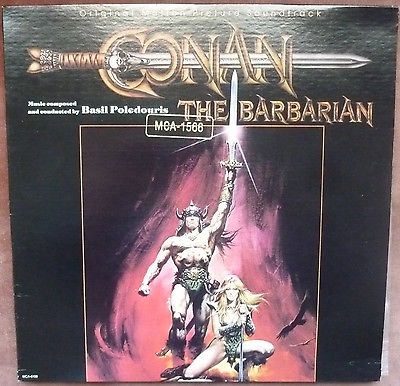
Basil Poledouris ?Conan The Barbarian Soundtrack LP 1982 US MCA-6108 NM
A$
45
$
29


Favourite Auctions
To save auctions to your favourites, please login
If you don't have an account, please register
Description
Basil Poledouris ?Conan The Barbarian Soundtrack LP 1982 US MCA-6108 NM
Original US pressing on MCA-6108 in overstamped MCA 1566 sleeve
When director John Milius and his college buddy Basil Poledouris collaborated to produce their first fantasy adventure film, little did they know that they would be catapulting their own careers, as well as that of emerging muscleman Arnold Schwarzenegger, into the bright lights of both cult and mainstream attention. Hollywood was hitting the peak of its "sword and sorcery" phase (which some instead termed the "swords and steroids" phase) when Conan the Barbarian hit the theatres in 1982, and producers and directors struggled to create authentic representations of a fantasy mould of Earth from the Middle Ages on limited budgets and do so during a time when audiences were being awed by the special effects of stories of galactic proportions. The story of a boy's ascension from slave to king during the Hyborean age was the creation of pulp writer Robert E. Howard, and the concept was greeted on screen with enough enthusiasm to warrant a sequel (albeit frightfully inferior) a few years later. Film scores were also undergoing a renaissance in the early 1980's, pointed by John Williams' orchestral adventure works back towards large, symphonic representations of the fantasy genre. The producer of Conan the Barbarian, Dino De Laurentiis, was an advocate of experimenting with pop scores in the epic fantasy genre, and he recommended such an approach for this film. Milius and Poledouris were on a different page, though; the friends were so loyal to each other that the composer would turn down the assignment of Kevin Costner's Dances With Wolves to score the director's Flight of the Intruder. The two men recognized that a rock/pop score would not function for Conan the Barbarian because of the production would rely on the music and cinematography to take the place of dialogue in painting the correct canvas for the film's depiction of the Hyborean age. De Laurentiis, of course, would take his pop score ideas to Dune instead, with a surprisingly effective result. Nothing but Poledouris' heavy symphonic and choral approach would function for Conan the Barbarian, however, and the composer would have to dig deep into Middle Age musical construction (abandoning modern, lyrical strategies) in order to achieve a convincing pre-historic score.
The result of Poledouris' efforts is a complex score that sounds surprisingly primitive and brutal, and the composer reinforced this approach by utilizing the sheer, awesome power of a huge orchestral and choral ensemble. He employed players from two separate orchestras and combined them with a chorus for a recording of monumental proportions in Rome. Unlike other modern composers, Poledouris successfully took Milius' suggestion of adapting the sounds of Carl Orff's "Carmina Burana" (already popularly utilized in Excalibur) and the Gregorian chanting of "Dies Irae" and provided similar emotional constructs without allowing the score to sound like a cheap and unaccomplished imitation. Thrown into the mix, of course, is Poledouris' own knowledge of ancient folk music, a style that would inform his subsequent score for Flesh + Blood to an even greater degree. He accomplishes a consistent Middle Age atmosphere by utilizing powerful arrays of brass and percussion throughout several different memorable motifs that carry the film along as though it were a concert piece with several distinct parts. First, the film begins with the theme that many associate with Conan incorrectly; rather, "Anvil of Crom" is meant as a representation of the period in time and its primitive human behavior. It follows the prologue in the film with a powerful performance by timpani drums and 24 French horns. In the string interlude of that title theme, Conan's true theme is introduced. This more heroic idea is also developed during the "Riddle of Steel" cue and would accompany Conan on his journey of revenge throughout the film. The third theme utilized by Poledouris is the Orff-inspired "Riders of Doom" composition to represent the evil Thulsa Doom (James Earl Jones) during his attacks through the land to collect slaves and followers. This stunning piece, while bothering some listeners with its Orff-like qualities and often performed poorly in concerts by undersized performing groups, is a continuation of unabashed percussion and brass, with a Latin chorus providing an intriguingly melodic sense of horror. A monumental solo sequence for the timpani in this cue (at 4:25) is extremely engaging. This theme, tracked artificially for the "Orgy Fight," returns in different arrangements but with equal force during the climactic battle between Conan and Doom's warriors near the end of the film, and a disappointingly shallow and fragmented version of the idea would carry over to Conan the Destroyer.
For Thulsa Doom's more hauntingly pleasant side, Poledouris worked with a simple theme inspired by the musical tinkering of his young daughter, Zoe, for "The Orgy," a basic, but effectively rolling representation of the barbaric sexual environment of the villain. The love theme for Conan, sometimes included as a passage within Conan's own similarly rendered theme, is performed with an appealing, lush heart by woodwinds, instruments that often act as the soul of the characters in the film. Among the smaller motifs are the relentlessly grinding rhythms of "Wheel of Pain" and the light-hearted, percussively festive "Civilization" theme that accompanies Conan's Mongol friend and flourishes in grandeur as Conan is rescued from "The Tree of Woe." To finish a commentary about Conan the Barbarian by suggesting that these are the only superior ideas in the work would be an insult to Poledouris, because nearly every cue contains an equally effective motif of some kind, culminating in the harmonically lovely and chorally lamenting "Orphans of Doom" at the conclusion of the film. While the score is never completely integrated so that all of the themes come together in a suite format (outside of artificial editing of sequences in the film to collect the best portions for multiple uses), Poledouris does manage to restate most of his ideas consistently throughout the film, providing the perfect musical canvas for the rather predictable characters. The score is rich in exotic percussion, heart-pounding rhythms, and mesmerizing instrumentation, proving what level of magic can result when a composer and director work towards a common goal with a massive ensemble of performers collected from two orchestras and a broad, expansive scope in mind from the outset. (from the excellent and informative review on filmtracks.com)
A1 Anvil Of Crom 2:30
A2 Riddle Of Steel / Riders Of Doom 5:31
A3 Gift Of Fury 3:47
A4 Wheel Of Pain 4:05
A5 Atlantean Sword 3:53
A6 Theology / Civilization 3:10
B1 Wifeing 2:07
B2 The Search 3:05
B3 The Orgy 4:10
B4 Funeral Pyre 4:28
B5 Battle Of The Mounds 4:48
B6 Orphans Of Doom / The Awakening 5:28
CONDITION:
SLEEVE: NM (Gold overstamped MCA 1566)
RECORD: NM
I NO LONGER MAIL TO ITALY! ALSO NOT TO BRAZIL, UKRAINE OR RUSSIAN FEDERATION.
Any bids or purchases from these countries will be cancelled immediately.
price rating