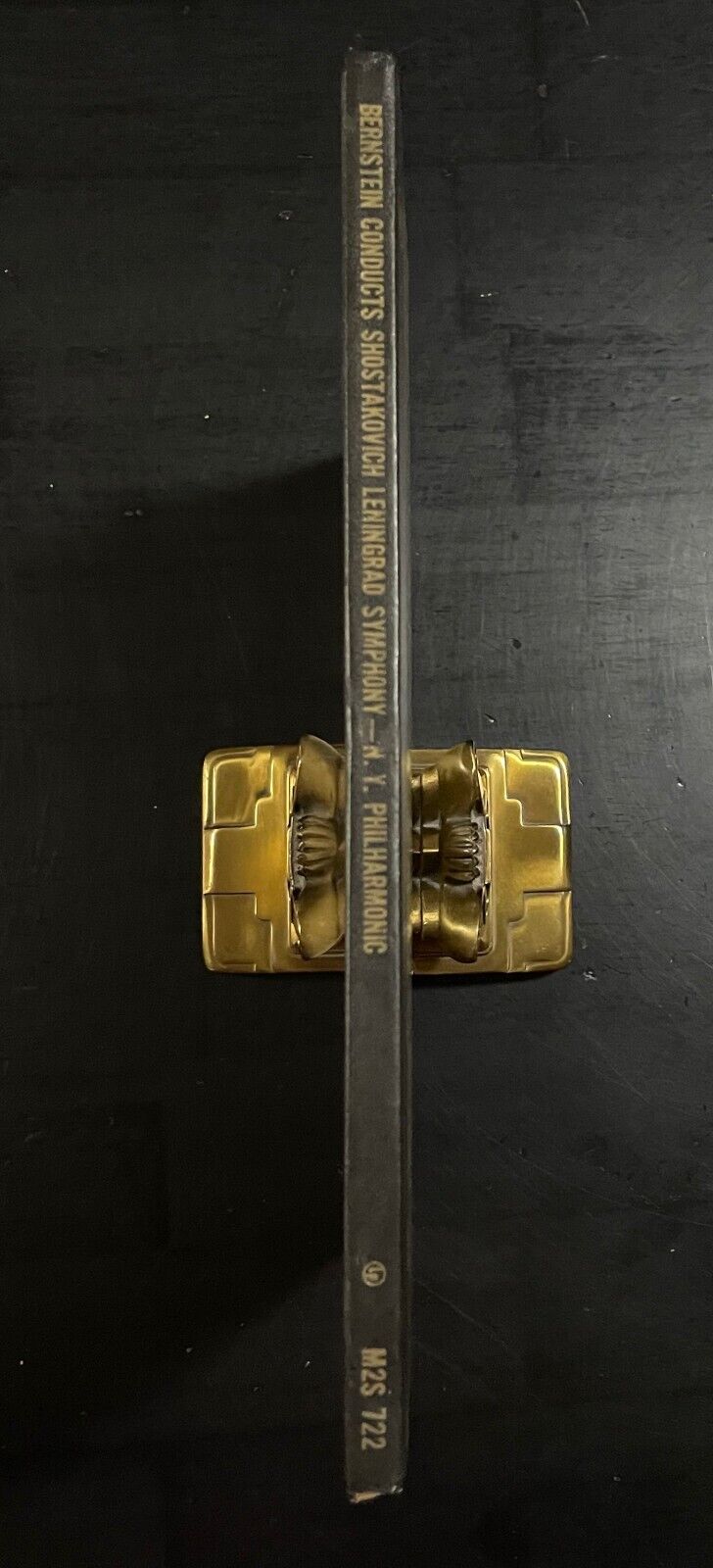
Bernstein Conducts Shostakovich Leningrad Symphony No. 7 New York 2LP Box EX
$
24




Favourite Auctions
To save auctions to your favourites, please login
If you don't have an account, please register
Description
Leonard Bernstein Conducts Dmitri Shostakovich
Leningrad Symphony No. 7 with the
New York Philharmonic
Label: Columbia Masterworks M2S 722
Liner Notes – Nicolas Slonimsky
2 x Vinyl, LP, Reissue, Stereo
US, Modern Classical
Recording: Philharmonic Hall, now Avery Fisher Hall, Lincoln Center, New York City, October 22 & 23, 1962
All four vinyl sides are EX to NM. Very faint to indiscernible surface wear under glare of light. Clean labels. The box is NM, clean, intact edges, no writing, no stains.
Free USA Shipping
>>>>
Dmitri Shostakovich's Symphony No. 7 in C major, Op. 60, nicknamed the Leningrad, was begun in Leningrad, completed in the city of Samara (then known as Kuybyshev) in December 1941, and premiered in that city on March 5, 1942. At first dedicated to Lenin, it was eventually submitted in honor of the besieged city of Leningrad, where it was first played under dire circumstances on August 9, 1942, nearly a year into the siege by German forces. The performance was broadcast by loudspeaker throughout the city and to the German forces in a show of resilience and defiance. The Leningrad soon became popular in both the Soviet Union and the West as a symbol of resistance to fascism and totalitarianism, thanks in part to the composer's microfilming of the score in Samara and its clandestine delivery, via Tehran and Cairo, to New York, where Arturo Toscanini conducted a broadcast performance on July 19, 1942, and Time magazine placed Shostakovich on its cover. That popularity faded somewhat after 1945, but the work is still regarded as a major musical testament to the 27 million Soviet people who lost their lives in World War II, and it is often played at Leningrad Cemetery, where half a million victims of the 900-day Siege of Leningrad are buried.
>>>>
Dmitri Dmitriyevich Shostakovich (25 September [O.S. 12 September] 1906 – 9 August 1975) was a Soviet-era Russian composer and pianist who became internationally known after the premiere of his First Symphony in 1926 and thereafter was regarded as a major composer. Shostakovich achieved early fame in the Soviet Union, but had a complex relationship with its government. His 1934 opera Lady Macbeth of Mtsensk was initially a success, but eventually was condemned by the Soviet government, putting his career at risk. In 1948 his work was denounced under the Zhdanov Doctrine, with professional consequences lasting several years. Even after his censure was rescinded in 1956, performances of his music were occasionally subject to state interventions, as with his Thirteenth Symphony (1962). Shostakovich was a member of the Supreme Soviet of the RSFSR (1947) and the Supreme Soviet of the Soviet Union (from 1962 until his death), as well as chairman of the RSFSR Union of Composers (1960–1968). Over the course of his career, he earned several important awards, including the Order of Lenin, from the Soviet government.
Shostakovich combined a variety of different musical techniques in his works. His music is characterized by sharp contrasts, elements of the grotesque, and ambivalent tonality; he was also heavily influenced by neoclassicism and by the late Romanticism of Gustav Mahler. His orchestral works include 15 symphonies and six concerti (two each for piano, violin, and cello). His chamber works include 15 string quartets, a piano quintet, and two piano trios. His solo piano works include two sonatas, an early set of 24 preludes, and a later set of 24 preludes and fugues. Stage works include three completed operas and three ballets. Shostakovich also wrote several song cycles, and a substantial quantity of music for theatre and film. Shostakovich's reputation has continued to grow after his death. Scholarly interest has increased significantly since the late 20th century, including considerable debate about the relationship between his music and his attitudes toward the Soviet government.
>>>>
Leonard Bernstein (August 25, 1918 – October 14, 1990) was an American conductor, composer, pianist, music educator, author, and humanitarian. Considered to be one of the most important conductors of his time, he was the first American-born conductor to receive international acclaim. Bernstein was "one of the most prodigiously talented and successful musicians in American history" according to music critic Donal Henahan. Bernstein's honors and accolades include seven Emmy Awards, two Tony Awards, and 16 Grammy Awards (including the Lifetime Achievement Award) as well as an Academy Award nomination. He received the Kennedy Center Honor in 1981. As a composer, Bernstein wrote in many genres, including symphonic and orchestral music, ballet, film and theatre music, choral works, opera, chamber music, and pieces for the piano. Bernstein's works include the Broadway musical West Side Story, which continues to be regularly performed worldwide, and has been adapted into two (1961 and 2021) feature films, three symphonies, Serenade after Plato's "Symposium" (1954), and Chichester Psalms (1965), the original score for the Elia Kazan drama film On the Waterfront (1954), and theater works including On the Town (1944), Wonderful Town (1953), Candide (1956), and his Mass (1971).
Bernstein was the first American-born conductor to lead a major American symphony orchestra. He was music director of the New York Philharmonic and conducted the world's major orchestras, generating a legacy of audio and video recordings. Bernstein was also a critical figure in the modern revival of the music of Gustav Mahler, in whose music he was most interested. A skilled pianist, Bernstein often conducted piano concertos from the keyboard. He shared and explored classical music on television with a mass audience in national and international broadcasts, including Young People's Concerts with the New York Philharmonic. Bernstein worked in support of civil rights, protested against the Vietnam War, advocated nuclear disarmament, raised money for HIV/AIDS research and awareness, and engaged in multiple international initiatives for human rights and world peace. He conducted Mahler's Resurrection Symphony to mark the death of president John F. Kennedy, and in Israel at a concert, Hatikvah on Mt. Scopus, after the Six-Day War. The sequence of events was recorded for a documentary entitled Journey to Jerusalem. At the end of his life, Bernstein conducted a performance of Beethoven's Symphony No. 9 in Berlin to celebrate the fall of the Berlin Wall.
price rating

![Blood Sugar Sex Magik [LP] by Red Hot Chili Peppers (Record, 2012)](https://www.popsike.net/php/thumbnail.php?url=https://www.popsike.pics/pix/20220827/185554570597.jpg)