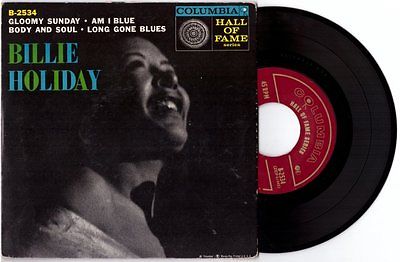
Billie Holiday "Gloomy Sunday" 7" B-2534 NM 45
$
30


Favourite Auctions
To save auctions to your favourites, please login
If you don't have an account, please register
Description
Billie Holiday "Gloomy Sunday" 7" Columbia Records B-2534 (US)
Vinyl is NM, Jacket is VG w/seam split
Track Listing:
A1 Gloomy Sunday (The Famous Hungarian Suicide Song) Written-By – Seress*, Lewis* A2 Am I Blue? Written-By – G. Clarke*, Akst* B1 Body And Soul Written-By – Heyman*, Eyton*, J. Green*, Sour* B2 Long Gone Blues Written-By – Holiday*, Smith*Billie Holiday (born Eleanora Fagan; April 7, 1915 – July 17, 1959) was an American jazz singer and songwriter.
Nicknamed "Lady Day" by her friend and musical partner Lester Young, Holiday had a seminal influence on jazz and pop singing. Her vocal style, strongly inspired by jazz instrumentalists, pioneered a new way of manipulating phrasing and tempo.
Lady Sings the Blues (1952–1959)
By the 1950s, Holiday's drug abuse, drinking, and relationships with abusive men caused her health to deteriorate. She appeared on the ABC reality series The Comeback Story to discuss attempts to overcome her misfortunes. Her later recordings showed the effects of declining health on her voice, as it grew coarse and no longer projected its former vibrancy.
Holiday first toured Europe in 1954 as part of a Leonard Feather package. The Swedish impresario, Nils Hellstrom, initiated the "Jazz Club U.S.A." (after the Leonard Feather radio show) tour starting in Stockholm in January 1954 and then Germany, Netherlands, Paris and Switzerland. The tour party was Holiday, Buddy DeFranco, Red Norvo, Carl Drinkard, Elaine Leighton, Sonny Clark, Berryl Booker, Jimmy Raney, and Red Mitchell. A recording of a live set in Germany was released as Lady Love - Billie Holiday.
Holiday's late recordings on Verve constitute about a third of her commercial recorded legacy and are as popular as her earlier work for the Columbia, Commodore and Decca labels. In later years, her voice became more fragile, but it never lost the edge that had always made it so distinctive.
Holiday's autobiography, Lady Sings the Blues, was ghostwritten by William Dufty and published in 1956. Dufty, a New York Post writer and editor then married to Holiday's close friend Maely Dufty, wrote the book quickly from a series of conversations with the singer in the Duftys' 93rd Street apartment. He drew on the work of earlier interviewers as well and intended to let Holiday tell her story in her own way.
In his 2015 study, Billie Holiday: The Musician and the Myth, John Szwed argues that Lady Sings the Blues is a generally accurate account of her life, and that co-writer Dufty was forced to water down or suppress material by the threat of legal action. "In particular, Szwed traces the stories of two important relationships that are missing from the book—with Charles Laughton, in the nineteen-thirties, and with Tallulah Bankhead, in the late nineteen-forties—and of one relationship that’s sharply diminished in the book, her affair with Orson Welles around the time of Citizen Kane," according to reviewer Richard Brody.
To accompany her autobiography, Holiday released an LP in June 1956 entitled Lady Sings the Blues. The album featured four new tracks, "Lady Sings the Blues" (title track), "Too Marvelous for Words", "Willow Weep for Me", and "I Thought About You", as well as eight new recordings of Holiday's biggest hits to date. The re-recordings included "Trav'lin' Light" "Strange Fruit" and "God Bless the Child". On December 22, 1956, Billboard magazine reviewed Lady Sings the Blues, calling it a worthy musical complement to her autobiography. "Holiday is in good voice now," said the reviewer, "and these new readings will be much appreciated by her following." "Strange Fruit" and "God Bless the Child" were called classics, and "Good Morning Heartache", another reissued track in the LP, was also noted positively.
On November 10, 1956, Holiday performed two concerts before packed audiences at Carnegie Hall, a major accomplishment for any artist, especially a black artist of the segregated period of American history. Live recordings of the second Carnegie Hall concert were released on a Verve/HMV album in the UK in late 1961 called The Essential Billie Holiday. The thirteen tracks included on this album featured her own songs, "I Love My Man", "Don't Explain" and "Fine and Mellow", together with other songs closely associated with her, including "Body and Soul", "My Man", and "Lady Sings the Blues" (her lyrics accompanied a tune by pianistHerbie Nichols).
The liner notes on this album were written partly by Gilbert Millstein of The New York Times, who, according to these notes, served as narrator in the Carnegie Hall concerts. Interspersed among Holiday's songs, Millstein read aloud four lengthy passages from her autobiography Lady Sings the Blues. He later wrote:
“ The narration began with the ironic account of her birth in Baltimore – 'Mom and Pop were just a couple of kids when they got married. He was eighteen, she was sixteen, and I was three' – and ended, very nearly shyly, with her hope for love and a long life with 'my man' at her side. It was evident, even then, that Miss Holiday was ill. I had known her casually over the years and I was shocked at her physical weakness. Her rehearsal had been desultory; her voice sounded tinny and trailed off; her body sagged tiredly. But I will not forget the metamorphosis that night. The lights went down, the musicians began to play and the narration began. Miss Holiday stepped from between the curtains, into the white spotlight awaiting her, wearing a white evening gown and white gardenias in her black hair. She was erect and beautiful; poised and smiling. And when the first section of narration was ended, she sang – with strength undiminished – with all of the art that was hers. I was very much moved. In the darkness, my face burned and my eyes. I recall only one thing. I smiled." ”The critic Nat Hentoff of Down Beat magazine, who attended the Carnegie Hall concert, wrote the remainder of the sleeve notes on the 1961 album. He wrote of Holiday's performance:
“ Throughout the night, Billie was in superior form to what had sometimes been the case in the last years of her life. Not only was there assurance of phrasing and intonation; but there was also an outgoing warmth, a palpable eagerness to reach and touch the audience. And there was mocking wit. A smile was often lightly evident on her lips and her eyes as if, for once, she could accept the fact that there were people who did dig her. The beat flowed in her uniquely sinuous, supple way of moving the story along; the words became her own experiences; and coursing through it all was Lady's sound – a texture simultaneously steel-edged and yet soft inside; a voice that was almost unbearably wise in disillusion and yet still childlike, again at the centre. The audience was hers from before she sang, greeting her and saying good-bye with heavy, loving applause. And at one time, the musicians too applauded. It was a night when Billie was on top, undeniably the best and most honest jazz singer alive. ”Her performance of "Fine and Mellow" on CBS's The Sound of Jazz program is memorable for her interplay with her long-time friend Lester Young. Both were less than two years from death.
When Holiday returned to Europe almost five years later in 1959, she made one of her last television appearances for Granada's Chelsea at Nine in London. Her final studio recordings were made for MGM in 1959, with lush backing from Ray Ellis and his Orchestra, who had also accompanied her on Columbia's Lady in Satinalbum the previous year—see below. The MGM sessions were released posthumously on a self-titled album, later re-titled and re-released as Last Recordings.
On March 28, 1957, Holiday married Louis McKay, a Mafia enforcer. McKay, like most of the men in her life, was abusive, but he did try to get her off drugs. They were separated at the time of her death, but McKay had plans to start a chain of Billie Holiday vocal studios, à la Arthur Murray dance schools.
Although childless, Billie Holiday had two godchildren: singer Billie Lorraine Feather, daughter of Leonard Feather, and Bevan Dufty, son of William Dufty.
All records are shipped in professional 7” & 12” box mailers. All CDs are shipped in padded bubble mailers. Buy multiple items and save on shipping. Thanks for Visiting!!
price rating