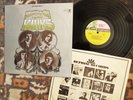
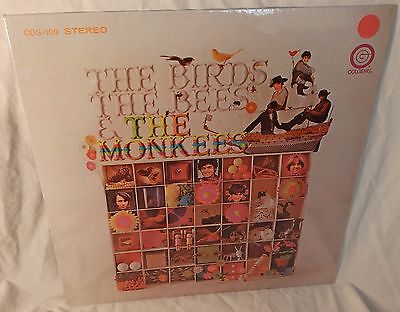
Birds, The Bees & The Monkees Original Colgems 1968 Vinyl Record Still Sealed
$
150


Favourite Auctions
To save auctions to your favourites, please login
If you don't have an account, please register
Description
Studio album by The Monkees
Released
April 22, 1968
Recorded
Late 1967–early 1968
Genre
Pop rock, baroque pop, psychedelic pop
Length
37:00
Label
Colgems (original US release)
RCA Victor (original release--rest of the world)
Arista (1980 Japanese LP reissue + 1986 CD reissue)
Rhino (1985 LP reissue + 1994 & 2010 CD reissues)
Sundazed (1996 LP reissue)
Producer
The Monkees, Chip Douglas
The Monkees chronology
Pisces, Aquarius, Capricorn & Jones Ltd.
(1967)
The Birds, The Bees & The Monkees
(1968)
Head
(1968)
Singles from The Birds, The Bees & The Monkees
- "Daydream Believer" / "Goin' Down"
Released: October 25, 1967 - "Valleri" / "Tapioca Tundra"
Released: March 2, 1968
Professional ratings
Review scores
Source
Rating
AllMusic
MusicHound
popdose
(favorable)
Record Collector
The Rolling Stone Album Guide
The Birds, The Bees & The Monkees is the fifth studio album by The Monkees released in April 1968. It was the first Monkees album not to reach Billboard's number one, peaking at number three in the US charts. It was also their first album to miss the UK charts altogether, with their four previous efforts all having reached the top ten. The album has sold over a million copies.
History
Despite the band's hardships in 1968 (their television series was canceled; their first motion picture project, Head, failed at the box office; and in December, Peter Tork left the group), The Birds, The Bees & The Monkees proved to be another successful album, yielding the group's sixth million-selling single in "Valleri" and yet another number one in "Daydream Believer," written by former Kingston Trio member John Stewart. Coincidentally, both songs had been holdovers from previous albums: "Valleri" had originally been recorded more than a year prior for the TV show (the version on this album is a new production) and "Daydream Believer" had been recorded for their previous album, Pisces, Aquarius, Capricorn & Jones Ltd.. "Tapioca Tundra," an experimental piece of poetry put to music by Nesmith, charted well as the B-side to "Valleri" and reached #34.
After gaining complete artistic control over their musical direction and being allowed to play instruments on their own records in early 1967, the success of Headquarters and Pisces, Aquarius, Capricorn & Jones Ltd. began to somewhat rebuff the critics who viewed The Monkees as a band of talentless individuals who were simply lucky enough to gain recognition through their "manufactured" origins.
The desire and focus, however, to remain as a complete band unit in the studio quickly evaporated after the Pisces album, when each individual band member began to produce his own sessions with his own selected studio musicians, often at entirely different studios around the Los Angeles area. An agreement was made to label all finished efforts as "Produced by The Monkees," but in reality, beyond a few exceptions, most of the recordings featured on The Birds, The Bees & The Monkees revert to the recording process of the first two albums (fewer group dynamics), except now each band member was fully in charge of the sessions. Chip Douglas, producer of The Monkees' previous two albums, fully expected to continue as the band's representative in the studio, but found the individual Monkees more interested in exploring their diverse musical backgrounds with their own friends and associates rather than relying on Douglas as the central figure.
Jones' Broadway rock, Michael Nesmith's country and western leanings and psychedelic experiments, and the rock and soul of Micky Dolenz made for a diverse album. Several of Peter Tork's compositions were considered for release on Birds; unfortunately however, they were all rejected (for reasons unknown). Aside from playing piano on "Daydream Believer," he did not participate in the making of the record as all. Veteran Monkees tunesmiths Boyce and Hart returned to the fold to contribute the psychedelic "P.O. Box 9847," as well as a new version of the aforementioned "Valleri."
The extremely rare U.S. mono album (COM-109) was released in a limited quantity, as mono albums were being phased out by 1968, and has become a highly sought item for its unique mixes that differ from the common stereo versions. Mono copies from Australia, India, Israel, Mexico and Puerto Rico are known to have the same mix as the USA. There may be others as well. Most countries' mono versions - including the UK's - feature a "fold-down" mix where the stereo channels are simply reduced to one monaural channel; basically a mono version of the stereo mix.
Artwork
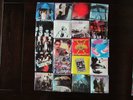
The front cover of the album shows a shadow box that contains some memorabilia from the 1940s through 1960s, including a Cootie bug, a popgun, a fan that folds out into a paper flower, ceramic birds, various paper flowers and stick flowers (which were popular in 1968). Alan Wolsky, whose agency created the cover, put a picture of himself in the bottom center square, partially obscured by some flowers. The rear cover contains the term "MIJACOGEO" alongside Micky's photo, a term that is an acronym for the members of Micky's family (Micky, Janelle, Coco and George, respectively). Another interesting quirk was that while Davy and Peter signed autographs in a traditional manner on their rear cover photos, Michael Nesmith signed "Carlisle Wheeling" to be superimposed onto his picture. This was the title of a song that did not make it on to any Monkees release at that time. However, it appeared on his post-Monkees album Loose Salute with the First National Band, having been renamed "Conversations". The song also was later released on various Monkees rarities collections.
Reissue
On February 8, 2010, Rhino Records' Rhino Handmade released a 3-CD boxed set reissue of the album. It was made available only online directly from Rhino. The set is housed in a 7 inch by 7 inch box with a 3D lenticular cover. It contains the original stereo and U.S. mono versions of the album in miniature vinyl replica sleeves, over 60 demos, rehearsals and outtakes from the original album's sessions, a commemorative pin and a booklet of essays and session information by Monkees historian Andrew Sandoval. The first 1,000 orders include a bonus vinyl single featuring two more unreleased tracks, acoustic versions of "St. Matthew" and "Lady's Baby".
Track listing
Original 1968 Colgems vinyl issue
Side 1
- "Dream World" (David Jones, Steve Pitts) - 3:22
- "Auntie's Municipal Court" (Michael Nesmith, Keith Allison) - 4:05
- "We Were Made for Each Other" (Carole Bayer, George Fischoff) - 2:25
- "Tapioca Tundra" (Nesmith) - 3:08
- "Daydream Believer" (John Stewart) - 3:00
- "Writing Wrongs" (Nesmith) - 5:08
Side 2
- "I'll Be Back Up on My Feet" (Sandy Linzer, Denny Randell) - 2:26
- "The Poster" (Jones, Pitts) - 2:21
- "P.O. Box 9847" (Tommy Boyce, Bobby Hart) - 3:16
- "Magnolia Simms" (Nesmith, Charles Rockett) - 3:48
- "Valleri" (Boyce, Hart) - 2:15
- "Zor and Zam" (Bill Chadwick, John Chadwick) - 2:10
price rating