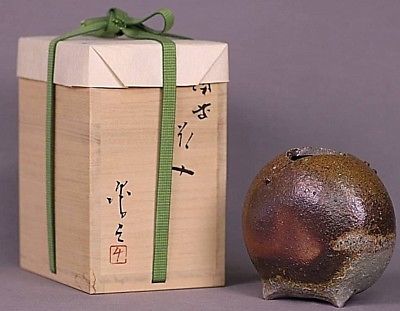
Bizen Ware Vase or incense koro burner Pottery Wakimoto Hiroyuki ???? Flower
$
329


$ 329
Sold For
Feb 2, 2018
Sold Date
Jan 6, 2018
Start Date
1
Number Of Bids
Italy
Country Of Seller
eBay
Sold at
Favourite Auctions
To save auctions to your favourites, please login
If you don't have an account, please register
Description
superb!!!!!!
[height] 12.5cm
[diameter] 8.5cm × 12cm
[bottom] 7.5cm
[Weight] 700G
Hiroyuki Wakimoto
They called it Feng-Huang, a mythical three-legged bird that would appear once every few hundred years. According to Chinese legends, the bird’s appearance was a good omen. Throughout Chinese history, this mythical creature has been depicted in various art forms. Among ancient Chinese pottery from the Neolithic era (12,000 – 2,000 B.C.), odd-looking vessels called gui with tripod legs and pointed spouts might well represent objectification of the creature. Ancient vessels like gui inspired Japanese ceramist Hiroyuki Wakimoto to create some of the most original forms in contemporary Japanese ceramics. One of Wakimoto's creations, "Myth", has the head of a prehistoric Pterodactyl, with strong jawbones and an enormous overhanging beak. A muscular faceted neck craned to the side supports the head, and its small body rests on three short pointed legs. It is plumed with beautiful natural ash glaze. The top of the head bears an opening, and the beak is grooved for pouring. Odd as it seems, "Myth" is functional either as a sake bottle or flower vase. Wakimoto’s innovative works were first shown outside Japan in his 2002 American debut at the Touching Stone Gallery. The show, which was enthusiastically received, firmly established Wakimoto as one of the brightest rising stars among contemporary Bizen ceramists.Unlike many other Japanese ceramists, Hiroyuki Wakimoto was not born into a family of potters. He was originally from Tsushima, Nagasaki Prefecture in Kyushu. He first studied textile design in a prestigious art school, Osaka Art College. Not until he was in his senior year did he realize that textiles were really not his interest. He left college and went back to his hometown to help in his parents’ business. A visit to a college friend who was doing an apprenticeship with a ceramist in Bizen proved to be a turning point in his life. He was inspired by Bizen-yaki and, at the age of 30, he became an apprentice under accomplished ceramist Joji Yamashita. Nine years later, in 1990, Wakimoto established his own kiln and studio in Bizen.
As one of the six oldest Japanese pottery centers in Japan, Bizen has produced many exceptional ceramists, including a number of National Living Treasures. There is an enormous legacy for Bizen ceramists to live up to. Realizing that he must make up for his relatively late start in ceramics, Wakimoto concentrates on developing a personal style. His fascination with form compels him to create some of the most interesting works in contemporary Japanese ceramics. His pieces are instantly recognizable by the bold, meticulously conceived forms with clean strong lines and his signature fire markings.
The current show introduces some of Wakimotos’s more abstract works. He recalled, "In the beginning, I cared too much about making my work unique, and my hands struggled with the clay. Then one day, I told myself to just set my hands free to express my honest feelings without thinking too much about it. From that day, I felt so relaxed and my work became more spontaneous". Some of his latest works are sculpted from chunks of clay rather than thrown on a potter’s wheel. The technique, called "kurinuki", offers the artist great flexibility to create new shapes. His "Legacy" series, for instance, are covered vases reminiscent of mythical beings that evoke the minimalist forms by Isamu Noguchi. The "Monarch" and "Emergence" series are composite pieces inspired by the massive stone walls of old Japanese castles and rock gardens. Each piece is an interesting study of forms, colors, and texture.
Producing such a wide range of forms and effects requires foresight and experimentation. As an essential step in his creative process, Wakimoto keeps a notebook of new ideas that come to mind. He also takes great care to document his firing procedures, keeping detailed data on temperature and positions of the pieces in his noborigama (climbing kiln). This methodical approach frees the artist from haphazard guesswork, allowing him to focus on turning his abstract visions into tangible forms. Wakimoto uses his intimate knowledge of the kiln to produce the composite pieces, by firing separate components in different locations in his kiln to achieve contrasting fire markings on the same piece.
Despite his soaring reputation, Wakimoto keeps his sense of humility. In a recent interview, the artist mused, "As an outsider who arrived at Bizen almost by chance, I was taught everything about Bizen-yaki that had taken hundreds of years to develop. I hope someday I can contribute my share of knowledge to the continuous evolution of Bizen-yaki as a way of repaying the generosity of my adopted home town". For now, the impact of Wakimoto’s work, like a premonition brought forth by the mythical bird that once inspired him, may foretell an era of new spirit and creative energy from this ancient center of Japanese ceramic.
price rating







![The Birthday Party [LP] Junk Yard *SEALED* [Drastic Plastic] LTD. Colored Vinyl](https://www.popsike.net/php/thumbnail.php?url=https://www.popsike.pics/pix/20161003/201682355563.jpg)