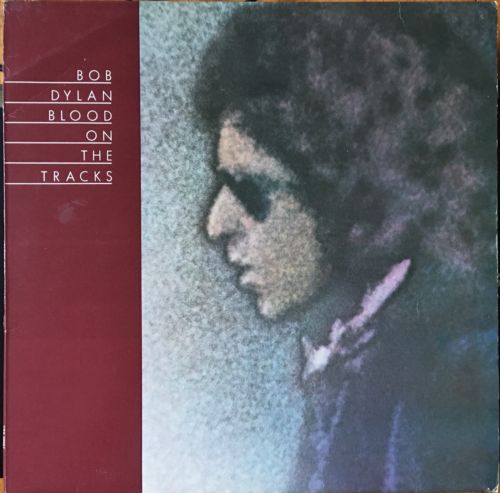
Bob Dylan "Blood On The Tracks" CBS S 69097 UK 1st 1974 Orange Label A2/B2
£
18
$
23


Favourite Auctions
To save auctions to your favourites, please login
If you don't have an account, please register
Description
Bob Dylan ?"Blood On The Tracks" CBS ?– S 69097 UK 1st press Vinyl, LP, with orange labels and a red inner sleeve, released in 1975.
The vinyl appears to have been lightly played and is in great condition. It played through beautifully on my elderly stereo - no hop, stick or jump. The sleeve, similarly, shows minimal signs of wear - some slight creasing to one corner and a little wear to the spine - but it is intact with no rips or writing. The inner sleeve is also intact with no writing and minimal signs of wear. Matrix / Runout Side 1 : CBS-S.69097.A-2 AlN Matrix / Runout Side 2 : CBS-S.69097.B-2
"Blood on the Tracks" is Bob Dylan's 15th studio album, released on January 20, 1975 by Columbia Records. The album marked Dylan's return to Columbia Records after a two-album stint with Asylum Records. Dylan commenced recording the album in New York City in September 1974. In December, shortly before Columbia was due to release the record, Dylan abruptly re-recorded much of the material in a studio in Minneapolis. The final album contains five tracks from New York and five from Minneapolis.
"Blood on the Tracks" was initially received with mixed reviews, but has subsequently been acclaimed as one of Dylan's greatest albums by critics and fans. The songs have been linked to tensions in Dylan's personal life, including estrangement from his then-wife Sara. One of their children, Jakob Dylan, has described the songs as "my parents talking". The album has been viewed as an outstanding example of the confessional singer-songwriter's craft, and it has been called "the truest, most honest account of a love affair from tip to stern ever put down on magnetic tape". In interviews, Dylan has denied that the songs on the album are autobiographical. In 2003, the album was ranked ?No.? 16 on Rolling Stone's list of the 500 greatest albums of all time, and in 2004, it was placed at ?No.? 5 on Pitchfork's list of the top 100 albums of the 1970s.
The album reached ?No.? 1 on the Billboard 200 charts and ?No.? 4 on the UK Albums Chart. The single "Tangled Up in Blue" peaked at ?No.? 31 on the Billboard Hot 100 singles chart. The album remains one of Dylan's best-selling studio releases, with a double-platinum U.S. certification by the Recording Industry Association of America (RIAA). In 2015, it was inducted into the Grammy Hall of Fame.
An influential review of the album was written by Dylan critic Michael Gray for the magazine Let It Rock. Gray argued that it transformed the cultural perception of Dylan, and that he was no longer defined as "the major artist of the sixties. Instead, Dylan has legitimized his claim to a creative prowess as vital now as then—a power not bounded by the one decade he so affected." This view was amplified by Clinton Heylin, who wrote: "Ten years after he turned the rock & roll brand of pop into rock ... [Dylan] renewed its legitimacy as a form capable of containing the work of a mature artist." In The Village Voice, Robert Christgau wrote that although the lyrics occasionally evoke romantic naiveté and bitterness, "Blood on the Tracks" is altogether Dylan's "most mature and assured record".
Since its initial reception, "Blood on the Tracks" has been viewed by critics as one of Dylan's best albums. In Salon.com, Wyman wrote: "Blood on the Tracks is his only flawless album and his best produced; the songs, each of them, are constructed in disciplined fashion. It is his kindest album and most dismayed, and seems in hindsight to have achieved a sublime balance between the logorrhea-plagued excesses of his mid-1960s output and the self-consciously simple compositions of his post-accident years." Bell, in his critical biography of Dylan, wrote that "Blood on the Tracks" was proof that "Dylan had won the argument over his refusal to argue about politics. In this, he began to seem prescient." Bell concluded the album "might well count as one of the best things Dylan ever did". Novelist Rick Moody called it "the truest, most honest account of a love affair from tip to stern ever put down on magnetic tape".
A result of the acclaim surrounding "Blood on the Tracks" has been that when critics have praised one of Dylan's subsequent albums they have often described it as "his best since "Blood on the Tracks". According to music journalist Rob Sheffield, "Blood on the Tracks" became a benchmark album for Dylan in the years that followed because it was "such a stunning comeback".
The album was also included in the book 1001 Albums You Must Hear Before You Die.
price rating






![Blood on the Tracks [180g Vinyl] [Limited] by Bob Dylan (Vinyl, Feb-2012, Mobile](https://www.popsike.net/php/thumbnail.php?url=https://www.popsike.pics/pix/20160711/112053222576.jpg)