Bruce Haack Jackpine Savage Together EX/EX
$
148


Favourite Auctions
To save auctions to your favourites, please login
If you don't have an account, please register
Description
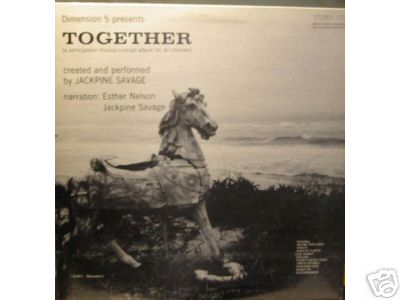
Jackpine Savage & Esther Nelson -
Together (a participation musical concept album for all children) ( Dimension 5 D151)
Classic 1971 release on Bruce Haack's Dimension 5 label only this time he's going it under the peculiar pseudonym of Jackpine. " Play this album on stereo equipment. The spaced-out movement of sound from speaker to speaker is important. Sometimes listen with earphones at moderate volume - you never know what you might discover.The songs are recorded so that they become complete when you add your voice to them. Jackpine Savage wrote the album, played all the instruments and sang it all (except for his back-up chorus which is electronic).
Release Date: 1971
Condition: Jacket is NEar Mint. Vinyl is Near Mint.
Tracks: Maybe this song, touch, rain of earth, p.k.. robot, colors, funky little song, abracadabra, punching bag, right on, outermission.
"Bruce Haack, born on May 4, 1931, was one of the most musically and lyrically inventive children's songwriters of the '60s and '70s. Despite — or perhaps because of — his intended audience, his music was unusually expressive, combining homemade analog synths; classical, country, pop, and rock elements; and surreal, idealistic lyrics. Haack's innovations and desire to teach still sound fresh, making his music a favorite with fans of analog synths and esoteric recordings. Followers like Luke Vibert and Add N to X championed his unique musical vision, which embraced concepts like "powerlove" and turned household appliances into synthesizers and modulators.
This musical vision appeared at age four, when Haack started picking out melodies on his family's piano; by age 12, he gave piano lessons and played in country & western bands as a teen. His upbringing in the isolated mining town of Rocky Mountain House in Alberta, Canada, gave Haack plenty of time to develop his musical gifts.
Seeking formal training to hone his ability, Haack applied to the University of Alberta's music program. Though that school rejected him because of his poor notation skills, at Edmonton University he wrote and recorded music for campus theater productions, hosted a radio show, and played in a band. He received a degree in psychology from the university; this influence was felt later in songs that dealt with body language and the computer-like ways children absorb information.
On the merits of one of his theatrical scores, New York City's Juilliard School offered Haack the opportunity to study with composer Vincent Persichetti; thanks to a scholarship from the Canadian government, he headed to New York upon graduating from Edmonton in 1954. At Juilliard, Haack met a like-minded student, Ted "Praxiteles" Pandel, with whom he developed a lifelong friendship. However, his studies proved less sympathetic, and he dropped out of Juilliard just eight months later, rejecting the school's restrictive approach.
Throughout the rest of his career, Haack rejected restrictions of any kind, often writing several different kinds of music at one time. He spent the rest of the '50s scoring dance and theater productions, as well as writing pop songs for record labels like Dot and Coral. Haack's early scores, like 1955's Les Etapes, suggested the futuristic themes and experimental techniques Haack developed in his later works. Originally commissioned for a Belgian ballet, Les Etapes mixed tape samples, electronics, soprano, and violin; the following year, he finished a musique concrète piece called "Lullaby for a Cat."
As the '60s began, the public's interest in electronic music and synthesizers increased, and so did Haack's notoriety. Along with songwriting and scoring, Haack appeared on TV shows like I've Got a Secret and The Tonight Show With Johnny Carson, usually with Pandel in tow. The duo often played the Dermatron, a touch- and heat-sensitive synthesizer, on the foreheads of guests; 1966's appearance on I've Got a Secret featured them playing 12 "chromatically pitched" young women.
Meanwhile, Haack wrote serious compositions as well, such as 1962's "Mass for Solo Piano," which Pandel performed at Carnegie Hall, and a song for Rocky Mountain House's 50th anniversary. One of his most futuristic pieces, 1963's "Garden of Delights," mixed Gregorian chants and electronic music and was one of Haack's favorites. Unfortunately, this work was never broadcast or released in its complete form.
Haack found another outlet for his creativity as an accompanist for children's dance teacher Esther Nelson. Perhaps inspired by his own lonely childhood, he and Nelson collaborated on educational, open-minded children's music. With Pandel, they started their own record label, Dimension 5, on which they released 1962's Dance, Sing, & Listen. Two other records followed in the series, 1963's Dance, Sing, & Listen Again and 1965's Dance, Sing, & Listen Again & Again. Though the series included activity and story songs similar to other children's records at the time, the music moves freely between country, medieval, classical, and pop, and mixes instruments like piano, synthesizers, and banjo. The lyrics deal with music history or provide instructions like, "When the music stops, be the sound you hear," resulting in an often surreal collage of sounds and ideas.
The otherworldly quality of Haack's music was emphasized by the instruments and recording techniques he developed with the Dance, Sing, & Listen series. Though he had little formal training in electronics, he made synthesizers and modulators out of any gadgets and surplus parts he could find, including guitar effects pedals and battery-operated transistor radios. Eschewing diagrams and plans, Haack improvised, creating instruments capable of 12-voice polyphony and random composition. Using these modular synthesizer systems, he then recorded with two two-track reel-to-reel decks, adding a moody tape echo to his already distinctive pieces.
As the '60s progressed and the musical climate became more receptive to his kind of whimsical innovation, Haack's friend, collaborator, and business manager Chris Kachulis found mainstream applications for his musical wizardry. This included scoring commercials for clients like Parker Brothers Games, Goodyear Tires, Kraft Cheese, and Lincoln Life Insurance; in the process, Haack won two awards for his work. He also continued to promote electronic music on television, demonstrating how synthesizers work on The Mr. Rogers Show in 1968, and released The Way-Out Record for Children later that year.
Haack's records were about to get even more way-out, however: Kachulis did another important favor for his friend by introducing Haack to psychedelic rock. Acid rock's expansive nature was a perfect match for Haack's style, and in 1969 he released his first rock-influenced work, The Electric Lucifer. A concept album about the earth being caught in the middle of a war between heaven and hell, The Electric Lucifer featured a heavy, driving sound complete with Moogs, Kachulis' singing, and Haack's homegrown electronics and unique lyrics, which deal with "powerlove" — a force so strong and good that it will not only save mankind but Lucifer himself. Kachulis helped out once more by bringing Haack and Lucifer to the attention of Columbia Records, who released it as Haack's major-label debut.
As the '70s started, Haack's musical horizons continued to expand. After the release of The Electric Lucifer, he struck up a friendship with fellow composer and electronic music pioneer Raymond Scott. They experimented with two of Scott's instruments, the Clavivox and Electronium. Unfortunately, nothing remains of the collaboration, and though Scott gave Haack a Clavivox, he didn't record with it on his own. However, he did continue on Lucifer's rock-influenced musical with 1971's Together, an electronic pop album that marked his return to Dimension 5. Perhaps in an attempt to differentiate this work from his children's music, he released it under the name Jackpine Savage, the only time he used this pseudonym.
Haack continued making children's albums as well, including 1972's Dance to the Music, 1973's Captain Entropy, and 1974's This Old Man, which featured science fiction versions of nursery rhymes and traditional songs. After relocating to Westchester, PA, to spend more time with Pandel, Haack focused on children's music almost exclusively, writing music for Scholastic Magazine Records like "The Witches' Vacation" and "Clifford the Small Red Puppy." He also released Funky Doodle and Ebenezer Electric (an electronic version of Charles Dickens' A Christmas Carol) in 1976, but by the late '70s, his prolific output slowed; two works, 1978's Haackula and the following year's Electric Lucifer Book II, were never released.
However, Haackula seems to have inspired Haack's final landmark work, 1981's Bite. The albums share several song titles and a dark lyrical tone different from Haack's usually idealistic style. Though Bite is harsher than his other works, it features his innovative, educational touch: a thorough primer on electronics and synthesizers makes up a large portion of the liner notes, and Haack adds a new collaborator for this album, 13-year-old vocalist Ed Harvey.
Haack's failing health slowed Dimension 5's musical output in the early '80s, but Miss Nelson and Pandel kept the label alive by publishing songbooks, like Fun to Sing and The World's Best Funny Songs, and re-released selected older albums as cassettes, which are still available today. Haack died in 1988 from heart failure, but his label and commitment to making creative children's music survives. And while Dimension 5's later musical releases — mostly singalong albums featuring Miss Nelson — may lack the iconoclastic spark of the early records, Nelson and Pandel's continued work reveals the depth of their friendship with Haack, a distinctive and pioneering electronic musician. " - All Music Guide
Who We?
We are a collective of vinyl & pop culture freaks who want to pass on our assumed good and bad taste to those of you in cyberspace who share the same feverish quest for hard to find records, books and art that we do. we intend to bring you records and other ephemera in categories known and imagined. All listings run for a 7 day cycle. We have been planting the seeds all winter long and now spring is here! Loads of ridiculous, weird, strange & wonderful albums, field recordings, sexy covers, beatnik hep cat wax, calypso fever,folk, funk, private pressings, bubblegum, sound effects, psych, electronic, latin, and just downright strange stuff! Many great items to explore and add to your library. Some rarely seen!
Payment Policy: Payment is due within 10 days of auction's end. We accept paypal, Money Orders, checks (10 days to clear), bidpay and well concealed cash (at buyer's risk). We ship merchandise once a week on Friday by media mail with delivery confirmation & by airmail to other parts of the physical world.
Bid with confidence: We have been buying and selling records and related pop culture items for over a decade now.
Grading: Vinyl is strictly graded according to Goldmine standards. We try to do our absolute best in explaining the condition of an lp to you. Once you have won an auction, your record is cleaned, carefully packed and shipped in sturdy, industry standard record mailer. Paper items are graded visually with as much detail as possible.
Shipping: In the U.S., shipping is sent by regular post at a rate of 1.75 for one 45 or $4.00 for the first lp record ( up to 4 singles count as one record) and $1 for each additional record (or 4 45s). Canada is $5 for the first record and $1.25 for each additional record. The rest of the Americas and Europe, shipping is $11.50 for airmail or $7.00 for parcel post for the first lp and $2.00 for each additional lp. Shipping to Asia is $13 for airmail for the first item or $8 for surface shipping. Each additional item is $2.75. Multiple buys will help defray the costs of shipping immensely.
On Jun-05-04 at 18:29:45 PDT, seller added the following information: UH OH...FORGIVE OUR MIXUP! WE SHIP WORLDWIDE FROM HERE TO TIMBUKTU!







![John Coltrane - Lush Life [Used Very Good Vinyl LP]](https://www.popsike.net/php/thumbnail.php?url=https://www.popsike.pics/pix/20241016/395804002693.jpg)