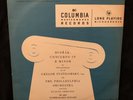
CARL NIELSEN Symphony No 5 Op 50 Live Recording Erik TUXEN 78
$
27


Favourite Auctions
To save auctions to your favourites, please login
If you don't have an account, please register
Description
Welcome to my auctions of great records
WEEK 2 of 3 weeks of great auctions – this is the SECOND week of three weeks of great records. As a default, I will not send you an invoice until the end of my sales cycle on September 27 – that way you can see my next listings and you can combine your wins into one parcel for a low postage.
International shipping: approx postage 1x10"=$25: 1x12"=$28: 10"Album 4 Rec=45$: 12" Album 2 Rec=45$
Less to Canada. Pls ignore international postage displayed in Ebay, rates are too high
IF YOU WIN MULTIPLE ITEMS DO NOT USE EBAY CHECK OUT in order for me to get you low combined postage. Send me an invoice request instead.
I am currently selling a series of great Richard Wagner and classic European 78 rpm orchestral recordings on all the great European labels:
From the great effort of Danish Orchestras and record companies to FIRST record the works of the great DANISH modernist CARL NIELSEN after his death in 1931. Unlike e.g. Elgar, Nielsen never recorded one of his works, so these first early recordings are as authentic to Nielsen as we can get.
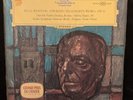
This first recording of CARL NIELSENs Symphony No 5 Op 50, live in concert
Danish Radio Symphony Orchestra under Erik Tuxen
5x 12" HMV 78 rpm records
Condition: EXCELLENT close to pristine, faintest scuffs, in solid generic album
Carl August Nielsen (June 9, 1865 – October 3, 1931) was a conductor, violinist, and composer from Denmark. His works are primarily known in Denmark, where cultural institutions, particularly since in the first years of the 21st century, have sought to promote the legacy of Danish-born artists. Carl Nielsen is especially admired for his six symphonies and his concertos for violin, flute and clarinet.
Life
Nielsen was the fifth of twelve children in a poor peasant family in Sortelung (Nørre Lyndelse), south of the city of Odense, Denmark. His father was a house painter and amateur musician. Carl first discovered music by experimenting with the sounds and pitches he heard when striking logs in a pile of firewood behind his home. He managed to learn the violin and piano as a child.
He also learned how to play brass instruments, which led to a job as a bugler in the 16th Battalion at nearby Odense. He later studied violin and music theory at the Copenhagen Music Conservatory, but never took formal lessons in composition. Nonetheless, he began to compose. At first, he did not gain enough recognition for his works to support him. During the concert which saw the premiere of his first symphony on March 14, 1894 conducted by Johan Svendsen, Nielsen played in the second violin section. However, the same symphony was a great success when played in Berlin in 1896, and from then his fame grew.
Carl Nielsen's childhood homeNielsen continued to play the violin at the Royal Theatre in Copenhagen until 1905, when he became 2nd conductor at the Theatre (till 1914). From 1914-26 he was conductor the orchestra of "Musikforeningen" In 1916 he took a post teaching at the Royal Danish Conservatory in Copenhagen, and continued to work there until his death, in his last year as director of the institute.
On April 10, 1891 Nielsen married the Danish sculptor Anne Marie Brodersen, after having met just a month before in Paris, and the couple honeymooned in Italy. Despite a long period of marital strife including a lengthy separation and mutual accusations of infidelity, they remained married until Nielsen's death. They had three children: Irmelin, Anne Marie, and Børge
He suffered a serious heart attack in 1925 and from that time on he was forced to curtail much of his activity, although he continued to compose until his death. Also during this period he wrote a delightful memoir of his childhood called My Childhood on Funen (1927). He also produced a short book of essays entitled Living Music (1925). Both are translated into English. He died in Copenhagen in 1931.
[edit] Music
Further information: List of compositions by Carl Nielsen
Nielsen is best known for his six symphonies. Other well-known pieces of his are the incidental music for Adam Oehlenschläger's drama Aladdin, the operas Saul og David and Maskarade, the concerti for flute, violin, and clarinet, the wind quintet, and the Helios Overture, which depicts the passage of the sun in the sky from dawn to nightfall. The vast majority of Danes knows and sings the numerous songs by various poets, set to music by Carl Nielsen.
Like his contemporary, the Finn Jean Sibelius, he studied Renaissance polyphony closely, which accounts for much of the melodic and harmonic "feel" of his music.
Nielsen's works are sometimes referred to by FS numbers, from the 1965 catalog compiled by Dan Fog and Torben Schousboe.
[edit] Symphonies
Nielsen's approach to sonata form, as seen in his six symphonies, is one of gradual abandonment. In considering the first movements of each symphony in turn, the first two reveal Nielsen working fairly comfortably within the confines of sonata form as later 19th century composers saw it; the middle two include certain high-level references to sonata form but little of the detail, and the last two inhabit a completely new world of Nielsen's own devising, wherein the structure of the movement can only be understood within the context of the material he is working with. By that point in his output there are no more parallels with any other forms or past traditions of musical construction.
Symphony No. 1
Nielsen's early Symphony No. 1 in G minor already shows his individuality and hints at what Robert Simpson calls "progressive tonality" , by which he refers to Nielsen's habit of beginning a work in one key and ending in another. It was written at the same time as, and shares some qualities with, the Holstein songs of Op. 10.
Symphony No. 2
A painting Nielsen saw at an inn, depicting the four temperaments (choleric, melancholic, phlegmatic and sanguine), inspired him to write Symphony No. 2, "The Four Temperaments". It is in four movements, each illuminating one of the temperaments, but despite this apparent tendency toward being a suite of tone poems, it is a fully integrated symphony. It is not true "program music" but rather a group of general character sketches, and one need not know which temperament Nielsen is considering in order to appreciate the work as a whole.
Symphony No. 3
Symphony No. 3, "Espansiva" was premiered in the same concert as the Violin Concerto. The second movement contains wordless solos for soprano and baritone voices (which can be played by clarinet and trombone if voices are not available).
Symphony No. 4
Perhaps the best known of Nielsen's Symphonies is Symphony No. 4, "The Inextinguishable". It is in four connected movements and is the most dramatic Nielsen had written to date. In the last movement two sets of timpani are placed on opposite sides of the stage as a sort of musical duel.
Symphony No. 5
Symphony No. 5 is the second of two of Nielsen's symphonies that lack a subtitle (which for Nielsen in any case are only very general signposts of intent, not indicating specific story-telling qualities). Like symphony no. 4, it has very dramatic use of percussion: at one point in the first movement – which itself consists of two large structures joined to one another – the snare drummer is instructed to improvise "as if at all costs to stop the progress of the orchestra." This symphony is the one by which Nielsen's music made its first significant post-war impact outside Scandinavia, when the Danish Radio Symphony, conducted by Erik Tuxen, performed it at the 1950 Edinburgh International Festival where it caused a sensation.
Symphony No. 6
Even Robert Simpson was at first confused by Nielsen's Symphony No. 6, "Semplice". It is not as obviously dramatic as the previous two and in some ways it strikes listeners as strange. For instance, the second movement is only scored for nine instruments of the orchestra (piccolo, 2 clarinets, 2 bassoons, trombone, and percussion) and represents Nielsen's commentary on trends in modern musical composition at the time (the mid-1920s). It is by far the most elusive of his symphonies to grasp, yet its very subtle architectural structure coupled with its enigmatic emotional tone make it a challenging, fascinating, and ultimately rewarding listening experience.
[edit] Historical Recordings
Nielsen did not record any of his symphonies, or for that sake any of his works. (He simply didn't believe in the medium). However, three younger contemporary conductors, Thomas Jensen, Launy Grøndahl, and Erik Tuxen, who had worked with him, did record his symphonies and other orchestral works, and their recordings are therefore considered to be the most 'authentic' Nielsen available.
Symphony No. 1: Thomas Jensen - 1952 (Decca)
Symphony No. 2: Thomas Jensen - 1947 (EMI)
Symphony No. 3: Erik Tuxen - 1946 (Decca)
Symphony No. 4: Launy Grøndahl - 1951 (EMI)
Symphony No. 5: Erik Tuxen - 1950 (EMI); Thomas Jensen - 1954 (Decca - first LP recording)
Symphony No. 6: Thomas Jensen - 1952 (Tono, a Danish label)
A series of great Violin, Piano and Orchestra records on rare labels, from 1902 Monarch to 1940 War Germany recordings.
More Great Records on sale right now:
http://shop.ebay.com/carsten_sf/m.html
http://shop.ebay.com/carsten_sf/m.html
====
A Quick NOTE ON GRADING AND SHIPPING:
As you can see from my feedback, I try hard to earn your POSITIVE FEEDBACK and FIVE STAR RATINGS.
If for any reason your transaction was NOT SATISFACTORY, pls contact me and I will work something out with you. YOU WILL NEVER HAVE A REASON TO GIVE ME A NEGATIVE RATING or a LOW STAR RATING.
Quick note on grading:
The Grade (Excellent to Fair, I don't give Mint) refers to the WEAR of the record. Any other defects are stated separately
When I listen to a record, I may also give it an aural grade (again E to F), and make a SUBJECTIVE judgment of the pressing quality for hiss and surface noise.
"SUPERQUIET" is basically noiseless, like a vinyl pressing.
"VERY QUIET" is an exceptionally quiet record for a given pressing.
"Quiet" is a record that is a great example without undue noise for a give pressing.
These judgments are SUBJECTIVE and will depend one the styli, phonograph etc. you use on your own equipment.
Pls check my other auctions for more great records and phonograph items:
Multiple item shipping: I am happy to combine items for shipment in one parcel.
If you win multiple items, pls send me an INVOICE REQUEST to calculate the correct postage. Ebay check out will not give you the multiple item discount!
Records will be packed safely between corrugated cardboard in a sturdy box with plenty of padding for safe shipment.
Shipment is usually Media Mail, unless another service is requested. Shipping is at your risk, I will be happy to insure items at your cost.
I charge actual postage plus a small fee for packing materials
As always, I guarantee your satisfaction. If you don't like the item, just return it, and I will refund the full purchase price.
If you are in the San Francisco area, I encourage pick-up in person.
US Domestic Shipping:
Here is a guideline for US Media Mail Shipping:
Prices below are for regular 78 rpm records. Up to about 5 records, I will ship Edison Discs for the same rates. Albums from Album Sets count as 1 record. Above that and for international shipments, it will be actual weight plus a small packing charge (1-3$ depending on size of shipment)
1 record: 4.50 – 5.00$
2 records: 5.75$
5 records: 7.50$
10 records: 9.50$
MANY MORE RECORDS: Don't worry. I safely ship 40 - 50 pounds of records double boxed in moving boxes, and even then Media Mail will probably not exceed 30$.
Please send me a message if you would like to lower your shipping rates!
International Buyers:
All'attenzione degli acquirenti italiani:
ATTENTION TO ITALIAN BUYERS:
Due to rare problems with delivery in ITALY, I will NOT GUARANTEE delivery of parcels sent by US Postal Service First Class and Priority Mail. If you prefer secure delivery, I will be happy to quote you either Registered Mail or shipment by FEDEX
I am very happy to ship records worldwide.
Please use the EBAY shipping cost only as a guideline. My actual charges are usually lower
One record usually ships for 25 – 28$ (Less for Canada).
I can get competitive rates from FedEx and the US Postal service for any kind of parcel weight, and will make use of all the cost-saving shipment methods
Pls contact me for a shipping estimate, or send me an invoice request after close of auction.
AND AGAIN -THANK YOU FOR YOUR INTEREST
As you can see from my feedback, I take great care in presenting, grading and shipping your items. I really want you to be happy with the purchase. If you feel that anything is wrong with the item or the shipping, contact me and we will work it out !!!
As always, I would appreciate any suggestions and corrections from you, pls contact me with any question.
Thank you very much, and good luck bidding !!!