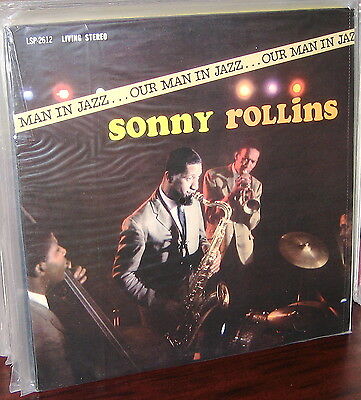
CLASSIC RECORDS LP LSP-2612: SONNY ROLLINS - Our Man In Jazz, 1990s USA 180gm SS
C$
150
$
109


Favourite Auctions
To save auctions to your favourites, please login
If you don't have an account, please register
Description
****Welcome to our listing, thanks very much for looking!
****See our own website! We have lots of out of print LPs and CDs! Find us on the web at -
hearthedifference.net
****Please see our other listings - new items added daily!
****Shipping cost is only an estimate - it depends on the actual weight and size of the package as well as the service required. We do not profit from shipping costs, so if we overcharge, we will refund the difference back to you. It's always best to wait for our invoice before paying for your item. We will combine shipping for multiple items purchased.
Background -
Theodore Walter "Sonny" Rollins (born September 7, 1930 in New York City) is an American jazz tenor saxophonist. Rollins is widely recognized as one of the most important and influential jazz musicians. A number of his compositions, including "St. Thomas", "Oleo", "Doxy", and "Airegin", have become jazz standards.Although Rollins was born in New York City, his parents were born in the United States Virgin Islands. Rollins received his first saxophone at age 13. He attended Benjamin Franklin High School in East Harlem. He said that a concert by Frank Sinatra there, accompanied by a plea for racial harmony, changed his life.
Rollins started as a pianist, changed to alto saxophone, and finally switched to tenor in 1946. During his high-school years, he played in a band with other future jazz legends Jackie McLean, Kenny Drew and Art Taylor. He was first recorded in 1949 with Babs Gonzales ( J. J. Johnson was the arranger of the group). In his recordings through 1954, he played with performers such as Miles Davis, Charlie Parker and Thelonious Monk.
In 1950, Rollins was arrested for armed robbery and given a sentence of three years. He spent 10 months in Rikers Island jail before he was released on parole. In 1952 he was arrested for violating the terms of his parole by using heroin. Rollins was assigned to the Federal Medical Center, Lexington, at the time the only assistance in the U.S. for drug addicts. While there he was a volunteer for then-experimental methadone therapy and was able to break his heroin habit. Rollins himself initially feared sobriety would impair his musicianship, but then went on to greater success. As a saxophonist he had initially been attracted to the jump and R&B sounds of performers like Louis Jordan, but soon became drawn into the mainstream tenor saxophone tradition. Joachim Berendt has described this tradition as sitting between the two poles of the strong sonority of Coleman Hawkins and the light flexible phrasing of Lester Young, which did so much to inspire the fleet improvisation of be-bop in the 1950s.
Rollins began to make a name for himself in 1949 as he recorded with J. J. Johnson and Bud Powell what would later be called "Hard Bop", with Miles Davis in 1951, with the Modern Jazz Quartet and with Thelonious Monk in 1953, but the breakthrough arrived in 1954 when he recorded his famous compositions "Oleo" "Airegin" and "Doxy" with a quintet led by Davis. Rollins then joined the Miles Davis Quintet in the summer of 1955, but left after a short stay to deal with his drug problems. Rollins was invited later in 1955 to join the Clifford Brown–Max Roach quintet; studio recordings documenting his time in the band are the albums Clifford Brown and Max Roach at Basin Street and Sonny Rollins Plus 4. After Brown's death in 1956 Rollins began his subsequent career as a leader, his first long-playing albums released on Prestige Records. He also recorded during the 1950s for Blue Note, Riverside, and the Los Angeles label Contemporary.
Our Man in Jazz is an album by jazz saxophonist Sonny Rollins, recorded for the RCA Victor label, featuring July 1962 performances by Rollins with Don Cherry, Bob Cranshaw, and Billy Higgins. These performances have been described as contrasting from Rollins' previous style by moving to "very long free-form fancies, swaggering and impetuous".
-
CLASSIC RECORDS / RCA Records LP item.
-
Record Made in the USA
-
Pressing is in STEREO
-
Record Speed: 33 1/3 rpm
-
Earliest (and best) version of this audiophile reissue by Classic Records - using 180-gram pure virgin vinyl, this title is long out of print.
-
Record Made in: mid 1990s - original LP were issued in 1962 by RCA Records.
-
Record Catalog Number: LSP 2612
Featured on this item -
Sonny Rollins
Sonny Rollins – tenor saxophone
Don Cherry - cornet
Bob Cranshaw - bass
Billy Higgins - drums
LP Title & Music on this item -
Our Man In Jazz
Track Listing -
- "Oléo" - 25:32
- "Dearly Beloved" (Jerome Kern, Johnny Mercer) - 8:15
- "Doxy" - 15:08
- Recorded at The Village Gate in New York City on July 27–30, 1962
- All compositions by Sonny Rollins except as indicated
CONDITION Details:
LP JACKET:-
The LP jacket is in Mint condition - this item is FACTORY SEALED.
-
The jacket has NO seam splits - it is completely intact.
-
The jacket has NO drill holes or saw marks of any kind.
-
The outer plastic cellophane (bag) wrap is perfect. The perforated seam is completely intact.
-
There is NO hand writing on the front or back of the jacket.
-
The cover has clean and sharp colors - see pictures with this listing for more detail.
-
The LP is assumed to be in MINT condition as this item is FACTORY SEALED!
-
This is the mint copy you have always wanted in your collection - any super picky audiophile would be happy with this one!
A Short Note About LP GRADING -
- Mint = Only used for sealed items.
- Near Mint = Virtually flawless in every way.
- Near Mint Minus = Item has some minor imperfections, some audible.
- Excellent = Item obviously played and enjoyed with some noise.
- Very Good Plus = Many more imperfections which are noticeable and obtrusive.
For best results, always properly clean your LPs before playing them.
The LP is an audiophile quality pressing (any collector of fine MFSL, half speeds, direct to discs, Japanese/UK pressings etc., can attest to the difference a quality pressing can make to an audio system).
Do not let this rarity slip by!
price rating