CONRAD SCHNITZLER control LP 1981 electronic avant tietchen kluster m.b. nww
$
355


Favourite Auctions
To save auctions to your favourites, please login
If you don't have an account, please register
Description
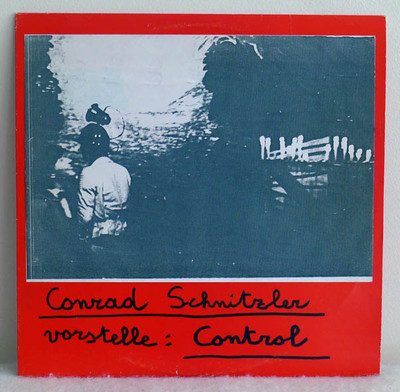
Conrad Schnitzler "Control" LP issued by DIY (DYS 04) in the US, 1981. Hand made sleeve by Maurizio Bianchi. ****** Rec:vg+++ / Cov:ex ****** This copy comes from the Maurizio Bianchi collection and features an unique handmade sleeve done by M.B. himself starting from a recycled "Regel" sleeve! Schnitzler and M.B. were close friends in the late 70s as the music of early Tangerine Dream and Kluster always was a great inspiration for the Italian modernist. "Control" is possibly Schnitzler best LP ever! "Control A": each side of the original LP is divided into several, untitled sections. Schnitzler welcomes the listener with atonal kernels of creamy, electronic vibrato, bleeping at varying dynamic levels. The only order in this disorder is that higher frequency chords are louder, leaving the muddier, brown frequency sounds partly concealed. At least three layers of these independently originated, expressionist tides collate, but never coagulate. In the second fragment, foggy synthesizer folds are sustained and then slowly pitch-modulated. Unlike in the previous track, the very act of modulation generates melodic expectations. Electric clangs fall like raindrops hitting window panes curiously intent on rejecting the liquid particles at various frequencies. This evanescent texture is sparse and the pitches are arranged to accentuate the mutual contrast. Still, the overall timbral effect is almost childlike. A more “industrial”-sounding track based on blender glissandos with controlled sustain. Tone colors permutate between the illusions of take-off, landing and taxing. Although the context harks back to the ideas first developed on LP “Con”, the selection of effects is more balanced. Discrete pitch bending occurs around the usually avoided parts of the frequency spectrum. Fast ‘grasshopper’ tremolo is drowned out by an alternating dynamics in doomed quest of nebulous, dormant realm. The dominant velocity would outpace any other track on the record, but the gesticulation is imperfectly robotic. Another stratum of glissandos brings a dose of painfully sullied nostalgia. "Control B": This is an even more atmospheric exploration of chalky textures. Sheaths of organ give rise to a rare moment of loose harmonic consonance. Another electronic landscape for stagnating sheets of lengthy notes, modulated in mid-flight. They all fade away, substituted instantly by clones whose energy dissipates in like manner. Simultaneous sizzling and rumbling epitomizes the hypnotic character of procyclical, compressed electronics. An essing, oscillatory web is delicately overlaid above the leading theme-building. The focus is on an eventless space, wide open terrain and visibility constrained only by atmospheric phenomena. The record closes as it opened – with abstract, a-melodic clusters, collected almost sequentially in search of the right nocturnal mood. A vague sense of solitude permeates the departures towards to the top of the staff, into ever shorter notes. Mid-range synthesizer provides some harmonic solution, but the track is cut abruptly. Originally from Düsseldorf, Conrad Schnitzler debuted as a sound artist around 1967. After studying with Joseph Beuys he moved to Berlin, when he was often associated with the local school of electronic rock even though his soundscapes were never “rock” and his aesthetic was always too idiosyncratic to be pigeonholed. In his most successful recordings, Schnitzler showed predilection for range compression that was unusual in the early days of analog synthesizers. It is as if he had done a careful scoping study before each session, imposing restraints on the adopted textures and energy levels. Nor did he seem to be tempted by excessive multi-layering of additive effects. His strength lied in poised tone colorings and controlled mood explorations. His forays into illustration were quickly abandoned and throughout most of his career his music remained subconceptual and non-ascriptive. Schnitzler’s creations went through several stages. Beginning with Berlin-based trios Kluster (with Joachim Roedelius and Dieter Moebius) and Eruption (with Wolfgang Seidel and Klaus Freudigmann), his spacious, psychotropic work relied as much on musical instruments as on amplifiers and echoes. He then moved on to explore in depth the modulatory capabilities of analog synthesizers, achieving much more groundbreaking and lasting results than many of his compatriots. An artistic hiatus befell him in the second half of the 1970s, when several misguided attempts at electronic rock introduced him to accidental audiences in Germany and abroad. But unlike the synthesized disciples of the Berlin school, he returned triumphantly in the early 1980s, penning some of the most intriguing and abstract oeuvres yet! "Control" music is designed to stimulate your mind!!! ****** The records would be graded m- if it was not for an very light scratch on side B which is almost un-noticeable when playing the record. ****** Handmade sleeve by Maurizio Bianchi has minimal wear and ring wear on back cover. ****** Please wait to receive my invoice before sending the payment after the auction ends. Attention! Real postage costs are not USD 4 as all the items are located in Doha, Qatar (which has a very safe and professional post system). Postage costs registered up to 1 Kilo (generally 3 LPs): to Europe and Japan is USD 16,50 / to America and Oceania is USD 22,50. Postage costs registered up to 2 Kilos: to Europe and Japan is USD 28,00 / to America and Oceania is USD 34,00. ****** More rare LPs and tapes from the Maurizio Bianchi early 80s collection available next week, including Camera Obscura, Chrome, Mnemonic Orchestra and more! ****** Thank you for your kind attention and good luck with your bids.