Cafe Society, J.C. Heard / Mary Lou Williams / Edmond Hall / Maxine Sullivan ?–
$
30



Favourite Auctions
To save auctions to your favourites, please login
If you don't have an account, please register
Description
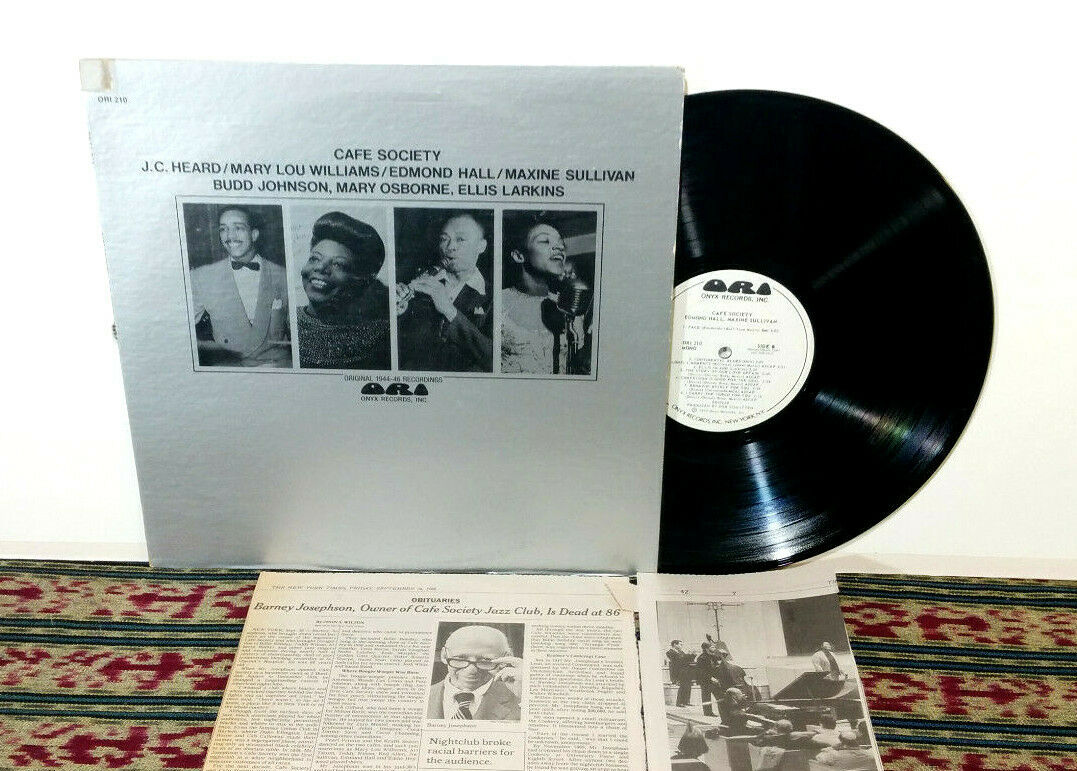
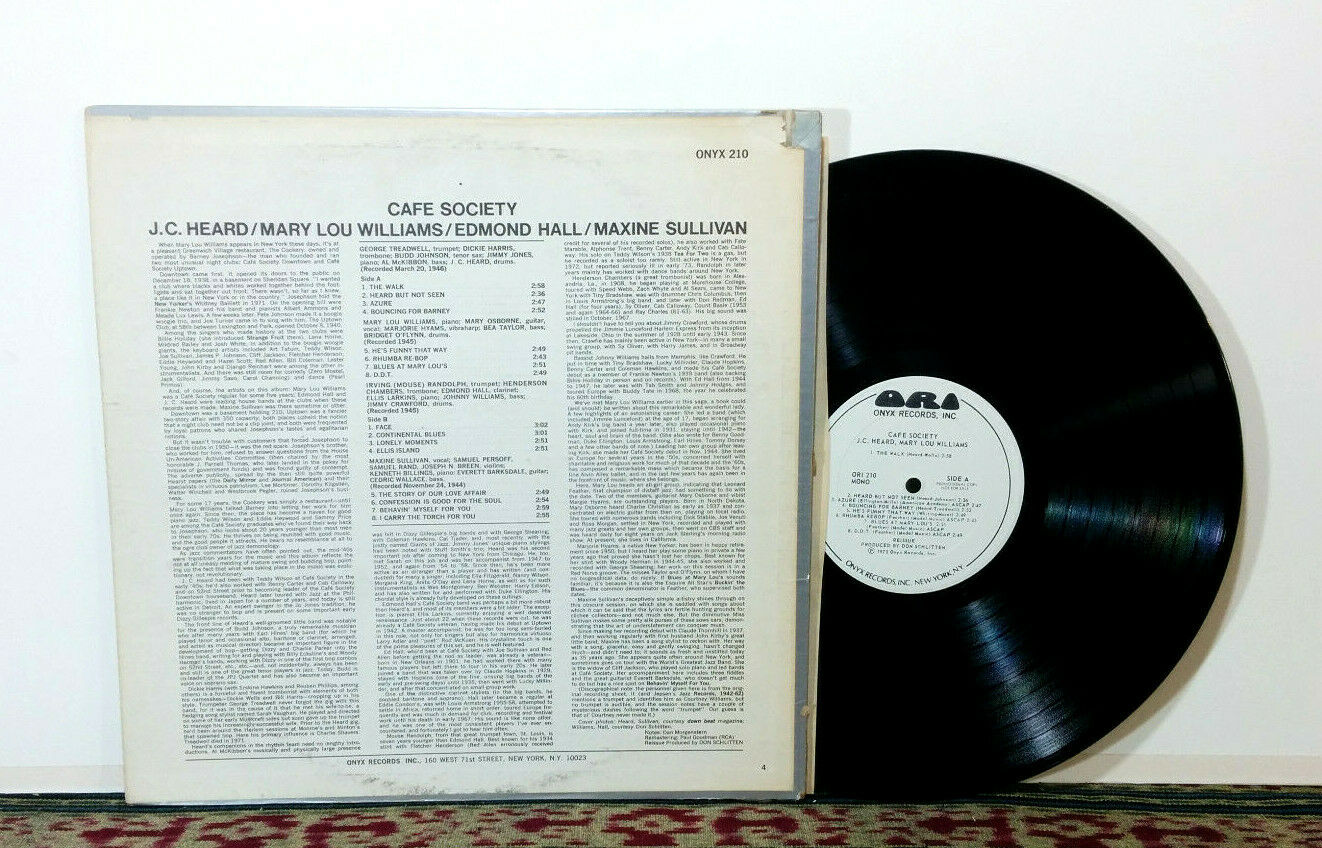
(Visually graded) Vinyl looks Near Mint and Sleeve looks VG/VG+ (promo notch) See pics. See pics and info for details.
J.C. Heard / Mary Lou Williams / Edmond Hall / Maxine Sullivan ?– Cafe Society
** Extras Included: Barney Josephson Obituary newspaper clippings from New York Times
Label:
Onyx Records ?– ORI 210, Onyx Records ?– ONYX 210
Format:
Vinyl, LP, Compilation, Promo, Mono, 12", 33 RPM
Country:
US
Released:
1973
Genre:
Jazz
Style:
Bop, Swing
Tracklist
A1 The Walk 2:58
A2 Heard But Not Seen 2:36
A3 Azure 2:47
A4 Bouncing For Barney 2:52
A5 He's Funny That Way 2:49
A6 Rhumba Be-Bop 2:43
A7 Blues At Mary Lou's 2:51
A8 D.D.T. 2:49
B1 Face 3:02
B2 Continental Blues 3:01
B3 Lonely Moments 2:51
B4 Ellis Island 2:51
B5 The Story Of Our Love Affair 2:49
B6 Confession Is Good For The Soul 2:54
B7 Behavin' Myself For You 2:59
B8 I Carry The Torch For You 2:55
Credits
Bass – Bea Taylor (tracks: A5-A8)
Drums – Bridget O'Flynn (tracks: A5-A8)
Guitar, Vocals – Mary Osborne (tracks: A5-A8)
Piano – Mary Lou Williams (tracks: A5-A8)
Vibraharp – Marjorie Hyams (tracks: A5-A8)
Notes
Original 1944-46 recordings.
- Onyx Records (3)
Profile:
US jazz reissue label founded by Joe Fields in 1973 alongside Muse Records, and managed by Don Schlitten.
- Café Society was a New York City nightclub open from 1938 to 1948 at Sheridan Square in Greenwich Village, and managed by Barney Josephson. -
Josephson created the club to showcase African American talent and to be an American version of the political cabarets he had seen in Europe earlier. As well as running the first racially integrated night club in the United States,[3] Josephson also intended the club to defy the pretensions of the rich; he chose the name to mock Clare Boothe Luce and what she referred to as "café society", the habitués of more upscale nightclubs, and that wry satirical note was carried through in murals done by Anton Refrigier, Russian immigrant who is more well known for the San Francisco Rincon Annex murals. Josephson trademarked the name Café Society, a phrase coined but not trademarked by Maury Paul, a society columnist who wrote as "Cholly Knickerbocker" for the New York Journal American. He also advertised the club as "The Wrong Place for the Right People".[4] Josephson opened a second branch on 58th Street, between Lexington and Park Avenue, in 1940. After that, the original club was known as Café Society Downtown and the new club—designed for a different audience—as Café Society Uptown.
The club also prided itself on treating black and white customers equally, unlike many venues, such as the Cotton Club, that featured black performers but barred black customers except for prominent blacks in the entertainment industry. The club featured many of the greatest black musicians of the day, from a wide range of backgrounds, often presented with a strongly political bent. Billie Holiday first sang "Strange Fruit" there; at Josephson's insistence, she closed her set with this song, leaving the stage without taking any encores, so that the audience would be left to think about the meaning of the song. Lena Horne was persuaded to stop singing "When it's Sleepy Time Down South", Pearl Bailey was fired for being "too much of an Uncle Tom", and Carol Channing was fired for an impersonation of Ethel Waters.[3]
Relying on the keen musical judgment of John Hammond, the club's "unofficial music director",[3] Josephson helped launch the careers of Ruth Brown, Lena Horne, dancer Pearl Primus, Hazel Scott, Pete Johnson, Albert Ammons, Big Joe Turner, and Sarah Vaughan, and popularized gospel groups such as the Dixie Hummingbirds and the Golden Gate Quartet among white audiences. Many of these acts had first been presented at Hammond's Carnegie Hall concerts, From Spirituals to Swing, in 1938 and 1939. Its defining star in the early 1940s was Josh White, who first appeared there with a gospel group, the Carolinians, then went on to head the bill as a solo performer for four years.
As part of the challenge to integrate America's segregated society, Josephson's club was the scene of numerous political events and fundraisers, often for left-wing causes, both during and after World War II. In 1947, Josephson's brother Leon Josephson was subpoenaed by the House Committee on Un-American Activities, which led to hostile comments from columnists Westbrook Pegler and Walter Winchell. Business dropped sharply as a result, and the club closed the following year. -wikipedia
- We really want you to be happy with your purchase. If the vinyl does not live up to our grading upon receipt, please email us through EBAY before leaving a Feedback or Rating so that we may correct it for you. We have a 30 day return policy.
---------------------------------
- General Standards For Record Grading -
M
(MINT) New, May be sealed. Perfection, no flaws, defects, marks, scuffs or otherwise indications of being handled or played. Any scuffs, hairline scratches or other marks disqualify discs from this category. New looking sleeve, usually in original shrink wrap.
NM-
(NEAR MINT) The vinyl is almost flawless, bright and shiny. A very light minor, barely visible mark or two may be permitted. The disc should play with no audible noise. The label is bright, clean and unmarked. Sleeve looks almost Mint.
VG++/EX
(VERY GOOD ++/ Excellent) Disc plays near perfectly, but may have minor, light scuffs that do not interfere with the sound quality. There can possibly be a light hairline scratch or two but nothing that is obvious or affects play. Vinyl is bright and shiny; label is clean and unmarked. Sleeve is Excellent.
VG+
(VERY GOOD PLUS) Some visible surface wear, very minor scratches and scuffs, but minimal impact on the sound quality. Vinyl will still have good luster; labels may have minor imperfections (small labels or initials, etc.) but otherwise clean. Sleeve may have some shelf wear, or minor writing, no seem splits.
VG
(VERY GOOD) Vinyl will have noticeable scratches or scuffs that cause minor surface noise, but do not overpower the music. There will be no skips. Vinyl may appear somewhat dull and grayish. Labels may have small tears, tape marks, larger writing, etc. but still easily legible. Sleeve will have moderate wear or writing, price tags etc, minor seem splits.
G
(GOOD) Well-played, dull, grayish vinyl with deeper scratches and wear causing distracting surface noise (hisses, pops, cracks and other nasties). The record will still play through without any skips. Labels may be significantly defaced or damaged and sleeve heavy wear/ writing, seems split/ damage.
price rating