Charlie Munro Quartet Eastern Horizons LP 1967 Philips Original rare Aust jazz
A$
650
$
415


Favourite Auctions
To save auctions to your favourites, please login
If you don't have an account, please register
Description
Charlie Munro Quartet Eastern Horizons LP 1967 Philips Original rare Australian jazz
(No offers taken at the moment, sorry.)
Original Australian stereo pressing on Philips JS 20.
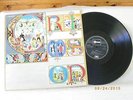
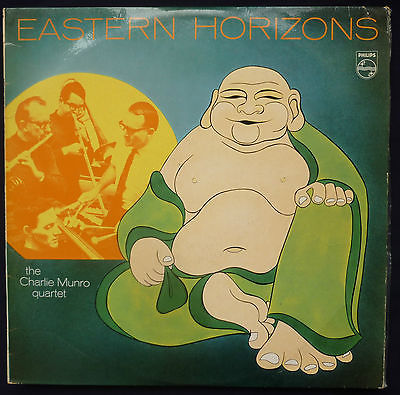
Classic and very rare Australian modern jazz LP. The cover sums up this group quite well. In the photo they can be seen in their ties, turtlenecks and black rimmed glasses next to an illustration of a smiling Buddha. The music is formally structured and uses Eastern motifs. Munro was a suburban family man and a stalwart of the ABC band, but he was also a keen student of new developments or influences, from Eastern scales (in this case) to Ayler or Led Zeppelin.
The LP opens with the classic "Islamic Suite" (heard on the ABC compilation Bodgie DaDa) featuring Munro on sax and cello, and a striking intro from percussionist Mark Bowden. Then comes "Arch's Groove", "Malahari Raga", "David", "Japanese Love Song", "Minimum" (composed by Syd Powell), "When I Look At You", "Raised Eyebrows" (composed by Mark Bowden). Composed by Munro except where noted.
Considered to be one of Australia's most important modern sessions, Eastern Horizons is an album of extraordinary force. A pioneering exploration of Eastern-influenced free jazz that stands as one of the earliest prototypes of the genre. Notably, this session from Sydney predates other more widely-acknowledged Eastern-influenced albums as well as other 'Indo jazz' recordings of the late '60s and early '70s. Following in the footsteps of early '60s Coltrane and the work of Ornette Coleman, The Charlie Munro Quartet were undoubtedly one of the most important groups to emerge from the Australian scene. Formed from the ashes of the Bryce Rohde Quartet, saxophonist and cellist Charlie Munro and drummer/percussionist Mark Bowden continued to explore the Lydian Mode with their new Quartet. Enlisting young players Neville Whitehead on bass (future Neil Ardley and Ian Carr) and top Sydney session trombonist Bob McIvor (Sven Libaek), they together delved deep into free form jazz exploration.
Charlie Munro: bass clarinet, soprano, alto & tenor sax, flute, cello.
Mark Bowden: drums, vibraharp, marimba
Neville Whitehead: bass
Bob McIvor: trombone
Charlie Munro Quartet, Eastern Horizons LP, 1967 (Phillips)
By Aaron Curran
The heady, incense-fogged year of 1967 saw much fruitful fusion between Eastern and Western music forms. Ravi Shankar’s intricate sitar playing famously found favour with the young hippies at Monterey Pop Festival, influencing rock notables like The Byrds’ Roger McGuinn and David Crosby and, perhaps most significantly, The Beatles’ George Harrison, who incorporated Shankar’s teachings into new songs like ‘Within You, Without You’ on that year’s smash LP, Sgt Pepper’s Lonely Hearts Club Band. At the same time, Jamaican-born UK-based jazz saxophonist Joe Harriott was experimenting with Indian music traditions, assembling a “double quintet” of five Indian and five jazz musicians to collaborate on new compositions by violinist John Mayer, recording landmark albums together like Indo-Jazz Fusions Volume 1 and 2.
Most Australian music lovers are unaware that explorations of a similarly pioneering nature were taking place much closer to home, for 1967 also saw the release of Sydney saxophonist/cellist Charlie Munro’s Eastern Horizons, a mod masterpiece and much-sought after rarity on the Phillips label. In his acclaimed history of Australian jazz, Bodgie Dada & the Cult of Cool, John Clare calls Eastern Horizons “arguably the most striking and powerful album (in all of) Australian jazz…(but) nobody seemed to take much notice of it”.
According to Clare, the ideas behind Eastern Horizons originated with Munro’s previous band, led by pianist Bryce Rohde in the early ‘60s. Rohde insisted that all his musicians, including Munro and drummer Mark Bowden, study George Russell’s ‘Lydian concept’ of modal improvisation. Soon forming his own quartet with Bowden, Neville Whitehead on bass and Bob McIvor on trombone, Munro extended this concern into “a comprehensive study of the modes used in Eastern music”, incorporating not just Indian Ragas into his sharp, confident John Coltrane-influenced compositions, but also early Jewish music and delicate Japanese instrumentals.
The opening section of first track ‘Islamic Suite’ beguiles the listener, with Munro’s ‘snake charmer’ lines on soprano saxophone uncannily replicating the distinctive phrasing of Eastern reed instruments. Next, Munro moves to cello with a mysterious melody that intensifies, before bursting into wild, free interplay. In the darkening final seconds of the ‘Suite’, tranquil calm returns.
While ‘Islamic Suite’ is the album’s key track, other tracks like ‘Malahari’, ‘Raised Eyebrows’ and ‘Arch’s Groove’ have much to offer, with Munro also incorporating flute, piano, alto and tenor sax into his searching compositions.
Unavailable for decades, Eastern Horizons was re-issued on CD on the Votary Label in 2008, though that’s become difficult to find once again (it is on iTunes though). Make an effort to track down a copy and you’ll be amazed at its unconventional and celebratory openness, its swinging carefree drive, so different from the more meditative indo-fusions that followed it (e.g. Alice Coltrane and Pharoah Sanders). Eastern Horizons instead explodes with all the colour and movement of a bustling spice market.
Charlie Munro died in 1985 of a cerebral haemorrhage, at the age of 68. Bruce Johnson wrote of Munro, “his intelligence was one of the most comprehensive in Australian jazz, yet wholly without pretentiousness. He was one of the closest things this country has had to a jazz-based genius.”
Note: All quotes from John Clare, Bodgie Dada & the Cult of Cool (UNSW Press, 1995 with photographs by Gail Brennan).
© Aaron Curran, 2013. (at http://www.monstermusic.com.au/music-blog/charlie-munro-quartet-eastern-horizons-lp-1967-phillips-)
Side 1:
1 Islamic Suite 12:30
2 Arch's Groove 2:18
3 Malahari Raga 4:00
4 David 4:07
Side 2:
1 Japanese Love Song 4:38
2 Minimum 10:49
3 When I Look At You 2:30
4 Raised Eyebrows 5:46
NB: POSTAGE WILL ONLY BE BY INSURED / TRACKING / REGISTRATION, WHATEVER IS APPROPRIATE FOR WINNING DESTINATION.
International Courier Delivery is available with full tracking and is often cheaper than normal postage.
PLEASE DON'T PAY UNTIL YOU RECEIVE AN INVOICE. POSTAGE QUOTES CAN BE SUPPLIED BEFORE CLOSE OF AUCTION.
CONDITION:
SLEEVE: VG++ Has several small creases, very slight shelf wear, but laminate is good, flipbacks intact and undamaged.
Some extra photos:
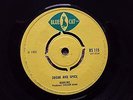
RECORD: EX+ Plays NM— Some minor fungal marks on label, probably from long term storage. There are some moments of very minor surface noise in the quietest moments, but these are not distracting. Anyone old enough will recall that this often afflicted brand-new records in those days. The mark on side 1 shown in the photo is soundless; all details in photos appear exaggerated, especially the label markings – the Philips lettering is actually a deep orange.
I NO LONGER MAIL TO ITALY! ALSO NOT TO BRAZIL, UKRAINE OR RUSSIAN FEDERATION.
Any bids or purchases from these countries will be cancelled immediately.
price rating