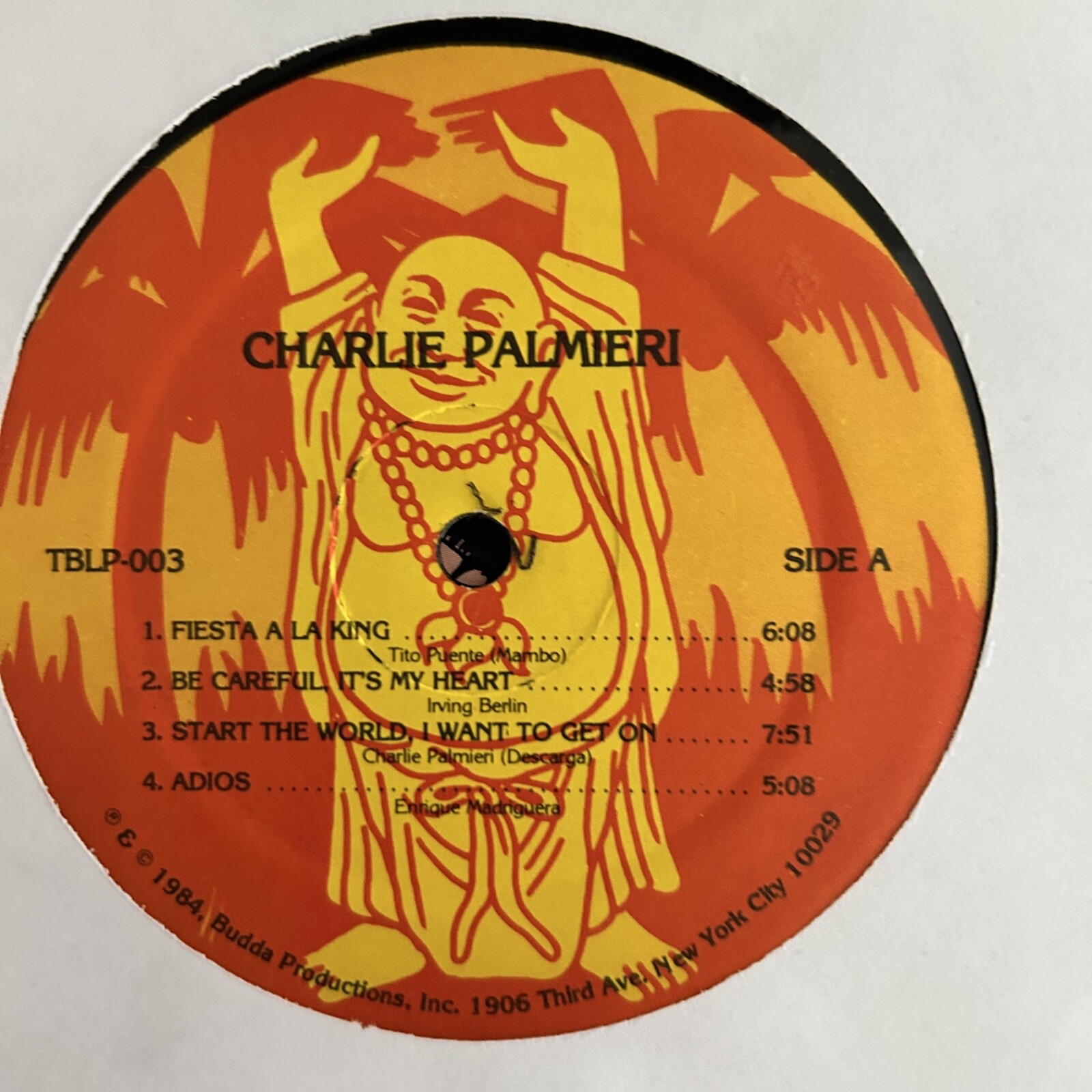
Charlie Palmieri A Giant Step LP 1984 1st Press Bobby Rodriguez Latin Jazz
$
40




Favourite Auctions
To save auctions to your favourites, please login
If you don't have an account, please register
Description
Charlie Palmieri A Giant Step LP 1984 1st Press Bobby Rodriguez Latin Jazz
This is the best latin piano playing you will ever hear with the exception of his younger Brother Eddie
For anyone familiar with the life and career of Charlie Palmieri, it is no secret that he was a pianist's pianist, but a master in his day. Not only was he an authoritative voice in Latin American piano styles, but an accomplished classical player; not only a fine arranger and ensemble player, but an inspired soloist. Never has that been so clear as on his 1984 release Giant Step. After hearing the record, one might wonder if the leap referenced in the title is one Palmieri made, or one he's asking of his audience. For those familiar with his work in the salsa world, this record could require stepping up to another level, taking a giant step in listening. Though quite palatable, as he's joined by an understated, tasteful rhythm section, the melodic and harmonic ideas explored distinguish Palmieri as one of the great creative Latino voices. His technical prowess is truly astounding, as he flexes muscles that only develop after a lifetime of dedicated study. With a variety of styles represented, including tango, bolero, cha cha and of course mambo, Giant Step is a well balanced and enjoyable listen. Though Charlie Palmieri has a large and impressive discography, this disc could be the one that best synopsizes his genius.
Carlos Manuel "Charlie" Palmieri(November 21, 1927 – September 12, 1988) was an American bandleader and musical director of salsa music. He was known as the "Giant of the Keyboards"
In October 1947, Tito Puente, the musical director of the Fernando Álvarez Band, was impressed with Palmieri and hired him to play for his band at the Copacabana Club; here he played with Puente until 1953 and, during the 1950s, he played with various bands.[1]Besides having played with Tito Puente, he played with Pupi Campo's Band, and worked on Jack Paar's CBS daytime television show. Palmieri also formed a couple of bands that performed at the Palladium Ballroom. These were however short-lived because of a lack of work. During this time, he also worked as an accompanist for other bands.
Palmieri worked for several years in Chicago, but returned to New York and formed a band called Charanga La Duboney. While performing at the Monte Carlo Ballroom, Palmieri heard Johnny Pacheco playing the flute - the playing so impressed him that he hired him on the spot. The mixture of Pacheco's flute with the strings of the violins in Palmieri's band led to the 1960s Charanga craze in the United States. Palmieri was signed by the United Artists Record company and had several Latino hits. Palmieri did however suffer various setbacks - first Pacheco left the band and then United Artists cancelled his contract because of a conflict of interest with their other recording star, Tito Rodríguez. This led to Palmieri's signing with the Alegre Records label and with whom he had two best selling "hits" with "Como Bailan La Pachanga" and "La Pachanga Se Baila Así".
When the Charanga craze declined in popularity, Palmieri switched to the new trend, the boogaloo, by replacing the flute and violins with three trumpets and two trombones, he also dropped the word "Charanga" from his bands' name and it became known simply as "La Duboney". In 1965, he scored a hit with Tengo Máquina y Voy a 60 (Going like 60) and in 1967 with Hay Que Estar En Algo/Either You Have It or You Don't. In 1968, Palmieri recorded Latin Bugalú under the Atlantic Records label, which was also released in the United Kingdom.
In the 1970s, Palmieri worked as the musical director for Tito Puente's television show, El Mundo de Tito Puente (Tito Puente's World). He also taught and lectured about Latin music and culture at various educational institutions. After reorganizing his band, Palmieri played the organ and recorded La Hija de Lola (Lola's Daughter) and La Vecina(The Neighbor). In 1971, he provided his organ playing talents to some of his brother's recordings. In 1978, he added the melodica to his recording The Heavyweight, an LP recorded for Alegre Records that also featured Bobby Rodríguez on bass, Quique Dávila on timbales, Papiro Allende on congas, Willie Rodríguez on bongoes, Roy Román y Lou Laurita on trumpets, Bobby Nelson on sax, Marco Katz on trombone, Harry Viggiano on tres, and the vocalists Meñique, Julito Villot, and Adalberto Santiago.
Among the artists Palmieri worked with at one time or another were his brother Eddie, Celia Cruz, Tito Puente, Herbie Mann, Ismael Rivera, Rafael Cortijo, Ismael Quintana, Bobby Capó, Mongo Santamaría, Cal Tjader, and Ray Barretto.
price rating