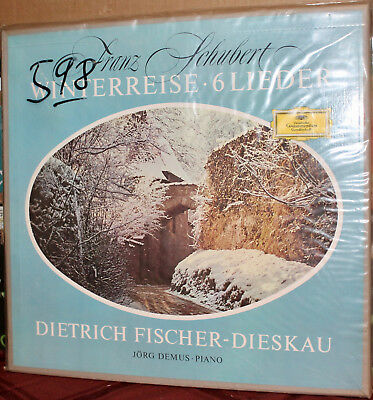
DGG 2-LPs 139201/02: SCHUBERT - Winterreise - FISCHER-DIESKAU, DEMUS 1966 DEU SS
C$
100
$
72



Favourite Auctions
To save auctions to your favourites, please login
If you don't have an account, please register
Description
****Welcome to our listing, thanks very much for looking!
****See our own website! We have lots of out of print LPs and CDs! Find us on the web at -
hearthedifference.net
****Please see our other listings - new items added daily!
****Shipping cost is only an estimate - it depends on the actual weight and size of the package as well as the service required. We do not profit from shipping costs, so if we overcharge, we will refund the difference back to you. It's always best to wait for our invoice before paying for your item. We will combine shipping for multiple items purchased.
Background -
FACTORY SEALED item from 1966.Dietrich Fischer-Dieskau (28 May 1925 – 18 May 2012) was a German lyric baritone and conductor of classical music, one of the most famous Lieder (art song) performers of the post-war period, best known as a singer of Franz Schubert's Lieder, particularly "Winterreise" of which his recordings with accompanist Gerald Moore and Jörg Demus are still critically acclaimed half a century after their release.
Recording an array of repertoire (spanning centuries) as musicologist Alan Blyth asserted, "No singer in our time, or probably any other has managed the range and versatility of repertory achieved by Dietrich Fischer-Dieskau. Opera, Lieder and oratorio in German, Italian or English came alike to him, yet he brought to each a precision and individuality that bespoke his perceptive insights into the idiom at hand." In addition, he recorded in French, Russian, Hebrew and Hungarian. He was described as "one of the supreme vocal artists of the 20th century" and "the most influential singer of the 20th Century". Fischer-Dieskau was ranked the second greatest singer of the century (after Jussi Björling) by Classic CD (United Kingdom) "Top Singers of the Century" Critics' Poll (June 1999). The French dubbed him "Le miracle Fischer-Dieskau" and Dame Elisabeth Schwarzkopf called him "a born god who has it all." At his peak, he was greatly admired for his interpretive insights and exceptional control of his soft, beautiful instrument. Despite the small size of his lyric/chamber baritone voice, Fischer-Dieskau also performed and recorded a great many operatic roles. He dominated both the opera and concert platform for over thirty years.
During a career that spanned nearly three decades, Dietrich Fischer-Dieskau established himself as one of the most accomplished performing artists of the twentieth century. He is now considered to be the finest modern interpreter of German songs, and his extensive operatic career was noted for fine musicianship and powerful characterization. He has also made important contributions as an author, conductor, and teacher.
Born in Berlin on May 28, 1925, Fischer-Dieskau began his vocal studies at the age of 16, only shortly before being drafted into the Nazi Wehrmacht. After two years as a prisoner of war, the young baritone returned to Germany and soon made his oratorio debut in Brahms ' A German Requiem, and his stage debut in Verdi 's Don Carlos (Posa). Engaged as the 'house' lyric baritone (kammersänger) at the Berlin Städtische Oper, ie he was making guest appearances at the Vienna State Opera, and the Salzburg Festival. In the early 1950's he began a series of engagements at the Bayreuth festival, establishing a lasting relationship with the music of Wagner, especially the role of Wolfram in Tannhäuser. In the following decades, Fischer-Dieskau would have traversed an impressive range of operatic roles, including Don Giovanni in Mozart 's eponymous work, Mittenhofer in Hans Werner Henze 's Elegy for Young Lovers, and John the Baptist in Strauss's Salome; his most critically admired performances were Don Alfonso at Così fan tutte, Germont père at La Traviata, and Count Almaviva at Le nozze di Figaro.
Fischer-Dieskau 's recital career began equally early and impressively - with a 1948 Radio Berlin broadcast of Schubert 's Winterreise; however, it was with his first concerts and recordings with the English collaborative pianist Gerald Moore that his international fame began to spread. Together, the two of them recorded every song of Schubert, Schumann, and Wolf and their portions of those by Brahms, Strauss, Loewe, and Beethoven . This catalog of repertoire is impressive for its sheer size, and even more so for its consistent excellence; What is the point of view of the performance of this song? What is the point of view of the song? While his collaboration with Gerald Moore was singular in his productivity, Fischer-Dieskau was a "one-pianist" man. His work with accompanist Jörg Demus represents an impressive catalog of its own, and he made memorable appearances and recordings with many other leading musicians, such as Alfred Brendel, Vladimir Horowitz, Daniel Barenboim, and Sviatoslav Richter. So, his repertoire was not limited to works of the Romantic masters; he has championed the works of lesser-known composers, such as Othmar Schoeck. His cumulative body of recorded performances is stunning, perhaps best illustrated by the number of pieces of his discography contains multiple (sometimes as many as four!) Performances. Benjamin Britten (Songs and Proverbs of William Blake), whose War Requiem the baritone was premiered in 1962, wrote a number of composers works for him.
Certainly Fischer-Dieskau is best characterized by his performance of works for voice and piano, in which his imagination, musicianship, and vocal timbre were showcased to the fullest. However, he made equal strides in the realm of orchestral songs; his performances of Mahler 's Lieder eines fahrenden Gesellen, Rückert Lieder, and Kindertotenlieder are some of the finest on record. Michelangelo Sonnets of Dmitri Shostakovich , Brahms ' German Requiem, and numerous cantatas of Bach and Telemann. - Allen Schrott
Jörg Demus (born 2 December 1928, in St. Pölten) is an Austrian pianist. At the age of six, Demus received his first piano lessons. Five years later, at the age of 11, he entered the Vienna Academy of Music, studying piano and conducting. His debut as a pianist came when he was still a student: at the age of 14, Demus played in the Brahms-Saal for the prestigious Gesellschaft der Musikfreunde. He graduated in 1945, then 17 years old, after which he continued to study conducting with Josef Krips and Hans Swarowsky. Demus studied in Paris with Yves Nat from 1951 to 1953. In 1953 he studied interpretation further with Wilhelm Kempff, Arturo Benedetti Michelangeli, and Edwin Fischer, and attended master classes with Walter Gieseking. In 1956 he won first prize at the Ferruccio Busoni International Piano Competition.
He has been active as a Lied accompanist and a chamber music partner, appearing with such singers as Elisabeth Schwarzkopf, Dietrich Fischer-Dieskau, Elly Ameling and Peter Schreier and string players like Josef Suk and Antonio Janigro. He has performed widely as a soloist both on modern and on historical instruments and has collaborated with Paul Badura-Skoda on the concert platform and in a book on the interpretation of Beethoven's piano sonatas. In 1974, Demus performed for the Peabody Mason Concert series in Boston. Demus played Romantic works quite often: among his recordings are sets of the complete piano works of Schumann and Debussy. Among his students is the pianist Domenico Piccichè.
Demus is also a composer, chiefly of music for the piano, chamber music and songs, composing in a generally conservative style. Recorded works include Schubert Impromptus on the Deutsche Grammophon label; and a recital of chamber music for cello and piano taking their inspiration from the poems of Paul Verlaine and the later music of Robert Schumann. He received the Mozart Medal of the Mozartgemeinde Wien (de) in 1979.
Jörg Demus is a highly regarded pianist and one of the finest of accompanists. He is noted for combining a romantic sound with an interest in historic keyboard interpretation and early model pianos.
He entered the Vienna Academy of Music at the age of 11, where he studied piano and conducting, graduating in 1945. He continued to study conducting with Josef Krips and Hans Swarowsky, while so taking composition classes. He made his debut as a pianist at the age of 14, while still a student at the conservatory.
From 1951-1953, he was a pupil of Yves Nat in Paris. In 1953, he attended master classes with Gieseking in Saarbrücken, and with Wilhelm Kempff, Arturo Benedetti Michelangeli, and Edwin Fischer.
He made his debut as a mature artist in Vienna in 1953. In 1956 he won the Busoni Prize of the International Competition for Pianists. He maintains a notable solo career, especially for personal interpretations of Bach and flexible, colorful Renditions of Debussy. He was well regarded for the music of Mozart to Schumann, and for his performance of the music of César Franck. He was a recipient of the Beethoven Ring and the Mozart Medal of Vienna.
He was a sensitive accompanist and worked with singers of the highest caliber, including Elisabeth Schwarzkopf and Dietrich Fischer-Diskau. His version of Schubert 's Winterreise, with Fischer-Dieskau, is perhaps the most critically acclaimed of all recordings of this great song cycle.
He was accompanied violinists (Josef Suk, for instance) and cellists (Antonio Janigro). He also appears in piano duet and two-piano concert with Paul Badura-Skoda, who shares Demus's interest in older keyboard instruments. Demus has received several notable examples of early instruments, including harpsichords and pianos by Broadwood, Clements, and Conrad Graf, and has recorded appropriate music on them. He has authored several essays, a book on interpretation, and, as co-author with Badura-Skoda, an analysis of the Beethoven piano sonatas. Later releases featuring him on piano included Mozart: Songs (2006), Primeval Sounds (2007), and Haydn: Complete Songs (2009). - Joseph Stevenson
Winterreise (Winter Journey) is a song cycle for voice and piano by Franz Schubert (D. 911, published as Op. 89 in 1828), a setting of 24 poems by Wilhelm Müller. It is the second of Schubert's two great song cycles on Müller's poems, the earlier being Die schöne Müllerin (D. 795, Op. 25, 1823).
Both were originally written for tenor voice but are frequently transposed to suit other vocal ranges – the precedent being established by Schubert himself. These two works have posed interpretative demands on listeners and performers due to their scale and structural coherence. Although Ludwig van Beethoven's cycle An die ferne Geliebte (To the Distant Beloved) had been published earlier, in 1816, Schubert's two cycles hold the foremost place in the history of the genre.
Any great concert singer is likely to have a lifelong obsession with Schubert's greatest song cycle, which tracks the winter journey of a jilted lover wandering into the snow finding ever-greater depths of alienation. Dietrich Fischer-Dieskau seemed to record the piece every 10 years or so, but this 1966 outing is said to be his favorite, and it's easy to understand why. All of his customary intelligence is in full evidence, but the voice is particularly resplendent. While this carries an obvious sensual appeal -- and every two minutes or so he does something that takes your breath away--the voice also illuminates his overall interpretive concepts with a clarity that can be achieved perhaps only by a voice in its absolute prime. Particularly gratifying is his emotional directness; later performances could be so refined, so worked over that the emotionalism (such an important part of this piece) seemed more remembered than felt. - David Patrick Stearns
Dietrich Fischer-Dieskau, among the greatest exponents of this haunting song cycle, recorded seven versions over four decades: with Gerald Moore (1955 HMV, 1963 HMV, and 1972 DG,) and with Jörg Demus (1966, DG), Daniel Barenboim (1980, DG), Alfred Brendel (1986, Philips) and Murray Perahia (1992, Sony Classical). This recording of the 1965 recital with Jorg Demus grew much in demand over the years, prompting Gramophone and many listeners to request that DG reissue it.
[Dietrich Fischer-Dieskau has] "notably fined down some dramatic outbursts and eliminated some unnecessary verbal pointmaking, but still presented a more virile, if tragic, figure than Hotter or Souzay, and, more recently Pears, gave us. He has now gone further in these directions, but the differences are so slight or subtle as to make it impossible to list them except by giving chapter and verse for each one." - Gramophone [1966]
"There is much to admire in Jörg Demus’s playing..." - Gramophone [1966]
"Interestingly of all of F-D's commercial recordings of Winterreise, this is the one which was "upgraded" by a later generation of critics, receiving warm praise from John Warrack, Alan Blyth and John Steane." - Gramophone [19 April, 2011]
Few singers had such an intense relationship with a piece of music, both in the concert-hall and on record, as the German baritone Dietrich Fischer-Dieskau had with Schubert’s song-cycle Winterreise. Commercially, he recorded the work seven times: in 1955 with Gerald Moore for HMV, then in 1963 they returned to the studio for the same label. In 1966 he and Jörg Demus recorded it for DG. In 1972, he was re-joined by Gerald Moore, again for DG. A third DG recording came in 1980 when Fischer-Dieskau was partnered by Daniel Barenboim. In 1986, Fischer-Dieskau teamed up with another ‘concert’ pianist: Alfred Brendel. A final version – with Murray Perahia – was recorded by Sony Classical in 1990 just after the baritone turned 65. There are, of course, numerous live recordings, performances not originally planned for release on disc: these include one from 1948 with Klaus Billing, a 1952 performance with Hermann Reutter and one the following year with Hertha Klust.
When Dietrich Fischer-Dieskau made his first commercial recording of Winterreise with Gerald Moore in 1955, he was no stranger to the work: three ‘off-air’ performances have since come to light, including one masterminded by Elsa Schiller. And his partner (in this work, and with this pianist, I hesitate to use the word accompanist) had a long history with the work. Moore had actually only recorded Winterreise the year before, with Hans Hotter. And when Alec Robertson reviewed the 1955 HMV disc, this was the comparison he used, and often in the younger singer’s favour. Already, Fischer-Dieskau’s care with the text was singled out: 'His articulation, also, is crisper than Hotter’s and he has a very special sense of verbal values and a wide command of tone-colour.' By 1963, Fischer-Dieskau and Moore had revisited their interpretation: 'Fischer-Dieskau’s interpretation remains the most dramatic of all, but he has now refined it, made it more searching and eliminated unnecessary verbal point making,' according to Alec Robertson – who again had Hotter as a comparison, this time with Erik Werba at the piano. And to complicate things there was a simultaneous new version from Gérard Souzay: his version, alas, was hampered by an indifferent recording. Desmond Shawe-Taylor addressed all three new recordings of the work in his Quarterly Retrospect in January 1964. He noted that Souzay had the most beautiful voice of the three baritones but he was more troubled by something that was creeping into F-D’s performance: 'it is some of his louder outbursts that still disturb me. Of course, loudness, even harshness, is often required by the music; but there are times, especially in the earlier songs, where Fischer-Dieskau begins to force, to do what musicians call "singing through the tone".' Forced to decide between the three he concluded: 'I feel that Fischer-Dieskau and Moore have a slight edge over the others – though there is also that other sort of ‘edge’ to be remembered. And I am not sure that Souzay’s more lyrical and relaxed style might not, after all, wear better in the long run. This is, I repeat, a perplexing issue, not at all a straight one. All three singers are fine artists, and great music allows of more than one style of interpretation.’
Only another three years passed before F-D recorded the cycle again. It was his first for DG and this time his partner was Jörg Demus. AR, again reviewing the disc, was not so taken with this new partnership: 'There is much to admire in Jörg Demus’s playing but it is not of [Moore’s] calibre, tiresome as it may seem to have to go on saying this.' Of the singer’s approach he felt that in 1963 he’d 'notably fined down some dramatic outbursts and eliminated some unnecessary verbal point making, but still presented a more virile, if tragic, figure than Hotter or Souzay, and, more recently Pears, gave us. He has now gone further in these directions, but the differences are so slight or subtle as to make it impossible to list them except by giving chapter and verse for each one'. Which he didn’t for lack of space! Interestingly of all of F-D's commercial recordings of Winterreise, this is the one which was 'upgraded' by a later generation of critics, receiving warm praise from John Warrack, Alan Blyth and John Steane.
The next recording – a second for DG – came in 1972 and saw F-D reunited with Gerald Moore. Moore had retired from live performance though he continued to record until 1975 (when he was 76). The impetus for this latest return to Schubert’s great cycle was the mammoth Schubrt Lieder Edition the baritone had undertaken for DG, and needless to say he had to return to the three cycles which, this time, were released together in a four-LP set. 'Of the three song-sets,' wrote William Mann who had taken over much of the Lieder reviewing from AR, 'Winterreise gets the strongest performance; it is the masterpiece, surely the song-cycle that lasts longest and offers most interpretative possibilities of any in the current repertory. In the third verse of "Gute Nacht" the vocal line and lovely phrasing, and the emotional involvement, captivates the sensitive ear; the piano postlude is exemplary.' And here was example when time brought many benefits: 'when this new reading is compared with that of 1963, Fischer-Dieskau’s voice sounds more natural, eagerly expressive, more resonant and Gerald Moore’s pianism more eloquent in the earlier version.’
In 1980 came the first recording with a pianist who more usually took the platform alone, or as a concerto soloist, Daniel Barenboim, though he was already an experienced accompanist by now. 'What strikes one immediately about the new version,' wrote Alan Blyth, Gramophone’s new ‘Lieder man’, 'are not any changes in Fischer-Dieskau’s reading as such, although there are some, but the arresting, creative quality of Barenboim’s piano-playing. I found myself time and again listening to what he was doing with the accompaniments, not because they were in any way too obtrusive but because he was throwing new light on the song concerned.' AB saw this as a totally revelatory partnership: 'I think Fischer-Dieskau has been inspired by his partner to re-live the text with an even greater immediacy, if that’s possible, than in the past.' The recording, in AB’s concluding words, was deemed to be 'the most compelling and deeply considered interpretation of this endlessly fascinating work yet to be recorded.' Praise indeed – but that wasn’t the end of the F-D Winterreise road!
No doubt stimulated by his encounters with great pianists (and Richter and Eschenbach had by now partnered him), he teamed up with Alfred Brendel for a recording of the work in 1986 for Philips. AB was slightly nervous of what to expect having heard F-D recently in concert: 'It cannot be overlooked here in several climaxes where he goes through his now frayed tone.' But – 'I feel there is something so special about the partnership that the frailties have to be forgotten in appreciation of the sustained inspiration of the whole.' Once again, a great pianist as partner inspired the singer to extraordinary heights: 'The reading is basically the same in tempo and phrasing, but below the surface there seems even more concentration on the plight of the forsaken lover. It remains an intensely subjective performance, peppered with spat-out consonants and pointed emphases, but the detail, at speeds perhaps a shade quicker than in the past, are here marvelously integrated into the whole.' It was some years later that an extraordinary filmed collaboration between F-D and Brendel emerged: recorded in 1979 it certainly impressed Alan Blyth.
Fischer-Dieskau’s last recording (1990) found him working again with a celebrated solo pianist, Murray Perahia, not someone you’d immediately expect to find in the role, even though he’d worked with Peter Pears. Alan Blyth, engaging with his performance by the 65-year-old singer has serious misgivings: 'I regret to say that I found listening to it, in spite of the undimmed powers of intellect and emotion still in place, a painful and dispiriting experience that I have no wish to dissect.' In fact, it sent him back to F-D’s earlier recordings and prompted a revaluation of the Demus set, and a plea to DG to reissue it (and the Barenboim version). - James Jolly
-
LPs made by DGG - Deutsche Grammophon Gesellschaft Records, in GERMANY
-
LPs released in 1966
-
LPs are recorded in MONO
-
Record Catalog Number: 39201 / 02
Schubert // Fischer-Dieskau // Demus
Winterreise / 6 Lieder
Track Listing -
1. Winterreise, D 911/Op. 89 by Franz SchubertPerformer: Dietrich Fischer-Dieskau (Baritone), Jörg Demus (Piano)
Period: Romantic
Written: 1827; Vienna, Austria
Date of Recording: 05/1965
Venue: UFA-Studio, Berlin, Germany
Length: 71 Minutes 22 Secs.
Language: German
Winterreise D.911 (Op. 89)
A1 Gute Nacht
A2 Die Wetterfahne
A3 Gefrorne Tränen
A4 Erstarrung
A5 Der Lindenbaum
B1 Wasserflut
B2 Auf Dem Flusse
B3 Rückblick
B4 Irrlicht
B5 Rast
C1 Frühlingstraum
C2 Einsamkeit
C3 Die Post
C4 Der Greise Kopf
C5 Die Krähe
C6 Letzte Hoffnung
C7 Im Dorfe
D1 Der Stürmische Morgen
D2 Täuschung
D3 Der Wegweiser
D4 Das Wirtshaus
D5 Mut
D6 Die Nebensonnen
D7 Der Leiermann
Performers / Credits -
• Baritone Vocals – Dietrich Fischer-Dieskau
• Composed By – Franz Schubert
• Engineer – Hans-Peter Schweigmann
• Lyrics By – Wilhelm Müller
• Piano – Jörg Demus
Other Information -
Box set with LP-Format booklet that contains lyrics and pictures of artists.
Printed in Germany
Recording: Berlin, Ufa-Studio, 5/1965.
CONDITION Details:
The 2-LP box is in mint condition! The box has NO splits or crushed corners and NO cut out marks - just gorgeous! The corners and seams are solid with no shelf wear. The outer plastic cellophane wrap is NOT torn - perfect! The colors on the box are sharp and clean (see pictures with this listing as they are of the actual item).
The set is assumed to come complete with a paper insert/libretto.
The 2-LPs are assumed to be in mint condition as this vintage 1966 item is still FACTORY SEALED! A Short Note About LP GRADING -- Mint = Only used for sealed items.
- Near Mint = Virtually flawless in every way.
- Near Mint Minus = Item has some minor imperfections, some audible.
- Excellent = Item obviously played and enjoyed with some noise.
- Very Good Plus = Many more imperfections which are noticeable and obtrusive.
For best results, always properly clean your LPs before playing them.
The LP is an audiophile quality pressing (any collector of fine MFSL, half speeds, direct to discs, Japanese/UK pressings etc., can attest to the difference a quality pressing can make to an audio system).
Do not let this rarity slip by!
price rating