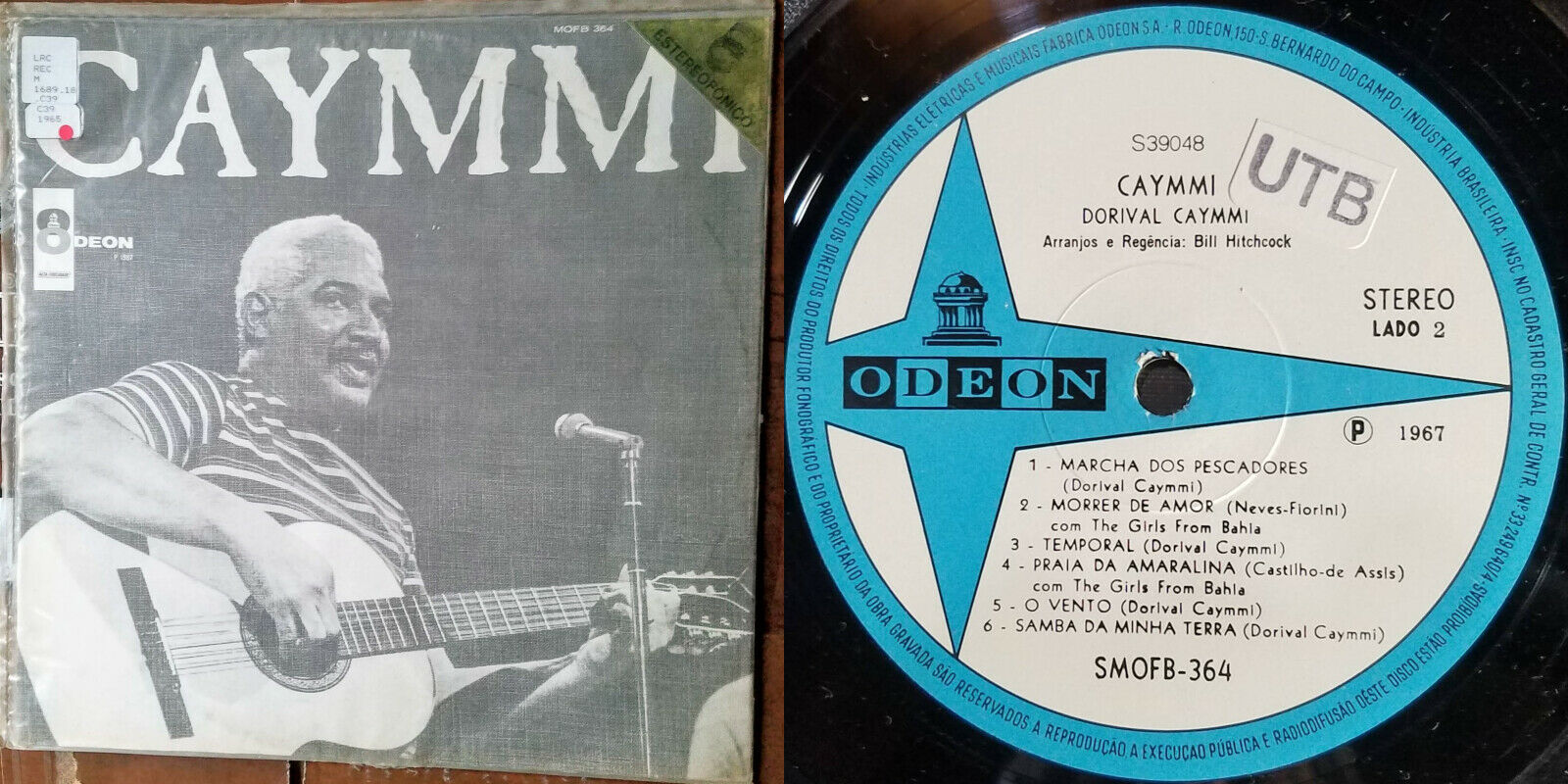
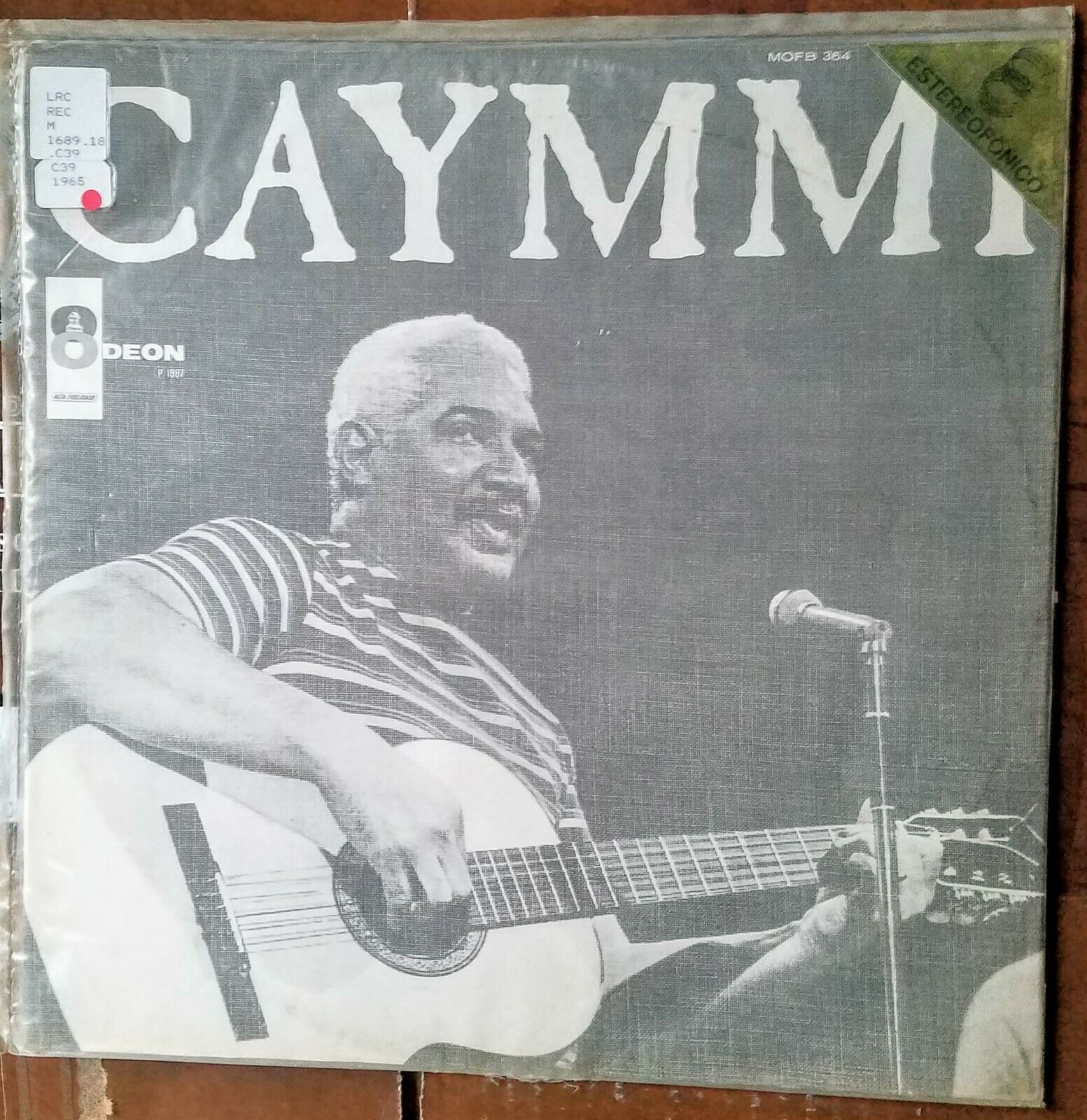
DORIVAL CAYMMI 1967 Brazil LP Samba MPB Bossa STEREO Berimbau RARE
$
30
Favourite Auctions
To save auctions to your favourites, please login
If you don't have an account, please register
Description
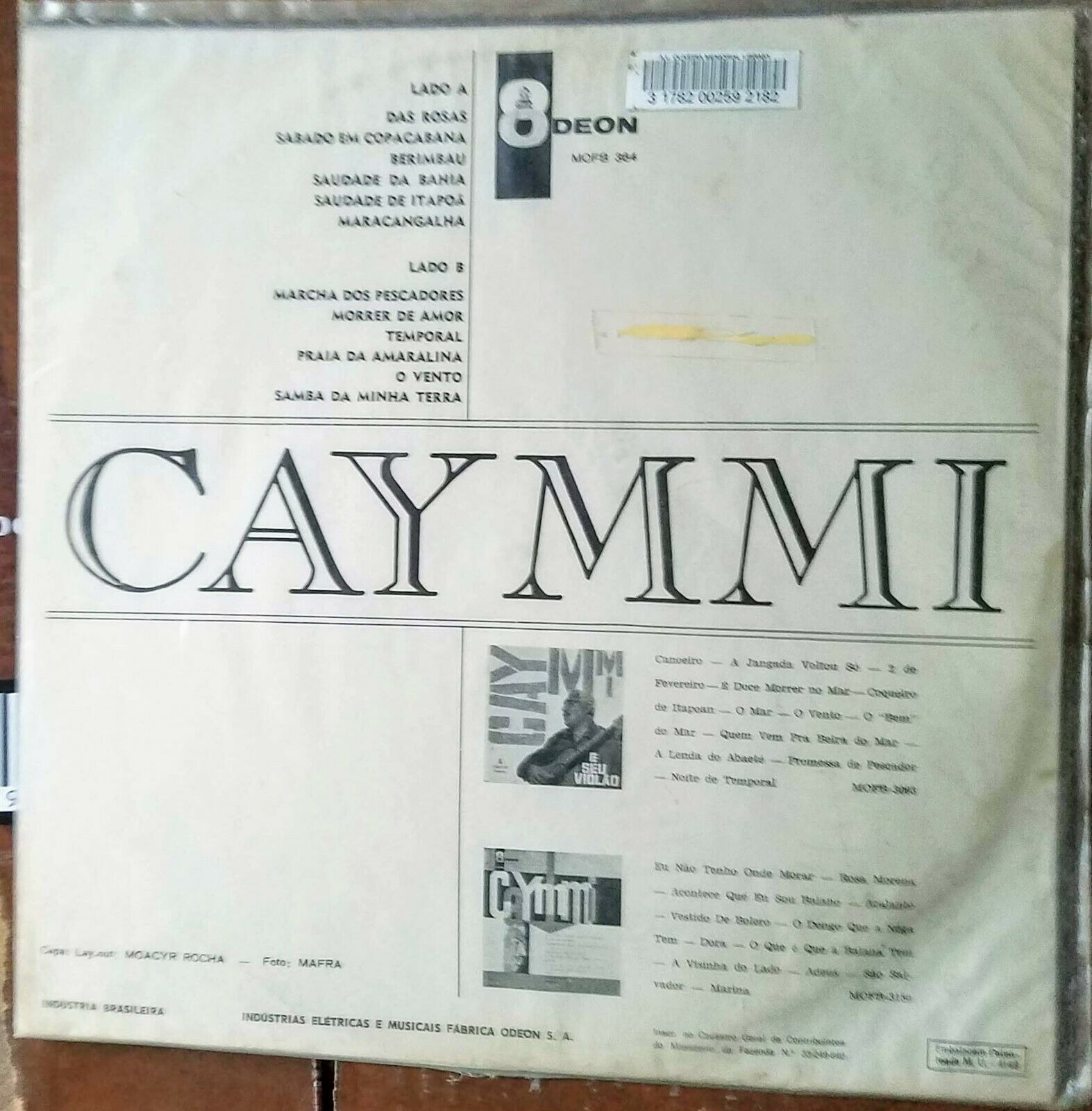
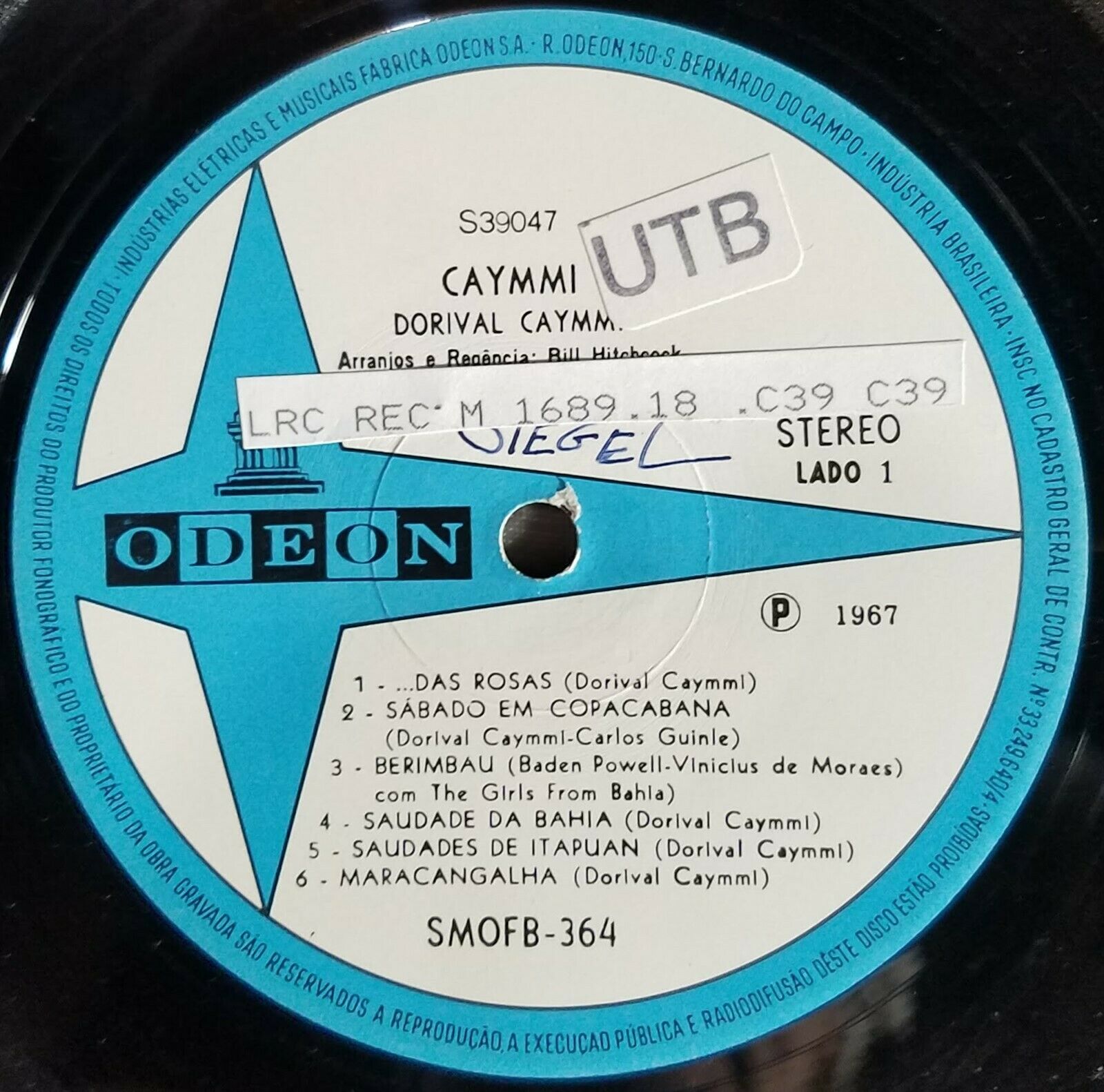
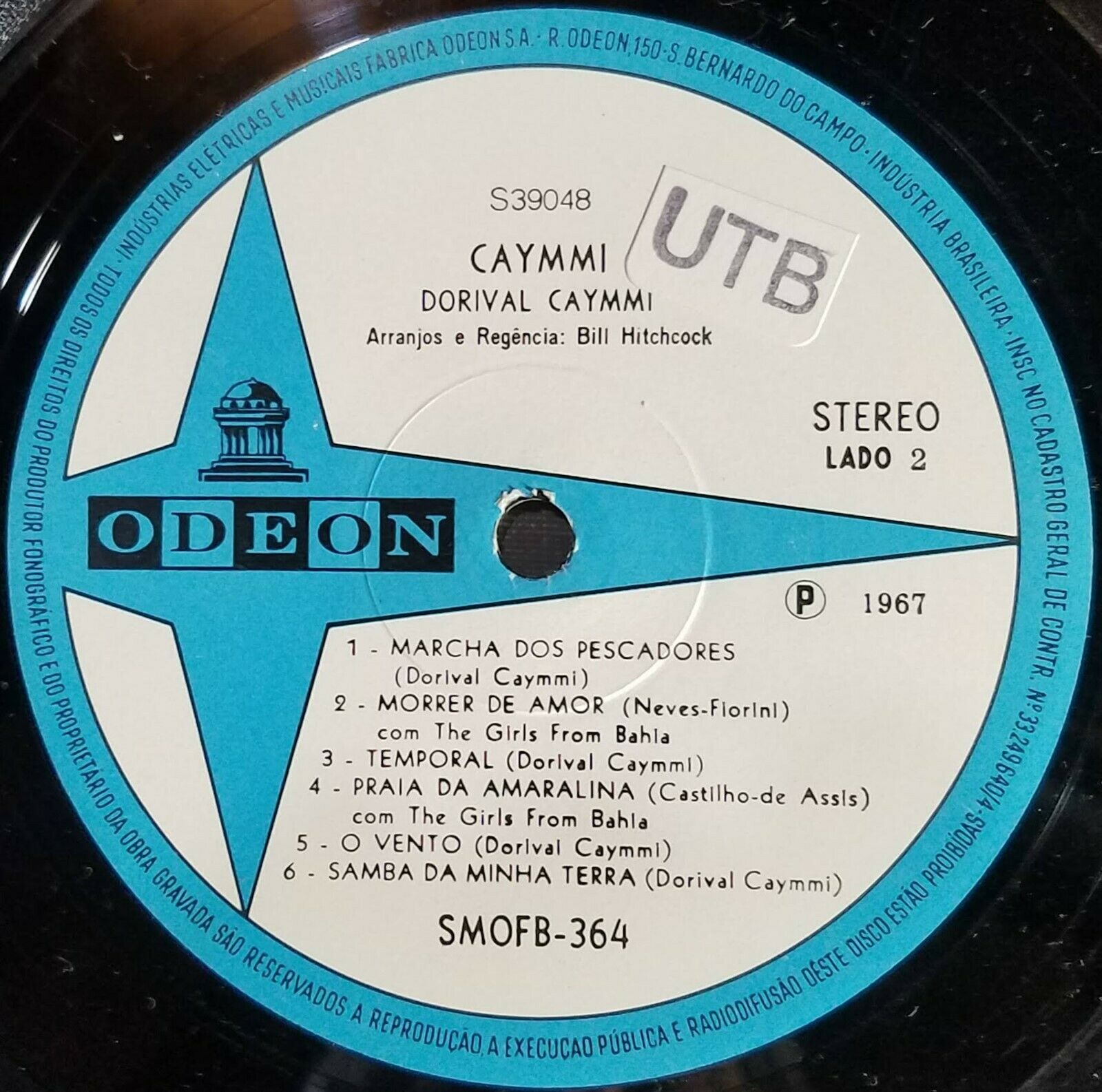
Record: Very Good Plus (VG+) shows some spins but looks and plays nearest VG+. Cover: Very Good Plus (VG+) Labels: writing and stickers Dorival Caymmi Caymmi 1967 Brazil Odeon Records 12" LP SB-59598
Dorival Caymmi
Caymmi
1967 Brazil Odeon Records 12" LP
Hard to find excellent value play copy of this Brazil original press
Condition
Vinyl: Very Good Plus (VG+) shows some spins but looks and plays nearest VG+.
Sleeve: Very Good Plus (VG+) has a couple of stickers on the heavy plastic sleeve as issued, actual cover underneath has no cuts, stickers or writing
Please see item specifics section above for more details
Tracks:
Dorival Caymmi ?– Caymmi Label: Odeon ?– SMOFB 364 Format: Vinyl, LP, Album, Stereo Country: Brazil Released: 1967 Genre: Latin Style: MPB, Samba Tracklist A1 Das Rosas A2 Sábado Em Copacabana A3 Berimbau A4 Saudade Da Bahia A5 Saudade De Itapoã A6 Maracangalha B1 Marcha Dos Pescadores B2 Morrer De Amor B3 Temporal B4 Praia Da Amaralina B5 O Vento B6 Samba Da Minha Terra
DORIVAL CAYMMI 1967 Brazil LP Samba MPB Bossa STEREO Berimbau RARE Samba (Portuguese pronunciation: [?s??b?] (About this soundlisten)), also known as samba urbano carioca (Urban Carioca Samba)[1][2] or simply samba carioca (Carioca Samba)[3][4] is a Brazilian music genre that originated in the Afro-Brazilian communities of Rio de Janeiro in the early 20th century.[5][6] Having its roots in the cultural expression of West Africa and in Brazilian folk traditions,[7] especially those linked to the primitive rural samba[5] of the colonial and imperial periods,[8] is considered one of the most important cultural phenomena in Brazil[9] and one of the country symbols.[10][11][12][13] Present in the Portuguese language at least since the 19th century, the word "samba" was originally used to designate a "popular dance".[14] Over time, its meaning has been extended to a "batuque-like circle dance", a dance style, and also to a "music genre".[14][15] This process of establishing itself as a musical genre began in the 1910s[16] and it had its inaugural landmark in the song "Pelo Telefone", launched in 1917.[17][18] Despite being identified by its creators, the public, and the Brazilian music industry as "samba", this pioneering style was much more connected from the rhythmic and instrumental point of view to maxixe than to samba itself.[16][19][20] Samba was modernly structured as a musical genre only in the late 1920s[16][19][21] from the neighborhood of Estácio and soon extended to Oswaldo Cruz and other parts of Rio through its commuter rail.[22] Today synonymous with the rhythm of samba,[23] this new samba brought innovations in rhythm, melody and also in thematic aspects.[24] Its rhythmic change based on a new percussive instrumental pattern resulted in a more "batucado" and syncopated style[25] – as opposed to the inaugural "samba-maxixe"[26] – notably characterized by a faster tempo, longer notes and a characterized cadence far beyond the simple ones palms used so far.[27][28] Also the "Estácio paradigm" innovated in the formatting of samba as a song, with its musical organization in first and second parts in both melody and lyrics.[20][29][30] In this way, the sambistas of Estácio created, structured and redefined the Urban Carioca Samba as a genre in a modern and finished way.[20] In this process of establishment as an urban and modern musical expression, the Carioca Samba had the decisive role of samba schools, responsible for defining and legitimizing definitively the aesthetic bases of rhythm,[31] and radio broadcasting, which greatly contributed to the diffusion and popularization of the genre and its song singers.[32] Thus, samba has achieved major projection throughout Brazil and has become one of the main symbols of Brazilian national identity.[nb 1][nb 2][35] Once criminalized and rejected for its Afro-Brazilian origins, and definitely working-class music in its mythic origins, the genre has also received support from members of the upper classes and the country's cultural elite.[11][36] At the same time that it established itself as the genesis of samba,[19] the "Estácio paradigm" paved the way for its fragmentation into new sub-genres and styles of composition and interpretation throughout the 20th century.[16][37] Mainly from the so-called "golden age" of Brazilian music,[38] samba received abundant categorizations, some of which denote solid and well-accepted derivative strands – such as bossa nova, pagode, partido alto, samba de breque, samba-canção, samba de enredo and samba de terreiro – while other nomenclatures were somewhat more imprecise – such as samba do barulho (literally "noise samba"), samba epistolar ("epistolary samba") ou samba fonético ("phonetic samba")[39] – and some merely derogatory – such as sambalada,[40] sambolero or sambão joia.[41] The modern samba that emerged at the beginning of the 20th century is predominantly in a 2 4 time signature varied[14] with the conscious use of a sung chorus to a batucada rhythm, with various stanzas of declaratory verses.[6][42] Its traditional instrumentation is composed of percussion instruments such as the pandeiro, cuíca, tamborim, ganzá and surdo[43][44][45] accompaniment – whose inspiration is choro – such as classical guitar and cavaquinho.[46][47] In 2007, the Brazilian National Institute of Historic and Artistic Heritage declared Carioca Samba and three of its matrixes – samba de terreiro, partido-alto and samba de enredo – as cultural heritage in Brazil.[48][49][50] Contents Etymology and definition "Batuque" (1835), a painting by the German Johann Moritz Rugendas.[51] There is no consensus among experts on the etymology of the term "samba". A traditionalist view defends that the etymum comes from the Bantu languages.[52][53] According to Nei Lopes and Luiz Antônio Simas, precisely from the verbs semba (in Kimbundu, "reject, separate" or "please, enchant, woo"),[54] sàmba (in Kikongo, a type of dance in which "a dancer hits against the chest of another ")[14] and samba (in Chokwe," to play, cabriolar ").[14] Already in Hispanic America of the past, the terms samba and semba designated candombe in the Río de la Plata Basin, a popular dance with atabaques, while zamba, in Bolivia, was an old dance of the coronation parties of the black kings.[55] It is believed that the first use of the word "samba" in the Brazilian press was in the Diário de Pernambuco in 1830.[56] The term was documented in the publication in a note opposing the sending of soldiers to the countryside of Pernambuco State as a disciplinary measure, as there they could be idle and entertained with "fishing of corrals [traps to catch fish], and climbing coconut trees, in whose hobbies viola and samba will be welcomed ".[56] Another old appearance was recorded in the humorous Recife newspaper O Carapuceiro, dated February 1838,[57] when Father Miguel Lopes Gama of Sacramento wrote against what he called "the samba d'almocreve" – not referring to the future musical genre, but a kind of merriment (dance drama) popular for black people of that time. According to Hiram Araújo da Costa, over the centuries, the festival of dances of slaves in Bahia were called samba.[58] In Rio de Janeiro, the word only became known at the end of the 19th century, when it was linked to rural festivities, to the universe of blacks and to the "north" of the country, that is, the Brazilian Northeast.[59] For many years of the Brazilian colonial and imperial history, the terms "batuque" or "samba" were used in any manifestation of African origins that brought together dances (mainly umbigada), songs and uses of Black people instruments.[14] At the end of the 19th century, "samba" was present in the Portuguese language, designating different types of popular dances made by African slaves (xiba, fandango, catereté, candomblé, baião) that assumed its own characteristics in each Brazilian state, not only by the diversity of the ethnic groups of the African diaspora, but also the peculiarity of each region in which they were settlers.[14] In the twentieth century, the term was gaining new meanings, as for a "circle dance similar to batuque" and a "genre of popular song".[15] The use of the word in a musical context was documented as early as 1913 in the "Em casa de baiana", registered as "samba de partido-alto".[60][61] Then, the following year, for the works "A viola está magoada"[61][62] and "Moleque vagabundo".[63][64] And, in 1916, for the famous "Pelo Telefone", released as "samba carnavalesco" ("carnival samba")[65][66] and regarded as the founding landmark of the Modern Carioca Samba.[5][67] Roots Hilário Jovino Ferreira founded the first carnival rancho in Rio. Rural tradition During a folkloric research mission in the Northeast Region of 1938, the writer Mário de Andrade noticed that, in rural areas, the term "samba" was associated with the event where the dance was performed, the way of dancing the samba and the music performed for the dance.[68] The Urban Carioca Samba was influenced by several traditions associated with the universe of rural communities throughout Brazil.[8] The folklorist Oneida Alvarenga was the first expert to list primitive popular dances of the type: coco, tambor de crioula, lundu, chula or fandango, baiano, cateretê, quimbere, mbeque, caxambu and xiba.[69] To this list, Jorge Sabino and Raul Lody added: the samba de coco and the sambada (also called coco de roda), the samba de matuto, the samba de caboclo and the jongo.[70] One of the most important forms of dance in the constitution of the choreography of the Carioca Samba,[71] the samba de roda practiced in Bahia's Recôncavo was typically danced outdoors by a soloist, while other participants of the roda took charge of the singing – alternating in solo and chorus parts[6] – and the performance of dance instruments.[71] The three basic steps of Bahian samba de roda were the corta-a-jaca, the separa-o-visgo and the apanha-o-bago, in addition to the little one danced exclusively by women.[6] In their research on Bahian samba, Roberto Mendes and Waldomiro Junior examined that some elements from other cultures, such as the Arab pandeiro and the Portuguese viola, were gradually incorporated into the singing and rhythm of African batuques, whose most well-known variants were samba corrido and the samba chulado.[72] In the São Paulo State, another primitive modality of known rural samba developed, practiced basically in cities along the Tietê River – from the São Paulo city, until its middle course[73] – and traditionally divided between samba de bumbo – with only instruments percussion, with bumbo[73] – and batuque de umbigada – with tambu, quinjengue and guaiá.[74] Essentially made up of two parts (choir and solo) usually performed on the fly, the partido alto was – and still is – the most traditional sung variant of rural samba in Rio de Janeiro State.[75] Originating in the Greater Rio de Janeiro, it is the combination, according to Lopes and Simas, of the Bahian samba de roda with the singing of the calango, as well as a kind of transition between rural samba and what would be developed in the urban environment of Rio from the 20th century.[75] Roots of Rio Carnival During colonial Brazil, many public Catholic events used to attract all social segments, including blacks and slaves, who took advantage of the celebrations to make their own manifestations, such as the crowning revelry of the congo kings and the cucumbis (Bantu revelry) in Rio de Janeiro.[76] Gradually, these exclusive celebrations of the black people were being disconnected from Catholicism ceremonies and changed to the Brazilian Carnival.[77] From the cucumbis, the "Cariocas cordões" emerged, which presented elements of Brazilianness – like blacks dressed as indigenous people.[77] At the end of the 19th century, on the initiative of Hilário Jovino, from Pernambuco, ranchos de reis (later known as carnival ranchos) emerged.[78] One of the most important ranches in Rio's carnival was Ameno Resedá.[79] Created in 1907, the self-titled "rancho-escola" became a model for carnival performances in procession and for future samba schools born in the hills and suburbs of Rio.[79] The Urban Carioca Samba Pelo Telefone Menu 0:00 "Pelo Telephone" is considered the landmark of samba as a musical genre. Primeira Linha Menu 0:00 Composed by Heitor dos Prazeres. Recording by Benedito Lacerda with accompaniment by Gente do Morro in 1930. Samba de fato Menu 0:00 Composed by Pixinguinha and Cícero de Almeida. Recorded by Patrício Teixeira and Trio T.B.T in 1932. Problems playing these files? See media help. Birth in a Bahian terreiro Donga recorded "Pelo telefone", considered the founding landmark of samba. A political and socio-cultural epicenter of Brazil, based on slavery, Rio de Janeiro was strongly influenced by African culture.[80] In the middle of the 19th century, more than half the population of the city – then capital of the Brazilian Empire – was formed by black slaves.[80] In the early 1890s, Rio had more than half a million inhabitants, of whom only half were born in the city, while the other part came from the old Brazilian imperial provinces, mainly from Bahia.[81] In search of better living conditions, this influx of black Bahians to Rio lands increased considerably after the abolition of slavery in Brazil.[82] Called "Pequena Africa" ("Little Africa") by Heitor dos Prazeres, this Afro-Bahian diaspora community in the country's capital settled in the vicinity of the Rio de Janeiro port area and, after the urban reforms of Mayor Pereira Passos, in the neighborhoods of Saúde and Cidade Nova.[82] Through the action of black Bahians living in Rio, new habits, customs and values of Afro-Bahian matrixes were introduced that influenced the culture of Rio,[82][83] especially in popular events such as the traditional Festa da Penha and Carnival.[83] Black women from Salvador and Bahia's Recôncavo,[84] the "Tias Baianas" ("Bahian aunts") founded the first Candomblé terreiros,[81] introduced the cowrie-shell divination[85] and disseminated the mysteries of the African-based religions of the Jeje-Nagô tradition in the city.[86] In addition to candomblé, the residences or terreiros of the aunts of Bahia hosted various community activities, such as cooking and the pagodes, where urban Rio samba would develop.[87][88] Among the most well-known Bahian aunts in Rio, were the Tias Sadata, Bibiana, Fê, Rosa Olé, Amélia do Aragão, Veridiana, Mônica, Perciliana de Santo Amaro and Ciata.[85][89] A place for meetings around religion, cuisine, dance and music,[87] Tia Ciata's home was frequented both by samba musicians and pais-de-santo as well as by influential intellectuals and politicians from Rio de Janeiro society.[nb 3][91] Among some of its members regulars were Sinhô, Pixinguinha, Heitor dos Prazeres, João da Baiana, Donga and Caninha, as well as some journalists and intellectuals, such as João do Rio, Manuel Bandeira, Mário de Andrade and Francisco Guimarães (popularly known as Vagalume).[85] It was in this environment that Vagalume, then a columnist for Jornal do Brasil, witnessed the birth of "O Macaco É Outro" in October 1916.[92] According to the journalist, this samba immediately won the support of the popular people who left singing the music in an animated block.[92] Donga registered the work in sheet music and, on 27 November of that year, declared himself as its author in the National Library, where it was registered as "carnival samba" called "Pelo telefone".[93][94] Shortly after, the score was used in three recordings at Casa Edison record label.[95] One of them interpreted by Baiano[65][96] with the accompaniment of classical guitar, cavaquinho and clarinet.[97] Released in 78 rpm format on 19 January 1917, "Pelo telefone" became a huge hit in that year's Rio carnival.[17][97] Two instrumental versions were also released – recorded by Banda Odeon and Banda de 1º Battalion of the Police of Bahia – in 1917 and 1918 respectively.[66][98][99] The success of "Pelo telefone" marked the official beginning of samba as a song genre.[5][93][97] Its primacy as "the first samba in history" has, however, been questioned by some scholars, on the grounds that the work was only the first samba under this categorization to be successful.[60][67][100][101] Before, "Em casa da baiana" was recorded by Alfredo Carlos Bricio, declared to the National Library as "samba de partido-alto" in 1913,[60][61] "A viola está magoada", by Catulo da Paixão Cearense, released as "samba" by Baiano and Júlia the following year,[60][61][100] and "Moleque vagabundo", "samba" by Lourival de Carvalho, also in 1914.[5][63][64] Another debate related to "Pelo telefone" concerns Donga's exclusive authorship, which was soon contested by some of his contemporaries who accused him of appropriating a collective, anonymous creation, registering it as his own.[102][103] The central part of the song would have been conceived in the traditional improvisations in meetings at Tia Ciata's house.[102] Sinhô claimed the authorship of the chorus "ai, se rolinha, sinhô, sinhô"[97] and created another song lyrics in response to Donga.[104] However, Sinhô himself, who would consolidate himself in the 1920s as the first important figure of samba,[105] was accused of appropriating other people's songs or verses – to which he justified himself with the famous maxim that samba was "like a bird" in the air, it is "whoever gets it first".[106][107] This defense is part of a period in which the figure of the popular composer was not that of the individual who composed or organized sounds, but the one who registered and disseminated the songs.[108] In the era of mechanical recordings, musical compositions – under the pretext of ensuring that there was no plagiarism – did not belong to composers, but to publishers[nb 4] and, later, to record labels,[110] a reality modified only with the advent of electrical recordings, when the right to intellectual property of the work became individual and inalienable to the composer.[110] In any case, it was because "Pelo Telefone" that samba gained notoriety as a product in the Brazilian music industry.[97][111] Gradually, the nascent urban samba was gaining popularity in Rio de Janeiro, especially at the Festa da Penha and Carnival.[83] In October, the Festa da Penha became a great event for composers from Cidade Nova who wanted to publicize their compositions in the expectation that they would be released at the following carnival.[112] Another promoter during this period was the revue shows, a place that enshrined Aracy Cortes as one of the first successful singers of the new popular song genre.[113] The solidification of the electric recording system made it possible for the recording industry to launch new sambas by singers with less powerful voices,[nb 5] such as Carmen Miranda[115] and Mário Reis, performers who became references when creating a new way of interpreting the most natural and spontaneous samba, without so many ornaments, as opposed to the tradition of belcanto style.[116][117][118] These recordings followed an aesthetic pattern characterized by structural similarities to the lundu and, mainly, to the maxixe.[19] Because of this, this type of samba is considered by scholars as "samba-maxixe" or "samba amaxixado".[16][119] Although the samba practiced in the festivities of Bahian communities in Rio was an urban stylization of the ancestral "samba de roda" in Bahia,[120] characterized by a high party samba with refrains sung to the marked rhythm of the palms and the plates shaved with knives, this samba it was also influenced by the maxixe.[121] It was in the following decade that a new model of samba would be born, from the hills of Rio de Janeiro, quite distinct from that of the amaxixado style associated with the communities of Cidade Nova.[16][19] Samba do Estácio, the genesis of urban samba Na Pavuna Menu 0:00 Composed by Homero Dornelas. Recorded by Bando de Tangarás. Hit in the Rio carnival of 1930. O que será de mim Menu 0:00 Composed by Ismael Silva, Nilson Bastos and Francisco Alves. Recorded by Francisco Alves and Mário Reis in 1931. Agora é Cinza Menu 0:00 Composed by Bide and Marçal. Recorded by Mario Reis in 1933. Problems playing these files? See media help. Samba rhythm.[122] The sambista Ismael Silva was one of the great composers of Estácio's samba that emerged in the 1920s. The sambista Heitor dos Prazeres participated in the foundation of the first Brazilian samba schools. Between the end of the 19th century and the beginning of the 20th century, in the context of the First Brazilian Republic, the poor strata of Rio de Janeiro faced serious economic issues related to their survival in the federal capital, such as the imposition of new taxes resulting from the provision of public services (such as electric lighting, water and sewage, modern pavements), new legislation that imposed architectural norms and restrictions for urban buildings, and the prohibition on the exercise of certain professions or economic practices linked to subsistence, especially of the poorest.[123] The situation of this population worsened further with the urban reforms in the center of Rio, whose widening or opening of roads required the destruction of several tenements and popular housing in the region.[124][125] As a result, these homeless residents were temporarily occupying slopes in the vicinity of these old demolished buildings, such as Morro da Providência (mainly occupied by former residents of the Cabeça de Porco tenement[126] and former soldiers of the War of Canudos)[127] and Morro de Santo Antonio (especially by ex-combatants of the Brazilian Naval Revolts).[128] In a short time, this type of temporary housing was permanently established in the urban landscape of Rio, originating the first favelas in the city.[129] From the increase in the populations expelled from the tenements and the arrival of new poor migrants to the capital of the Republic, the favelas grew rapidly and spread through the hills settlements and suburban areas of Rio.[127][130] It was in this scenario that a new type of samba would be born during the second half of the 1920s, called "samba do Estácio", which would constitute the genesis of urban Carioca samba[19] by creating a new pattern so revolutionary that its innovations last until the days current.[34][131] Located close to Praça Onze and housing Morro do São Carlos, the neighborhood of Estácio was a center of convergence of public transport, mainly of trams that served the North Zone of the city.[132] Its proximity to the nascent hills settlements as well as its primacy in the formation of this new samba ended up linking its musical production, from urban train lines, to the favelas and suburbs of Rio, such as Morro da Mangueira,[133][26] and the suburban neighborhood of Osvaldo Cruz.[22] Estácio's samba was distinguished from Cidade Nova's samba both in thematic aspects, as well as in the melody and rhythm.[24] Made for the parades of the carnival blocs in the neighborhood,[134] the samba do Estácio innovated with a faster tempo, longer notes and a cadence beyond the traditional palms.[27][28] Another structural change resulting from this samba was the valorization of the "second part" of the compositions: instead of using the typical improvisation of the samba circles of the alto party or carnival parades, there was the consolidation of pre-established sequences, which would have a theme - for example, everyday problems[27] - and the possibility of fitting everything within the standards of the phonograph recordings of 78 rpm at the time[29] - something like three minutes on 10-inch discs.[135] In comparison to the works of the first generation of Donga, Sinhô and company, the sambas produced by the Estácio group also stood out for a greater countermetricity,[136] which can be evidenced in a testimony by Ismael Silva about the innovations introduced by him and his companions in the new urban samba in Rio: At that time, samba did not work for carnival groups to walk on the street as we see today. I started noticing that there was this thing. The samba was like this: tan tantan tan tantan. It was not possible. How would a bloc get out on the street like that? Then, we started making a samba like this: bum bum paticumbum pugurumdum.[137] —?Ismael Silva The intuitive onomatopoeia built by Ismael Silva tried to explain the rhythmic change operated by the sambistas of Estácio with the bum bum paticumbum pugurumdum of the surdo in marking the cadence of the samba, making it a more syncopated rhythm.[138][139] It was, therefore, a break with the samba tan tantan tan tantan irradiated from the Bahian aunts meetings.[24] Thus, at the end of the 1920s, the modern carioca samba had two distinct models: the primitive urban samba of Cidade Nova and the new syncopated samba of the Estácio group.[140][141] However, while the Bahian community enjoyed a certain social legitimacy, including the protection of important personalities of Rio society who supported and frequented the musical circles of the "Pequena Africa",[142] the new Estaciano sambistas suffered socio-cultural discrimination, including through police repression.[143] A popular neighborhood with a large contingent of blacks and mulattos, Estácio was one of the great strongholds of poor samba musicians situated between marginality and social integration, who ended up being stigmatized by the upper classes in Rio as "dangerous" rascals.[133][144] Because of this infamous brand, the Estaciano samba suffered great social prejudice in its origin.[142] To avoid police harassment and gain social legitimacy, Estácio's samba musicians decided to link their batucadas to carnival samba and organized themselves in what they christened as samba schools.[145][146] At the end of the carnival, samba has continued because we did samba all year. At Café Apolo, Café do Compadre, across the street, at the backyard feijoadas or at dawn, on street corners and in bars. Then the police used to come and bother us. But it didn't bother the guys of (carnival rancho) Amor, which had a headquarter and license to parade at the carnival. We decided to organize a carnival bloc, even without a license, that could allow us to go out at the carnival and do samba all year round. Organization and respect, without fights or huffing, were important. It was called “Deixa Falar” as it despises the middle class ladies of the neighborhood who used to call people a vagabond. We were malandros, in a good way, but vagabonds weren't.[147] —?Bide According to Ismael Silva – also founder of Deixa Falar and the creator of the expression "samba school" – the term was inspired by the Normal school that once existed in Estácio,[148] and therefore the samba schools would form "samba teachers".[149] Although the primacy of the country's first samba school is contested by Portela and Mangueira,[83][150] Deixa Falar was a pioneer in spreading the term in its quest to establish a different organization from the carnival blocks of that time[151] and also the first carnival association to use the group in the future known as bateria, a unit made up of percussion instruments such as the surdo, tambourines and cuícas, which – when joining the already used pandeiros and shakers – gave a more "marching" characteristic to the samba of the parades.[131][152] In 1929, the sambista and babalawo Zé Espinguela organized the first contest among the first samba schools in Rio: Deixa Falar, Mangueira and Oswaldo Cruz (later Portela).[153][150] The dispute did not involve parede, but a competition to choose the best samba theme among these carnival groups – whose winner is the samba "A Tristeza Me Persegue", by Heitor dos Prazeres, one of Oswaldo Cruz's representatives.[153] Deixa Falar was disqualified for the use of a flute and tie by Benedito Lacerda, then representative of the Estácio group.[154] This veto on wind instruments became the rule from then on[155] – including for the first parade between them, organized in 1932 by journalist Mario Filho and sponsored by the daily Mundo Sportivo[153] -, because it differentiated schools from carnival ranchos with the appreciation of batucadas, which would definitely mark the aesthetic bases of samba from then on.[155] Estácio's batucado and syncopated samba represented an aesthetic break with Cidade Nova's maxixe-style samba.[26] In turn, the first generation of samba did not accept the innovations created by the samba musicians of the hill, seen as a misrepresentation of the genre[156] or even designated as "march".[nb 6] For musicians such as Donga and Sinhô, samba was synonymous with maxixe – a kind of the last Brazilian stage of European polka.[158] For the samba musicians from the hills of Rio, samba was the last Brazilian stage of Angolan drumming that they proposed to teach to Brazilian society through samba schools.[158] This generational conflict, however, did not last for long, and Estácio's samba established itself as the rhythm par excellence of Rio's urban samba during the 1930s.[21][143][23] Between 1931 and 1940 samba was the most recorded genre music in Brazil, with almost 1/3 of the total repertoire – 2,176 sambas songs in a universe of 6,706 compositions.[159] Sambas and marchinhas together made up the percentages just over half of the repertoire recorded in that period.[159] Thanks to the new electric recording technology, it was possible to capture the percussive instruments present in samba schools.[114] The samba "Na Pavuna", performed by Bando de Tangarás, was the first recorded in studio with the percussion that would characterize the genre from there: tamborim, surdo, pandeiro, ganzá, cuíca, among others.[160] Although there was the presence of these percussive instruments, the samba recordings in the studio were characterized by the predominance of musical arrangements of orchestrated tone with brass and string instruments.[161] This orchestral pattern was mainly printed by European arrangers, among them Simon Bountman, Romeu Ghipsmanm, Isaac Kolman and Arnold Gluckman, conductors whose erudite formation ended up giving a European symphonic sound in the counter-metric rhythm and batucada of the samba from Estacio.[162] Another reason for the success of the new samba in the music industry was the introduction of the "second part", which stimulated the establishment of partnerships between the composers.[30] For example, one composer created the chorus of a samba and another composer conceived the second part, as occurred in the partnership between Ismael Silva and Noel Rosa in "Para Me Livrar do Mal".[163] With the growing demand for new sambas by the singers, the practice of buying and selling compositions has also become common.[164][165] This transaction usually took place in two different ways: the author negotiated only the sale of the samba recording – that is, he remained as the author of the composition, but he would not receive any part of the gains obtained from the sales of the records, which were divided between the buyer and the record label[nb 7] – or the entire composition – that is, the real author completely lost the rights to his samba, including authorship.[166] In some cases, the sambista sold the partnership to the buyer and also received a portion of the profits from the sales of the records.[166] Selling a samba meant the composer had a chance to see his production publicized – especially when he did not yet enjoy the same prestige acquired by the first generation samba composers – and also a way to make up for his own financial difficulties.[nb 8][166] For the buyer, it was the possibility to renew his repertoire, record more records and earn sales, and further consolidate his artistic career.[168] Artists with good contact with record labels, the popular singers Francisco Alves and Mário Reis were adepts of this practicea,[116][169][170] having acquired sambas from composers such as Cartola[171][172][173] and Ismael Silva.[171][174][175] Radio era and popularization of samba Uva de caminhão Menu 0:00 Composed by Assis Valente. Recorded by Carmen Miranda in 1939. Problems playing this file? See media help. The sambista Noel Rosa was the first major figure in samba to bring the genre closer to the Brazilian middle class. Carmen Miranda was the first samba singer to promote the genre internationally. The 1930s in Brazilian music marked the rise of Estácio's samba as a musical genre to the detriment of maxixe-style samba.[176] If the samba schools were crucial to delimit, publicize and legitimize the new Estaciano samba as the authentic expression of the Rio's urban samba, the radio also played a decisive role in popularizing it nationwide.[31] Although broadcasting in Brazil was officially inaugurated in 1922,[177] it was still an incipient and technical, experimental and restricted telecommunication medium.[178] In the 1920s, Rio de Janeiro was home to only two short-range radio stations[179][180] whose programming was basically limited to broadcast educational content or classical music.[169] This panorama changed radically in the 1930s, with the political rise of Getúlio Vargas, who identified the media as a tool of public interest for economic, educational, cultural or political purposes, as well as for the national integration of the country.[178] A 1932 Vargas decree regulating radio advertising was crucial to the commercial, professional and popular transformation of Brazilian broadcasting.[178][181] With the authorization that ads could occupy 20% (and then 25%) of the programming,[181] the radio became more attractive and safe for advertisers[182] and – added to the increase in sales of radio sets in the period – transformed this telecommunication medium of its function once educational for an entertainment powerhouse.[183] With the contribution of financial resources from advertising, the broadcasters began to invest in musical programming, turning the radio into the great popularizer of popular music in the Brazil[32] – whether phonograph record or live recordings directly from the stations' auditoriums and studios.[184] With samba as a great attraction, the radio gave space to the genre with the "sambas de carnaval", released for the carnival celebrations, and the "sambas de meio de ano" ("mid-year sambas"), launched throughout the year.[185] This expansion of radio as a medium of mass communication enabled the formation of professional technicians linked to sound activities, as well as for singers, arrangers and composers.[185] From this scenario, broadcasters Ademar Casé (in Rio) and César Ladeira[nb 9] (in São Paulo) stood out as pioneers in the establishment of exclusive contracts with singers for presentation in live programs.[182][187] That is, instead of receiving only one fee per presentation, the monthly remuneration was fixed to pay the artists, a model that triggered a fierce dispute between radio stations to form its professional and exclusive casts with popular stars of Brazilian music and also philharmonic orchestras.[182][188] The most important samba singers, such as Carmen Miranda, started signing advantageous contracts to work exclusively with a certain radio station.[189][190] The institution of auditorium programs created the need to set up big radio orchestras, conducted by arranging conductors, which gave a more sophisticated look to Brazilian popular music.[184] One of the most notorious orchestral formations on the radio was the Orquestra Brasileira – under the command of conductor Radamés Gnatalli and with a team of musicians such as the sambistas João da Baiana, Bide and Heitor dos Prazeres in percussion[191] -, which combined standards of the international song at that time with popular instruments in Brazilian music, such as the cavaquinho.[192][193] The Orquestra Brasileira was notable for the success of the program Um milhão de melodias (One million melodies), by Rádio Nacional, one of the most popular in the history of Brazilian radio.[194] In this golden age of radio broadcasting in Brazil, a new generation of composers from the middle class emerged, such as Ary Barroso, Ataulfo Alves, Braguinha, Lamartine Babo and Noel Rosa, who have built successful careers in this media.[195] Grown up in the Vila Isabel middle class neighborhood, Noel Rosa was instrumental in destigmatizing the samba do Estácio.[134] Although he started his musical trajectory by composing Northeastern emboladas and similar Brazilian rural music genres, the composer changed his style by having contact with the samba made and sung by the sambistas from Estácio and others hills of Rio.[196] This meeting resulted in friendships and partnerships between Noel and names as Ismael Silva and Cartola.[196] Among singers, in addition to Noel himself, a new generation of performers broke out, such as Jonjoca, Castro Barbosa, Luís Barbosa, Cyro Monteiro, Dilermando Pinheiro, Aracy de Almeida, Marília Batista.[115] Another highlight was the singer Carmen Miranda, the greatest star of Brazilian popular music at that time and the first artist to promote samba internationally.[164][197] Renowned in Brazil, Carmen continued her successful artistic career in the United States, where she worked in musicals in New York City and, later, in Hollywood cinema.[197] Her popularity was such that she even performed at the White House for President Franklin D. Roosevelt.[197] The consolidation of samba as the flagship of the radio programming of Rio de Janeiro was characterized by the association of the musical genre with the image of white artists, who, even when proletarianized, were more palatable to the preference of the public, while the poor black sambistas remained normally on the sidelines of this process as a mere supplier of compositions for the white performers or as instrumentalists accompanying them.[198] This strong presence of white singers and composers was also decisive for the acceptance and appreciation of samba by the economic and cultural elites of Brazil.[36][199][200] From this, the middle class started to recognize the value of the rhythm invented by black Brazilians.[199] The Municipal Theater of Rio became the stage for elegant carnival balls attended by the high society.[201] Having contact with the popular genre through samba and choro circles meetings,[202] the renowned conductor Heitor Villa-Lobos promoted a musical meeting between the American maestro Leopold Stokowski with the sambistas Cartola, Zé da Zilda, Zé Espinguela, Donga, João da Baiana and others.[203] The recording results were edited in the United States on several 78 rpm discs.[203][204] Another privileged space for the white, rich elite in the Brazilian society was the casinos, which peaked in Brazil during the 1930s and 1940s.[205][206] In addition to working with games of chance, these elegant amusement houses offered restaurant and bar services and were the stage for shows – among which samba also featured prominently.[206][207] Thus, the casinos signed exclusive contracts with major artists, as was the case with Carmen Miranda as a big star at Cassino da Urca.[205][206] In an unusual event for the universe of sambistas on the hill, composer Cartola performed for a month at the luxurious Casino Atlântico, in Copacabana, in 1940.[203] The consolidation of samba among Brazilian elites was also influenced by the valorization of the ideology of miscegenation in vogue with the construction of nationalism under the Getulio Vargas regime.[208] From an image of a symbol of national backwardness, the mestizo became a representative of Brazilian singularities, and samba, with its mestizo origin, ended up linked to the construction of national identity.[209][35] Having acted decisively for the growth of radio in Brazil, the Vargas government perceived samba as a vital element in the construction of this idea of miscegenation.[160][199][210] Samba's triumph over the airwaves allowed it to penetrate all sectors of Brazilian society.[211] Especially under the Estado Novo, whose ideological cultural policy of reconceptualizing the popular and extolling everything that was considered an authentic national expression,[1][212] samba was elevated to the position of major national symbol of the country[12][13][213][214] and the official pace of the country.[nb 10] However, one of the concerns of the Vargas regime was to interfere in music production in order to promote samba as a means of "pedagogical" socialization,[216] that is, by banning compositions that confront the regime's ethics.[217] In this quest to "civilize" samba,[218] political bodies such as the Department of Press and Propaganda (DIP, Departamento de Imprensa e Propaganda) took action to order sambas that would exalt the work and censor lyrics that addressed bohemia and malandragem,[36][217] two of the most common themes in the tradition of the urban Carioca samba.[219][220] Musical contests were also instituted through which public opinion elected its favorite composers and performers.[221] Under Vargas, samba had an expressive weight in the construction of an image of Brazil abroad and was an important means of cultural and tourist dissemination of the country.[212] In an attempt to reinforce a positive national image, the presence of renowned singers of the kind in presidential committees to Latin American countries has become frequent.[222][223] At the end of 1937, the sambistas Paulo da Portela and Heitor dos Prazeres participated in a caravan of Brazilian artists to Montevideo that performed at the Gran Exposición Feria Internacional del Uruguay.[203] The Brazilian government also financed an information and popular music program called "Uma Hora do Brasil", produced and broadcast by Radio El Mundo, from Buenos Aires, which had at least one broadcast to Nazi Germany.[222] When the Vargas regime approached the United States, DIP made an agreement to broadcast Brazilian radio programs on hundreds of CBS radio network.[224] Under this context, the samba "Aquarela do Brasil" (by Ary Barroso) was releaded in the United States market,[225] becoming the first Brazilian song that was very successful abroad[226][227] and one of the most popular works of the Brazilian popular songbook.[228] In the midst of the good neighborhood policy, the animator Walt Disney visited Portela samba school during his visit to Brazil in 1941, from which he hypothesized that Zé Carioca, a character created by the cartoonist to express the Brazilian way,[221] would have been inspired by the figure of the sambista Paulo da Portela.[203] The rise of samba as a popular musical genre in Brazil also relied on its dissemination in Brazilian cinema, especially in musical comedies, being an integral part of the soundtrack, the plot or even the main theme of the cinematographic work.[229][230] The good public acceptance of the short film "A Voz do Carnaval" (by Adhemar Gonzaga) paved the way for several other cinematographic works related to rhythm,[230][231] many of which had a strong presence of radio idol singers in the cast, such as "Alô, Alô, Brasil! ", which had sisters Carmen and Aurora Miranda, Francisco Alves, Mário Reis, Dircinha Batista, Bando da Lua, Almirante, Lamartine Babo, among others.[229] The advent of the popular chanchada films made Brazilian cinema one of the biggest promoters of carnival music.[232][233] In one of the rare moments when sambistas from the hill starred in radio programs, Paulo da Portela, Heitor dos Prazeres and Cartola led the program "A Voz do Morro", at Rádio Cruzeiro do Sul, in 1941.[203] There, they presented unpublished sambas whose titles were given by listeners.[234][235][236] However, over the course of the decade, the samba made by these genuine sambistas was losing space on Brazilian radio to new sub-genres that were being formed, while figures such as Cartola and Ismael Silva were ostracized until they left the music scene in the late 1940s.[164] New sub-genres of samba Ary Barroso became one of the major composers of samba in the "golden age" of Brazilian music. Thanks to its economic exploitation through the radio and the records, samba not only became professional,[237] but also diversified into new sub-genres,[238] many of which were different from the hues originating in the hills of Rio de Janeiro[170] and established by the interests of the Brazilian music industry.[160] The period of Brazilian music between 1929 and 1945 marked by the arrival of radio and electromagnetic recording of sound in the country and by the notability of major composers and singers,[38] – the so-called "golden age" registered several styles of samba, some with greater and others with less solidity.[39] Publications devoted to the topic disseminated a broad conceptual terminology, including denominations later enshrined in new sub-genres – such as samba-canção, samba-choro, samba-enredo, samba-exaltação, samba-de-terreiro, samba de breque -, as well as registered scores and released labels and album covers printed various nomenclatures for samba in an attempt to express a functional, rhythmic or thematic trend – such as "samba à moda baiana" (samba in the Bahian style), "samba-batucada", "samba-jongo", "samba-maxixe" -, although some sounded quite inconsistent – such as "samba à moda agrião" (samba in the watercress style), "samba epistolar" (epistolary samba) and "samba fonético" (phonetic samba).[39] In other cases, it was music critics that imputed pejorative labels with a view to disapproving certain aesthetic changes or fashion trends – as in the disparagingly called sambalada and sambolero for stylistic nuances the samba-canção.[40] Established in the radio era as one of the main sub-genres of samba, the samba-canção style emerged among professional musicians who played in the revues of Rio de Janeiro in the late 1920s and early 1930s.[239][240] Although the term began to circulating in the press in 1929 to mistakenly designate "Jura", by Sinhô, and "Diz que me amas", by J. Machado,[241] the starting point of the line was "Linda Flor (Ai, Ioiô)", a melody by Henrique Vogeler and lyrics by Luis Peixoto,[nb 11] released in the revue and on disc by singer Aracy Cortes.[6] In general, the samba-canção was characterized as a slower tempo variant, with a dominance of the melodic line over the rhythmic marking[243] that basically explores the subjectivity of subjectivity and feeling.[244][245] As their releases took place outside the carnival season, the trend was linked to the so-called "mid-year samba". However, during the 1930s, the term samba-canção was used arbitrarily to designate many compositions contained under the name of "samba de meio de ano" ("mid-year samba"),[6][239] but which did not fit as samba-canção themselves.[244][246] On the other hand, many sambas at the time of their releases would later be recognized as samba-canção, as in the case of works by Noel Rosa and Ary Barroso.[247][248] Not by chance, Zuza Homem de Mello and Jairo Severiano consider that this samba style was truly inaugurated with the second version of the song "No rancho fundo", with melody by Ary Barroso and lyrics by Lamartine Babo.[249] Basically, Carnaval was reserved for the launch of marchinhas and sambas-enredo, a sub-genre typified in this way in the 1930s because of the lyrics and melody, which must comprise the poetic summary of the theme chosen by the samba school for its carnival parade.[250] Samba-de-terreiro – or also samba de quadra – was a short-tempo samba modality, with the second most measured part that prepares the bateria for a more lively return to the beginning.[251][252] Its format was also consolidated in the 1930s.[252] Also from that time, samba-choro – at first called choro-canção or choro-cantado – was a syncopated hybrid sub-genre of samba with the instrumental music genre choro, but with medium tempo and presence of lyrics.[245] Created by the Brazilian music industry, it was released, with all indications, with "Amor em excesso", by Gadé and Valfrido Silva, in 1932.[nb 12][253] One of the most popular sambas of this variant is "Carinhoso", by Pixinguinha, released as choro in 1917, received lyrics and ended up relaunched two decades later, in the voice of Orlando Silva, with great commercial success.[164] In the following decade, Waldir Azevedo would popularize chorinho, a kind of fast-moving instrumental samba.[164] Widespread during the Estado Novo, samba-exaltação was a sub-genre marked by the character of grandeur, expressed notably by the extensive melody, the lyrics with a patriotic-ufanist theme and by the lavish orchestral arrangement.[251][254] Its great paradigm was "Aquarela do Brasil", by Ary Barroso.[255][256] From the huge success of the first version recorded by Francisco Alves, in 1939, samba-exaltação started to be well cultivated by professional composers in the musical theater and in the music industry and radio media.[251] Another well-known samba of this type was "Brasil Pandeiro", by Assis Valente, a huge hit with the vocal group Anjos do Inferno in 1941.[203] At the turn of the 1940s, samba de breque emerged, a sub-genre marked by a markedly syncopated rhythm and sudden stops called breques (from English word break, Brazilian term for car brakes),[257] to which the singer added spoken comments, generally humorous in character, alluding to the theme.[6][258] The singer Moreira da Silva consolidated himself as the great name of this sub-genre.[259][260] Samba-canção hegemony and influences of foreign music The sambista Wilson Batista, who also stood out as a composer of carnival marchinhas. The composer Lupicínio Rodrigues, author of some of the great classics of the samba-canção style. After the end of the World War II and the consequent growth in the production of consumer goods, radio sets spread in the Brazilian market in different models and at affordable prices to the different social class of the Brazilian population.[261] Within this context, Brazilian radio broadcasting also went through a moment of change in language and audience[262] that made radio an even more popular media in Brazil.[261] In search of easier communication with the listener, the programming standard became more sensational, melodramatic and appealing.[263] One of the best expressions of this new format and the new popular audience was the auditorium programs and the "kings" and "radio queen" contests.[261][263] Although they played a role in legitimizing samba as a cultural product and national symbol music[264] and also transforming popular musical culture with the circulation of new musical genres and more extroverted performances,[263] auditorium programs such as the paradigmatic "Programa César de Alencar" and "Programa Manoel Barcelos"[265] – both on Radio Nacional, leader in audience and main media of communication in Brazil[266] – stimulated the cult of personality and the private life of artists,[263] whose apex was the collective frenzy generated around the fan clubs of popular music stars during the concourses of kings and queens of the radio.[267][268] For the samba more linked to the traditions of Estácio and the hills, the 1950s was characterized by the vitalizing presence of old and new composers who led the renewal of the genre for the next years.[269][270] This renewal was present in the sambas of well-known authors from the general public, such as Geraldo Pereira[271] and Wilson Batista,[272] of lesser-known sambistas but active in their communities, such as Zé Kéti[273] and Nelson Cavaquinho[274] – a composer who would establish a great partnership with Guilherme de Brito[269] – and also of new composers, such as Monsueto.[275] The samba de breque by Jorge Veiga also stood out[276] and, in São Paulo, the Demônios da Garoa enshrined the sambas by Adoniran Barbosa.[269] Missing for many years, samba composer Cartola was found washing cars in Ipanema by journalist Sérgio Porto, who took him to sing on Rádio Mayrink Veiga and got him a job at a newspaper.[234] As part of the celebrations of the Fourth Centenary of the city of São Paulo, the composer Almirante organized the "Festival da Velha Guarda" ("Old Guard Festival"),[277] which brought together great names of Brazilian popular music then forgotten, such as Donga, Ismael Silva, and Pixinguinha.[278] However, the period between the second half of the 1940s and the end of the 1950s – well-known as post-war – was deeply characterized by the prestige and dominance of samba-canção in the Brazilian music scene.[247][279] Although in its time of appearance there were not so many releases characteristic of this aspect, many achieved huge commercial success and,[280] in the mid-1940s,[280] this sub-genre began to dominate Brazilian radio programming[247] and be the most played style outside the carnival era.[281] This rise of samba-canção as a hegemonic musical style was also accompanied mainly by the avalanche of foreign musical genres[282][283] – imported to Brazil under the political-cultural context of World War II[284][285] – that began to compete in the country's market with the samba-canção itself.[267][270] Tango and, especially, bolero, which occupied a significant part of radio programming, proliferated in clubs and dance halls in Rio de Janeiro and São Paulo.[286] Music from the United States has also come to occupy a large part of the programming of Brazilian radio stations.[287] With big bands in evidence, some radio stations made great publicity about jazz, a genre that was gaining more and more appreciation among some musicians from Rio de Janeiro, especially those who worked in nightclubs.[267] In a samba-canção rhythm, many boleros, foxtrots and French songs were also part of the repertoire of nightclub pianists.[248] Bossa nova (Portuguese pronunciation: [?b?s? ?n?v?] (About this soundlisten)) is a style of samba developed in the late 1950s and early 1960s in Rio de Janeiro, Brazil.[3] It is mainly characterized by "different beat"[nb 3] that altered the harmonies with the introduction of unconventional chords and an innovative syncopation of traditional samba from a single rhythmic division.[5][6] Therefore, the "bossa nova beat", then, is characteristic of a samba style and not of an autonomous genre.[7][8] According to the Brazilian journalist Ruy Castro, the bossa beat – which would be created by the drummer Milton Banana – was "an extreme simplification of the beat of the samba school", as if all instruments had been removed and only the tamborim had been preserved.[9] In line with this thesis, musicians such as Baden Powell, Roberto Menescal and Ronaldo Bôscoli, also claim that this beat is related to the tamborim of the samba school.[10] One of the major innovations of bossa nova was the way to synthesize the rhythm of samba on the classical guitar.[3][8] According to musicologist Gilberto Mendes, the bossa nova was one of the "three rhythmic phases of samba", in which the "bossa beat" had been extracted by João Gilberto from the traditional samba.[7] According to the author Walter Garcia, the synthesis performed by Gilberto's guitar was a reduction of the "batucada" of samba, a stylization produced from one of the percussion instruments: the thumb stylized a surdo; the index, middle and ring fingers phrased like a tamborim.[8] The bossa nova wave came to renow samba and to contribute to the modernization of Brazilian music, being a watershed.[11] The style emerged at the time when samba-canção[nb 4] was the dominant rhythm in the Brazilian music scene.[13][14] Its first appearance was on the album Canção do Amor Demais, in which the singer Elizeth Cardoso recorded two specifically compositions by the duo Antonio Carlos Jobim and Vinicius de Moraes, "Outra Vez" and "Chega de Saudade", which were accompanied by João Gilberto's guitar. It was the first time that the Bahian musician presented the beat of his guitar that would become characteristic of the style.[3] By accompanying Cardoso's voice, Gilberto innovated in the way of pacing the rhythm, accentuating the weak times, in order to carry out a synthesis of the beat of samba to guitar.[3][15] Months later, João Gilberto's first compact was released, containing the tracks "Chega de Saudade" and "Bim Bom".[15] Considered the landmark of the birth of bossa nova,[3][15] it also featured Gilberto's innovative way of singing samba, which was inspired by Dorival Caymmi.[16][17] With the LP Chega de Saudade, released in 1959, Gilberto consolidated the bossa nova as a new style of playing samba.[3][5] His innovative way of playing and singing samba, combined with the harmonies of Antonio Carlos Jobim and the lyrics of Vinicius de Moraes, found immediate resonance among musicians who were looking for new approaches to samba in Rio de Janeiro,[3][18] many of them were influenced by American jazz.[19] Then, it emerged an artistic movement around Gilberto and others professional artists such as Jobim, Moraes and Baden Powell, among others, which attracted young amateur musicians from the South Zone of Rio – such as Carlos Lyra, Roberto Menescal, Ronaldo Boscoli and Nara Leão.[18][20] Contents Etymology Bossa nova rhythm[21] In Brazil, the word "bossa" is old-fashioned slang for something done with particular charm, natural flair or innate ability. As early as 1932, Noel Rosa used the word in a samba: "O samba, a prontidão e outras bossas são nossas coisas, são coisas nossas." ("Samba, readiness and other bossas are our things, are things from us.") The phrase bossa nova means literally "new trend" or "new wave".[22] The exact origin of the term "bossa nova" remained unclear for many decades, according to some authors. Within the artistic beach culture of the late 1950s in Rio de Janeiro, the term "bossa" was used to refer to any new "trend" or "fashionable wave". In his book Bossa Nova, Brazilian author Ruy Castro asserts that "bossa" was already in use in the 1950s by musicians as a word to characterize someone's knack for playing or singing idiosyncratically.[23] Castro claims that the term "bossa nova" might have first been used in public for a concert given in 1957 by the Grupo Universitário Hebraico do Brasil (Hebrew University Group of Brazil). The authorship of the term "bossa nova" is attributed to the then-young journalist Moyses Fuks, who was promoting the event.[24] That group consisted of Sylvia Telles, Carlos Lyra, Nara Leão, Luiz Eça, Roberto Menescal, and others. Mr. Fuks's description, fully supported by most of the bossa nova members, simply read "HOJE. SYLVIA TELLES E UN GRUPO BOSSA NOVA" ("Today. Sylvia Telles and a 'Bossa Nova' group"), since Sylvia Telles was the most famous musician in the group at that time. In 1959, Nara Leão also participated in more than one embryonic display of bossa nova. These include the 1st Festival de Samba Session, conducted by the student union of Pontifícia Universidade Católica. This session was chaired by Carlos Diegues (later a prominent Cinema Novo film director), a law student whom Leão ultimately married.[25] Instruments Classical guitar Bossa nova is most commonly performed on the nylon-string classical guitar, played with the fingers rather than with a pick. Its purest form could be considered unaccompanied guitar with vocals, as created, pioneered, and exemplified by João Gilberto. Even in larger, jazz-like arrangements for groups, there is almost always a guitar that plays the underlying rhythm. Gilberto basically took one of the several rhythmic layers from a samba ensemble, specifically the tamborim, and applied it to the picking hand. According to Brazilian musician Paulo Bitencourt, João Gilberto, known for his eccentricity and obsessed by the idea of finding a new way of playing the guitar, sometimes locked himself in the bathroom, where he played one and the same chord for many hours in a row.[26] Drums and percussion As in samba, the surdo plays an ostinato figure on the downbeat of beat one, the "ah" of beat one, the downbeat of beat two and the "ah" of beat two. The clave pattern sounds very similar to the two-three or three-two son clave of Cuban styles such as mambo but is dissimilar in that the "two" side of the clave is pushed by an eighth note. Also important in the percussion section for bossa nova is the cabasa, which plays a steady sixteenth-note pattern. These parts are easily adaptable to the drum set, which makes bossa nova a rather popular Brazilian style for drummers. Structure Certain other instrumentations and vocals are also part of the structure of bossa nova: Bossa nova and samba Basic bossa nova accompaniment pattern About this soundPlay (help·info) Bossa nova has at its core a rhythm based on samba. Samba combines the rhythmic patterns and feel originating in former African slave communities. Samba's emphasis on the second beat carries through to bossa nova (to the degree that it is often notated in 2/4 time). However, unlike samba, bossa nova has no dance steps to accompany it.[27] When played on the guitar, in a simple one-bar pattern, the thumb plays the bass notes on 1 and 2, while the fingers pluck the chords in unison on the two eighth notes of beat one, followed by the second sixteenth note of beat two. Two-measure patterns usually contain a syncopation into the second measure. Overall, the rhythm has a "swaying" feel rather than the "swinging" feel of jazz. As bossa nova composer Carlos Lyra describes it in his song "Influência do Jazz", the samba rhythm moves "side to side" while jazz moves "front to back". Bossa nova was also influenced by the blues, but because the most famous bossa novas lack the 12-bar structure characteristic of classic blues, as well as the statement, repetition and rhyming resolution of lyrics typical of the genre, bossa nova's affinity with the blues often passes unnoticed.[28] Vocals Aside from the guitar style, João Gilberto's other innovation was the projection of the singing voice. Prior to bossa nova, Brazilian singers employed brassy, almost operatic styles. Now, the characteristic nasal vocal production of bossa nova is a peculiar trait of the caboclo folk tradition of northeastern Brazil.[29][30] Themes and lyrics The lyrical themes found in bossa nova include women, love, longing, homesickness, nature. Bossa Nova was often apolitical. The musical lyrics of the late 1950s depicted the easy life of the middle to upper-class Brazilians, though the majority of the population was in the working class. However, in conjunction with political developments of the early 1960s (especially the 1964 military coup d'état), the popularity of bossa nova was eclipsed by Música popular brasileira, a musical genre that appeared around the mid-1960s, featuring lyrics that were more politically charged, referring explicitly to working class struggle. Notable bossa nova recordings João Gilberto Chega de Saudade (recorded 1959) O Amor, o Sorriso e a Flor (recorded 1960) Getz/Gilberto with Stan Getz (recorded 18 & 19 March 1963) Luiz Bonfá Luiz Bonfá Plays and Sings Bossa Nova (recorded December, 1962) Antônio Carlos Jobim The Composer of Desafinado Plays (recorded 9 & 10 May 1963) The Wonderful World of Antonio Carlos Jobim (recorded 1965) Bossa Nova has its roots in Brazil. While the music eventually influenced american jazz artists in the 1960's, those recordings were not notable in terms of the origins of Bossa Nova (they were jazz recordings). In addition to those listed above, some important Bossa Nova recorings include: Bossa Nova—Carlos Lyra—on Phillips, 1960 Bossa Nova—Roberto Menescal—on Imperial, 1962 A Bossa dos Cariocas—Os Cariocas—on Phillips, 1962 Tamba Trio—Tamba Trio—on Phillips, 1962 Big Band Bossa Nova—Oscar Castro Neves—on Audio Fidelity, 1962 Vinícius e Odete Lara—Vinícius and Odete Lara—on Elenco, 1963 Bossa, Balanço e Balada—Sylvia Telles—on Elenco, 1963 A Bossa Muito Moderna de Donato—João Donato—on Polydor, 1963 Baden Powell à Vontade—Baden Powell—on Elenco, 1964 Pobre Menina Rica—Carlos Lyra and Dulce Nunes—on CBS, 1964 Zimbo Trio—Zimbo Trio—on RGE, 1964 Entre Nós—Walter Wanderley—on Phillips, 1964 Opinião de Nara—Nara Leão—on Phillips, 1964 Luiz Eça & Cordas—Luiz Eça—on Phillips, 1965 Dom Um—Dom Um Romão—on Phillips, 1965 Manfredo Fest Trio—Manfredo Fest—on RGE, 1965 Dois na Bossa—Elis Regina and Jair Rodrigues—on Phillips, 1965 Milton Banana Trio—Milton Banana Trio—on Odeon, 1965 Dorival Caymmi Caymmi 1967 Brazil Odeon Records SMOFB 364 12" LP Cover: Very Good Plus (VG+) has a couple of stickers on the heavy plastic sleeve as issued, actual cover underneath has no cuts, stickers or writing Record: Very Good Plus (VG+) shows some spins but looks and plays nearest VG+. Labels: writing and stickers SB-59598
This exquisite slice of retro music history is a vinyl sound recording (not a CD). Please reference Item Specifics above for additional detail. Strict Goldmine grading -- Over 23 years on Ebay! Combine Items to Save $$$!
©A Sound Deal
price rating