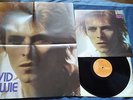
David Bowie "Space Oddity" RCA LSP-4813 1st UK Re-Issue 1972 1E/1E + inner
£
15
$
19


Favourite Auctions
To save auctions to your favourites, please login
If you don't have an account, please register
Description
David Bowie ? "Space Oddity" RCA Victor ?LSP-4813 UK reissue.
Stereo Vinyl, LP, reissued in the UK in 1972. This is a reissue by RCA of David Bowie "David Bowie", in a non-laminated card sleeve with a new design; Printed in England by Robert Stace. Note that this reissue drops track A2.2 'Don't Sit Down' that appears on the original 1969 release. "Previously released on Philips Records SBL 7912" in the front bottom right corner - the text is on one line only, other issues have it split onto two lines. The orange labels are semi-glossy, with headers reading : Side1Stereo and Side2Stereo and have four lines of text in white at the bottom in a semi-circle. Matrix variations start at BPRS 4501 1E / BPRS 4502-1E, subsequent issues may have MainMan replacing Titanic Music in the credits and a MainMan logo on back cover. Inner sleeve with lyrics printed in blue and pink, LSP-4813, Printed in England, also crediting Titanic Music.
The vinyl appears to have been well cared for and is in great condition, apart from a couple of surface scuffs, which can produce a bit of crackle in the run-in to Side 1. It played through beautifully on my elderly stereo - no hop, click or stick. The LP is housed in its original printed inner sleeve, which is in good condition, no rips or writing. The sleeve has a little ring-wear front and back, and is a little worn at one corner, but it is intact and, again, has no rips or writing. The spine is intact and completely legible. Matrix / Runout Side 1 : BPRS 4501 1E Matrix / Runout Side 2 : BPRS 4502-1E
"David Bowie" is the second studio album by the English musician David Bowie, released under that title by Philips in the UK, and as "Man of Words/Man of Music" by Mercury in the US, on 14 November 1969. It was reissued in 1972 by RCA Records as "Space Oddity" (the title of the opening track, which had reached No. 5 in the UK Singles Chart).
Regarding its mix of folk, balladry and prog rock, NME editors Roy Carr and Charles Shaar Murray have said, "Some of it belonged in '67 and some of it in '72, but in 1969 it all seemed vastly incongruous. Basically, "David Bowie" can be viewed in retrospect as all that Bowie had been and a little of what he would become, all jumbled up and fighting for control..."
The album came about after Bowie had made the transition from a cabaret/avant-garde-inspired musician to a hippie/folk-based sound and as such the album is a major turning point from his 1967 debut.
"Don't Sit Down", an unlisted 40-second jam heard after the album's second song on the UK Philips LP, was excluded from the US Mercury release and from the 1972 RCA reissue.
Released as a single in July 1969, "Space Oddity" was a largely acoustic number augmented by the eerie tones of the composer's Stylophone, a pocket electronic organ. The title and subject matter were inspired by Stanley Kubrick's '2001: A Space Odyssey' and introduced the character of Major Tom. The song dates back as early as February 1969. It was written for a promotional video named "Love You till Tuesday". The video's intent was to sell Bowie to a new label as he had been dropped from Deram Records in April 1968. He was urged by his manager Kenneth Pitt to record some new material and so "Space Oddity "was born. Some commentators have also seen the song as a metaphor for heroin use, citing the opening countdown as analogous to the drug's passage down the needle prior to the euphoric 'hit', and noting Bowie's admission of a "silly flirtation with smack" in 1968. His 1980 hit "Ashes to Ashes" declared "We know Major Tom's a junkie".
Held to be "the first Bowie album proper", and his first deemed worthy by record companies of regular reissue, David Bowie featured a notable list of collaborators, including session players Herbie Flowers, Tim Renwick, Terry Cox, and Rick Wakeman, as well as cellist Paul Buckmaster, multi-instrumentalist and producer Tony Visconti, and bassist John Lodge (not to be confused with The Moody Blues' bassist of the same name). Before recording for the album commenced at Trident Studios, the song "Space Oddity" had been selected as the lead single based on an earlier demo. Visconti saw it as a "novelty record" and passed the production responsibility for the song on to Gus Dudgeon. However, Visconti produced all the remaining songs on the album. Tim Renwick, John 'Honk' Lodge, Mick Wayne and John Cambridge – all from the band 'Junior's Eyes' – featured on the album sessions and briefly served as Bowie's backing band for live appearances and on an October 1969 BBC Radio session.
Although the opening song had given Bowie a No. 5 hit in the UK earlier in the year, the remainder of the material bore little resemblance to it and the album was a commercial failure on its initial release, despite some decent reviews. The New York Times, in a review published over a year after the album's release, praised the album, calling it, "a complete, coherent and brilliant vision". On the other hand, Village Voice critic Robert Christgau considered this album, like his debut, to be "overwrought excursions". However the November 1972 reissue, released in the wake of Bowie's breakthrough 'The Rise and Fall of Ziggy Stardust and the Spiders from Mars' and featuring a contemporary Ziggy photo on the cover, made No. 17 in the UK charts and No. 16 in the United States.
price rating