ERNST KRENEK+KOENIG 50's ELECTRONIC 10" STOCKHAUSEN-NWW
$
91


Favourite Auctions
To save auctions to your favourites, please login
If you don't have an account, please register
Description
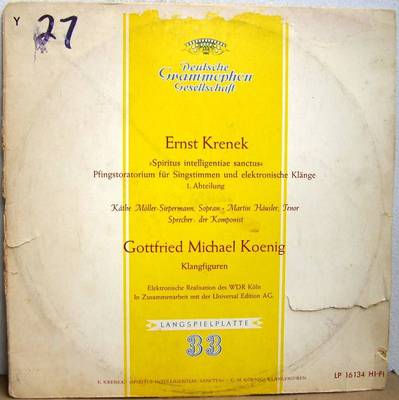
ERNST KRENEK / GOTTFRIED MICHAEL KOENIG
SPIRITUS INTELLIGENTIAE SANCTIS / KLANGFIGUREN LP
Deutsche Grammophon
1st edition October 1957
Extremely rare first pressing back from 1957 with tulip labels on DGG, early electronic music experiments from Ernst Krenek & Gottfried Michael Koenig.
Some info on the release: Extremely rare 1st edition issue, released in Germany back in October of 1957 by Deutsche Grammophon. Several re-issues exist (that mention a later release date on the back cover, but this one is the original 1st press!! Belongs to a "series" of 3 10" records with electronic music experiments back from the 50's issued by Deutsche Grammophon (the other 2 with works from Herbert Eimert & Karlheinz Stockhausen).
Koenig studied composition, piano, analysis and acoustics in Detmold, music representation techniques in Cologne and computer technique in Bonn. He attended and later lectured at the "Darmstädter Ferienkurse" (Darmstadt music summer schools). From 1954 to 1964 Koenig worked in the electronic studio of West German Radio (WDR) producing his electronic compositions Klangfiguren, Essay and Terminus 1 and wrote orchestral and chamber music. Furthermore he assisted other composers, including Mauricio Kagel, Franco Evangelisti, Gyorgy Ligeti, Herbert Brün and Karlheinz Stockhausen (with the realization of Kontakte and Gesang der Jünglinge).
From 1961 to 1965 Koenig taught at the Gaudeamus Foundation in Bilthoven, and from 1962 to 1964 at the Hochschule für Musik Köln. In 1964 Koenig moved to the Netherlands, where he taught at the University of Utrecht and was, until 1986, director and later chairman of the electronic music studio, which became the Institute of Sonology (Frobenius 2001). Here he developed his computer composition programs Project 1 (1964) and Project 2 (1966), designed to formalise the composition of musical structure-variants. Both programs had a significant impact on the further development of algorithmic composition systems. Among his notable students are Mario Bertoncini, Konrad Boehmer, Karl Gottfried Brunotte, Johannes Fritsch, Annea Lockwood, Tomás Marco, Pierre Mariétan, Zoltán Pongrácz, Atli Heimir Sveinsson, and Jan Vriend.
His sound synthesis program SSP (started 1971) is based on the representation of sound as a sequence of amplitudes in time. It makes use of the methods of aleatoric and groupwise selection of elements employed in Project 1 and Project 2. He continued to produce electronic works (Terminus 2, the Funktionen series). These were followed by the application of his computer programs, resulting in chamber music (Übung for piano, the Segmente series, 3 ASKO Pieces, String Quartet 1987, String Trio) and works for orchestra (Beitrag, Concerti e Corali). 6 volumes of his theoretical writings were published between 1991 and 2008 under the title Ästhetische Praxis by Pfau Verlag; an Italian selection appeared under the title Genesi e forma (Semar, Rome 1995).
Ernst Krenek (August 23, 1900 – December 22, 1991) was an Austrian composer. He explored atonality and other modern styles and wrote a number of books, including Music Here and Now (1939), a study of Johannes Ockeghem (1953), and Horizons Circled: Reflections on my Music (1974). Krenek wrote two pieces using the pseudonym Thornton Winsloe. In 1938 Krenek moved to the United States of America, where he taught music at various universities, including Hamline University in Saint Paul, Minnesota from 1942-1947. There he met and married his third wife, his student and composer Gladys Nordenstrom. He became an American citizen in 1945. He later moved to Toronto, Canada where he taught at The Royal Conservatory of Music during the 1950s. His students included Milton Barnes, Lorne Betts, Samuel Dolin, Robert Erickson, Halim El-Dabh, Richard Maxfield, Will Ogdon, and George Perle. He died in Palm Springs, California. In 1998 Gladys Nordenstrom founded the Ernst Krenek Institute and in 2004 the private foundation Krems die Ernst Krenek in Vienna, Austria.
Condition: Vinyl lies in very good+ condition, looks clean with some scuffs here and there and plays with some crackle mostly at the first part of each side (side a: plays vg/side b: plays vg++), while cover lies in only good condition with tears and extensive age wear.
Tracklist
A
Ernst Krenek -
"Spiritus Intelligentiae Sanctus" Pfingstoratorium Für Singstimmen Und Elektronische Klänge
Other [Electronic Realization] - Heinz Schütz
Soprano Vocals - Käthe Möller-Siepermann
Tenor Vocals - Martin Häusler
Voice - Ernst Krenek
B
Gottfried Michael Koenig -
Klangfiguren
SHIPPING & PAYMENT
Shipping: Shipping for this 10" is 7$ airmail in Europe / 9$ for the rest of the world
Registered mail: +5$
Insurance: optional
Combined shipping: BIG discounts
Payment: Paypal
Packaging: I am a collector too and i know
price rating