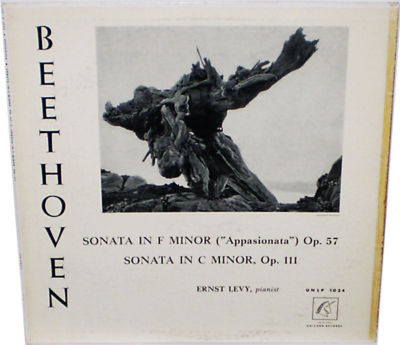
ERNST LEVY Beethoven Piano Sonatas LP UNICORN 1956 Rare
$
24


Favourite Auctions
To save auctions to your favourites, please login
If you don't have an account, please register
Description
Ernst Levy -- Beethoven: Piano Sonata No. 23 in F Minor ("Appassionata") Op. 57 & Piano Sonata No. 32 in C Minor, Op. 111 LP
Original 1956 US mono release on Unicorn Records (catalog # UNLP 1034, green labels).This extremely rare original Unicorn LP was recorded at the famous Kresge Auditorium at M.I.T., and the recording is superb -- great audiophile sound. Recorded and Mastered by Peter Bartok.
The limited edition Marston compilation 2-CD set "Ernst Levy - Forgotten Genius" containing only one sonata from this LP sells for $150+ if you can find one.
Ernst Levy was one of the century’s most remarkable musicians, although his name is all but unknown to even many specialists in the study of great pianists. As a pianist he made some commercial recordings in the late 1950s (reissued here and on subsequent Marston releases) which received mostly lukewarm and negative reviews when originally released, and there exist non-commercial tapes of his playing which the International Piano Archives at the University of Maryland will soon issue.Levy was a protean artist, whose multifaceted life as a pianist, conductor, teacher, author, theorist, general polymath and prolific composer was one that shaped and affected his interpretations to an extraordinary degree. Many experts consider his interpretations and playing among the greatest ever recorded; many disagree.
Levy’s performances are not for the faint of heart. Those encountering him for the first time may well be shaken—perhaps irritated—by some of the unorthodox aspects of his approach. Although obviously grounded in a total intellectual knowledge of the inner workings of the score, Levy’s conceptions—and especially the freedom with which he handles dynamics and tempo relationships—definitely demand an open-minded receptivity from the listener. Therefore it may be useful to suspend, as much as possible, any and all preconceived notions concerning how the music “is supposed to be played.” Levy’s departures from convention are borne of an absolute sincerity of conviction, but one must be prepared for some unexpected jolts. In the Liszt Sonata, for example (and to a lesser extent in the Beethoven works), Levy sometimes flies defiantly in the face of the composer’s instructions. He does this in order to boldly construct an edifice of towering and overwhelming drama—a life-and-death conflict, even—that makes many other interpretations sound meek by comparison. In other words, this is the kind of titanic playing that grabs the listener by the neck and does not let go until the final note has evaporated. As a composer himself, and as a performer who often worked with living composers, Levy knew as well as anyone that musical creators are far more flexible in their acceptance of individual interpretations than is generally acknowledged. And because the compositional process imparts such an intensely and uniquely personal message, it invites (and even requires) a similarly personal response from the interpreter.
Not surprisingly, Levy had very definite ideas about the role of the interpreter. “One must first read the text exactly. Then one has to know how to read between the notes. This means, I read first philologically exactly what there is, what is written down, but what is written down is always imperfect, notation is imperfect, everything is imperfect. From across the notes I try to penetrate to the spirit, to what has produced the writing. I interpret the writing starting with the knowledge I have acquired, or the feeling, it is all together. I try to arrive as close as possible to what the creator has wanted to say. If I am mistaken, [then] I am mistaken. Those who are dead do not protest, and from the living it has never happened to me. But that does not mean that I am not sometimes in error. I do what I can. There are as many interpretations as there are interpreters, but the essential [elements] should always remain the same.”
Let us now consider the sonata as we know it from Beethoven. What is its characteristic feature as a spiritual entity? I hope I shall meet with approval when I say that it is an impression of dramaticism. The question is whether we shall ascribe it to Beethoven’s personality or to the character of the sonata. Beethoven, no doubt, was a dramaticist in music. But the fact that the adequate form of expression for his dramaticism was the sonata points to the sonata as an inherently dramatic form. [The appearance of the ‘development section’ within a sonata movement was the event that presented] us with a veritable drama. First part: ‘exposition’—personae dramatis are introduced. Second part: development—the conflict, the dramatic evolution proper. Finally: the ‘recapitulation,’ which is an improper term, for it is really the outcome of the drama. The first theme appears as the victor, so to speak, the second theme giving up its own home key, if we may say, and adopting that of the main theme.
These changes came about gradually, and also were only gradually apprehended by the composers. The first to become fully aware of the situation was Beethoven. Mozart and Haydn did not, in general, completely yield to the exigencies of the new idea. They kept the dramaticism in chains, so to speak, thereby realizing an infinitely precious, if precarious, balance between the old static conception and the new dynamic influx.
The sonata as it was handed over to Beethoven showed a succession of movements, the number of which varied from two to four. The four-movement scheme was generally established in this way: a first movement in sonata-form, followed by two lyrical (in contradistinction to ‘dramatic’) movements, one in slow tempo, the other a minuet whose name [and character were altered] by Beethoven into a ‘scherzo’. [For the finale, the composer faces a problem]: if his sonata is to be considered as one work in several parts rather than as a loose succession of pieces—and that is how Beethoven understood it—the last movement has to balance the first in importance, in weight. Haydn could still write his wonderful, witty, carefree Rondos. But Beethoven could not, because the dramatic idea of the first movement, of the sonata-form, had begun to radiate over the rest, imperiously driving toward a complete coherence and unity of the sonata as a whole. The finale represented an artistic problem of the first magnitude, and Beethoven struggled with it all his life. This means that he attempted a different solution in practically every new sonata composition. With each work, whether sonata, symphony, or quartet, Beethoven had to start anew the attack on the finale-problem, because the spiritual data and, hence, the formal consequences, were different in every one of his works. In this, Beethoven is characteristically of the ninteenth century—a ‘modern’ composer.
For instance, in Op. 111, which consists of only two movements [the second being a theme and variations], the dramaticism is twofold. Each of the movements is dramatic in itself. Superimposed on that primary dramaticism is another one, resulting from an implicit polarity: in the first movement, an outward struggle—in the second an inward ascension. Both parts are connected by a musical symbolism of the highest and most profound significance.
You will admit that we are pretty far, by now, from the academic concept of the sonata scheme. Also, it might occur to you that by this time the terms ‘classic’ and ‘romantic’ [may] appear a little vague, a little emptied of the meanings we usually associate with them. If that should be the case, we are just in the right state of mind to approach the Liszt Sonata. Thus, I am sure you will already have [anticipated] that the next step in sonata composition—a step Beethoven himself did not take, but presumably would have taken had he lived only a little longer—must logically consist in writing a sonata in one movement. The dramatic idea, spreading out from the first movement, had taken hold of the [entire] sonata. The different movements had lost their independence, and had become stations in a continuous dialectical process. It really needed only minor adjustments, beside the blotting-out of a few double bars, to bring forth the sonata in one movement. It was Liszt who took that step, as an inevitable consequence of Beethoven’s concept of ‘development’.
If you can see why the one-movement sonata had to be written, you will certainly also have an idea as to how it might be organized. The presiding principle being that of dialectics, the whole work will consist of one huge ‘development’ (the term taken in its technical meaning), in which more lyrical parts will lie imbedded. Liszt’s sonata is a drama played without interruption. On the formal level, this is achieved through such an arrangement of the sonata-form that, first of all, the finale is made to be identical with the recapitulation. This provides the possibility of letting the slow section and the scherzo become functions of the development. In fact, all the sections of the sonata are functions of the development, which begins right at the exposition and is carried through the recapitulation, up to what would correspond to the ‘catastrophe’. The climax—not to be [confused] with the ‘catastrophe’—coincides with the beginning of the recapitulation, as in Beethoven’s Op. 111. Preceding the climax, and leading up to it, a demonic fugato must be considered that part of the development which goes through the station of the Scherzo. The slow section, though clearly also a function of the development, has a slightly more independent, because less transitional, character.
Donald Manildi, 1997
CONDITION: Cover VG+ / Vinyl NM- tape residue at opening from where LP was first sealed; vinyl is excellent, just very slight wear, plays quite well. Graded conservatively using Goldmine standards [G / G+ / VG / VG+ / NM / ]grade only used if record is brand new.
Bid with confidence -- over 12000 positive feedbacks selling vinyl on eBay since 1998, with a total 11-year average of 100% positive.
Shipping And Payment Info
Records can be shipped worldwide via any method.
I will combine shipping. Winners of multiple items save substantially on shipping costs.
Within the US: shipping is $4.00 for Media Mail. Priority Mail is a recommended option, it's faster and more secure -- cost is reasonable and calculated based on your zip code. Shipping costs include delivery confirmation for all US orders. - Combine shipping with other items: The cost of each extra item is calculated automatically based on weight: if you want to add a record (7", 12", LP or double-LP) or CD to your order the cost is only between 25 cents and 75 cents per extra item depending on total weight.
- Combine shipping with other items: If you want to add a normal-weight record (7", 12", or LP) or CD to your order the cost is reasonable, usually not more than $3.99 per extra item, often less, depending on total weight.
All records are packaged securely, protected by both stiff and cushion packaging, with vinyl (in original innersleeve) removed from cover and placed safely in poly sleeve to help prevent seam splitting during transit.
I can usually accommodate special shipping requests or special payment requirements, just ask.
price rating