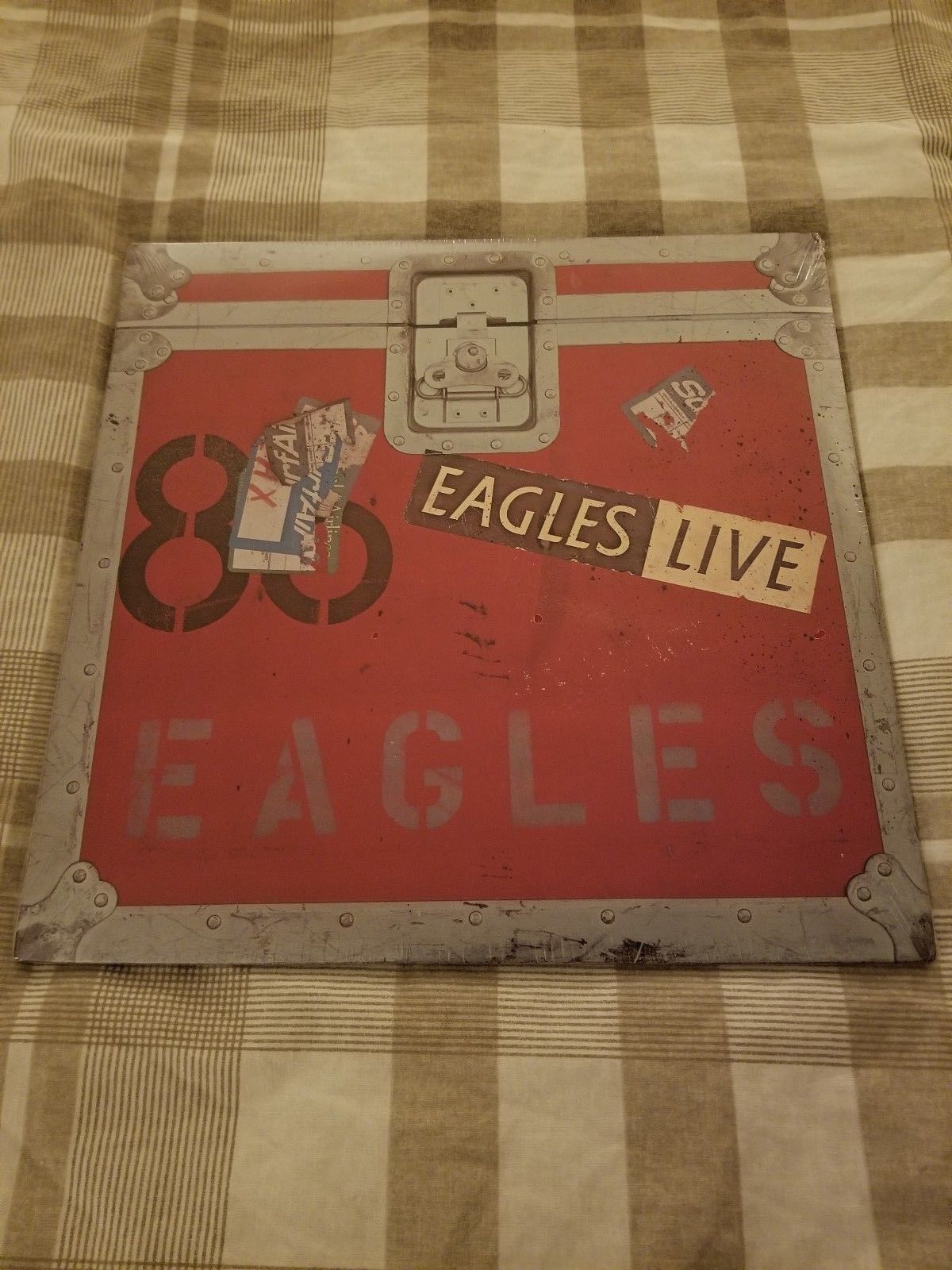
Eagles Live Factory Sealed Never Opened Vinyl LP Record Mint Unplayed
$
47


Favourite Auctions
To save auctions to your favourites, please login
If you don't have an account, please register
Description
Eagles Live Factory Sealed Never Opened Vinyl LP Record Mint Unplayed
Eagles Live
From Wikipedia, the free encyclopedia
Eagles Live Live album by Eagles Released November 7, 1980 Recorded October 20, 1976 – July 31, 1980 Genre Rock Length 77:10 Label Asylum Producer Bill Szymczyk Eagles chronology The Long Run(1979) Eagles Live
(1980) Eagles Greatest Hits, Vol. 2
(1982) Singles from Eagles Live
- "Seven Bridges Road"
Released: December 15, 1980
Eagles Live is the first live album by the American rock band Eagles, a two-LP set released on November 7, 1980. The Eagles were already breaking up after an argument between bandmates Glenn Frey and Don Felder on July 31, 1980, however, the band owed Elektra/Asylum Records one more album, and they fulfilled that obligation with a release of performances from the Hotel Californiaand The Long Run tours.
Eagles Live was mixed by Frey and Don Henley on opposite coasts in Los Angeles and Miami, respectively, and as producer Bill Szymczyk put it, the record's harmony and instrument fixes were made "courtesy of Federal Express." The 1983 Rolling Stone Record Guide said it is "perhaps the most heavily overdubbed [live album] in history." "Seven Bridges Road," a Steve Young cover, was released as a single and became a top-40 hit.
Contents
[hide]
- 1Background
- 2Track listing
- 3Personnel
- 4Charts and certifications
- 4.1Weekly charts
- 4.2Year-end charts
- 4.3Sales and certifications
- 5References
Background[edit]
The album provides a balanced document of the band's musical history, recorded in two phases. Five of the tracks were recorded in October 1976, during three performances at The Forum in Inglewood, California. The other 10 tracks were recorded in July 1980, from three shows at the Santa Monica Civic Auditorium and one at the Long Beach Arena in California. The band had different line-ups in 1976 and 1980 as Timothy B. Schmit only joined later replacing the original bassist Randy Meisner.[3] Five lead singers are featured in the 14 vocal songs on the album (excluding the brief musical interlude of "Doolin Dalton (Reprise II))": Don Henley, Glenn Frey, Joe Walsh, Meisner, and his replacement Schmit. Songs from each Eagles studio album except one (On the Border) are included, as well as two Walsh solo tracks and one cover song: the acoustic harmony-laden "Seven Bridges Road."
However, by July 1980, the band was already in the process of breaking up. During a concert in Long Beach, California that served as a fund-raiser for then-Senator Alan Cranston's campaign, bandmates Glenn Frey and Don Felder nearly came to blows backstage. Frey then refused to join the band to record overdubs or even speak to his former bandmates, the recording was therefore done piecemeal. Frey was in Los Angeles while the rest of the band were in Miami with Don Henley overseeing the post-production sessions, and tapes were sent back and forth between the two locations so that the album may be completed.[4][3] The producer Bill Szymczyk said: "I had my assistant in Los Angeles with Glenn, and I had the rest of the band fly to Miami. We were fixing three-part harmonies courtesy of Federal Express."[5] Five different lawyers were thanked in the liner notes.[3]
The Eagles also rejected a $2 million offer from the label to record two new songs for the album. The only previously unreleased song in the album is a version of "Seven Bridges Road".[3] The song was a showcase for the band's close harmony singing, as the first and last verses feature a cappella vocals from all five members of the 1980 lineup including Don Felder, the only member of the band not to have a solo vocal on the album.
Track listing[edit]
Side one No. Title Writer(s) Lead vocals Length 1. "Hotel California" (July 29, 1980, Santa Monica)- Don Henley
- Glenn Frey
- Don Felder
- Henley
- Frey
- Bob Seger
- J. D. Souther
- Henley
- Frey
- Timothy B. Schmit
- Henley
- Frey
- Henley
- Frey
- Souther
- Henley
- Frey
- Henley
- Frey
- Randy Meisner
- Henley
- Frey
- Jim Ed Norman
- Henley
- Frey
- Henley
- Frey
- Meisner
- Bernie Leadon
- Henley
- Frey
- Walsh
- Frey
- Jackson Browne
- The album cover is the image of a band-equipment storage chest used during a concert tour. It includes two elements hinting at the Eagles' breakup (which was not officially announced until May 1982[4]): The number 86 on both sides and "MIA" written on air-freight stickers on the back.
- The record labels were custom, showing a bird's nest filled with eggs and hand grenades.
- Original pressings of this double-album had text engraved in the run-out grooves on each side, as had been the band's tradition since their 1975 album One of These Nights:
- Side 1: Is it illegal to yell "Movie!" in a firehouse?
- Side 2: "Hello, Federal? ... Ship it!"
- Side 3: Not Tonight, thanks ...
- Side 4: ... I've gotta rest up for my monster
- The run-out groove of the fourth side did not fade to silence as was customary. Instead, the crowd noise continued into the final-loop groove. Thus, for those listening on manual turntables, the applause would not end until the listener removed the stylus from the disc.
Personnel[edit]
Eagles
- Don Felder – guitars, harmony and backing vocals
- Glenn Frey – rhythm guitar, keyboards, vocals
- Don Henley – drums, percussion, vocals
- Randy Meisner – bass guitar, vocals (1976 shows; "New Kid In Town," "Wasted Time," "Take It to the Limit," "Doolin'-Dalton (Reprise II)," and "Desperado")
- Timothy B. Schmit – bass guitar, vocals (1980 shows; all other songs)
- Joe Walsh – guitars, keyboards, vocals
Additional musicians
- Jage Jackson – rhythm guitar, percussion
- Phil Kenzie – saxophone
- Vince Melamed – electric piano
- The Monstertones – backing vocals
- J. D. Souther – vocals, acoustic guitar
- Joe Vitale – piano, organ, drums, percussion
Production
- Bill Szymczyk – production
- Ted Jensen – mastering engineer
Charts and certifications[edit]
Weekly charts[edit]
Chart Position Australian Kent Music Report[6] 3 Canadian RPM Albums Chart[7] 25 Dutch Albums Chart[8] 7 Japanese Oricon LPs Chart[9] 8 New Zealand Albums Chart[10] 9 Norwegian VG-lista Albums Chart[11] 25 Swedish Albums Chart[12] 44 UK Albums Chart[13] 24 US Billboard 200[14] 6 West German Media Control Albums Chart[15] 55Year-end charts[edit]
Chart (1980) Position Australian Albums Chart[6] 67 Chart (1981) Position Australian Albums Chart[6] 60 US Billboard Pop Albums[16] 67Sales and certifications[edit]
Region Certification Certified units/Sales Canada (Music Canada)[17] Gold 50,000^ France (SNEP)[18] Gold 100,000* Japan (Oricon Charts) 105,000[9] United Kingdom (BPI)[19] Gold 100,000^ United States (RIAA)[20] 7× Platinum 3,500,000^*sales figures based on certification alone
^shipments figures based on certification alone
price rating