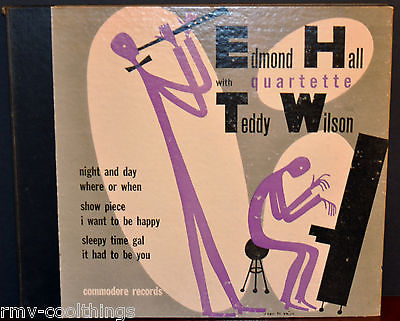
Edmond Hall Quartette with Teddy Wilson, 3 Record Set 78's, Commodore CR5, RARE
$
27


Favourite Auctions
To save auctions to your favourites, please login
If you don't have an account, please register
Description
VG++ to NM / NM -
**** COOL 1944 RECORD SET ****
- ART WORK BY JOHN DE VAIES.
- COVER HAS SOME WEAR AND UPPER SPINE HAS SMALL SPLIT. OTHERWISE, IN EXCELLENT CONDITION.
- INTERIOR IS CLEAN AND DRY - ABSOLUTELY NO WATER OR MOLD DAMAGE.
- RECORDS ARE OLD BUT SHOW VERY LITTLE OR NO SIGNS OF WEAR.
- VERY LITTLE OR NO SPINDLE MARKS
Early life
Edmond Hall (May 15, 1901 – February 11, 1967) was an American jazz clarinetist and bandleader.
Over his long career Hall worked extensively with many top performers as both a sideman and bandleader, and is perhaps best known for the 1941 chamber jazz song "Profoundly Blue" which is regarded as a classic of pre-WWII jazz.
Born in Reserve, Louisiana, about 40 miles west of New Orleans on the Mississippi River, Hall and his siblings were born into a musical family. His father Edward Blainey Hall and mother Caroline Duhe had eight children, Priscilla (1893), Moretta (1895), Viola (1897), Robert (1899), Edmond (1901), Clarence (1903), Edward (1905) and Herbert (1907).
His father Edward played the clarinet in the Onward Brass Band, respectively uncle Jules Duhe played trombone, uncle Lawrence Duhe the clarinet and uncle Edmond Duhe the guitar. The Hall brothers, Robert, Edmond and Herbert all became clarinetists, but before picking up the clarinet Edmond was taught guitar by his uncle Edmond Duhe. When Ed Hall finally picked up the clarinet, "He could play it within a week. He started Monday and played it Saturday." his brother Herb recalls in an interview with Manfred Selchow who wrote an extensive Edmond Hall Biography (A Bio-Discographical Scrapbook on Edmond Hall), 640 pages, Profoundly Blue in 1988.
Ed Hall worked as a farm-hand but by 1919 he had become tired of the hard work, and despite his parents' worries of finding a decent job as a musician, he left for New Orleans. The first New Orleans Band he played with was that of Bud Rousell (Bud Russell). He also played with Jack Carey (trombone) and blues cornetist Chris Kelley.
Begins career in music
Hall's first big break came in late 1920, when he went to a dance at Economy Hall. The legendary Buddy Petit was playing. "When I got inside, it was a revelation", Hall said. Petit's clarinet player left the band just a few days later, and the following Saturday Ed Hall was sitting in with Petit's band as a replacement. In 1922 Ed Hall left Petit.
Arriving in Florida, Pensecola he joined Lee Collins' band. In 1923 he joined Mack Thomas' band, from there he went on to play with the "Pensacola Jazzers" where Hall met the young trumpeter Charles Williams better known as Cootie Williams. From there he went on to play with "Eagle Eye" Shields. Together with Cootie Williams he left Shields and joined Alonzo Ross' band the "Alonzo Ross DeLuxe Syncopators" in early 1927. In 1928 the band's pianist Arthur "Happy" Ford formed a new group and immediately hired Hall and Williams.
In New York
In 1929 Hall went back to New York, where he joined Charlie Skeet's band, but soon changed yet again to play with Claude Hopkins. Under the leadership of Hopkins the band became enormously popular and in 1930 they got an offer to play at the Savoy Ballroom "The World's finest Ballroom", a big step for Hall. In late 1935 due to personal problems with the band leader, Hall left the Hopkins Band.
In 1936 he joined Billy Hicks' band, the "Sizzling Six". Hall who had been featured mainly on alto and baritone saxophone since 1922, finally had a place as a full-time clarinetist. Meanwhile his new sound on the clarinet had made a full circle and he began recording with the "big stars". On June 15, 1937 in New York, he had his first recording session with Billie Holiday. Among the band members was Lester Young on tenor saxophone.
Hall stayed with Hicks' band until early 1939, when no attractive jobs were in sight, he left and stepped into Café Society, joining Joe Sullivan's band in late 1937. While playing with Sullivan Hall had many recording dates with different bands and musicians in between the regular job at the Cafe Society with Sullivan.
Barney Josephson, the owner of Cafe Society Downtown and Cafe Society Uptown was very fond of Hall's playing and after Sullivan left to play solo piano at "Nick's", Hall became the "house clarinetist". Any band that would come in to play, had to get rid of their clarinetist, and take Hall or they would not get the job according to Barney Josephson the owner. In 1940 Henry "Red" Allen came to play at the Cafe Society. Hall became the band's clarinetist. Hall spent 9 years at the Cafe Society, playing and recording in between jobs with many of his contemporaries like Bud Freeman, Teddy Wilson, Charlie Christian, Henry "Red" Allen, J.C. Higginbotham, Art Tatum, Big Joe Turner, Hot Lips Page, Zutty Singleton, Meade Lux Lewis, Big Sid Catlett, Josh White, Ida Cox, Coleman Hawkins, Helen Ward, Vic Dickenson, Sidney de Paris, Wild Bill Davison, Eddie Heywood, Roy Eldridge and Jack Teagarden. Wednesday, February 5, 1941 was a special day in Hall's career, for the first time he was the nominal leader of a recording session.
Edmond Hall joins Teddy Wilson
Late in 1941 Hall left Allen, to join Teddy Wilson who also played at the Café Society. Around this time Hall's style changed. His admiration for Benny Goodman and Artie Shaw, caused him to work on his technique, as he had always tried to improve technically. Hall did try the Boehm System Clarinet but that was short lived. He soon went back to his beloved Albert System, which he'd play until his death.
Many records under his name as band leader appeared during this period as Edmond Hall's Blue Note Jazzmen, Edmond Hall Sextet, The Edmond Hall Celeste Quartet, Edmond Hall's Star Quintet, Ed Hall and the Big City Jazzmen and Edmond Hall's Swingtet. The recording sessions always took place in between the work hours of the Café Society, including many of the musicians who performed there as well.
Hall had become very popular among the musicians and critics likewise and was frequently invited to the New York Town Hall Concerts led by Eddie Condon.
Payment
Payment is due within 5 days. I accept Paypal and any other form of Payment that is allowed by eBay. Please email any concerns regarding payment.
Shipping
- The shipping rate listed is for the Continental United States ONLY.
- If you live in Alaska, Hawaii, or Puerto Rico please contact us prior to payment to determine shipping costs.
- Items will be shipped out the day after payment has been received.
Terms of Sale
Sales are never final until the item has been received and the buyer is satisfied. Please email any problems with an item upon receipt and give me the chance to make things right. I leave feedback once an item is shipped as the buyer has fulfilled their obligation. I would appreciate feedback upon satisfactory receipt of item.
About Me
All of items are usually found in garage or estate sales, so most items are previously owned and used (unless indicated otherwise). I collect vintage/antique items as a hobby and have been for several years. I am now beginning to sell my treasures. The description listed above is made to the best of my knowledge, investigation and research.
Contact Us
Please email me with any questions. I will gladly answer your question or provide you more pictures as soon as possible. Thank you for your interest and I hope you enjoy my treasures
price rating






![(THE BEATLES-Revolver) -[NEAR MINT+]-A5-LP](https://www.popsike.net/php/thumbnail.php?url=https://www.popsike.pics/pix/20150126/251808201185.jpg)