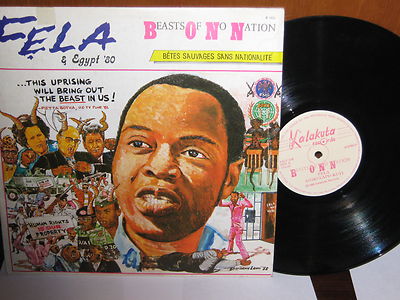
FELA KUTI & EGYPT 80 "BEASTS OF NO NATION" AFRICAN LEGEND" RARE
$
30


Favourite Auctions
To save auctions to your favourites, please login
If you don't have an account, please register
Description
Fela continued to release albums with Egypt '80, made a number of successful tours of the United States and Europe and also continued to be politically active. In 1986, Fela performed in Giants Stadium in New Jersey as part of the Amnesty International A Conspiracy of Hope concert, sharing the bill with Bono, Carlos Santana, and The Neville Brothers. In 1989, Fela and Egypt '80 released the anti-apartheid Beasts of No Nation album that depicts on its cover U.S. President Ronald Reagan, UK Prime Minister Margaret Thatcher and South African Prime Minister Pieter Willem Botha.
His album output slowed in the 1990s, and eventually he stopped releasing albums altogether. In 1993, he and four members of the Afrika '70 organization were arrested for murder. The battle against military corruption in Nigeria was taking its toll, especially during the rise of dictator Sani Abacha. Rumors were also spreading that he was suffering from an illness for which he was refusing treatment.
The musical style performed by Fela Kuti is called Afrobeat, which is a complex fusion of Jazz, Funk, Ghanaian/Nigerian High-life, psychedelic rock, and traditional West African chants and rhythms. Afrobeat also borrows heavily from the native "tinker pan" African-style percussion that Kuti acquired while studying in Ghana with Hugh Masekela, under the uncanny Hedzoleh Soundz.[15] The importance of the input of Tony Allen (Fela's drummer of twenty years) in the creation of Afrobeat cannot be overstated. Fela once famously stated that "without Tony Allen, there would be no Afrobeat".
Afrobeat is characterized by a fairly large band with many instruments, vocals, and a musical structure featuring jazzy, funky horn sections. The "endless groove" is used, in which a base rhythm of drums, shekere, muted West African-style guitar, and melodic bass guitar riffs are repeated throughout the song. Commonly, interlocking melodic riffs and rhythms are introduced one by one, building the groove bit-by-bit and layer-by-layer to an astonishing melodic and polyrhythmic complexity. The horn section then becomes prominent, introducing other riffs and main melodic themes.
Fela's band was notable for featuring two baritone saxophones, whereas most groups were using only one of this instrument. This is a common technique in African and African-influenced musical styles, and can be seen in funk and hip hop. Fela's bands at times even performed with two bassists at the same time both playing interlocking melodies and rhythms. There were always two or more guitarists. The electric West African style guitar in Afrobeat bands are paramount, but are used to give basic structure, playing a repeating chordal/melodic statement, riff, or groove.
Some elements often present in Fela's music are the call-and-response within the chorus and figurative but simple lyrics. Fela's songs were also very long, at least 10–15 minutes in length, and many reaching the 20 or even 30 minutes, while some unreleased tracks would last up to 45 minutes when performed live. This was one of many reasons that his music never reached a substantial degree of popularity outside Africa. His LP records frequently had one 30-minute track per side. Typically there is an instrumental "introduction" jam part of the song, perhaps 10-15 minutes long, before Fela starts singing the "main" part.
His songs were mostly sung in Nigerian pidgin, although he also performed a few songs in the Yoruba language. Fela's main instruments were the saxophone and the keyboards, but he also played the trumpet, electric guitar, and took the occasional drum solo. Fela refused to perform songs again after he had already recorded them, which also hindered his popularity outside Africa.
Fela was known for his showmanship, and his concerts were often quite outlandish and wild. He referred to his stage act as the Underground Spiritual Game. Fela attempted making a movie but lost all the materials to the fire that was set to his house by the military government in power. Kuti thought that art, and thus his own music, should have political meaning. Record/Cover Vinyl is VG due to long term storage and scuffs, minor/light scratches. Sounds Wonderful. A great collectible.
price rating


