Furtwängler Mozart WInd Serenade Vienna Philharmonic HMV 78s
$
27


Favourite Auctions
To save auctions to your favourites, please login
If you don't have an account, please register
Description
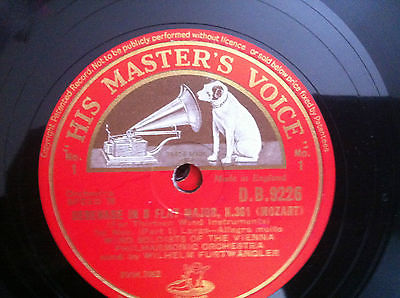
Wilhelm Furtwängler conducts the Wind Soloists of the Wiener Philharmoniker in one of his first recordings after the war.
Mozart's Serenade Nr. 10 B-Dur "Gran Partita" for 13 wind instruments, K. 361.
Recorded on 10, 19, 26 November and 3 December 1947 in the Brahmssaal, Wien.
This is the Original His Master's Voice 78 rpm issue on records DB 9226 / 9230 in England
matrices: 2 VH 7062-1; 7063-1; 7064-1; 7104-1; 7051-3; 7090-1; 7103-1; 7071-1; 7072-1; 7089-2
Each record has an import stamp on one side. The records are in beautiful condition, showing no wear, with minimal spindle wear as well.
Produced by Walter Legge (or as Furtwängler would say, "His Master's Legge") with the great Douglas Larter as sound engineer.
Wilhelm Furtwangler (January 25, 1886 – November 30, 1954) was a German conductor and composer. He is widely considered to have been one of the greatest symphonic and operatic conductors of the 20th century. During the 1920s and 1930s he became one of the leading conductors in Europe - as principal conductor of the Berlin Philharmonic from 1922, as principal conductor of the Gewandhaus Orchestra from 1922-6, and as a major guest conductor of other leading orchestras such as the Vienna Philharmonic. He was the leading conductor who remained in Germany during the Second World War, and although not an adherent to the Nazi regime this decision caused controversy for the rest of his life. The extent to which his presence lent prestige to the Third Reich is still debated. Furtwängler's interpretive art is well documented in commercial and off-air recordings and this has led to him being revered by a large number of musicians, critics and record collectors since his death. His conducting style is often contrasted to that of his older contemporary Arturo Toscanini, whose work during this period was also widely documented. Like Toscanini, Furtwängler was a major influence on many later conductors, and his name is often mentioned when discussing their interpretive style. Unlike Toscanini, Furtwängler sought a weighty, less rhythmically strict, more bass-oriented orchestral sound with more conspicuous use of tempo inflections not indicated in the printed score. (The difference is sometimes mis-characterized by the terms "objective" and "subjective," but Furtwängler's tempo inflections were often planned and reflected his studies with the harmonic theorist Heinrich Schenker from 1920–35).
Furtwängler was born in Berlin into a prominent family. His father Adolf was an archaeologist, his mother a painter. Most of his childhood was spent in Munich, where his father taught at the city's Ludwig Maximilian University. He was given a musical education from an early age, and developed an early love of Ludwig van Beethoven, a composer with whom he remained closely associated throughout his life. Though his chief posthumous fame rests on his work as a conductor, he was also a composer and regarded himself first and foremost as such, having in fact first taken up the baton in order to perform his own works.
By the time of Furtwängler's conducting debut at the age of twenty, he had written several pieces of music. However, they were not well received, and that - combined with the financial insecurity of a career as a composer - led him to concentrate on conducting. At his first concert, he led the Kaim Orchestra (now the Munich Philharmonic) in Anton Bruckner's Ninth Symphony. He subsequently held posts at Munich, Strasbourg, Lübeck, Mannheim, Frankfurt, and Vienna, before securing a job at the Berlin Staatskapelle in 1920, and in 1922 at the Leipzig Gewandhaus Orchestra where he succeeded Arthur Nikisch, and concurrently at the prestigious Berlin Philharmonic Orchestra.
Furtwängler also made a number of appearances as a conductor abroad. He made his London debut in 1924, and continued to appear there as late as 1938 to conduct a cycle of Richard Wagner's Ring. In 1925 he appeared as guest conductor of the New York Philharmonic Orchestra, and made return visits in the following two years.[1]
Towards the end of the Second World War, under extreme pressure from the Nazi Party, Furtwängler fled to Switzerland. It was during this troubled period that he composed what is largely considered his most significant work, the Symphony No. 2 in E minor. Work on the symphony was begun in 1944, and carried on into 1945. It was given its premiere in 1948 by the Berlin Philharmonic Orchestra under Furtwängler's direction. Furtwängler and the Philharmonic recorded the symphony for Deutsche Grammophon; the music was much in the tradition of Bruckner and Gustav Mahler, composed on a grand scale for very large orchestra with romantic, dramatic themes. Another important work is the Symphonic Concerto for Piano and Orchestra, completed and premiered in 1937 and revised in 1954. Many themes from this work were also incorporated into Furtwängler's unfinished Symphony No. 3 in C sharp minor.
He resumed performing and recording following the war, and remained a popular conductor in Europe, although always under something of a shadow. He died in 1954 in Ebersteinburg, close to Baden-Baden. He is buried in the Heidelberg Bergfriedhof. The tenth anniversary of his death was marked by a concert in the Royal Albert Hall, London, conducted by his biographer[3] Hans-Hubert Schönzeler.[4]
Furtwängler is most famous for his performances of Beethoven, Brahms, Bruckner, and Wagner. However, he was also a champion of modern music, notably the works of Paul Hindemith and Arnold Schoenberg,[5] and conducted the World premiere of Sergei Prokofiev's Fifth Piano Concerto (with the composer at the piano) on October 31, 1932[6] as well as performances of Béla Bartók's Concerto for Orchestra.
"Third Reich" controversy
Furtwängler's relationship with — and attitude towards — Adolf Hitler and the Nazi Party was a matter of much controversy.
On April 10, 1933, Furtwängler wrote a public letter to Goebbels to denounce the new rulers' anti-Semitism:
" I feel that I am first and foremost an artist, and that I am therefore apolitical in the sense of party politics. Art and artists exist to create love, not hate; to unite, not to divide. Ultimately there is only one dividing line I recognize: that between good and bad art. However, while the dividing line between Jews and non-Jews is being drawn with a downright merciless theoretical precision, that other dividing line, the one which in the long run is so important for our music life, yes, the decisive dividing line between good and bad, seems to have far too little significance attributed to it. Musical activity today, already weakened by the World crisis, the radio, etc., cannot tolerate any more experiments. Music cannot be made contingent in the same way as other essentials such as potatoes and bread. If concerts offer nothing then people will not attend; that is why the QUALITY is not just an idea: it is of vital importance. If the fight against Judaism concentrates on those artists who are themselves rootless and destructive and who seek to succeed in kitsch, sterile virtuosity and the like, then it is quite acceptable; the fight against these people and the attitude they embody (as, unfortunately, do many non-Jews) cannot be pursued thoroughly or systematically enough. If, however, this campaign is also directed at truly great artists, then it ceases to be in the interests of Germany's cultural life […] It must therefore be stated that men such as Walter, Klemperer, Reinhardt etc. must be allowed to exercise their talents in Germany in the future as well, in exactly the same way as Kreisler, Huberman, Schnabel and other great instrumentalists of the jewish race. It is only just that we Germans should bear in mind that in the past we had Joseph Joachim one of the greatest violinists and teachers in the German classical tradition, and in Mendelssohn even a great German composer - for Mendelssohn is a part of Germany's musical history".Furtwängler received a flood of letters agreeing with him and thanking him, people hoping that Furtwängler would disallow the politics of anti-Semitism in music. The Nazis considered this letter as a very clear support for Jews. For instance, Winifred Wagner wrote: "the claim that Dr. Furtwängler has a favourable attitude towards Jews was proved once again by himself in his exchange of letter with Dr. Goebbels. For the last sixteen years or so he has had Fräulein Dr. Geissmar - a full-blooded Jewess - as his full-time assistant, and my first serious disagreement with him during the 1931 festival [in Bayreuth] was provoked by our opposing views of the Jewish press." In another text of June 1933 that was the basis for a coming discussion with Goebbels, Furtwängler starts saying : "The Jewish question in musical spheres: a race a brilliant people!" He writes that if the boycotts against Jews are extended to artistic activities, he will resign from all his posts immediately, concluding "at any rate to continue giving concerts would be quite impossible without [the Jews] - to remove them would be an operation which would result in the death of the patient."
During the period 1933-1934, Furtwängler was constantly helping Jewish people so that Georg Gerullis, ministerial director at the Ministry of Culture sent a letter to Goebbels saying: "Can you name me a Jew on whose behalf Furtwängler has not intervened?"[11] Because of his international renown, he was appointed as the first vice-president of the Reichsmusikkammer and Staatsrat of Prussia. He accepted these honorific positions only in order to try to bend the racial policy of Nazis in music and to support Jewish musicians.[12] On 25, November 1944, he wrote a letter in the Deutsche Allgemeine Zeitung to support Hindemith's art, a degenerate artist for the Nazis and conducted a piece of Hindemith's opera Mathis der Maler.[13] This unleashed a storm, the Nazis understood that all their opponents were behind Furtwängler. He was then forced to resign from all his positions. In 1936 it seemed possible that he might follow Erich Kleiber's footsteps into exile when he was offered the principal conductor's post at the New York Philharmonic Orchestra, where he would have succeeded Arturo Toscanini. Toscanini's biographer Harvey Sachs wrote that Toscanini recommended Furtwängler for the position, one of the few times Toscanini expressed admiration for a fellow conductor.[15] There is every possibility that Furtwängler would have accepted the post,[16] but a report from the Berlin branch of the Associated Press, possibly ordered by Hermann Göring, said that he was willing to take up his post at the Berlin Opera once more. This caused the mood in New York to turn against him; from their point of view, it seemed that Furtwängler was now a full supporter of the Nazi Party.[17] In addition, Grove Online notes that he was "personally unpopular" with the orchestra's board, whom he had treated disrepectfully when he conducted the orchestra in 1925-27; influential boards were unknown in German orchestras at the time.
However, Furtwängler never joined the Nazi Party nor did he approve of them, much like the composer Richard Strauss, who made no secret of his dislike of the Nazis. Furtwängler always refused to give the Nazi salute, to conduct the Horst-Wessel-Lied and to sign his letters with 'Heil Hitler' even in those he sent to Hitler. Berta Geissmar who was Furtwängler's secretary during the period 1915-1935 was a Jewess. She says on the book she wrote on Furtwängler in England in 1943 :
"Furtwängler, although he had decided to remain in Germany, was certainly no Nazi […] He had a private telephone line to me which was not connected via the exchange […] Before going to bed, he used to chat with me over telephone. Sometimes I told him amusing stories to cheer him up, sometimes we talked about politics. One of the main threats the Nazis used against Furtwängler and myself later on was the assertion that they had recorded all these conversations. I should not have thought that it was possible ! Was there enough shellac ? If the Nazis really did this, their ears must certainly have burnt, and it was not surprising that Furtwängler was put eventually put on their black list, let alone myself."[20]Furtwängler was treated relatively well by the Nazis; he had a high profile, and was an important cultural figure, as evidenced by his inclusion in the Gottbegnadeten list ("God-gifted List") of September 1944 (however, his name was removed from the list on December 7, 1944 because of his relationships with German resistance[21]). During the war, he tried to avoid conducting in occupied Europe as much as possible. In particular, he categorically refused to go to France during the occupation of this country, although the Nazis tried to force him to conduct there. However, he conducted in Prague in 1940 and again in March 1944 in a concert marking the fifth anniversary of the German occupation[25] where he played Slavonic music (Má vlast (My Country) of Bed?ich Smetana in 1940 and the Symphony No. 9 of Antonín Dvo?ák in 1944) and in Oslo in 1943 where he helped the Jewish conductor Issay Dobrowen to flee to Sweden. His concerts were often broadcast to German troops to raise morale, though he was limited in what he was allowed to perform by the authorities. He later said he tried to protect German culture from the Nazis; it is now known that he used his influence to help Jewish musicians and non-musicians escape the Third Reich. He managed, for example, to have Max Zweig, a nephew of conductor Fritz Zweig, released from Dachau concentration camp. Others, from an extensive list of Jews he helped, included Carl Flesch, Josef Krips and the composer Arnold Schönberg.[30] Goebbels wrote in two entries of his diary in 1937 that Furtwängler was constantly helping Jews, "half-Jews" and "his small Hindemith".[31]
In April 1944, Goebbels wrote:
"Furtwängler has never been a National Socialist. Nor has he ever made any bones about it. Which Jews and emigrants thought was sufficient to consider him as one of them, a key representative of so-called 'inner emigration'. Furtwängler['s] stance towards us has not changed in the least"Albert Speer claimed that in December 1944 Furtwängler asked whether Germany had any chance of winning the war. Speer replied in the negative, and advised the conductor to flee to Switzerland from possible Nazi retribution. Indeed, Furtwängler had strong links to German resistance that organized the 20 July plot against Hitler. As Furtwängler explicitly said during his denazification trial, he knew that an attack was organized against Hitler, although he did not participated in its organization. He knew Claus von Stauffenberg very well[37] and his Doctor, Dr. Johannes Ludwig Schmitt, who wrote him many false health prescriptions to avoid official manifestations, was a member of the Kreisau Circle.[ Grove Online states that he was "within a few hours of being arrested " by the Gestapo when he escaped to Switzerland shortly after a concert in Vienna with the Vienna Philharmonic on January 28, 1945 (the Nazis had begun to crack down on German liberals at this time). At that concert he conducted an account of Brahms's Second Symphony that was caught on tape and is considered one of his greatest recordings.
At his denazification trial, Furtwängler was charged with two official concerts for the period 1933-1945. The first concert was for the Hitler Youth on 3 February 1938. It was part of a long series of concerts presented to Furtwängler as a way to acquaint the rising generation with classical music. According to Fred Prieberg: "when he looked at the audience he realized that this was more than just a concert for school kids in uniform; a whole collection of prominent political figures were sitting there as well […] and it was the last time he raised his baton for this purpose". The second concert was a performance of Wagner's Die Meistersinger von Nürnberg with the Vienna Philharmonic on 5 September 1938, on the evening before the Nazi congress in Nüremberg. Furtwängler agreed to conduct this concert to preserve the Viennese orchestra (the Nazis wanted to eliminate the orchestra) but required that the concert was not part of the nazi congress and this is why the political event only formally opened the following morning. He was charged also with his honorific title of Staatsrat of Prussia (he had resigned from this title in 1934, but the Nazis had refused his resignation) and with making an anti-semitic remark against the part-Jewish conductor Victor de Sabata. The judge started the trial with the following sentences:
"The investigations showed that Furtwängler had not been a member of any [Nazi] organization, that he tried to help people persecuted because of their race, and that he also avoided … formalities such as giving the Hitler salute."
At the end of the trial, musicians certified that Furtwängler helped many people during Nazi era such as Hugo Strelitzer who declared:
"If I am alive today, I owe this to this great man. Furtwängler helped and protected a great number of Jewish musicians and this attitude shows a great deal of courage since he did it under the eyes of the Nazis, in Germany itself. History will be his judge".As part of his closing remarks at his denazification trial, Furtwängler said,
"I knew Germany was in a terrible crisis; I felt responsible for German music, and it was my task to survive this crisis, as much as I could. The concern that my art was misused for propaganda had to yield to the greater concern that German music be preserved, that music be given to the German people by its own musicians. These people, the compatriots of Bach and Beethoven, of Mozart and Schubert, still had to go on living under the control of a regime obsessed with total war. No one who did not live here himself in those days can possibly judge what it was like. "Does Thomas Mann [who was critical of Furtwängler's actions] really believe that in 'the Germany of Himmler' one should not be permitted to play Beethoven? Could he not realize that people never needed more, never yearned more to hear Beethoven and his message of freedom and human love, than precisely these Germans, who had to live under Himmler’s terror? I do not regret having stayed with them."(quoted from John Ardoin's The Furtwängler Record)
He was eventually cleared on all the counts.
The violinist Yehudi Menuhin was, with Arnold Schoenberg, among the musicians in the Jewish community who had a positive view of Furtwängler. In 1933 he had refused to play with him, but in the late 1940s after a personal investigation of Furtwängler, he became supportive of him, and performed and recorded alongside him.
Yehudi Menuhin had sent a wire to General Robert A. McClure in February 1946 that has remained very famous:
"Unless you have secret incriminating evidence against Furtwängler supporting your accusation that he was a tool of Nazi Party, I beg to take violent issue with your decision to ban him. The man never was a Party member. Upon numerous occasions, he risked his own safety and reputation to protect friends and colleagues. Do not believe that the fact of remaining in one's own country is alone sufficient to condemn a man. On the contrary, as a military man, you would know that remaining at one's post often requires greater courage than running away. He saved, and for that we are deeply his debtors, the best part of his own German culture. As for quote 'lending an aura of respectability to the Party', are we the Allies not infinitely more guilty and of our own free will by recognising and pactizing with these monsters when almost despite ourselves we were literally dragged and unchivalrously knocked into this struggle, except of course for Great Britain which declared war before being directly attacked. Remember Munich and Berchtesgaden and all the years when we all wantonly abandoned to their cruel fate every brave and hopeful heart, every valiant and defiant nation. I believe it patently unjust and most cowardly for us to make of Furtwängler a scapegoat for our own crimes. If the man is guilty of specific crimes, accuse him and convict him. As far as I can see, it is no punishment to be banned from sordid, filthy Berlin and if the man now old and ill is willing and anxious to return to his exacting task and responsibilities he should be encouraged for that is where he belongs, right in Berlin. If this diseased nation should ever grow up to become a self-respecting member of the community of nations, it will be due to the efforts of men like Furtwängler who have proven that they are able to rescue from the war at least part of their soul. Witness the Berlin Philharmonic. These men alone are able to build on this unsullied base a better society. It is not by stifling such men that you will achieve your aim. Quite the contrary you will only stir up a justifiable resentment against a vandalism as real as the more obvious variety which carves up churches and paintings […]In 1949 Furtwängler accepted the position of principal conductor of the Chicago Symphony Orchestra. However the orchestra was forced to rescind the offer under the threat of a boycott from several prominent musicians including Arturo Toscanini, George Szell, Vladimir Horowitz, Artur Rubinstein, Isaac Stern and Alexander Brailowsky. According to a New York Times report, Horowitz said that he "was prepared to forgive the small fry who had no alternative but to remain and work in Germany." But Furtwängler "was out of the country on several occasions and could have elected to keep out". Rubinstein likewise wrote in a telegram, "Had Furtwängler been firm in his democratic convictions he would have left Germany". Yehudi Menuhin got very upset with this boycott. He, indeed, declared on many occasions that some of the main organizers had admitted to him having organized this boycott only to eliminate Furtwängler's huge musical competition in North-America.
Conducting styleFurtwängler had a unique conducting technique. He saw symphonic music as creations of nature that could only be realised subjectively into sound. This is why composers such as Beethoven, Brahms and Bruckner were so central to Furtwängler's repertoire, because he identified them as great forces of nature. He disliked Toscanini's approach to the German repertoire. He walked out of a Toscanini concert once, calling him "a mere time-beater!".
Neville Cardus wrote in the Manchester Guardian in 1954 of Furtwängler's conducting style:
"He did not regard the printed notes of the score as a final statement, but rather as so many symbols of an imaginative conception, ever changing and always to be felt and realised subjectively…Not since Nikisch, of whom he was a disciple, has a greater personal interpreter of orchestral and opera music than Furtwängler been heard."
And the conductor Henry Lewis:
"I admire Furtwängler for his originality and honesty. He liberated himself from slavery to the score ; he realized that notes printed in the score, are nothing but SYMBOLS. The score is neither the essence nor the spirit of the music. Furtwängler had this very rare and great gift of going beyond the printed score and showing what music really was."
Many commentators and critics regard him as the greatest conductor in history. For example, in his book on the symphonies of Johannes Brahms, musicologist Walter Frisch writes that Furtwängler's recordings show him to be "the finest Brahms conductor of his generation, perhaps of all time," demonstrating "at once a greater attention to detail and to Brahms's markings than his contemporaries and at the same time a larger sense of rhythmic-temporal flow that is never deflected by the individual nuances. He has an ability not only to respect, but to make musical sense of, dynamic markings and the indications of crescendo and diminuendo[…]. What comes through amply … is the rare combination of a conductor who understands both sound and structure." He notes that Vladimir Ashkenazy says that his sound "is never rough. It's very weighty but at the same time is never heavy. In his fortissimo you always feel every voice…. I have never heard so beautiful a fortissimo in an orchestra," and that Daniel Barenboim says he "had a subtlety of tone color that was extremely rare. His sound was always 'rounded,' and incomparably more interesting than that of the great German conductors of his generation."
Indeed, contrary to conductors such as Carlos Kleiber or Sergiu Celibidache, Furtwängler did not try to reach the perfection in details and the number of rehearsals with him was small. He said,
"I am told that the more you rehearse, the better you play. This is wrong. We often try to reduce the unforeseen to a controllable level, to prevent a sudden impulse that escapes our ability to control, yet also responds to an obscure desire. Let's allow improvisation to have its place and play its role. I think that the true interpreter is the one who improvises. We have mechanized the art of conducting to an awful degree, in the quest of perfection rather than of dream […] As soon as rubato is obtained and calculated scientifically, it ceases to be true. Music making is something else than searching to achieve an accomplishment. But striving to attain it is beautiful. Some of Michelangelo's sculptures are perfect, others are just outlined and the latter ones move me more than the first perfect ones because here I find the essence of desire, of the wakening dream. That's what really moves me: fixing without freezing in cement, allowing chance its opportunity.Instead of perfection in details, Furtwängler was looking for the spiritual in art. Sergiu Celibidache explained,
"Everybody was influence at the time by Arturo Toscanini - it was easy to understand what he was trying to do: you didn't need any reference to spiritual dimension. There was a certain order in the way the music was presented. With Toscanini I never felt anything spiritual. With Furtwängler on the other hand, I understood that there I was confronted by something completely different: metaphysics, transcendence, the relationship between sounds and sonorities […] Furtwängler was not only a musician, he was a creator […] What happens to those who don't understand the manifold variety of musical performance? Who are unable to hear that famous astral octave because they are deaf to music? Then their integration is related only to a part of musical score, to the least important one, the raw material. But that's precisely what music is not about […] Then you find each tempo too slow. Because the slowness or fastness are determined by the complexity of these musical manifestations. Furtwängler had the ear for it: not the physical ear, but the spiritual ear that captures these parallel movements.Conductor and pianist Christoph Eschenbach has said of Furtwängler that he was a "formidable magician, a man capable of setting an entire ensemble of musicians on fire, sending them into a state of ecstasy".
Furtwängler was famous for his exceptional inarticulacy. His pupil Sergiu Celibidache remembered that the best he could say was, "Well, just listen" (to the music). Carl Brinitzer from the German BBC service tried to interview him, and thought he had an imbecile before him. A live recording of a rehearsal with a Stockholm orchestra documents hardly anything intelligible, only hums and mumbling. On the other hand, a collection of his essays, On Music, reveals deep thought. Still, Furtwängler remained highly respected amongst musicians. Even Arturo Toscanini, usually regarded as Furtwängler's complete antithesis (and sharply critical of Furtwängler on political grounds), once said – when asked to name the World's greatest conductor apart from himself – "Furtwängler!"Furtwängler's art of conducting is considered as the synthesis and the peak of the so-called "germanic school of conducting". This "school" was initiated by Richard Wagner. Contrary to Mendelssohn's conducting style at the same period that was "characterized by quick, even tempos and imbued with what many people regarded as model logic and precision […], Wagner's way was broad, hyper-romantic and embraced with the idea of tempo modulation".[62] Wagner considered an interpretation as a re-creation and put more emphasis on the phrase than on the measure. The fact that the tempo was changing was not something new since it is proved that Beethoven himself interpreted is own music with a lot of freedom. Beethoven wrote in some of his letters: "my tempi are valid only for the first bars, as feeling and expression must have their own tempo", or "why do they annoy me by asking for my tempi? Either they are good musicians and ought to know how to play my music, or they are bad musicians and in that case my indications would be of no avail". Beethoven's disciples, such as Anton Schindler, testified that the composer was changing continuously the tempo when he conducted his works. Wagner's tradition was pursued by the first two permanent conductors of the Berlin Philharmonic. Hans von Bülow highlighted more the unitary structure of symphonic works, while Arthur Nikisch stressed the magnificence of tones. The styles of these two conductors were synthesized by Furtwängler.
Furtwängler was the student of Felix Mottl, a disciple of Wagner, when he was in Munich in 1907-1909. Moreover, he has always considered Arthur Nikisch as his model. As stated by John Ardoin, from Wagner the subjective style of conducting led to Furtwängler and from Mendelssohn the objective style of conducting led to Toscanini.
In addition, Furtwängler's art has been deeply influenced by the great Jewish music theorist Heinrich Schenker with whom he worked between 1920 and Schenker's death in 1935. Schenker is the founder of musical analysis (called the Schenkerian analysis) and emphasized underlying long-range harmonic tensions and resolutions in a piece of music. Furtwängler read Schenker's famous monograph on Beethoven's Ninth symphony in 1911. Since then he tried to find and read all his books. Furtwängler met Schenker in 1920 for the first time and, since then, they continuously worked together on the musical works that Furtwängler conducted. Due to his ideas that were too modern for that time, Schenker could never get an academic position in Austria and Germany in spite of the efforts of Furtwängler to support him. Schenker lived thanks to several patrons including Furtwängler. Furtwängler's second wife certified much later that Schenker had an immense influence on her husband. Schenker considered Furtwängler as the greatest conductor in the World and as the "only conductor who truly understood Beethoven".
Furtwängler's recordings are also characterized by an "extraordinary sound wealth", special emphasis being placed on cellos, doubles basses, percussion and woodwind instruments. According to Furtwängler, he learned how to obtain this kind of sound from Arthur Nikisch. This sound wealth is partly due to his "vague" beat often called his "fluid beat". This fluid beat created a slight gap between the musicians allowing the brain of listeners to clearly distinguish all the instruments in the orchestra even in the tutti. This is why Vladimir Ashkenazy once said : "I never heard such beautiful fortissimi as Furtwängler's." Yehudi Menuhin has stated under many occasions that Furtwängler's fluid beat was more difficult but superior than Toscanini's very precise beat. In addition, contrary to Otto Klemperer, Furtwängler did not try to suppress emotions giving an hyper romantic aspect to his interpretations whose emotional intensity is almost unbearable in the World War II recordings. He always wanted to keep an aspect of improvisation and unexpected in his concerts, each interpretation being conceived as a recreation like with Richard Wagner. However, the melodic line as well as the global unity were never lost with Furtwängler even in the most dramatic interpretations, partly due to the influence of Heinrich Schenker and to the fact that Furtwängler was a composer and had studied composition during his whole life.
Influence
One of Furtwängler's protégés was the pianist prodigy Karlrobert Kreiten who was killed by the Nazis in 1943 because he had criticized Hitler. He was also an important influence on the pianist/conductor Daniel Barenboim, of whom Furtwängler's widow, Elisabeth Furtwängler, said, "Er furtwänglert" ("He furtwänglers"). Barenboim has conducted a recording of Furtwängler's 2nd Symphony, with the Chicago Symphony Orchestra. Other conductors known to speak of Furtwängler in reverent tones include Valery Gergiev, Claudio Abbado, Sergiu Celibidache, Christoph Eschenbach, Alexander Frey, Eugen Jochum, Zubin Mehta, Kurt Masur and Christian Thielemann. George Szell, whose precise and martinet-like musicianship was in many ways antithetical to Furtwängler's, always kept a picture of his older colleague in his dressing room. Herbert von Karajan, who in his early years was Furtwängler's most detested rival, maintained throughout his life that Furtwängler was one of the great influences on his music making, even though his cool, objective modern style had little in common with Furtwängler's white-hot Romanticism. More precisely, Karajan said :
"He certainly had an enormous influence on me […] I remember that when I was Generalmusidirektor in Aachen, a friend invited me to a concert that Furtwängler gave in Cologne […] Furtwängler's performance of the Robert Schumann's Fourth, which I didn't know at the time, opened up a new world for me. I was deeply impressed. I didn't want to forget this concert, so I immediately returned to Aachen".The conductor who probably most clearly represented a continuity with Furtwängler's incandescent style was Jascha Horenstein, who had worked as an assistant to Furtwängler in Berlin during the 1920s.
Furtwängler's performances of Beethoven, Wagner, Bruckner, and Brahms remain important reference points today, as do his interpretations of other works such as Haydn's 88th Symphony, Schubert's Ninth Symphony, and Schumann's Fourth Symphony. His performances are grounded in the spontaneous flexibility that Wagner referred to as the "elastic phrase."
The musicians who have expressed the highest opinion about Furtwängler are some of the most prominent ones of the 20th century such as Arnold Schönberg, Paul Hindemith, or Arthur Honegger. Soloists such as Dietrich Fischer-Dieskau, Yehudi Menuhin and Elisabeth Schwarzkopf who have played music with almost all the major conductors of the 20th century have clearly declared upon several occasions that, for them, Furtwängler was the most important one. John Ardoin has reported the following discussion he has had with Maria Callas in August 1968 after having listened to Beethoven's Eight with the Cleveland orchestra conducted by George Szell:
""Well", she sighed, "you see what we have been reduced to. We are now in a time when a Szell is considered a master. How small he was next to Furtwängler." Reeling this disbelief - not at her verdict, with which I agreed, but from the unvarnished acuteness of it - I stammered, "But how do you know Furtwängler? You never sang with him." "How do you think?" she stared at me with equal disbelief. "He started his career after the war in Italy [in 1947]. I heard dozens of his concerts there. To me, he was Beethoven."Posted with eBay Mobile
price rating


![Apparat - The Devil’s Walk [Vinyl,LP,CD,Album,Limited Edition]](https://www.popsike.net/php/thumbnail.php?url=https://www.popsike.pics/pix/20161017/322296493334.jpg)
![José González - Veneer [Vinyl,LP,Repress]](https://www.popsike.net/php/thumbnail.php?url=https://www.popsike.pics/pix/20171129/322910996867.jpg)
![José González - Veneer [Vinyl,LP,Repress]](https://www.popsike.net/php/thumbnail.php?url=https://www.popsike.pics/pix/20180105/322979979468.jpg)


