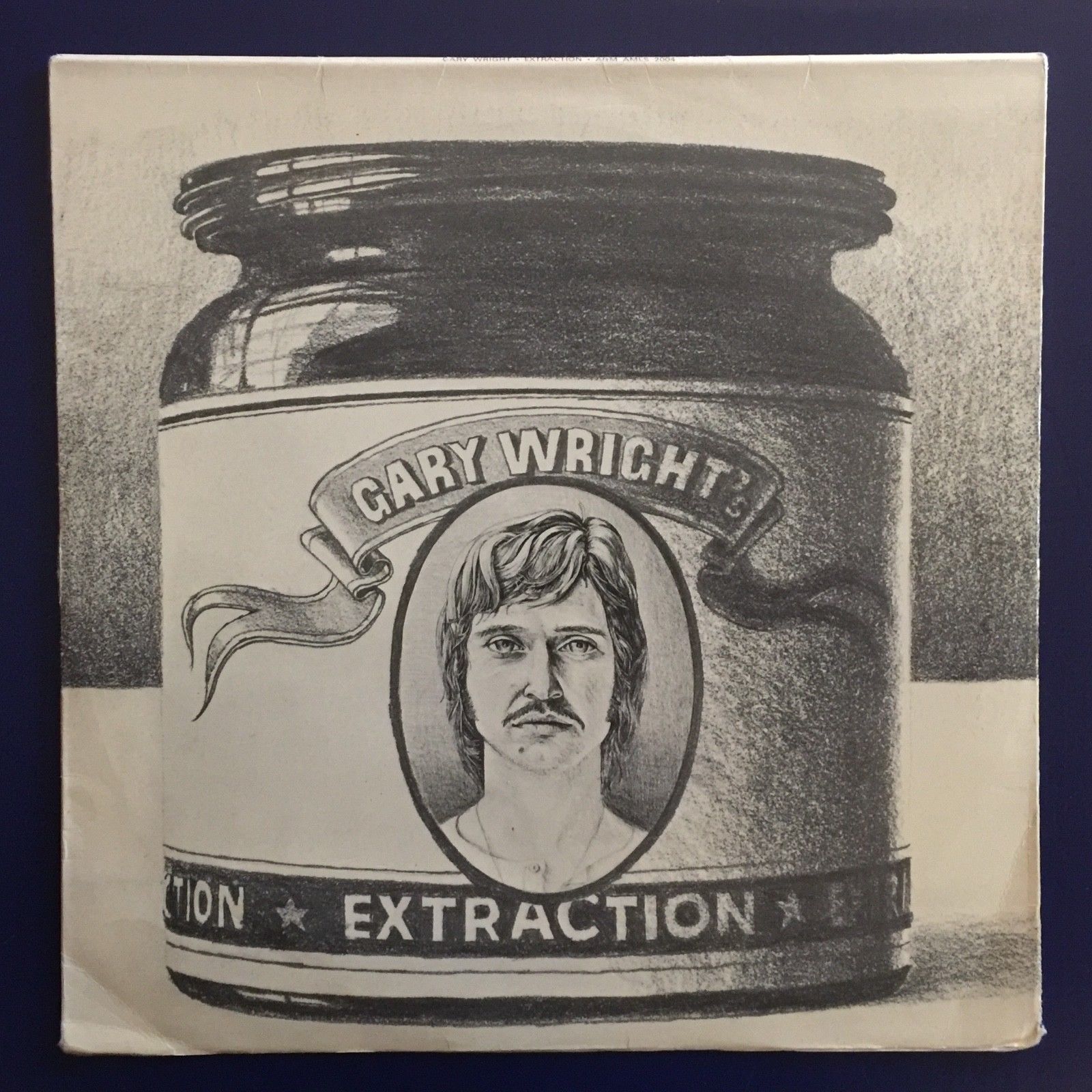
GARY WRIGHT 'EXTRACTIONS" 1971 A&M VINYL LP WITH EXTRAORDINARY SLEEVE
£
31
$
41


Favourite Auctions
To save auctions to your favourites, please login
If you don't have an account, please register
Description
More Images
Gary Wright ?– Gary Wright's Extraction
Label: A&M Records ?– AMLS 2004 Format: Vinyl, LP, Album, Poster SleeveCountry: UK Released: 1971 Genre: Rock Style: Classic Rock
Tracklist Hide Credits
A1 Got On The Right Road 3:10 A2 Get Hold Of Yourself 3:10 A3 Sing A Song 3:10 A4 We Try Hard 2:30 A5 I Know A Place 4:55 B1 The Wrong Time Written-By – Gary Wright, Hugh McCracken 3:19 B2 Over You Now 3:35 B3 Too Late To Cry 3:50 B4 I've Got A Story Written-By – Gary Wright, Hugh McCracken 5:25Companies, etc.
- Mastered At – Artisan Sound Recorders
- Printed By – MacNeill Press Ltd.
Credits
- Backing Vocals – Doris Troy, Madeline Bell, Nanette Newman
- Design [Artwork And Cover] – Klaus Voormann
- Engineer – Andrew Johns*
- Producer – Andrew Johns*
- Producer, Written-By – Gary Wright
Notes
6-panel foldout poster sleeveMade in England
Barcode and Other Identifiers
- Matrix / Runout (A Side Etched): AMLS 2004-A1 - I
- Matrix / Runout (B Side Etched): AMLS 2004-B1 A
- Other (Label A-Side): AMLS 2004-A
- Other (Label B-Side): AMLS 2004-B
Gary Malcolm Wright (born April 26, 1943) is an American singer, songwriter, musician and composer best known for his 1976 hit songs "Dream Weaver" and "Love Is Alive", and for his role in helping establish the synthesizer as a leading instrument in rock and pop music. Wright's breakthrough album, The Dream Weaver (1975), came after he had spent seven years in London as, alternately, a member of the British heavy rock band Spooky Tooth and a solo artist on A&M Records. While in England, he played keyboards on former Beatle George Harrison's All Things Must Pass triple album (1970), so beginning a friendship that inspired the Indian religious themes and spirituality inherent in Wright's subsequent songwriting. His work since the late 1980s has embraced world music and the new age genre, although none of his post-1976 releases has matched the popularity of The Dream Weaver.
A former child actor, Wright performed on Broadway in the hit musical Fanny before studying medicine and then psychology in New York and Berlin. After meeting Chris Blackwell of Island Records in Europe, Wright moved to London, where he helped establish Spooky Tooth as a popular live act. He also served as the band's principal songwriter on their recordings – among them, the well-regarded albums Spooky Two (1969) and You Broke My Heart So I Busted Your Jaw (1973). His solo album Footprint (1971), recorded with contributions from Harrison, coincided with the formation of Wright's short-lived band Wonderwheel, which included guitarist Mick Jones. Also during the early 1970s, Wright played on notable recordings by B.B. King, Jerry Lee Lewis, Ringo Starr, Harry Nilsson and Ronnie Spector, while his musical association with Harrison endured until shortly before the latter's death in 2001.
Wright turned to film soundtrack work in the early 1980s, which led to him re-recording his most popular song, "Dream Weaver", for the 1992 comedy Wayne's World. Following Spooky Tooth's reunion tour in 2004, Wright has performed live frequently, either as a member of Starr's All-Starr Band, with his own live band, or on subsequent Spooky Tooth reunions. Wright's most recent solo albums, including Waiting to Catch the Light (2008) and Connected (2010), have all been issued on his Larklio record label. In 2014, Penguin Random House published his autobiography, titled Dream Weaver: Music, Meditation, and My Friendship with George Harrison.
Early life[edit]
Gary Wright was born and raised in Cresskill, New Jersey.[1] A child actor, he made his TV debut at the age of seven, on the show Captain Video and His Video Rangers, filmed in New York.[2] Among other acting work, he appeared in TV and radio commercials, before being offered a part in the 1954 Broadway production of the musical Fanny.[2] Wright played the role of Cesario, the son of Fanny, who was played by future Brady Bunch matriarch Florence Henderson.[3] He spent two years with the production, during which he performed with Henderson on The Ed Sullivan Show.[4]
Having studied piano and organ,[2] Wright led various local rock bands while attending high school[1] at Tenafly, New Jersey.[5][6] In 1959, he made his first commercial recording, with Billy Markle at NBC Radio's New York studios.[7] Credited to "Gary & Billy", the single "Working After School" was released on 20th Century Fox Records in 1960.[7]
Seeing music as "too unstable" a career choice, as he later put it,[4] Wright studied to become a doctor at the College of William & Mary in Virginia and New York University before attending Downstate Medical College for a year,[6] all the while continuing to perform with local bands.[4][8] Having specialized in psychology in New York,[2] he then went to West Germany in 1966[9] to complete his studies at the Free University of Berlin.[1]
Career[edit]
1967–70: With Spooky Tooth[edit]
Wright has described his initial musical influences as "early R&B" – namely, Ray Charles, Aretha Franklin, James Brown and Bobby Bland – along with rock 'n' roll artists Elvis Presley and Jerry Lee Lewis, and the Beatles.[4] While in Europe in 1967, Wright abandoned his plans to become a doctor[4] and instead toured locally with a band he had formed, the New York Times.[1] When the latter supported the English group Traffic – at Oslo in Norway, according to Wright[8] – he met Island Records founder Chris Blackwell.[1] Wright recalls that he and Blackwell had a mutual friend in Jimmy Miller,[8] the New York-born producer of Island acts such as the Spencer Davis Group and Traffic.[10]
Blackwell invited Wright to London, where he joined English singer and pianist Mike Harrison and drummer Mike Kellie in their band Art (formerly the VIPs).[11] The group soon changed its name to Spooky Tooth,[1] with Wright as joint lead vocalist[8] and Hammond organ player.[12] While noting the band's lack of significant commercial success over its career, The New Rolling Stone Encyclopedia of Rock & Roll describes Spooky Tooth as "a bastion of Britain's hard-rock scene".[11]
Spooky Tooth's first album was It's All About, released on Island in June 1968.[2] Produced by Miller,[2] it contained the Wright-composed "Sunshine Help Me" and six songs he co-wrote with either Miller, Harrison or Luther Grosvenor,[13] the band's guitarist.[14] Spooky Two, often considered the band's best work, followed in March 1969, with Miller again producing.[15] Wright composed or co-composed seven of the album's eight songs, including "That Was Only Yesterday" and "Better By You, Better Than Me".[16] Spooky Two sold well in America but, like It's All About, it failed to place on the UK's top 40 albums chart.[17]
The third Spooky Tooth album was Ceremony, a Wright-instigated collaboration with French electronic music pioneer Pierre Henry,[14][18] released in December 1969.[11] Songwriting for all the tracks was credited to Henry and Wright,[19] after the latter had passed the band's recordings on to Henry for what The New Rolling Stone Encyclopedia terms "processed musique concrète overdubs".[20]
Although Wright had traditionally provided an experimental influence within Spooky Tooth,[14] he regretted the change of musical direction, saying in a 1973 interview: "We should have really taken off after Spooky Two but we got into the absurd situation of letting Pierre Henry make the Ceremony album. Then he took it back to France and remixed it."[17] With bass player Greg Ridley having already left the band in 1969 to join Humble Pie,[21] Wright departed in January 1970 to pursue a solo career.[17]
1970–72: Solo career on A&M Records, Wonderwheel, and London session work[edit]
Extraction[edit]After signing with A&M Records, Wright recorded Extraction (1970) in London[22] with musicians including Kellie, guitarist Hugh McCracken, bassist Klaus Voormann and drummer Alan White.[23] Wright co-produced the album with Andy Johns,[23] who had been the recording engineer on Spooky Two[24] and Ceremony.[19] The album included "Get on the Right Road", which was issued as a single, and "The Wrong Time",[25] co-written by Wright and McCracken.[26]
George Harrison's All Things Must Pass[edit]Through Voormann,[27] Wright was invited to play piano on former Beatle George Harrison's 1970 triple album All Things Must Pass.[3][28] Among what author Nicholas Schaffner later described as "a rock orchestra of almost symphonic proportions, whose credits read like a Who's Who of the music scene",[29]Wright was one of the album's principal keyboard players, together with former Delaney & Bonnie organist Bobby Whitlock.[30] During the sessions, Wright and Harrison established a long-lasting friendship,[1][31] based on music and their shared interest in Indian religion.[3][32] In a 2009 interview with vintagerock.com, Wright described Harrison as "my spiritual mentor";[8] author Robert Rodriguez writes of Wright's "unique" place among musicians with whom Harrison collaborated at this time, in that Wright was neither an established star nor a friend from the years before Harrison achieved fame as a Beatle, and nor was he a "studio pro".[33]
Wright played on all of Harrison's subsequent solo albums during the 1970s,[34][35] as well as on other releases that the ex-Beatle produced for Apple Records.[36] These included two hit singles by Harrison's former bandmate Ringo Starr over 1971–72, "It Don't Come Easy" and "Back Off Boogaloo", and a 1971 comeback single by ex-Ronette Ronnie Spector, "Try Some, Buy Some".[37][nb 1]
Footprint[edit]To promote Extraction, Wright formed the band Wonderwheel in April 1971,[38] with a lineup comprising guitarist Jerry Donahue – soon replaced by Mick Jones – Archie Legget (bass) and Bryson Graham (drums).[39][40] Donahue was among the many musicians on Wright's second album, Footprint (1971),[41]along with George Harrison and All Things Must Pass contributors such as Voormann, White, Jim Gordon, Bobby Keys and John Barham.[22][42] Produced by Wright, the album included "Stand for Our Rights", a call for social unity, partly inspired by the Vietnam War,[43] "Two Faced Man" and "Love to Survive".[44] In November 1971, Wright and Wonderwheel performed "Two Faced Man" on The Dick Cavett Show in New York, with Harrison accompanying on slide guitar.[45][nb 2] Wright has expressed gratitude for Harrison's support during this stage of his career, citing the ex-Beatle's uncredited production on Footprint[47] and his arranging the Dick Cavett Show appearance.[8] Despite this exposure,[45] like Extraction, the album failed to chart.[22][48]
Among other recordings over this period, Wright played piano on Harry Nilsson's 1972 hit "Without You"[33] and accompanied B.B. King, Starr, Gordon, Voormann and others on B.B. King in London (1971),[49] which included Wright's composition "Wet Hayshark".[50] He later participated in London sessions by Jerry Lee Lewis,[34] issued as the double album The Session (1973).[51] Wright also produced an eponymous album by folk rock band Howl the Good,[52] released on the Rare Earth label.[53]
Ring of Changes[edit]In 1972, Wright moved to Devon with Wonderwheel to work on songs for a new album, titled Ring of Changes. With Tom Duffey having replaced Leggett on bass, the band recorded the songs at Olympic and Apple studios in London.[54] After issuing "I Know" as an advance single,[55] A&M chose to cancel the album.[56][nb 3] Wright also wrote the soundtrack for a film by former Olympic skier Willy Bogner, Benjamin (1972),[57] from which the German label Ariola Records released "Goodbye Sunday" as a single that year.[58] The full soundtrack album, recorded with Jones, Leggett and Graham,[59] was issued by Ariola in 1974.[60]
In September 1972, Wright decided to disband Wonderwheel and re-form Spooky Tooth.[61] Shortly before doing so, he participated in sessions for Harrison's Living in the Material World (1973),[62] an album that Wright describes as "a beautiful masterpiece" and his favorite Harrison album.[63] Talking to Chris Salewicz of Let It Rock in early 1973, Wright explained his decision to abandon his solo career: "I think my main talent is getting the music together and arranging it. I'm not a showman and so I couldn't be a Cat Stevens out front with just backing musicians, which I was expected to be with Wonderwheel."[17]In his autobiography, however, Wright says that it was his disappointment at A&M's rejection of Ring of Changes that led him to contact Blackwell about re-forming Spooky Tooth.[56]
1972–74: Re-forms Spooky Tooth[edit]
The only members from the original lineup, Wright and Mike Harrison relaunched Spooky Tooth with Jones and Graham from Wonderwheel, and Chris Stewart,[11][14] formerly the bassist with English singer Terry Reid.[17] Salewicz visited the band while they were recording at Island's Notting Hill studio and remarked of Wright's role in the group, "it is clear who is the leader of this brand of Spooky Tooth, and, I suspect, of the original, too"; Salewicz described Wright as "urbane, loquacious with the remnants of a New Jersey accent, and a touch of Dudley Moore about the face".[17]
On their new album, You Broke My Heart So I Busted Your Jaw (1973),[11] Wright composed six of the eight tracks, including "Cotton Growing Man", "Wildfire" and "Self Seeking Man", and co-wrote the remaining two.[64] With the group's standing having been elevated since 1970 – a situation that music journalist Steven Rosen likened at the time to the Yardbirds, the Move and other 1960s bands after their break-up[61] – Spooky Tooth toured extensively to promote the album.[38] Rolling Stone reviewer Jon Tiven praised Wright's songwriting on You Broke My Heart, adding: "there is tremendous consistency to these originals ... and 'Wildfire' is ample proof that Gary could have written for the Temptations if he really wanted to."[65]
[We] could have definitely been like one of those bands, like Jethro Tull and all those people who were our contemporaries. I think [Spooky Tooth] didn't have the steady momentum and upward drive. It stopped and started, broke up and then went back and broke up. It never really got enough behind it to really catapult it to success.[8] – Wright in 2009, reflecting on Spooky Tooth's lack of a commercial breakthroughThe band released a follow-up, Witness, in November 1973,[38] by which point Graham had departed, with Mike Kellie returning on drums.[61] By February 1974, Stewart and Harrison had also left.[38] In January that year, Wright accompanied George Harrison to India,[66] where they journeyed to Varanasi (Benares), the Hindu spiritual capital of India, and home to Harrison's friend Ravi Shankar.[67] The visit would influence the spiritual quality of Wright's lyrics when he returned to his solo career.[1]
In England, he and Harrison worked together on The Place I Love (1974),[68] the debut album by English duo Splinter.[69][70] In addition to playing keyboards, Wright served as what author Simon Leng terms "a sounding board and musical amanuensis" on the project,[71] which was the first album released on Harrison's Dark Horse record label.[72] Wright regrouped with Spooky Tooth for a final album, The Mirror (1974), with Mike Patto as their new vocalist.[73] Following further personnel changes, The Mirror was issued by Goodear Records in the UK in October 1974, a month after Wright had disbanded the group.[38]
1975–81: Solo career on Warner Bros. Records[edit]
The Dream Weaver[edit]After Spooky Tooth's break-up, Wright returned to New Jersey and began compiling songs for his third solo album.[74] Under the guidance of new manager Dee Anthony, he chose to sign with Warner Bros. Records, mainly because the company had no keyboard virtuosos among its other acts.[74] Wright says that it was while routining his songs with all his stage equipment set up – Hammond organ, Hohner Clavinet, Fender Rhodes electric piano, Minimoog and ARP String Ensemble – together with a drum machine, that he decided to record the album "all on keyboards", without guitars.[8] He acknowledges that artists such as Stevie Wonder had similarly released keyboard-dominated music, but "[Wonder] used brass and he used other things as well".[6] On Wright's debut album for Warner Bros., The Dream Weaver (1975),[2] he, David Foster and Bobby Lyle played a variety of keyboard instruments, supported only by drummers Jim Keltner and Andy Newmark,[75] apart from a guitar part on the track "Power of Love".[76] Jason Ankeny of AllMusic describes The Dream Weaver as "one of the first [rock albums] created solely via synthesizer technology".[1]
I mean ... I'm an overnight success in ten years, right? I've been through periods of self-doubt, wondering whether or not I wanted to stay an artist ... but I guess, like in all things, it's timing. The right timing, the right songs and strong management at last.[74] – Wright commenting in 1976 on the unexpected success of The Dream WeaverThe album was issued in July 1975 and enjoyed minimal success in America until the release of its second single, "Dream Weaver", in November.[74] The song, which Wright had written on acoustic guitar[74] after his visit to India with Harrison,[77] went on to peak at number 2 on the Billboard Hot 100[78] and number 1 on the Cash Box singles chart.[79] Wright's biggest hit, "Dream Weaver" sold over 1 million copies in the US and was awarded a gold disc by the RIAA in March 1976.[79] The album climbed to number 7 on the Billboard 200[80] and was certified platinum.[2] "Love Is Alive", originally the album's lead single,[74] then hit number 2 on the Hot 100, and "Made to Love You" climbed to number 79.[78] Although this commercial success was not repeated in the UK, The Dream Weaver was a big seller in West Germany,[74] where, Wright says, Spooky Tooth had been "the number one band" during 1969.[8]
Following the album's release, Wright toured extensively with a band comprising three keyboard players and a drummer.[74] His elder sister Lorna, also a professional singer, joined the tour band as his backing vocalist.[81] Subsidized by synthesizer manufacturers Moog and Oberheim,[6] Wright became one of the first musicians to perform with a portable keyboard, in the style of Edgar Winter.[74] Shawn Perry of vintagerock.com credits Wright with being "as responsible for the emergence of the synthesizer as a mainstream instrument as Keith Emerson and ... Rick Wakeman",[8] while Robert Rodriguez describes Wright as a pioneer in both "the integration of synthesizers into analog recordings" and the use of the keyboard–guitar hybrid known as the keytar.[33]
Among his live performances in 1976, Wright shared the bill with Yes and Peter Frampton at the US Bicentennial concert held at JFK Stadium, Philadelphia, playing to a crowd estimated at 120,000.[82] Wright then supported Frampton on a European tour, by which time a fourth keyboard player had been added to the band.[83] Amid this success, A&M issued That Was Only Yesterday (1976)[11] – a compilation containing tracks from Wright's albums for the label and selections by Spooky Tooth[84] – which charted at number 172 in America.[80]
price rating
![Hurry Up We'Re Dreaming [VINYL]](https://www.popsike.net/php/thumbnail.php?url=https://www.popsike.pics/pix/20200711/224076077617.jpg)
![TRON: Legacy Daft Punk [2 LP]](https://www.popsike.net/php/thumbnail.php?url=https://www.popsike.pics/pix/20180220/282854915590.jpg)
![Skinhead Luv-a [VINYL]](https://www.popsike.net/php/thumbnail.php?url=https://www.popsike.pics/pix/20171106/332439800529.jpg)
![Kim Wilde - Clear With Black Splatter Vinyl Edition [VINYL]](https://www.popsike.net/php/thumbnail.php?url=https://www.popsike.pics/pix/20220905/403868949870.jpg)