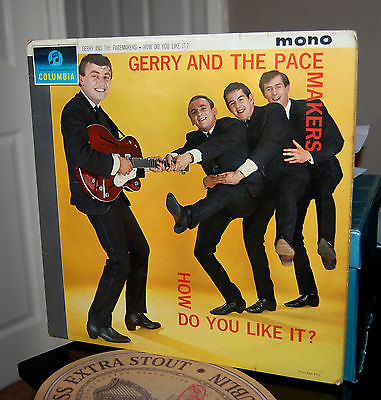
GERRY & THE PACEMAKERS. "HOW DO YOU LIKE IT ?" COLUMBIA UK 1963 LP. ORIG MONO.
£
20
$
26


Favourite Auctions
To save auctions to your favourites, please login
If you don't have an account, please register
Description
More Images
Gerry And The Pacemakers* ?– How Do You Like It?
Label: Columbia ?– 33SX 1546 Format: Vinyl, LP, Album, MonoCountry: UK Released: 1963 Genre: Rock, Pop Style: Beat, Rock & Roll, Pop Rock
TracklistHide Credits
A1 A Shot Of Rhythm And Blues Written-By – Thompson* A2 Jambalaya Written-By – Williams* A3 Where Have You Been? Written-By – Gunter* A4 Here's Hoping Written-By – Stephens*, Reid* A5 Pretend Written-By – Parman*, Lavere*, Douglas* A6 Maybellene Written-By – Freed*, Berry*, Fratt* A7 You'll Never Walk Alone Written-By – Rodgers-Hammerstein II* B1 The Wrong Yo Yo Arranged By – Marsden*Written-By – Trad.* B2 You're The Reason Written-By – Edwards*, Henley*, Imes*, Fell* B3 Chills Written-By – Goffin*, Keller* B4 You Can't Fool Me Written-By – Murray* B5 Don't You Ever Written-By – Marsden* B6 Summertime Written-By – Gershwin* B7 Slow Down Written-By – Williams*Companies etc
- Printed By – Garrod & Lofthouse
Credits
- Bass – Les Chadwick
- Drums, Vocals – Freddy Marsden*
- Liner Notes – Tony Barrow
- Photography By – Edgar Brind
- Piano – Les Maguire*
- Producer – George Martin, Ron Richards
- Vocals – Gerry Marsden
Notes
1st pressing on Black / Blue Columbia labelReleased in a front laminated 3-flipback cover printed by Garrod & Lofthouse Ltd.
Review by Bruce Eder [-]
Gerry & the Pacemakers' debut album, produced by George Martin and Ron Richards, is representative of the mainstream Liverpool sound beyond the Beatles, circa 1963. Gerry & the Pacemakers based their music around American R&B ballads, coupled with a delight in straight-ahead rock & roll and country music with a beat, in a manner similar to the Beatles. Gerry Marsden was a fairly powerful singer and a more natural (but not necessarily better) rock & roll guitarist than George Harrison, as revealed by his crunchy playing on numbers like "A Shot of Rhythm and Blues," "Jambalaya," and "The Wrong Yo-Yo," and his lively solo on "Maybelline" -- the problem was that neither he nor the rest of the band could match the Beatles for style. Drummer Freddie Marsden, despite much quicker hands, wasn't nearly as distinctive as Ringo Starr, and Les Chadwick's bass work was weighty, but not a third as interesting as Paul McCartney's, and Gerry's singing never came close to Paul's. When you add in the fact that their in-house songwriting was almost non-existent here, and their backing harmony vocals were a shadow of what the Beatles could produce, the result is a more limited quantity; How Do You Like It isn't as good an album as Please Please Me or With the Beatles, but it also reveals a band that was already 85-percent as interesting and complex as it was ever going to be. On the other hand, the group does rock out, which is all they really ever set out to do, and on those terms they're pretty engaging -- their covers of Hank Williams' "Jambalaya," Larry Williams' "Slow Down" and the Piano Red/Carl Perkins number "The Wrong Yo-Yo" are more than a little diverting, good examples of the classic, thumping Liverpool sound. Their version of the Arthur Alexander number "Where Have You Been" is moving and passionate, if not as well sung as the Searchers' rendition. And as the T.A.M.I. Show revealed, Chuck Berry didn't mind jamming with Marsden on "Maybellene." The 1997 EMI 100th Anniversary edition, remastered in 20-bit digital sound, is close and loud, and features both the stereo and mono versions of the album -- the mono version is punchier and more enveloping, but the stereo has its virtues, separating the voices and instruments binaurally, as was the custom in those days, which allows the listener to pick them apart, if anyone wants to analyze Gerry's guitar, Marsden's drumming, or Les Maguire's piano playing that closely; it's a reminder of what EMI is not permitting us to do with the Beatles' first two albums and early singles.
Strictly Graded - RECORD COLLECTOR Grading System.
Grading System: In order to assist everyone who buys and sells rare discs, Record Collector magazine has originated a set of standards for the condition of second-hand records, I have added a (+) or (-) to my gradings where applicable.
MINT: The record itself is in brand new condition with no surface marks or deterioration in sound quality. The cover and any extra items such as the lyric sheet, booklet or poster are in perfect condition. Records advertised as Sealed or Unplayed should be Mint.
EXCELLENT: The record shows some signs of having been played, but there is very little lessening in sound quality. The cover and packaging might have slight wear and/or creasing.
VERY GOOD: The record has obviously been played many times, but displays no major deterioration in sound quality, despite noticeable surface marks and the occasional light scratch. Normal wear and tear on the cover or extra items, without any major defects, is acceptable.
GOOD: The record has been played so much that the sound quality has noticeably deteriorated, perhaps with some distortion and mild scratches. The cover and contents suffer from folding, scuffing of edges, spine splits, discoloration, etc.
FAIR: The record is still just playable but has not been cared for properly and displays considerable surface noise; it may even jump.
The cover and contents will be torn, stained and/or defaced.
POOR: The record will not play properly due to scratches, bad surface noise, etc. The cover and contents will be badly damaged or partly missing.
BAD: The record is unplayable or might even be broken, and is only of use as a collection-filler.
POSTAGE DISCOUNTS FOR MULTIPLE PURCHASES.REQUEST INVOICE PRIOR TO PAYMENT SO YOU BENEFIT.
price rating


