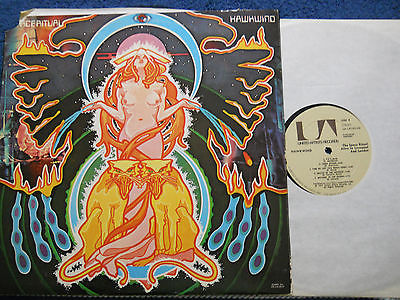
*HAWKWIND - Space Ritual double LP from 1973, double gatefold cover NEAR MINT
$
25


Favourite Auctions
To save auctions to your favourites, please login
If you don't have an account, please register
Description
PLEASE TAKE A LOOK AT MY OTHER eBAY AUCTIONS - ALWAYS EXPECT THE UNEXPECTED
PLEASE CHECK OUT MY OTHER NEWLY LISTED RARE & OBSCURE LP's
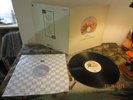
HAWKWIND - "The Space Ritual Alive at Liverpool and London" in stereo on United Artists LA-120-H2.
RECORD GRADE: Near Mint
COVER GRADE: Near Mint Minus, top left cut corner, no wear to speak of; actually this is a "double-double" gatefold because left to right it's a tri-fold cover and also opens top to bottom
ABOUT THE ALBUM:
Review by Wilson Neate [-] (from the All Music Guide Website)
Recorded live in December 1972 and released the following year, Space Ritual is an excellent document of Hawkwind's classic lineup, underscoring the group's status as space rock pioneers. As the quintessential "people's band," Hawkwind carried '60s countercultural idealism into the '70s, gigging constantly, playing wherever there was an audience, and even playing for free on five consecutive days outside the 1970 Isle of Wight Festival. The band's multimedia performances were the perfect accompaniment for exploring inner space and imagining outer space. While not concerned with rock's material trappings, Hawkwind were, ironically, among the hardest-working groups in Britain, averaging one show every three days during the year preceding these recordings. Given all that practice, it's not surprising that the performances collected here are incredibly tight (although, reportedly, a couple of tracks were edited). Incorporating most of Doremi Fasol Latido, the show for the Space Ritual tour was conceived as a space rock opera, its blend of sci-fi electronics, mesmerizing psy-fi grooves, and heavy, earthbound jamming punctuated with spoken word interludes from astral poet Bob Calvert. Although his intergalactic musings date the album, coming across now as camp futurism, they still provide fitting atmospheric preambles to Hawkwind's astounding, mind-warping sounds. Calvert's manic recital of Michael Moorcock's "Sonic Attack," for instance, is an exercise in tension that subsequently explodes on the stomping "Time We Left This World Today"; with Nik Turner's otherworldly sax, Dave Brock's guitar distortion, and the earth-moving rhythm section of Simon King and Lemmy, this track offers a blueprint for the album's most potent material. Another standout is "Orgone Accumulator," ten minutes of hypnotic (Wilhelm) Reich & roll that could be the missing link between Booker T. and Stereolab. A 1973 advertisement described Space Ritual as "88 minutes of brain damage"; that characterization still holds true.
ABOUT THE ARTIST:
Artist Biography by Bruce Eder (from the All Music Guide Website)
Any sci-fi fan with long memories probably remembers those 1970s' DAW paperback editions of Michael Moorcock's sword-and-sorcery novels, with their images of heavily armored, very muscular warriors, carrying large swords and standing against eerie land- and starscapes. Take that imagery, throw in some terminology and names seemingly lifted from the Marvel Comics of the era (The Watcher, etc.) and particle physics articles of the period, translate it into loud but articulate hard rock music, and that's more or less what Hawkwind is about. One of England's longest-enduring heavy metal bands, Hawkwind was formed during the late '60s, just as art-rock was coming into its own. They combined bold guitar, synthesizer, and Mellotron sounds, creating heavy metal music that seemed to cross paths with Chuck Berry and the Moody Blues without sounding like either of them. At their best, their early records sounded like the Beatles of "Yer Blues" combined with the Cream of "I Feel Free." The introduction of lyrics steeped in science fiction and drug effects on their second album helped define the group and separate them from the competition -- in some ways they were like Pink Floyd with more of a rock & roll beat and a vengeance. They've never charted a record anywhere near the same heights, but it's a sign of the dedication of the fans they do have that the group has dozens of albums available, including archival releases of decades-old live shows and multiple compilations.
Hawkwind's history has been marked by a series of confusing lineup changes, as members began an almost revolving-door relationship with the band virtually from the outset. The seeds of the group were planted when guitarist/singer Dave Brock and guitarist Mick Slattery of the group Famous Cure, which was playing a gig in Holland in 1969, met saxman/flautist/singer Nik Turner, a member of Mobile Freakout, on the same tour. Once back in England, Brock, Slattery, and Turner hooked up again and, adding John Harrison on bass, Terry Ollis on drums, and DikMik Davies on electronic keyboards, called themselves Group X, later changed to Hawkwind Zoo, and finally to Hawkwind. They secured a contract with United Artists/Liberty Records in England. Before the group recorded, however, Huw Lloyd Langton replaced Mick Slattery on guitar.
The fledgling band hooked up with two Pretty Things alumni -- drummer Viv Prince, who occasionally joined them on stage, and bassist (and onetime Rolling Stones member) Dick Taylor, who was recruited as a producer but played on their early records. Their first single, "Hurry on Sundown" (aka "Hurry on a Sundown") b/w "Mirror of Illusion," was released in July of 1970, just in time for Harrison to exit the lineup, to be replaced by bassist Thomas Crimble. Their first album, Hawkwind, was released to little public notice in August, but that same month the group made a modest splash by playing outside the fences of the Isle of Wight Festival.The following month, Huw Lloyd Langton quit the band along with Thomas Crimble -- the replacement bassist, ex-Amon Duul member Dave Anderson, joined in May of 1971, the same month that DikMik Davies quit, to be replaced on keyboards by Del Dettmar. In June of that year, two more new members came aboard -- poet Robert Calvert, who became lead vocalist, and a dancer named Stacia, who began appearing with the group on stage. Meanwhile, the band also hooked up with artist Barney Bubbles, who gave the group a new image, redesigning their stage decor and equipment decoration, and also devising distinctive new album graphics.
Ex-bassist Crimble helped arrange for the group's performance at the Glastonbury Fayre in Somerset in June of 1971, which gave Hawkwind fresh exposure, and brought them to the attention of writer Michael Moorcock, who was entering a vastly popular phase in his career as the author of many science fiction and fantasy novels. Moorcock helped organize some of their performances, as well as occasionally serving as a substitute for Calvert.
Equally important, in August of 1971, Dave Anderson departed the group, while DikMik Davies returned to the lineup to join Dettmar on keyboards and brought as Anderson's replacement -- his friend Lemmy (born Ian Kilmister), an ex-roadie for Jimi Hendrix and a member of the rowdy mid-'60s Blackpool rock & roll band the Rocking Vicars. Lemmy had joined the group just in time to participate on the recording of the band's second album, In Search of Space.Released in October of 1971, it proved a defining work, carving out new frontiers of metal, drug, and science-fiction-laced music, including one major classic song, "Masters of the Universe," which became one of the group's most popular concert numbers and turned up on numerous studio and live compilations. More lineup changes followed, as Simon King succeeded Terry Ollis on the drums in January of 1972. The group played the Greasy Truckers Party -- a showcase of underground and alternative music and politics -- at the Roundhouse in London the next month, parts of which later surfaced on a pair of subsequent albums. All of these lineup changes and career steps had been compromised by a string of annoying bad luck and thefts of equipment, which were serious enough to threaten their solvency. Coupled with Bob Calvert's shaky health, the result of a nervous breakdown, Hawkwind went into 1972 on a very uncertain footing.
The group's early sound, characterized by their singles up through this point, was essentially hard rock with progressive trappings. They slotted in perfectly with the collegiate and drug audiences, putting on the kind of show that acts like King Crimson and ELP were known for, but with more of a pure rock & roll base (not surprising, considering Lemmy's background). Their commercial breakthrough took place when a version of the driving hard rocker "Silver Machine," sung by Lemmy, got to number three on the British charts in August of 1972. They were unable to follow up on this unexpected flash of mass success, particularly when their follow-up single, "Urban Guerrilla," a surprisingly melodic rocker with lots of crunchy guitar at the core of multiple layers of metallic sound, was withdrawn amid a series of terrorist attacks in London, even though it had reached the British Top 40 and seemed poised to mimic "Silver Machine"'s success.
The British tour that followed "Silver Machine," their first major circuit of the country, gave them more concert exposure, and their third album, Doremi Fasol Latido, released in November of 1972, which got to the number 14 spot on the British charts. This album codified the group's science-fiction orientation, presenting an elaborate mythology about the history of the universe (or some universe) into which the group and their music was woven. By this time, they had a major reputation as a live act, and rose to the occasion with an elaborate concert show called the Space Ritual. Their fourth album, a double-disc set recorded in concert called Space Ritual, issued in June of 1973, got to number nine. By the time of their next album, In the Hall of the Mountain Grill in 1974, Bob Calvert had departed to work on a planned solo project (Captain Lockheed and the Starfighters), and violinist and keyboard player Simon House had joined the group. This was the heyday of progressive bands such as Yes, ELP, and Genesis, and Hawkwind's mix of dense keyboard textures and heavy metal guitar and bass, coupling classical bombast and hard rock playing, became the sudden recipient of massive international press coverage -- though they'd never charted a record in the United States, they became well known to readers in the rock press, and their records were available as imports. The group toured the United States twice during this era, once in late 1973 and again in the spring of the next year. These tours had their usual share of problems -- the band and its entire entourage were arrested in Indiana for non-payment of taxes -- but it was after the release of their 1975 album, Warrior on the Edge of Time, that a major membership change ensued. They were touring the United States behind the release of the album when Lemmy was arrested on drug charges. He was fired from the band and went on to form Motörhead, a successful and influential metal band. His exit also took away a lot of the energy and focus driving Hawkwind's sound. There was talk about the band calling it quits, but they carried on with Lemmy's replacement, Paul Rudolph, and with Bob Calvert back in the lineup. By this time, their chances for a breakthrough in America had been reduced considerably by the chart success of such groups as Kansas and Blue Oyster Cult, both of which melded proletariat rock with progressive sensibilities in just the right portions to appeal to kids on this side of the Atlantic. Hawkwind's revamped lineup did release a new album, Astounding Sounds, which performed moderately well, and followed it a year later with Quark Strangeness and Charm (1977), which had a good title song, among other virtues. Hawkwind was still working as a quintet, but by this time their chronic instability was about to reach critical levels -- at the end of their 1978 American tour, Calvert quit the band again, and then the entire group virtually disbanded. When the smoke cleared, Calvert had put together a direct offshoot group, the Hawklords, and abandoned an entire finished album to record 25 Years On with a lineup that included Brock, Martin Griffiths on drums, Steve Swindell on keyboards, and Harvey Bainbridge on drums. That record made a respectable showing at number 48 on the British charts with a supporting tour, but the new group wasn't much more stable than the old one, with drummer Griffiths gone by December of 1978. Then Calvert quit (again), while Simon King, who had been a Hawkwind member a couple of years back, rejoined on drums, replacing Griffiths. The group was left as a four-piece and resumed the use of the name Hawkwind in January of 1979. Huw Lloyd Langton was back in the lineup by May of 1979, while Tim Blake replaced a departing Swindell. This lineup proved relatively stable and recorded a very successful live album (number 15 in the U.K.), released as part of a new contract with Bronze Records. The one big change took place in September of 1980 when Ginger Baker replaced Simon King, although Baker himself only lasted until March of 1981, when he was let go from the band and replaced by "Hawklords" drummer Martin Griffiths. This core lineup cut a string of good-selling albums through 1984, which were embraced by the heavy metal community and initially propelled into the Top 30 and Top 20 in England, culminating with another live album. By their 1984 album This Is Hawkwind, Do Not Panic, released under a new contract with Flickknife Records, Turner, Brock, and Langton were back together again. By this time, the band's 1970s recordings were starting to show up in profusion, in competition with their current work. Ironically, it was in 1985, just as the current group was starting to compete with their own early history, that they released their most ambitious record of all, Chronicle of the Black Sword. An adaptation of Michael Moorcock's sci-fi novels, the album was a return to their old style as well. It was in this same period that Brock, Turner, Langton, Anderson, Crimble, Bainbridge, and Slattery attended the first Hawkwind Convention, held in Manchester -- Turner left soon after, but the remaining members held together for three years, a record for the band. Bob Calvert, who had quit the band twice at the end of the '70s, died of a heart attack in 1988. Hawkwind was still together, however, and the following year even managed its first American tour since Calvert's first exit from the band. By 1990, their fortunes were on the upswing again, when their sudden embrace of the rave culture on a new album, Space Bandits, gave them a new chart entry and a distinctly younger listenership. Their commercial revival was short-lived, however, and by 1991, they were busying themselves re-recording their classic material. They toured America again in 1992.They were left as a trio after a falling out among the members at the end of that tour, and in recent years, apart from periodic reissues of their classic material, the surviving group has achieved a serious following on the underground, drug-driven dance/rave scene in England, ironically returning to a modern version of their roots. They've played various major showcases (including the 12 Hour Technicolor Dream All Nighter at Brixton Academy), as well as benefit performances. Their entire catalog has been reissued on CD by several different labels (Griffin, Cleopatra, One Way, Magnum, etc.), in some cases recompiled and retitled (especially the live recordings), including numerous compilations and archival explorations, all very confusing and numbering in the dozens.
All records are carefully graded. In an attempt to give customers an accurate impression of condition rather than adhere to somewhat arbitrary criteria, I give an "overall presentation" grade, supplemented when necessary with additional remarks. Please refer to my grading system below for a more detailed explanation.
MY GRADING SYSTEMS: I’ve been told that I grade conservatively. My NM (near mint) is my highest grade for opened records (which would also include unplayed records). It’s a 9 or 10 on a 1-10 scale. M- would be equivalent to an 8; VG++ to a 7; VG+ to a 6; VG to a 5; VG- to a 4; G to a 3; F to a 2 and P to a 1. The same scale applies when I grade covers (jackets). Significant defects are specifically noted and taken into consideration in the grade.
GRADING DESCRIPTIONS
RECORDS:
- GRADING is based on the following criteria
- Sealed = store stock new
- Near Mint = like new or near new with only one or two small insignificant defects, a 9 or better on a 1-10 scale
- Near Mint Minus (or NM-) = very nice. Would be Near Mint, except for a couple of light hairlines or scuffs, which do not affect play
- VG++ = still a very nice record with all or nearly all of its original gloss but may have a few more light, surface marks, hairlines, needle tracks or the like which should not materially effect play
- VG+ = a nice, but used record that may have a series of light scuffs or scratches. It probably plays with a few pops, but has no serious problems.
- VG = a well-used record that still should sound OK when played, but may have moderate surface noise, pops, etc.
- VG- = a well-worn record that plays through without skipping, but will do until a better copy comes along.
- Good = not actually good at all but probably will play through but with much in the way of surface noise, pops, crackles, etc. Still, will have no cracks, chips or the like
- Fair = you’re getting this record just to own but not to play
- Poor = the sky’s the limit, generally I will discard a record this bad (and sell the cover, jacket or sleeve alone) unless the label holds some particular interest
VISUAL GRADING: All records are visually graded only unless I state that they are play-graded. Some major labels were pressed on better quality vinyl and will sound better than a record which visually appears the same on "budget" labels which were pressed on lower quality vinyl. Recording techniques also varied. The sound on live albums may be far inferior to studio recordings. There may also be defects in the pressing which are invisible. The point is that an album on a high quality label that was visually graded VG+ may sound better than an album on a budget label that was visually graded Mint- or even Near Mint. Please refer to my return policy, below. But please don’t be shocked if a record visually graded Near Mint doesn’t sound state of the art. If I base my grade on a PLAY GRADE, I will state this specifically in my grading section.
COVERS: There are really too many possible defects regarding covers to be as specific in my definitions as I had been with my record grades. But please keep in mind these general grading guidelines:
- I will give greater weight to the condition of the front cover than back cover when assigning an overall grade
- No cover with a cut out hole or saw mark will be graded Near Mint even if it is still in factory shrink and there is no other wear
- I will not reduce the grade of a cover for stickers which are glued to the jacket by the record company (eg. Contains the hit song Expressway to Your Heart); but will reduce the grade for stickers glued on the cover by stores, previous owners, etc.
- If I write that a cover has a bb hole, I’m talking about a small cut out hole
- A saw mark is a narrow cut in the perimeter of the cover, could be anywhere and vary in length from 1/2” to 2” at the most.
- The overall grade takes into consideration any stated defects. For example, if I grade a cover VG+ and then state it has 6” top and bottom seam splits - I’ve already reduced the grade because of the seam splits. If the seams weren’t split, the cover would be graded higher such as VG++ or Mint-.
Shipping Costs: CURRENT SHIPPING RATES AND POLICIES.
The winning bidder pays for shipping.
DOMESTIC SHIPPING WITHIN THE UNITED STATES: Due to increase in postage rates, I have sometimes been losing money on shipping as I send all records in sturdy professional Bags Unlimited mailers with one or more fillers. Therefore, I am now using the eBay postage calculator to determine postage. This will also result in a more equitable charge for priority mail shipments. Instead of a flat fee, those who live in the southeast and mid-east will reap the benefit of reduced priority mail rates.
DOMESTIC AND INTERNATIONAL SHIPMENTS: COMBINED SHIPPING - Save money when I mail 2 or more records in the same package. Please wait until I send you an invoice or request an invoice when combining two or more records or cd's in one shipment -prior to making payment.
INTERNATIONAL SHIPMENTS: Overseas customers are invited to bid. As with U.S. shipments, I will use eBay's postage calculator for all overseas shipments. Postage to Canada is substantially less than to other countries - if you live in Canada and don't see a separate rate for Canada , please e-mail me and I'll modify the invoice to reflect the lower shipping charges. Surface mail is no longer available for overseas. Express Mail International and Priority Mail International are available - rates are substantially higher than first class international and will be quoted for each purchase if buyer requests this service. First class priority express or registered mail is now required for purchases over $100. Generally, Express International costs $60 for 1 album and additional albums are about $5-6 more. Registered costs about $35 for 1 album, about $3 more for each additional album. Registered mail may not be available to certain countries. I am sorry but the increased risks and costs must be passed on to the international buyer. On the bright side of things, Express Mail International will get you the package faster and it is safer. Registered mail is the safest form of shipment (but not as fast as express mail international). So there are benefits to the buyer as well as the seller. Please wait until I send you an invoice or request an invoice when combining two or more records or cd's in one shipment -prior to making payment.
Please check out my other eBay auctions and stores listings.
I’ve been listing all types of records - mostly LP’s - including 50’s and 60’s rock ‘n’ roll, country, folk jazz, blues, personalities, new wave and punk, surf, psych, spoken word, comedy, etc., etc....... I try to list unusual, unique or obscure records, not the ones that you see all the time. While a majority of my listings are albums, you’ll often find a nice selection of 45’s, EP’s or picture sleeves...and an occasional 78 or two.
My return policy: . You may return an item if it's not in the condition described. You may not return items if you decide you don't like the music. I will return the base price of the item unless I make an error in shipment such as sending you the wrong record or cd. In that case, you will be reimbursed for the cost of the item and shipping both ways. In addition, the item must be returned in its original condition , i.e. the way it was shipped when it left my hands. While a very high percentage of my records arrive safe and sound (I use professional mailers and a filler or two, more for 78’s), they occasionally are damaged in transit. If that happens, I won’t accept the return of the record or other item.
Sealed Records: After a sealed record is paid for, I will gladly open it before mailing to make sure that the record is new & unplayed. If the record is not, I will give a full refund. Even though it is easy to spot most resealed records from the 50's and 60's [I will mention that in the desription if it looks like a possibility], not all records from the 70's & 80's are quite as obvious. Please ask for any details about the seal of a particular record & I will be happy to answer.
price rating