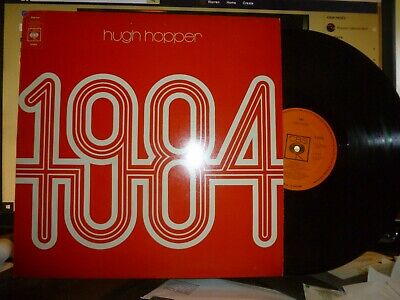
HUGH HOPPER "1984" LP UK NM/EX (1973) Soft Machine Bassist w John Marshall more
$
26


Favourite Auctions
To save auctions to your favourites, please login
If you don't have an account, please register
Description
AllMusic Review by William Tilland [-]
Originally released in 1973 by the Soft Machine bassist shortly after the band had lost eccentric drummer/vocalist Robert Wyatt and had begun their evolution into a respectable (and somewhat predictable) jazz-rock ensemble, this was Hopper's attempt at something more experimental. As he reports in his amusing CD notes, the record label CBS was all in favor of his solo excursion until he let them know what he had in mind, at which point they declined to pay even for studio time, so Hopper had to take out a bank loan to make the recording -- which says a lot for Hopper's belief in his artistic vision, and not much at all for the musical (as opposed to financial) vision of CBS. Hopper's 1984 is inspired by George Orwell's totalitarian fantasy of the same name, and the two longest tracks, "Miniluv" and "Miniplenty," feature Hopper's multitracked solo work on bass, percussion, mellophone, loops and electronics, with only John Marshall, the Soft Machine drummer, contributing additional percussion on the second piece. This music had an appropriately eerie, ominous quality, with heavy use of chattering tape loops, reverberating bass drones and woozy, sometimes harsh slide work on bass guitar strings. Terry Riley's early cyclical trance music was a large influence on Hopper at the time of this recording, and there are also strong echoes of "Poppy Nogood and the Phantom Band," for example, in the intertwined, looped sax lines in "Minitrue." However, several of the shorter selections on this CD, with the addition of various saxophones, trombones and other horns, are inexplicably tied to a rather twisted and ponderous R&B groove. Hopper suggests, retrospectively, that these several pieces may have represented the "normal" citizens in Orwell's dystopia, who were nonetheless a little "bent" by their soul-destroying environment. However, it is just as likely that Hopper was simply indulging his admitted fondness for James Brown. 1984 was always a musical oddity, and it may be a little incoherent and self-indulgent at times, but it has held up well over time, and still contains music of great interest.
Hugh Hopper ?– 1984
Label:
CBS ?– S 65466
Format:
Vinyl, LP, Album
Country:
UK
Released:
1973
Genre:
Jazz, Rock
Style:
Jazz-Rock, Avantgarde, Prog Rock
Tracklist
A1 Miniluv 14:37
A2 Minipax I 3:16
A3 Minipax II 3:09
B1 Minitrue 1:23
B2 Miniplenty 18:14
B3 Minitrue Reprise 3:22
Companies, etc.
Recorded At – Advision Studios
Pressed By – CBS Pressing Plant, Aston Clinton
Credits
Bass Guitar, Percussion, Mellophone, Piano, Bells [Handbells], Voice, Soprano Saxophone – Hugh Hopper
Drums, Percussion – John Marshall (tracks: A2 to B3)
Engineer – Gary Martin (3)
Executive-Producer – Sean Murphy
Guitar – Pye Hastings (tracks: A2)
Liner Notes – John Esam
Producer, Written By – Hugh Hopper
Soprano Saxophone – Lol Coxhill (tracks: A2)
Tenor Saxophone – Gary Windo (tracks: A2 to B1)
Trombone – Malcolm Griffiths (tracks: A2 to B1), Nick Evans (tracks: A2 to B1)
Notes
Recorded at Advision Studios, London during the months of July and August, 1972
GOLDMINE GRADING
MINT ---- It should appear to be perfect. No scuffs or scratches, blotches or stains, labels or writing, tears or splits. Mint means perfect.
NEAR MINT ---- Otherwise mint but has one or two tiny inconsequential flaws that do not affect play. Covers should be close to perfect with minor signs of wear or age just becoming evident: slight ring-wear, minor denting to a corner, or writing on the cover should all be noted properly.
VERY GOOD PLUS ---- The record has been handled and played infrequently or very carefully. Not too far from perfect. On a disc, there may be light paper scuffs from sliding in and out of a sleeve or the vinyl or some of the original luster may be lost. A slight scratch that did not affect play would be acceptably VG+ for most collectors.
VERY GOOD ---- Record displays visible signs of handling and playing, such as loss of vinyl luster, light surface scratches, groove wear and spindle trails. Some audible surface noise, but should not overwhelm the musical experience. Usually a cover is VG when one or two of these problems are evident: ring wear, seam splits, bent corners, loss of gloss, stains, etc.
GOOD ---- Well played with little luster and significant surface noise. Despite defects, record should still play all the way through without skipping. Several cover flaws will be apparent, but should not obliterate the artwork.
POOR ---- Any record or cover that does not qualify for the above "Good" grading should be seen as Poor. Several cover flaws.
price rating